The Shapiro administration has moved from pilot to partnership: the Commonwealth of Pennsylvania announced a newly expanded Cooperative Agreement with Carnegie Mellon University to provide ongoing AI advising, and at the same time the state is scaling enterprise-grade generative AI tools — continuing ChatGPT Enterprise access and adding Microsoft Copilot Chat for qualified employees — alongside formalized governance, mandatory training, and regional research investments designed to anchor an AI innovation cluster in Pennsylvania.
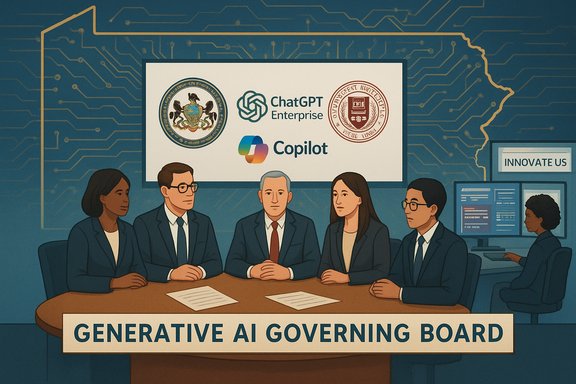
Pennsylvania’s AI push traces back to an executive order signed in September 2023 that established core principles for state use of generative AI and created a Generative AI Governing Board to oversee policy and deployment. The administration ran a year‑long pilot with OpenAI and Carnegie Mellon University that involved roughly 175 employees across multiple agencies; participants reported substantial time savings and broadly positive experiences, a finding the state has repeatedly cited as it scales the program. More recently — at a conference billed as “Unlocking AI for Public Good” and tied to the AI Horizons programming in Pittsburgh — the administration announced a Cooperative Agreement for Artificial Intelligence Advising Services with Carnegie Mellon University that formalizes ongoing CMU advisory support for strategy, governance and operational adoption across the commonwealth. The press material and university accounts place the new agreement announcement in early November 2025 and describe the arrangement as the next step in a multi‑year engagement that began during the pilot phase.
That framework — however promising — rests on execution: rigorous procurement safeguards, enforceable technical controls (tenancy, DLP, provenance logging), independent audits of pilot claims (including the headline 95‑minute savings metric), and transparent reporting that keeps the public informed. For Windows‑centric IT teams, the immediate work is practical and operational: lock down identity, classify and route data correctly, instrument logging and provenance, and gate access behind competency checks.
Pennsylvania is now a high‑visibility case study in how state governments can pair technology adoption with governance and workforce development. The next chapters will show whether that design converts into durable public benefit, replicable governance practices, and a sustainable, equitable local AI ecosystem — or whether the unaddressed technical, legal and labor risks will outweigh the early productivity gains.
Source: The Business Journals Shapiro administration announces expanded AI collaboration with Carnegie Mellon University - Pittsburgh Business Times
 Background
Pennsylvania’s AI push traces back to an executive order signed in September 2023 that established core principles for state use of generative AI and created a Generative AI Governing Board to oversee policy and deployment. The administration ran a year‑long pilot with OpenAI and Carnegie Mellon University that involved roughly 175 employees across multiple agencies; participants reported substantial time savings and broadly positive experiences, a finding the state has repeatedly cited as it scales the program. More recently — at a conference billed as “Unlocking AI for Public Good” and tied to the AI Horizons programming in Pittsburgh — the administration announced a Cooperative Agreement for Artificial Intelligence Advising Services with Carnegie Mellon University that formalizes ongoing CMU advisory support for strategy, governance and operational adoption across the commonwealth. The press material and university accounts place the new agreement announcement in early November 2025 and describe the arrangement as the next step in a multi‑year engagement that began during the pilot phase. What the announcement actually says
Key components of the expansion
- Continued or expanded access to ChatGPT Enterprise for qualifying Commonwealth employees.
- Addition of Microsoft Copilot Chat to the state’s toolkit, creating a dual‑vendor approach intended to cover conversational RAG (retrieval‑augmented generation) workflows as well as deep integration inside Microsoft 365 apps.
- A new Cooperative Agreement for Artificial Intelligence Advising Services with Carnegie Mellon University to provide ongoing advisory, research partnerships, and implementation support.
- Formal governance and workforce commitments: continuation of the Generative AI Governing Board, creation of a Generative AI Labor and Management Collaboration Group, and mandatory InnovateUS training as a prerequisite for tool access.
- Economic and research investments announced at related events, notably a multi‑year BNY–CMU research partnership (reported at $10 million) and industry accelerators aimed at small business skilling.
How the administration frames it
Officials portray the move as a three‑pronged strategy: (1) increase government productivity, (2) protect citizen data and ensure responsible use, and (3) grow Pennsylvania’s AI economy by anchoring private investment, research funding and workforce training in the region. The administration has repeatedly described the combined offering as “the most advanced suite of generative AI tools offered by any state,” a promotional characterization that the state itself has framed as evidence of national leadership.Why Carnegie Mellon matters here
Carnegie Mellon University is not an incidental partner; it is one of the world’s leading AI research institutions and has played a hands‑on role throughout Pennsylvania’s pilot and policy development. CMU faculty and research centers contributed to pilot design, evaluation and the creation of tooling to help agencies scope appropriate AI use cases. The new cooperative agreement institutionalizes that advisory channel and positions CMU as the Commonwealth’s primary academic partner for governance, risk analysis, and applied research. That academic tie offers two practical advantages:- Access to applied research and graduate student support for operational challenges (e.g., scoping tools, building evaluation frameworks, constructing red‑team protocols).
- Credibility and an evidence‑generation pathway: CMU’s Block Center and allied research teams can design independent validation exercises, fairness audits and technical controls that the state will need as the rollout expands.
The headline claims — what to believe and what to verify
The 95‑minute figure: promising, but pilot‑level and self‑reported
The most widely cited pilot metric is that participating employees reported an average of 95 minutes saved per workday when using ChatGPT during pilot activities like drafting, summarizing, research and basic coding help. That figure appears in official briefings and university accounts, and it was a central piece of evidence used to justify expansion. However, the metric is self‑reported, derived from exit surveys and structured feedback in a limited cohort (roughly 175 employees), and therefore should be treated as an encouraging pilot result rather than an audited, system‑wide productivity delta. Independent, instrumented measurement — baseline handling times, error and rework rates, and longitudinal verification — remains essential to understanding the true net effect on service quality and workload.“Most advanced suite” — promotional, not a neutral ranking
The administration’s claim that Pennsylvania now offers the “most advanced suite of generative AI tools” among U.S. states is a defensible framing given the dual‑vendor strategy and governance scaffolding, but it is not the kind of objective ranking produced by an independent authority. The phrasing should be read as aspirational marketing that compresses tool coverage, governance posture and training reach into a single headline. Verifying the claim would require a systematic state‑by‑state comparison across tenancy models, contractual safeguards, audit rights, training penetration and role‑based governance — a nontrivial exercise.Economic totals and investment claims
State materials tie the AI initiative to broader economic claims — private commitments running into the billions and transformative infrastructure investments in the region. Some of these totals (for example, multi‑billion corporate investments announced at related summits) come from a mix of corporate announcements and state aggregation, and the exact numbers vary across briefings. Treat headline totals as rolling aggregates that merit project‑level verification against official economic development databases or contract announcements when precision matters.Technical and procurement realities — what this deployment entails
Moving from a small, controlled pilot to thousands of employees with access to enterprise generative AI is a heavy operational lift. The technical checklist the Commonwealth highlights — and that enterprise implementers should insist on — includes:- Secure tenancy configuration (Azure Government / GCC or equivalent) for any workflows that handle sensitive or regulated data.
- Data classification and label‑based routing so that PII, Controlled Unclassified Information (CUI) and other sensitive records are blocked from permissive AI flows.
- Extended Data Loss Prevention (DLP), Microsoft Purview integration, and retention policies to preserve auditability and to meet FOIA/eDiscovery obligations.
- Least‑privilege access models, conditional access policies and phishing‑resistant multi‑factor authentication (MFA) for accounts authorized to prompt AI systems.
- Prompt provenance and immutable logging to support incident investigations and transparency reporting.
Governance, labor and workforce strategy
A notable strength of the administration’s posture is its explicit inclusion of labor and worker representation in implementation design. Pennsylvania created a Generative AI Labor and Management Collaboration Group intended to give unions and front‑line staff a formal voice in where and how AI is used across roles. This is an important mitigation against two common public‑sector failures: (1) technological decisions made without worker buy‑in, and (2) one‑size‑fits‑all automation that disregards job complexity and human oversight needs. Mandatory training is another central plank: the administration reports that more than 1,300 employees have completed InnovateUS training, with thousands more enrolled, and that training completion is a prerequisite for tool access. This points to a competency‑gated access model — a best practice that reduces the chance of naïve tool misuse and helps ensure that AI becomes an augmentation, not a liability. That said, training alone does not eliminate the need for process redesign, role re‑scoping and measurable reskilling plans tied to workforce outcomes.The CMU / BNY / industry ecosystem: building a regional AI cluster
Beyond operational rollout, the administration pairs tool deployment with ecosystem investments meant to anchor talent and research locally. Announcements at the AI‑focused summits included a $10 million, five‑year BNY–CMU collaboration to establish an applied lab focused on governance and accountability, and industry accelerators to offer free training and tooling to small businesses. Those commitments are designed to create a feedback loop: practical government adoption informs academic research, which in turn builds commercial capabilities and workforce pipelines for local employers. This cluster approach has two practical payoffs:- It provides the administration with ongoing access to independent technical expertise, graduate research resources and evaluation capacity.
- It signals to private investors and vendors that Pennsylvania is serious about AI infrastructure, skills and governance — a message that can attract follow‑on commitments and local hiring.
Major risks and unresolved questions
Even well‑designed public‑sector AI programs face well‑documented hazards. The Pennsylvania plan acknowledges many of these but the real test will be in execution and transparency.- Accuracy and hallucination risk: generative models produce plausible but incorrect outputs; human verification thresholds must be enforced for legal, benefits, licensing, and safety‑critical cases. The administration emphasizes human‑in‑the‑loop controls, but enforcement and auditing will be essential.
- Data governance and FOIA exposure: public records obligations create complex retention and retrieval requirements for prompts, outputs and draft artifacts. Contracts must give the state the ability to extract logs and preserve eDiscovery evidence.
- Vendor lock‑in and portability: the dual‑vendor approach reduces single‑vendor dependence but does not eliminate lock‑in risks tied to tenancy, connectors and proprietary APIs. Procurement should require egress rights, non‑training clauses, and clear audit capabilities.
- Workforce and reskilling outcomes: the administration frames AI as a job enhancer, not a replacer, but measurable plans to redeploy saved labor into higher‑value tasks, reskill affected roles and track job‑quality outcomes are necessary to make that promise credible. The labor‑management collaboration group is an important step, but outcome metrics will be required.
- Transparency and independent evaluation: to sustain public trust the state must publish red‑team results, independent audits, and annual transparency reports showing both successes and incidents. Without third‑party validation, pilot metrics risk appearing promotional.
What Windows‑centric IT teams and enterprise admins must prepare for
For system administrators, desktop engineers, and security teams operating Windows environments across state agencies, the practical implications are immediate and specific.Priority technical tasks
- Identity and access hardening: integrate Entra ID / SSO, apply RBAC, enforce phishing‑resistant MFA for accounts permitted to use Copilot or ChatGPT, and build conditional access policies to gate high‑sensitivity prompts.
- Data classification & Purview integration: map agency data flows, apply sensitivity labels, and ensure DLP rules prevent high‑risk content from reaching non‑cleared AI tenancies.
- Audit, logging, and provenance: extend endpoint management to capture prompt provenance, immutable logs and output retention policies that align with FOIA and eDiscovery needs. Plan for scalable storage and indexed search for records retrieval.
- Endpoint provisioning and ringed deployment: validate Copilot features and AI execution providers in a staged release ring, signaling set‑aside device groups (e.g., high‑security workstations) that do not receive Copilot functionality. Treat AI features as a separate release track requiring validation and rollback plans.
- Training and competency gating: coordinate InnovateUS completion reports with provisioning systems so that tool access is automatically granted only after verified training completion and role‑based competency checks.
Operational and policy tasks
- Negotiate procurement clauses with vendors that include portability/e‑gress rights, audit transparency, and explicit non‑training guarantees where state data cannot be used to refine vendor models.
- Define human‑in‑the‑loop thresholds for outputs (what must be verified, and by whom), and instrument decision trails to show who accepted, edited or published AI‑generated content.
- Create incident response playbooks that include AI‑specific vectors (hallucination remediation, data leakage investigations, prompt provenance requests) and test them with red‑team exercises.
Recommendations for making the expansion credible and durable
The administration’s design choices are promising; to turn them into durable public‑sector capability, the following execution steps are recommended:- Publish an independent third‑party audit plan that will validate pilot claims and run longitudinal measurements across agencies. Make at least the high‑level KPIs public: baseline handling times, rework rates, error remediation time, and citizen outcome metrics.
- Require manifest governance outputs: publish governing board meeting minutes, red‑team results and annual transparency reports detailing deployments, incidents and mitigations.
- Tie further procurement phases to measurable milestones: training completion rates, audit logs availability, FOIA responsiveness, and documented human‑in‑the‑loop enforcement.
- Use the BNY–CMU lab to operationalize governance research into applied auditing tools (bias detection, provenance logging) that can be integrated into real deployments. Fund reproducible tooling, not only white papers.
How to read this as a national case study
Pennsylvania’s strategy embodies a pragmatic public‑sector playbook for generative AI adoption: instrumented pilot, academic partnership for independent expertise, role‑based training and a layered governance model that includes labor. That combination is an emerging best practice and is already influencing other states and universities designing their own deployments. The crucial differentiator will be whether the Commonwealth converts pilot‑level enthusiasm into verifiable evidence: longitudinal audits, published red‑team results, and procurement language that preserves audit rights and data portability. If executed well, Pennsylvania may become a replicable model. If not, the rollout risks the common failure modes: overpromising, insufficient oversight, and hidden operational costs tied to error correction and FOIA burdens.Conclusion
Pennsylvania’s expanded collaboration with Carnegie Mellon University and the scaling of generative AI tools to more state employees is a consequential, well‑scaffolded step from pilot to enterprise adoption. The dual‑vendor approach (ChatGPT Enterprise plus Microsoft Copilot Chat), explicit labor engagement, mandatory training and local research investments create a robust framework for responsible adoption.That framework — however promising — rests on execution: rigorous procurement safeguards, enforceable technical controls (tenancy, DLP, provenance logging), independent audits of pilot claims (including the headline 95‑minute savings metric), and transparent reporting that keeps the public informed. For Windows‑centric IT teams, the immediate work is practical and operational: lock down identity, classify and route data correctly, instrument logging and provenance, and gate access behind competency checks.
Pennsylvania is now a high‑visibility case study in how state governments can pair technology adoption with governance and workforce development. The next chapters will show whether that design converts into durable public benefit, replicable governance practices, and a sustainable, equitable local AI ecosystem — or whether the unaddressed technical, legal and labor risks will outweigh the early productivity gains.
Source: The Business Journals Shapiro administration announces expanded AI collaboration with Carnegie Mellon University - Pittsburgh Business Times