

Perplexity’s latest push into the enterprise — an AI‑native browser called Comet Enterprise, a connector‑driven Computer for Enterprise platform, and a personal automation appliance — is not a simple product update; it’s a deliberate move to turn an AI search company into an orchestration layer that sits between employees, corporate systems, and multiple frontier models.
Perplexity began life as an AI‑first research and search engine, prized for concise, citation‑aware answers. In 2025 the company unveiled Comet, an AI‑integrated browser that combined a conversational research layer with the ability to act inside web pages. The company now says it has expanded those agentic capabilities into formal enterprise offerings — notably Comet Enterprise, Computer for Enterprise, and a single‑user Personal Computer appliance — positioning them as tools for teams to query data warehouses, pull CRM context, and automate multi‑step workflows without always needing a data scientist or developer to write queries. This roadmap and the company’s own framing are detailed in Perplexity’s recent product blog and enterprise pages.
Those moves arrive at a moment when enterprise spending on AI infrastructure is accelerating. Gartner forecasts global AI spending to climb to roughly $2.5 trillion in 2026 — a 44% jump year‑over‑year — a backdrop that helps explain why Perplexity and others are racing to convert consumer attention into managed, monetizable enterprise footprints.
Security analyses from independent vendors also flagged architecture problems where web content could influence an agent’s behaviour. Those audits created headlines and forced vendors to describe mitigations; the practical takeaway for enterprise IT is that agentic browsing still carries novel risks that traditional DLP and endpoint protections may not fully address.
For IT leaders, the opportunity is substantial: faster insight, natural‑language access to warehouses and CRMs, and potentially dramatic improvements in analyst and developer velocity. But realizing those gains requires careful gating: security vetting, contractual guarantees on data handling, robust model lineage and auditing, and disciplined rollout strategies. Perplexity’s documentation and marketing make compelling claims, and early adopter reports show genuine productivity upside; still, the enterprise must demand operational transparency and proof before turning agentic browsers and always‑on personal computers into company‑wide infrastructure.
Source: CIO Dive Perplexity aims for the enterprise with AI-enabled browser, tools
 Background / Overview
Perplexity began life as an AI‑first research and search engine, prized for concise, citation‑aware answers. In 2025 the company unveiled Comet, an AI‑integrated browser that combined a conversational research layer with the ability to act inside web pages. The company now says it has expanded those agentic capabilities into formal enterprise offerings — notably Comet Enterprise, Computer for Enterprise, and a single‑user Personal Computer appliance — positioning them as tools for teams to query data warehouses, pull CRM context, and automate multi‑step workflows without always needing a data scientist or developer to write queries. This roadmap and the company’s own framing are detailed in Perplexity’s recent product blog and enterprise pages.Those moves arrive at a moment when enterprise spending on AI infrastructure is accelerating. Gartner forecasts global AI spending to climb to roughly $2.5 trillion in 2026 — a 44% jump year‑over‑year — a backdrop that helps explain why Perplexity and others are racing to convert consumer attention into managed, monetizable enterprise footprints.
What Perplexity announced (what it is and claims it can do)
Comet Enterprise: an AI‑native, managed browser
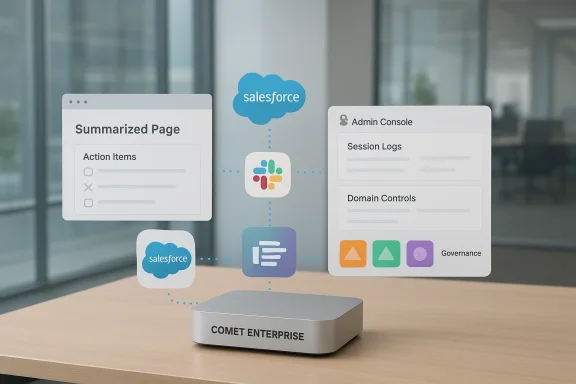
Comet Enterprise is Perplexity’s enterprise‑grade iteration of its Comet browser. The company describes it as an AI‑native browser that:- Embeds AI assistance directly in the browsing context so users can summarize pages, create action items, and ask follow‑ups without switching tools.
- Provides administrative controls to limit the browser’s agentic powers by domain or organization policy, and logs actions at the session level so admins can audit what the agent did during a user session.
- Is deployable via enterprise device management tools such as Microsoft Intune, with installer artifacts and an organization token workflow for mass deployment.
Computer for Enterprise: connectors, orchestration, and models
Perplexity’s Computer product family is an orchestration layer that selects from a suite of models and connects to app data. Perplexity frames the platform as doing three things at once:- Orchestrating across “frontier” models — choosing a model best suited to a task (for instance, a retrieval‑optimized model for research vs. a code‑trained model for developer tasks).
- Connecting to enterprise systems with prebuilt connectors (the company explicitly references Snowflake and Salesforce among “hundreds” of integrations), enabling natural‑language queries that return structured results and, in many cases, auto‑generated queries the system runs on behalf of users.
- Supporting team workflows via Slack and other collaboration platforms so teams can pull financial models, dashboards, or scraped competitive context into chat without waiting on analytics teams.
Personal Computer: a dedicated Mac mini for cross‑system automation
Perplexity’s Personal Computer offering is a more controversial item: a dedicated device (the company references a Mac mini) that acts as a “digital proxy” to orchestrate a user’s tools, files, and automations 24/7. Perplexity pitches this as a privacy‑conscious way to automate cross‑system tasks and give an agent a reliable, on‑premises execution point. The design suggests Perplexity is trying to balance powerful agentic automation with an architecture that can be materially isolated from cloud SaaS tenancy.Why Perplexity is aiming at enterprise (strategy and opportunity)
Orchestration beats single‑model monoculture
Perplexity’s core bet — that “orchestrating across models and families is the only way to build a system versatile enough to handle real work” — is increasingly common among AI vendors who accept that no single model is best for every task. Perplexity’s thesis aligns with an industry trend: enterprises want specialized accuracy (finance, legal, code) and the ability to surface live business data securely. Offering a platform that routes to different models and connects to Snowflake or Salesforce is a packaging play that appeals to C‑suite buyers who care about outcomes and auditors who care about traceability.A predictable revenue play
Turning Comet into an enterprise‑managed endpoint — deployable through Intune and controllable via organization tokens — converts what would otherwise be free usage into an IT‑managed product. That enterprise footprint is stickier, opens procurement channels, and increases per‑seat monetization opportunities. Perplexity has already experimented with paid tiers and premium bundles; enterprise licensing is a logical next step.A timing advantage amid ballooning AI spend
With Gartner predicting $2.5 trillion in AI spending next year, vendors are racing to be the integration layer that enterprises select for AI initiatives. Perplexity’s messaging focuses on reducing friction between knowledge workers and data, a problem that’s urgent as companies scale beyond pilot projects into production AI deployments.What this delivers for IT: benefits and practical use cases
Faster self‑service analytics and decision support
Perplexity’s Computer for Enterprise promises that a business analyst can ask for “revenue by vertical” and the system will write and execute Snowflake queries, then return structured numbers — without waiting for BI tickets. For organizations with reliable data governance and mature warehouses, that shortcut can compress cycles and reduce friction between analysts and stakeholders. The claim is validated directly by Perplexity’s product messaging and corroborated by contemporaneous reporting.Better developer and automation velocity
Routing code tasks to models trained on production codebases (the “Codex and Claude” claim Perplexity makes) can accelerate routine development and automation chores. If Computer for Enterprise truly integrates model selection and can run code snippets safely against test environments, it could reduce internal backlog for small engineering teams. Practical caution is needed around code review and sandboxing, however.Centralized governance and auditability
Comet Enterprise’s session action logs and domain‑based permissions are designed to meet enterprise needs: admin control over what agents can do, and audit trails for what they did. That’s essential for compliance teams concerned about data exfiltration and risky automated actions. Perplexity’s documentation references Intune deployment and session logs as explicit features.Risks, gaps, and areas IT must scrutinize
Agentic browsers increase the attack surface
The same features that let Comet or Atlas (OpenAI’s browser) act inside a page also create new vectors for prompt injection and malicious instruction execution. Independent security researchers and audits have flagged vulnerabilities in agentic browsers — including Perplexity’s Comet — that can allow web content to masquerade as user instructions or induce the agent to perform harmful actions. Those findings are not theoretical: multiple security write‑ups and vendor audits raised practical concerns about how agentic browsers parse and separate user intent from web content. Enterprises must approach agentic browsers with a red‑team mindset.Data residency, leakage, and auditability questions
Connecting an AI to Snowflake, Salesforce, Slack and other systems is a powerful capability — but it also raises immediate questions:- Where do the queries run and where do model‑generated results get stored?
- Are ephemeral context windows persisted to Perplexity’s servers? For how long?
- Does the agent create or cache intermediate files that are then accessible outside the enterprise boundary?
Model governance and explainability
Perplexity’s multi‑model approach is sensible, but it complicates governance. When an employee acts on a recommendation, which model produced the output, and which data sources informed it? For auditability and regulatory compliance, enterprises will need model lineage, source citations, and reproducibility guarantees. Perplexity highlights citations and retrieval‑optimized routing, but customers should insist on concrete logging and retracing capabilities.Device and endpoint risk from “Personal Computer” appliances
A device that runs an always‑on personal agent — even one physically housed in a user’s office — expands the perimeter. The Mac mini model Perplexity describes could help keep data local, but it also introduces maintenance, patching, and local network risk. IT must weigh the operational overhead of managing a fleet of personal appliances against the productivity gains they enable.How enterprise teams should evaluate Perplexity’s offerings (practical checklist)
- Confirm the security posture
- Require third‑party security assessments and recent penetration testing reports.
- Ask for details on prompt‑injection mitigations and how the browser distinguishes user instructions from webpage content.
- Validate data usage and retention
- Get explicit documentation on where query results are stored, who can access logs, and how long contextual data persists.
- Insist on contractual guarantees for data residency and encryption practices.
- Test connector behaviour in a sandbox
- Validate that Computer for Enterprise’s Snowflake and Salesforce connectors produce safe, auditable queries, and that the system asks for permission before executing write actions or high‑risk reads.
- Assess model lineage and explanation tooling
- Require the platform to log which model and retrieval chain produced each answer and to attach citations or SQL provenance to analytical outputs.
- Pilot with strict scopes
- Start with read‑only integrations and a narrow set of domains for Comet’s agentic abilities. Expand domain permissions only after proving safe operations in production.
- Plan for endpoint management
- If deploying Comet across employee devices, ensure it can be managed via MDM/Intune with configuration policies and automatic patching.
Comparative context: where Perplexity fits among Google, OpenAI, and others
Perplexity is not alone in pushing an AI browser or agentic platform. Google has layered AI features into search and offers Vertex AI Search for enterprise integration; OpenAI released Atlas and an enterprise agent offering called Frontier that natively connects to enterprise systems and warehouses; Microsoft has embedded Copilot features into Edge and the Windows ecosystem with deep enterprise tooling behind Azure. Each approach has strengths:- Big cloud providers emphasize deep cloud integration, identity, and enterprise SLAs.
- OpenAI brings a tightly integrated agent and model stack that’s straightforward for organizations invested in the ChatGPT ecosystem.
- Perplexity emphasizes research‑grade citation, pluralistic model orchestration, and a search‑first heritage that appeals to knowledge‑intensive workflows.
Real‑world signals: community reaction and early security findings
Perplexity’s product moves have produced vigorous discussion among IT and Windows‑focused communities. Forum threads and community posts catalogue both excitement about productivity gains and concern about security and data governance as Comet broadened availability. Community observers noted Perplexity’s shift from invite‑only and paid tiers toward wider distribution — a sign of product maturation but also of urgent security review needs.Security analyses from independent vendors also flagged architecture problems where web content could influence an agent’s behaviour. Those audits created headlines and forced vendors to describe mitigations; the practical takeaway for enterprise IT is that agentic browsing still carries novel risks that traditional DLP and endpoint protections may not fully address.
A balanced verdict: strengths, uncertainties, and pragmatic next steps
Strengths
- Integration and orchestration: Perplexity’s Computer family is deliberately designed to bridge data and models, which is exactly the capability many organizations need to scale AI beyond experiments.
- Search and citation expertise: Perplexity’s search DNA makes its outputs more citation‑aware than many conversational models, which helps analysts who need verifiable answers.
- Enterprise deployment tooling: Support for Intune and MDM deployment, session logs, and domain‑level permissions show an awareness of enterprise operational needs.
Uncertainties / risks
- Agentic attack surface: Prompt injection and the difficulty of separating webpage instructions from user prompts remain live, practical threats. Independent audits documented these concerns for multiple agentic browsers.
- Data governance clarity: Marketing materials promise controls, but enterprises should demand contractual and technical proof about retention, processing, and encryption.
- Operational overhead for personal appliances: The Personal Computer idea is novel but introduces a fleet‑management problem and increases on‑premise operational responsibilities.
Pragmatic next steps for IT leaders
- Run a narrow, read‑only pilot with Comet Enterprise restricted to low‑risk domains while actively red‑teaming agent behaviour.
- Negotiate explicit SLAs and data handling contracts before enabling connectors to Snowflake, Salesforce, or other sensitive backends.
- Expand governance tooling to include model provenance tracking and automated alerts for unusual agent actions.
- Require third‑party security attestation and continuous vulnerability disclosure commitments from vendors that operate agentic browsers.
What to watch next
- Vendor transparency on prompt‑injection mitigations and third‑party audits. The pace and quality of red teams’ disclosures will be a leading indicator of enterprise readiness.
- Contractual clarity around data residency and retention as Perplexity expands connectors and “Computer” automation in production environments.
- How major enterprises stitch Perplexity (or rival agentic browsers) into existing identity and DLP stacks; compatibility with MDM, SIEM, and CASB tooling will determine whether agentic browsers are sustainable in large regulated organizations.
Conclusion
Perplexity’s enterprise push — Comet Enterprise, Computer for Enterprise, and a Personal Computer appliance — reflects a clear product strategy: deliver an orchestration layer that spans models, data connectors, and end‑user devices so teams can ask natural language questions, run queries, and automate multi‑step tasks without constant engineering intervention. That approach is well aligned with the broader market forces driving trillions of dollars of AI investment, but it is not risk‑free.For IT leaders, the opportunity is substantial: faster insight, natural‑language access to warehouses and CRMs, and potentially dramatic improvements in analyst and developer velocity. But realizing those gains requires careful gating: security vetting, contractual guarantees on data handling, robust model lineage and auditing, and disciplined rollout strategies. Perplexity’s documentation and marketing make compelling claims, and early adopter reports show genuine productivity upside; still, the enterprise must demand operational transparency and proof before turning agentic browsers and always‑on personal computers into company‑wide infrastructure.
Source: CIO Dive Perplexity aims for the enterprise with AI-enabled browser, tools
