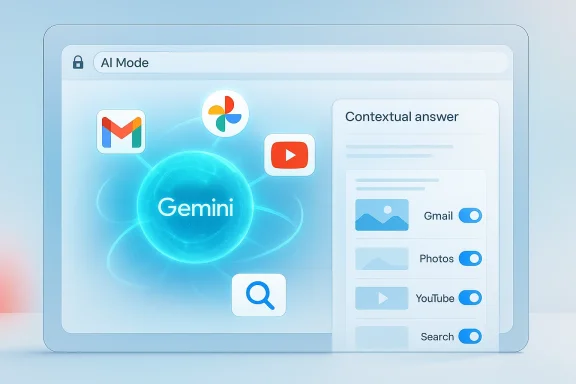
Google’s move to roll Personal Intelligence into three flagship entry points — the Gemini app, AI Mode in Search, and the Gemini integration inside Chrome — marks a deliberate shift from AI novelty toward everyday utility. The company has begun enabling an opt‑in experience that lets Gemini draw from your connected Google apps (Gmail, Google Photos, Search and, in places, YouTube and other Google services) to answer questions and take actions with personal context. The initial launches target eligible U.S. users on Google’s paid AI tiers, and Google says broader availability — including a wider free‑tier rollout and deeper Chrome integration — will follow in phases.
Google first announced Personal Intelligence for the standalone Gemini app in mid‑January 2026, positioning it as a beta connection that lets Gemini reason across a person’s Google apps to deliver personalized answers. A week later Google expanded the capability to AI Mode in Search, letting opt‑in users ask the search experience to use Gmail and Google Photos context for responses. Chrome has also received a more persistent Gemini side panel and agentic features such as Auto Browse, and Google has signaled that Personal Intelligence support will arrive inside Chrome in the months after the initial app and Search rollouts.
The incremental launch pattern — Gemini app first, Search next, Chrome thereafter — is deliberate. It lets Google gather feedback and tune privacy guardrails before embedding the same cross‑app intelligence deeper into services people use most often. The resulting product is less a single feature than a layer of “ambient” personalization that can be turned on or off, and configured for specific kinds of data.
But the risks are equally tangible. Privacy promises are necessary but not sufficient — they must be accompanied by transparent provenance, simple data hygiene tools, and strong defaults for any agentic behavior. The early product design shows an awareness of these concerns: opt‑in defaults, temporary chats, and explicit disconnect controls. The next six months will tell whether those safeguards are operationally effective and whether Google’s assurances about training, retention and provenance survive real‑world use and scrutiny.
For people who value convenience and are comfortable with Google’s ecosystem, Personal Intelligence will likely become an indispensable tool. For privacy‑sensitive users, or organizations with compliance constraints, caution and gradual adoption — combined with careful configuration — remain the prudent path.
Conclusion
Google’s push to weave Personal Intelligence across Gemini, AI Mode in Search, and eventually Chrome is a decisive move to make AI assistants a routine part of daily computing. It amplifies what these assistants can do by turning personal data into usable context — and in doing so, creates both powerful convenience and fresh responsibilities. The coming months of rollout, feedback and regulatory observation will determine whether Personal Intelligence becomes a trusted layer of everyday productivity or a cautionary example of personalization pushed too quickly. Users should approach opt‑in thoughtfully, demand clear provenance and editing controls, and watch how the company translates privacy promises into dependable practice.
Source: The Tech Buzz https://www.techbuzz.ai/articles/google-expands-personal-intelligence-ai-across-search-and-gemini/
 Background / Overview
Google first announced Personal Intelligence for the standalone Gemini app in mid‑January 2026, positioning it as a beta connection that lets Gemini reason across a person’s Google apps to deliver personalized answers. A week later Google expanded the capability to AI Mode in Search, letting opt‑in users ask the search experience to use Gmail and Google Photos context for responses. Chrome has also received a more persistent Gemini side panel and agentic features such as Auto Browse, and Google has signaled that Personal Intelligence support will arrive inside Chrome in the months after the initial app and Search rollouts.The incremental launch pattern — Gemini app first, Search next, Chrome thereafter — is deliberate. It lets Google gather feedback and tune privacy guardrails before embedding the same cross‑app intelligence deeper into services people use most often. The resulting product is less a single feature than a layer of “ambient” personalization that can be turned on or off, and configured for specific kinds of data.
What is Personal Intelligence?
Core idea
At its heart, Personal Intelligence is about contextualizing generative AI responses with a user’s own data so answers become personally relevant rather than merely generic. Instead of answering only from public web content, Gemini can consult a user’s connected Gmail, Google Photos, Search history, and other linked content to:- Retrieve specific details (flight reservations, receipts, photos).
- Reason across data sources (combine calendar events with travel confirmations to suggest an itinerary).
- Make proactive, personalized suggestions (shopping recommendations tuned to previously purchased brands or sizes).
How it’s exposed to users
Personal Intelligence is delivered as an opt‑in feature. Google’s announced behavior:- In the Gemini app, users can enable Personal Intelligence in settings and select which Google apps to connect.
- In AI Mode in Search, eligible users can choose to connect Gmail and Google Photos to allow AI Mode to use personal context for Search answers.
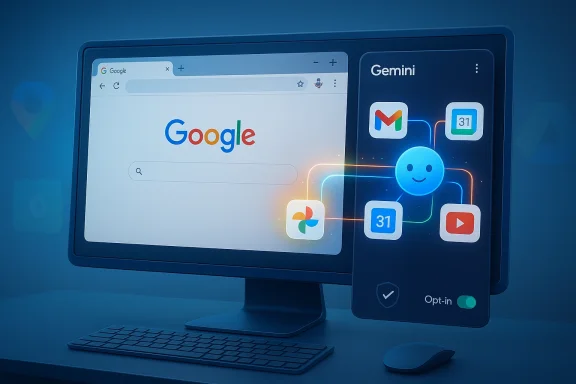
- In Chrome, Gemini runs as a side‑panel assistant and the company has said Personal Intelligence will be added to that experience in subsequent stages.
Eligibility and limits
At launch Google limited the feature to eligible personal Google accounts in the United States, with early access given to Google AI Pro and AI Ultra subscribers. Google has repeatedly emphasized that the feature is currently not intended for Workspace business, education, or enterprise accounts and that rollout will expand over time.Rollout timeline — factual snapshot
- Jan 14, 2026 — Google announced Personal Intelligence for the Gemini app as a U.S. beta; users could opt in and connect Gmail, Google Photos, YouTube and Search. This announcement included explicit privacy and control messaging from Google.
- Jan 22, 2026 — Google expanded Personal Intelligence into AI Mode in Search, enabling eligible U.S. AI Pro/Ultra users to opt in and let Search reference Gmail and Google Photos for personalized answers.
- Late January 2026 — Google rolled a persistent Gemini side panel and other AI features into Chrome (Auto Browse, Nano Banana image tools). Google stated Personal Intelligence would arrive in Chrome “in the coming months,” with Chrome receiving staged updates to add deeper connected‑apps functionality.
- March 2026 — Google continued to refine the availability and control surface, announcing broader Search tweaks and reminding users of opt‑in controls and feedback mechanisms.
Why this matters: the product case
1) Utility at scale
Integrating personal data with a large language model fundamentally changes the kinds of tasks the assistant can help with. Instead of only producing general advice, Gemini can:- Summarize your week of meetings by scanning Calendar invites and Gmail threads.
- Locate a boarding pass or booking confirmation from Gmail and summarize travel logistics.
- Pull a specific photo (or details from it) to answer immediate questions, such as vehicle identifiers or receipts.
2) Competitive differentiation
Google is leveraging an advantage few rivals can match: the breadth of apps that many people already use and store data in (Search history, Gmail, Photos, YouTube, Maps, Calendar, Drive). Where Apple emphasizes on‑device processing and Microsoft embeds Copilot across Office and Windows, Google’s strategy is to make the assistant aware of the entire Google app ecosystem. For many users this could feel more seamless than juggling several separate AI tools.3) New workflow surfaces
The combination of a persistent browser sidebar (Gemini in Chrome), a proactive auto‑browsing agent, and cross‑app context creates new workflow primitives:- Auto Browse can perform multi‑step web tasks (research, form filling, price comparison) and then surface candidate results for confirmation.
- The side panel decouples the assistant from the active tab, letting it keep long‑running tasks visible while you do other work.
- Personal Intelligence supplies the context that makes agent actions more accurate and personally useful.
The privacy and safety argument (Google’s claim)
Google’s public framing emphasizes several controls and safeguards:- Personal Intelligence is opt‑in and user‑configurable — you pick which apps to connect and can disconnect at any time.
- Google states that Gemini does not directly train models on your raw Gmail or Photos; training uses limited feedback artifacts and obfuscated prompts rather than direct ingestion of personal content.
- The system will attempt to attribute when it uses personal content and let users ask for more explanation or correct mistakes.
- Google offers temporary chats or the option to regenerate responses without personalization for privacy-sensitive interactions.
Critical analysis — strengths and limits
Strengths (what feels genuinely new)
- Contextual accuracy: For personal tasks, an assistant that “remembers” bookings, prior purchases, or family preferences is immediately more useful than the stateless chatbots many people have used to date.
- Friction reduction: Tasks that previously required manually copying emails or opening multiple apps can now be handled in one place with a natural‑language prompt.
- Rapid iteration: Staged rollouts let Google iterate on privacy and correctness before broad exposure; early access to paid subscribers provides higher‑quality feedback loops.
Practical limits and current weaknesses
- Rollout scope is narrow at first: U.S. personal accounts on paid AI tiers get first access. Many users will not see the feature for months.
- Accuracy and nuance: Google itself warns about over‑personalization — the assistant can make wrong inferences (for example, mistaking frequent photos at a golf course as a love of golf when photos reflect family attendance).
- Opaque decisioning: While Google promises explanations, current systems often struggle to produce clear provenance about exactly which piece of personal data produced a claim. That creates risk for useful but unverifiable assertions.
The privacy tradeoffs — what to watch for
Google’s opt‑in approach is critical, but opt‑in does not eliminate risk. Key privacy considerations:- Scope creep: A feature that begins with Gmail and Photos might later expand to Drive, Contacts, Maps, your Shopping history, and more. Each expansion multiplies potential exposure.
- Data lifecycle and deletion: Users need simple, reliable ways to see what was used, edit or delete the assistant’s derived summaries, and know whether those derived artifacts influence future responses.
- Training vs. inference: Google asserts that raw personal content isn’t used to train models directly. But “training on limited info” is vague. Independent auditing and transparency about what minimal signals are retained are necessary to build trust.
- Agentic actions: Auto Browse and agentic tools that log into websites or fill forms introduce new attack surfaces. Any agent that stores credentials or automates web interactions requires hardened security and explicit confirmation flows for sensitive transactions.
- Regulatory and compliance concerns: For users in regulated industries, or where data residency matters, personal assistants that cross apps may create compliance exposures. Google has already restricted the initial beta to personal accounts rather than Workspace, which reflects some of these concerns.
Enterprise and policy implications
- Not for Workspace by default: Google’s public notes say the beta is not for Workspace business, enterprise or education users. That reduces immediate enterprise risk but doesn’t eliminate the potential for similar features to appear inside Workspace later.
- Governance: Organizations will need policy controls — for example, can employees link their personal Gmail/Photos to a corporate browser used for work? Admin controls and endpoint policies will be required.
- Auditability: Enterprises will demand logs and governance tools showing what the assistant read and when. Without this, adoption in regulated workplaces will be slow.
Security and abuse scenarios
- Phishing or social engineering amplification: A personal assistant that can summarize your recent emails might be a target for phishing lure sequences tailored to your schedule or recent purchases.
- Automatic actions gone wrong: Auto Browse that signs into accounts or posts on behalf of users must require strong, explicit confirmation and robust rollback paths.
- Cross‑account leakage: Shared devices, multiple signed‑in accounts, or ephemeral logins risk accidental cross‑account context mixing if safeguards are imperfect.
How users should approach Personal Intelligence today
If you are considering enabling Personal Intelligence, here is a practical checklist:- Review eligibility: ensure you’re aware whether your account is on a qualifying Google AI Pro/Ultra tier and whether the feature is available in your region.
- Start with limited connections: enable only the apps you absolutely need (for trip planning, enable Gmail and Calendar; for photo lookups, enable Photos). Don’t connect everything at once.
- Use temporary chats for sensitive topics: opt for a temporary chat when discussing financial, legal or medical details.
- Learn where settings live: Google’s setup paths are surfaced in the Gemini app and Search personalization settings. Familiarize yourself with how to disconnect apps and delete Gemini history.
- Monitor provenance: when Gemini cites personal content, ask it to show the source and confirm before acting on it.
- If you use Chrome, treat Auto Browse cautiously: require manual confirmations for purchase flows and credential submissions.
What Google should do next (recommended product and policy changes)
- Granular provenance UI: Don’t just say “I used your Gmail.” Show which message or photo and surface a secure link back to the source with a timestamp.
- Editable user summaries: If the assistant builds a “user summary” or memory, let users edit or delete individual items without clearing all history.
- Transparent telemetry: Publish a clear, machine‑readable description of what minimal signals are used for model improvement and how long they are retained.
- Stronger default safeguards for agentic tasks: Auto Browse should have strict default limits (no purchases, no posting) until the user explicitly raises the permission level.
- Independent audits: Invite third‑party privacy and security auditors to validate claims about training and data handling and publish summaries of findings.
Competitive context — Apple, Microsoft, and others
- Apple emphasizes on‑device processing and private cloud compute; the company pitches privacy and local computation as a differentiator. That model reduces central server risk but limits the scale of cross‑app integration that cloud‑native services can provide.
- Microsoft has pushed Copilot across Windows and Microsoft 365 with memory and actions tied into Office apps and Windows itself. Microsoft’s approach prioritizes enterprise governance and integration with business workflows.
- Google is aiming for the opposite tradeoff: broader, ecosystem‑level synergies across consumer apps in the cloud. The result is richer cross‑app assistance — at the cost of raising more complex privacy and governance questions.
The immediate industry implications
- Expect rapid iteration. Personal assistants move quickly from “experimental” to feature expectations for users who try them. Google’s staged rollout means competing platforms will accelerate their own integration stories.
- Regulators and privacy watchdogs will watch agentic abilities (Auto Browse, cross‑app access) carefully, especially where those agents can access financial data, identity artifacts, or post on behalf of users.
- Developers and third‑party services will need guidance and controls if the assistant begins to act as a bridge between users and external commerce platforms (the Universal Commerce Protocol experiments point to that future).
Final assessment — utility vs. risk
Personal Intelligence represents a meaningful step toward assistants that are actually useful for day‑to‑day life: contextually accurate travel help, shopping made personal, and a browser assistant that can compare and act across tabs without continuous manual coordination. For many users, the convenience payoff will be real and immediate.But the risks are equally tangible. Privacy promises are necessary but not sufficient — they must be accompanied by transparent provenance, simple data hygiene tools, and strong defaults for any agentic behavior. The early product design shows an awareness of these concerns: opt‑in defaults, temporary chats, and explicit disconnect controls. The next six months will tell whether those safeguards are operationally effective and whether Google’s assurances about training, retention and provenance survive real‑world use and scrutiny.
For people who value convenience and are comfortable with Google’s ecosystem, Personal Intelligence will likely become an indispensable tool. For privacy‑sensitive users, or organizations with compliance constraints, caution and gradual adoption — combined with careful configuration — remain the prudent path.
Conclusion
Google’s push to weave Personal Intelligence across Gemini, AI Mode in Search, and eventually Chrome is a decisive move to make AI assistants a routine part of daily computing. It amplifies what these assistants can do by turning personal data into usable context — and in doing so, creates both powerful convenience and fresh responsibilities. The coming months of rollout, feedback and regulatory observation will determine whether Personal Intelligence becomes a trusted layer of everyday productivity or a cautionary example of personalization pushed too quickly. Users should approach opt‑in thoughtfully, demand clear provenance and editing controls, and watch how the company translates privacy promises into dependable practice.
Source: The Tech Buzz https://www.techbuzz.ai/articles/google-expands-personal-intelligence-ai-across-search-and-gemini/