

Phison’s chief executive has given one of the starkest public warnings yet about the memory market: a worsening shortage of DRAM and NAND flash that he says will force many consumer electronics companies to shut down or exit product lines in 2026. The claim — confirmed by multiple industry reports and echoed by memory makers and OEMs — is not just a price-shock headline. It describes a structural reallocation of wafer capacity toward high-margin AI and data‑center products that is already reshaping what devices will be affordable, available, or even sensible to build in the next 18 months.
The semiconductor memory market entered a dramatic supply rebalancing in 2024–2025. Two interlocking trends created the pressure:
Why Phison’s voice matters: Phison is a major SSD‑controller and white‑label SSD vendor that sits at the junction between NAND wafer manufacturers and consumer/enterprise SSD assemblers. Its sales and procurement teams have visibility into allocation trends and contract bookouts, which makes its leadership’s procurement outlook a meaningful market signal rather than idle rhetoric.
That said, Phison’s perspective is not neutral — the company is already shifting strategy toward enterprise and industrial customers where margins are higher. That business model shift both reflects and reinforces the reallocation of supply. When a company with an interest in serving high‑value enterprise accounts warns of shortages, analysts must weigh both the factual procurement picture and the speaker’s commercial incentives.
At the same time, the memory business is structurally benefiting from the AI supercycle: companies can earn much higher revenue from AI customers than from commodity consumer products. That profit incentive makes it rational — from a supplier point of view — to permanently reallocate a larger share of wafer output to HBM and server DRAM even after demand normalizes. If that happens, consumer‑grade memory volumes become a residual product treated opportunistically, not the market priority they once were.
Shorter‑term policy tools (easing trade friction, export controls, or easing tax incentives) can influence procurement patterns, but they cannot materially change wafer physics or fabrication timelines within a single year.
Companies that respond with pragmatic procurement and product strategies will survive and, in some cases, thrive. Those that treat memory as a commodity they can source on demand face the highest risk, especially smaller OEMs and white‑label brands dependent on thin margins.
For consumers, the era of inexpensive, feature‑packed entry devices is likely to be compressed into shorter windows and tighter stock cycles. If you value upgrades or new hardware, plan purchases with the expectation that certain components will remain scarce and expensive through at least 2026 — with the medium‑term horizon depending on suppliers’ investment choices.
In the end, this is a market rewiring as much as it is a shortage: wafer capacity and profitability structures are shifting toward big‑ticket AI and cloud projects, and memory — once a predictable commodity in consumer BOMs — is becoming a strategic, contested resource. Whether that means a wave of consumer brands folding in 2026, as Phison’s CEO predicted, depends on how aggressively OEMs hedge, how fast new capacity is qualified, and whether hyperscalers continue to outbid the market for bits. The memory market’s next 18 months will decide which of these scenarios becomes reality.
Source: TechPowerUp Phison CEO Says DRAM and NAND Flash Shortage Will Shut Down Many Consumer Electronics Companies in 2026 | TechPowerUp}
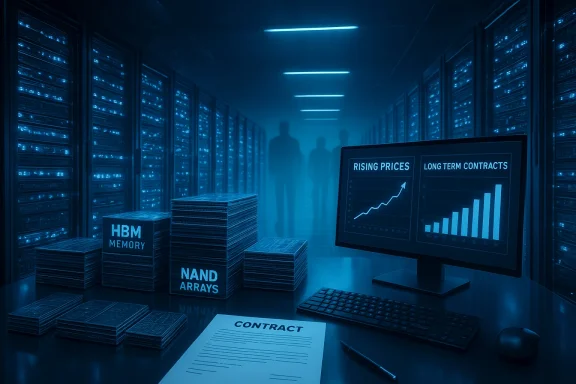 Background / Overview
The semiconductor memory market entered a dramatic supply rebalancing in 2024–2025. Two interlocking trends created the pressure:- Explosive demand from hyperscalers and AI infrastructure for large, high‑bandwidth pools of RAM and fast NAND storage.
- A deliberate, cautious approach to capital expenditure by major memory manufacturers after years of low profitability, combined with the economics that make HBM and other AI‑tailored memory far more lucrative than commodity DRAM and consumer NAND.
What the Phison CEO actually said — and why it matters
Phison’s CEO (K. S. Pua) stated publicly that NAND prices have doubled over a recent six‑month window, that most NAND production capacity is already allocated for 2026, and that DRAM/NAND shortages could last for years — in some comments he extended that horizon as far as a decade. He warned that the period from late 2025 into 2026 would be severe enough that “many system companies will shut down or exit product lines” simply because they cannot source the memory they need at viable prices.Why Phison’s voice matters: Phison is a major SSD‑controller and white‑label SSD vendor that sits at the junction between NAND wafer manufacturers and consumer/enterprise SSD assemblers. Its sales and procurement teams have visibility into allocation trends and contract bookouts, which makes its leadership’s procurement outlook a meaningful market signal rather than idle rhetoric.
That said, Phison’s perspective is not neutral — the company is already shifting strategy toward enterprise and industrial customers where margins are higher. That business model shift both reflects and reinforces the reallocation of supply. When a company with an interest in serving high‑value enterprise accounts warns of shortages, analysts must weigh both the factual procurement picture and the speaker’s commercial incentives.
The empirical picture: prices, allocations, and capacity
Multiple industry sources have reported the same key facts that underpin Phison’s warning:- Wholesale NAND and DRAM contract prices have surged, in some cases doubling within months. Reported spot wholesale examples show dramatic jumps in how much a 1‑Terabit TLC die costed over mid‑2025 to late‑2025 periods.
- Large shares of 2026 wafer output are already reserved. Hyperscalers and cloud providers have been locking in supply with long‑term agreements, leaving limited allocation for the normal OEM and retail channels.
- Lead times and inventory cycles have lengthened. Orders for certain LPDDR and DDR5 configurations carry lengthy lead times, and general DRAM/NAND inventories at OEMs and distributors are compressed to only a few weeks’ cover in many segments.
- Memory makers are prioritizing HBM and server DRAM growth. Fabric retooling and product roadmaps show strong preference for advanced nodes and stacking technologies used by AI accelerators.
Technical drivers explained: why AI eats memory
To understand why memory supply is under structural pressure, you must separate types of memory and how they are used:- DRAM (DDR, LPDDR) is the working memory used by PCs, phones, and many servers. It’s also used in large quantities by inference and training clusters.
- HBM (High Bandwidth Memory) is physically stacked DRAM designed to feed GPUs and AI accelerators with massive throughput. HBM requires specialized packaging and wafer process steps and yields much higher margins per wafer.
- NAND flash (TLC, QLC) underpins SSD capacity. AI workloads that reduce HDD reliance for nearline storage push hyperscalers to buy more NAND‑based storage, multiplying demand for NAND bits.
Who wins and who loses
Winners- Memory manufacturers and wafer foundries (by revenue and margin). Tight supply and higher ASPs lift financial results for suppliers that can allocate goods to the highest bidders.
- Hyperscalers and cloud providers that pre‑book supply — they secure the inventory they need for AI rollouts.
- Enterprise SSD and storage vendors that can extract premium pricing from data‑center customers.
- Small and low‑margin consumer electronics brands that do not have the procurement muscle to win high‑priority allocations.
- PC OEMs, smartphone mid‑tier vendors, and value OEMs who historically relied on commodity memory at predictable prices.
- DIY PC builders and the enthusiast market — retail DDR and SSD supplies tighten while prices spike, reducing upgrade activity and demand.
The corporate and market response so far
Manufacturers and OEMs are already adjusting:- Some PC makers are re‑specing models to ship with lower DRAM capacities or slower storage to preserve margins.
- Others are diversifying their supplier base, testing memory from newer entrants or Chinese suppliers to secure allocations.
- Several consumer brands are prioritizing enterprise shipments or reducing retail volumes, favoring high‑margin product lines.
- There are reports of retail purchase limits and allocation controls at distribution channels to avoid hoarding and ensure wider product availability.
Economics and capacity timelines — why shortages could persist
The key reason shortages may persist beyond 2026 is capex inertia. Memory fabs are complex, expensive, and slow to build. After a multi‑year period of underinvestment, makers are cautious about heavy new spend until they see sustained pricing — that means capacity expansion lags demand spikes. Reports from several industry watchers forecast that a realistic ramp of additional consumer‑grade DRAM and NAND capacity will not fully arrive before late 2027 or 2028.At the same time, the memory business is structurally benefiting from the AI supercycle: companies can earn much higher revenue from AI customers than from commodity consumer products. That profit incentive makes it rational — from a supplier point of view — to permanently reallocate a larger share of wafer output to HBM and server DRAM even after demand normalizes. If that happens, consumer‑grade memory volumes become a residual product treated opportunistically, not the market priority they once were.
How credible is the “many companies will shut down” claim?
Strengths of the claim- It reflects confirmed allocation data: capacity is booked and wholesale prices are rising rapidly.
- Phison and other vendors report concrete price movements and sold‑out futures, which align with other independent industry reports.
- The structural shift (HBM prioritization, hyperscaler procurement) is visible in supplier roadmaps and public filings.
- A CEO of a supplier with a business case to pivot to enterprise customers may emphasize scarcity to justify strategic choices or favorable contract positioning.
- Market dynamics can change: if hyperscalers slow AI capex or consumer demand collapses further, price signals could reverse and make new capacity investment more attractive.
- New entrants, accelerated fab construction, or policy interventions could restore consumer allocation faster than pessimistic scenarios predict.
Practical implications for companies and consumers
For consumer electronics companies- Hedge procurement now. Locking in supply through longer‑term agreements or partnering with alternative memory suppliers is the most direct defense.
- Re‑architect product lines. Design for lower memory footprints, use compression, or offload functionality to the cloud where affordable.
- Prioritize product tiers. Focus on higher‑margin, enterprise‑adjacent SKUs; reduce investment in thin‑margin baseline models.
- Diversify BOMs. Where feasible, qualify alternative memory types and suppliers, including new entrants in China and Taiwan.
- Reconsider launch cadence. Delaying launches until supply normalizes may be better than shipping uncompetitive or overpriced devices.
- Expect higher prices for PCs, phones, and SSDs in 2026, with constrained supply for popular mid‑range products.
- If you need a specific upgrade or device, buy sooner rather than later — retail inventories may tighten.
- For enthusiasts and DIY builders, be prepared to pay a premium for DRAM kits and SSDs, or accept lower capacities for the same money.
Policy angle and supply‑chain resilience
The crisis underlines a strategic vulnerability: global memory capacity is concentrated among a handful of firms and geographies. Governments in North America, Europe, and parts of Asia are responding with incentives and funding for domestic fabs and for supply‑chain diversification. But industrial policy is a long game: subsidies and projects can take several years to translate into usable, qualified production.Shorter‑term policy tools (easing trade friction, export controls, or easing tax incentives) can influence procurement patterns, but they cannot materially change wafer physics or fabrication timelines within a single year.
What to watch next — timeline and signals
- Hyperscaler procurement behavior. If major cloud providers continue to convert HDD budgets to SSDs aggressively and keep pre‑booking DRAM/HBM, consumer pressure will persist.
- Fab capex announcements and equipment deliveries. New capacity slated to come online in 2027–2028 will show whether suppliers will prioritize consumer lines or continue to bias AI memory production.
- Pricing indices and lead times. Continued month‑on‑month price increases and stretched lead times will confirm a prolonged shortage; a relaxation would show market balance returning.
- OEM inventory and Q1/Q2 2026 guidance. If major consumer OEMs revise ship‑count guidance downward or announce product line consolidations, the “product winter” thesis will have stronger evidence.
Strategic takeaway — navigating a memory‑constrained market
The Phison CEO’s warning should be read as a vivid market signal, not a deterministic prophecy. The structural forces driving memory shortages are real, and their immediate effects — higher DRAM and NAND prices, long lead times, and vendor prioritization of AI customers — are already observable.Companies that respond with pragmatic procurement and product strategies will survive and, in some cases, thrive. Those that treat memory as a commodity they can source on demand face the highest risk, especially smaller OEMs and white‑label brands dependent on thin margins.
For consumers, the era of inexpensive, feature‑packed entry devices is likely to be compressed into shorter windows and tighter stock cycles. If you value upgrades or new hardware, plan purchases with the expectation that certain components will remain scarce and expensive through at least 2026 — with the medium‑term horizon depending on suppliers’ investment choices.
In the end, this is a market rewiring as much as it is a shortage: wafer capacity and profitability structures are shifting toward big‑ticket AI and cloud projects, and memory — once a predictable commodity in consumer BOMs — is becoming a strategic, contested resource. Whether that means a wave of consumer brands folding in 2026, as Phison’s CEO predicted, depends on how aggressively OEMs hedge, how fast new capacity is qualified, and whether hyperscalers continue to outbid the market for bits. The memory market’s next 18 months will decide which of these scenarios becomes reality.
Source: TechPowerUp Phison CEO Says DRAM and NAND Flash Shortage Will Shut Down Many Consumer Electronics Companies in 2026 | TechPowerUp}
