

PhysicsX’s platform is proof that the most consequential engineering bottleneck of the last century—time—can be reframed as a software problem, not a materials one.
PhysicsX began as the kind of contrarian idea that turns up where elite engineering meets modern AI: a London-founded startup led by former Formula 1 engineers and AI researchers, built to move physical design from slow numerical solvers into near-instant inference. Backed by major strategic and financial investors, the company has positioned itself as an “AI-native engineering” vendor that wants to compress design cycles from months and weeks into minutes and seconds.
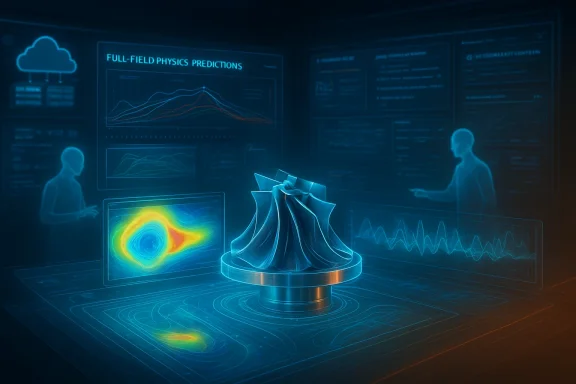
The core promise is deceptively simple: replace or augment long-running computational fluid dynamics (CFD), finite element analysis (FEA), and multi-physics simulations with learned surrogates that deliver full-field, physics-grounded predictions orders of magnitude faster. PhysicsX packages these models—what it calls Large Physics Models (LPMs) and Large Geometry Models (LGMs)—inside a business-oriented platform that integrates with enterprise cloud stacks, high-performance compute, and agent orchestration services so that teams can run massive, governed design-space sweeps without the choreography that usually slows R&D.
This is not hype-free marketing. PhysicsX’s public accounts of customer engagements range across semiconductor equipment, thermal optimisation for consumer devices, and mineral processing, and the company has formal integrations with major cloud and enterprise tooling to make the technology practical for regulated, mission-critical environments.
The practical advantage is twofold: faster go/no-go cycles for new equipment, and the ability to explore system-level trade-offs (thermal vs. throughput vs. contamination risk) that previously required months of lab-based tuning.
Embedding surrogate models into this loop allows product teams to explore acoustics, vibration, thermal dissipation, and structural integrity simultaneously—rather than solving each discipline in isolation and then stitching results together.
A public narrative around such projects claims objective improvements in recovery rates for critical materials like copper—the kind of gains that, if true at scale, would materially affect supply chains for electrification and data-center infrastructure. Note, however, that where partners are anonymised in public stories, specific recovery improvements should be treated as company-reported targets rather than independently validated outcomes until third-party data are disclosed.
Key benefits:
There’s also a geopolitical dimension: countries and regions that rapidly adopt AI-native engineering may capture upstream value in advanced manufacturing, reducing dependence on distant supply chains for critical components. That dynamic partly explains the strategic investor mix in PhysicsX’s funding rounds and the interest of major industrial firms in early trials.
This future brings real opportunities—faster innovation, lower scrap, smarter control, and better system-level outcomes—but it also demands rigorous validation, governance, and a measured approach to integration. For engineering leaders, the immediate task is practical: pick the right pilot, design verification into the workflow, and ensure the organisational changes that let people trust and act on the outputs.
PhysicsX’s platform is a vivid example of how physics AI can be deployed at scale. Whether the industry adopts it wholesale or evolves a mosaic of vendor solutions, the net effect is clear: the tempo of engineering is accelerating, and teams that combine domain mastery with disciplined AI practice will move fastest.
Source: Microsoft UK Stories How PhysicsX is transforming engineering with physics AI
 Background
PhysicsX began as the kind of contrarian idea that turns up where elite engineering meets modern AI: a London-founded startup led by former Formula 1 engineers and AI researchers, built to move physical design from slow numerical solvers into near-instant inference. Backed by major strategic and financial investors, the company has positioned itself as an “AI-native engineering” vendor that wants to compress design cycles from months and weeks into minutes and seconds.The core promise is deceptively simple: replace or augment long-running computational fluid dynamics (CFD), finite element analysis (FEA), and multi-physics simulations with learned surrogates that deliver full-field, physics-grounded predictions orders of magnitude faster. PhysicsX packages these models—what it calls Large Physics Models (LPMs) and Large Geometry Models (LGMs)—inside a business-oriented platform that integrates with enterprise cloud stacks, high-performance compute, and agent orchestration services so that teams can run massive, governed design-space sweeps without the choreography that usually slows R&D.
This is not hype-free marketing. PhysicsX’s public accounts of customer engagements range across semiconductor equipment, thermal optimisation for consumer devices, and mineral processing, and the company has formal integrations with major cloud and enterprise tooling to make the technology practical for regulated, mission-critical environments.
How Physics AI differs from traditional simulation
The old path: solver-centric engineering
Traditional engineering workflows are sequential and human-heavy. A concept moves from CAD to mesh generation, solver configuration, hours-to-weeks of compute, post-processing, and manual decision-making. Each stage requires specialist tools, file conversions, and human priors. The consequence: design iteration is expensive and conservative; teams explore small neighborhoods of the design space and settle for incremental improvements.The new path: inference-first, agent-augmented workflows
Physics AI flips the bottleneck. Instead of waiting for solvers, engineers query learned models that emulate the solver’s mapping from geometry, boundary conditions, and operating conditions to state fields (pressure, temperature, stress, velocity, acoustic spectra) almost instantaneously. This enables:- Massive parallel exploration of trade-offs across thousands of design candidates.
- Real-time “what-if” interrogation of system-level adjustments.
- Agentic orchestration that automates repetitive setup, validation checks, and traceable decision logs.
- Surrogate physics models trained on large datasets of high-fidelity solver outputs (and validated against them), often using architectures like Fourier Neural Operators, graph-based models, and transformer-style geometry encoders.
- Geometry models that understand and generate manufacturable variants—encodings that respect constraints such as minimum wall thickness, draft angles, and manufacturability rules.
The platform stack: what an AI-native engineering environment looks like
PhysicsX’s public materials and industry demonstrations reveal a multi-layer architecture that reflects enterprise priorities: accuracy, auditability, and governance.- Model layer: Private LPMs and LGMs trained on domain-specific simulation corpora and curated physical data. These models supply full-field predictions and uncertainty estimates rather than single-point outputs.
- Inference & runtime: GPU-accelerated batched inference, autoscaling, and runtime schedulers suitable for both exploratory batches and low-latency queries embedded into control loops.
- Active learning & validation: Automated detection of out-of-distribution queries, triggering of high-fidelity validation runs, and continuous retraining loops so the surrogate improves with operational data.
- Agent orchestration: Human-in-the-loop agents for intent understanding, automated experimental design, and stepwise validation—so engineers can ask natural language questions and receive physics-grounded recommendations in context.
- Enterprise integration: Connections to PLM systems, CAD tools, and knowledge management surfaces so outputs are traceable, auditable, and compliant with corporate governance.
Real-world use cases: where seconds change outcomes
Semiconductor equipment and process development
Semiconductor manufacturing is a race on multiple fronts—throughput, yield, defect reduction, and scale. Equipment vendors and chip fabs must iterate on reactor geometries, thermal budgets, and process windows rapidly. Physics AI reduces the turnaround time for prototype validation and allows equipment designers to evaluate operational variability and manufacturability earlier in the lifecycle.The practical advantage is twofold: faster go/no-go cycles for new equipment, and the ability to explore system-level trade-offs (thermal vs. throughput vs. contamination risk) that previously required months of lab-based tuning.
Cooling and aeroacoustic optimisation for consumer devices
Thermal management is a perennial constraint in thin, high-performance consumer devices. PhysicsX’s agentic workflows have been showcased against aeroacoustic and thermal design problems—instances where teams can generate thousands of fan or heat-sink geometries, evaluate flow and noise spectra, and narrow to Pareto-optimal designs long before a single physical prototype is built.Embedding surrogate models into this loop allows product teams to explore acoustics, vibration, thermal dissipation, and structural integrity simultaneously—rather than solving each discipline in isolation and then stitching results together.
Minerals and metals processing
Mining and metallurgical processes are multi-stage, non-linear, and heavily dependent on local ore characteristics. Physics AI can be used to model slurry dynamics, flotation behavior, and separation efficiency, enabling operators to test control strategies and equipment changes in silico before field deployment.A public narrative around such projects claims objective improvements in recovery rates for critical materials like copper—the kind of gains that, if true at scale, would materially affect supply chains for electrification and data-center infrastructure. Note, however, that where partners are anonymised in public stories, specific recovery improvements should be treated as company-reported targets rather than independently validated outcomes until third-party data are disclosed.
From analysis to action: predictive control and operational optimisation
One of the most consequential shifts Physics AI enables is moving from offline analysis to predictive control. Rather than using slow simulations to tune controllers reactively, real-time physics inference allows operators to predict a plant’s response to parameter changes and choose the best action before the system degrades.Key benefits:
- Proactive decision-making: Evaluate hundreds or thousands of control actions in parallel and select the one with the best expected outcome under uncertainty.
- Reduced downtime and scrap: Minimise trial-and-error tuning in production environments.
- System-level safety envelopes: Maintain auditable constraints that prevent agent actions from violating safety or quality thresholds.
Breaking disciplinary silos: unified multi-physics optimisation
Engineering organisations are often structured around discipline boundaries—thermal teams, structural teams, aerodynamics, controls—each optimising for local performance and handing off results. Physics AI changes the calculus by enabling concurrent multi-physics exploration.- Holistic trade-off analysis: Optimize for acoustics, efficiency, weight, and manufacturability simultaneously.
- Early detection of downstream conflicts: Surface trade-offs that would otherwise lead to rework late in development.
- Faster cross-disciplinary communication: Agents and shared model outputs create a common currency for decisions.
Platform governance, security, and enterprise practicality
PhysicsX’s design choices reflect three enterprise non-negotiables: confidentiality, auditability, and compliance.- Private models: Industry deployments emphasize private LPMs trained on customer data sets or private simulation corpora, rather than shared public models, to protect IP.
- Traceability: Every surrogate prediction is linked back to training artifacts, validation runs, and the geometry/solver that produced reference data.
- Governed agents: Agentic workflows expose checkpoints and require human approval at critical decision nodes—an essential feature for regulated industries such as aerospace, medical devices, and energy.
The technical and validation challenges that remain
Physics AI is powerful, but several technical and organisational hurdles require attention:- Model fidelity vs. explainability: Learned surrogates are approximation tools. Ensuring they capture rare failure modes, extreme boundary conditions, and the tail risks that solvers expose is critical. Active learning and conservative fallbacks help, but do not obviate the need for rigorous verification regimes.
- Out-of-distribution risk: Surrogates are only as reliable as their training data. Unseen geometries or novel material behaviours can produce mispredictions with serious consequences in production or safety-critical systems.
- Certification in regulated sectors: Aerospace, medical devices, and energy industries require qualification processes that involve traceable simulation lineage, repeated verification, and formal acceptance criteria. Bridging AI-native workflows to existing certification workflows is non-trivial.
- Data friction and IP management: High-fidelity simulation data and industrial test results are valuable IP. Firms must balance model improvement with strict governance on who sees what, particularly when multiple vendors or academic partners are involved.
- Human factors and workflows: Rapid iteration raises the cognitive burden on engineering teams. Tooling must surface uncertainty and rationale, not just recommendations, or engineers will distrust and underutilize the technology.
Business risks and competitive landscape
PhysicsX operates in a rapidly moving market where multiple paths to similar end-goals exist. Potential competitive and strategic risks include:- Platform lock-in: Enterprises may be wary of committing core R&D to a vendor that controls surrogate models and inference infrastructure.
- Open model initiatives and hardware vendors: Large hardware and software companies are investing in open physics model families and infrastructure ecosystems that could commoditise parts of the stack.
- Incumbent CAE vendors: Established simulation providers are incorporating ML accelerants into their tools and have deep relationships with engineering teams.
- Geopolitical supply-chain exposure: Because advanced manufacturing and semiconductor work is strategically sensitive, cross-border partnerships and investment can introduce regulatory and national-security review risks.
What successful adoption looks like: practical steps for engineering leaders
- Start with constrained, high-value pilots: Choose test cases with clear KPIs (reduction in iteration time, scrap rate, or energy consumption). Success stories in focused domains build trust.
- Establish model governance: Define data access, model retraining cadences, audit logs, and fallbacks to full-fidelity solvers.
- Integrate into existing PLM and verification pipelines: Ensure outputs are stored, traceable, and reviewable in the systems that already manage product history.
- Invest in cross-disciplinary teams: Create small, empowered squads that combine domain engineers, data scientists, and controls specialists to move ideas from pilot to production.
- Plan for certification: If operating in regulated industries, involve certification bodies early and design surrogate validation studies that map to formal acceptance criteria.
- Measure and monitor in production: Once models inform operational decisions, instrument feedback loops and monitor model confidence and drift.
Broader implications: speed, sustainability, and industrial geopolitics
Faster engineering cycles have multiplier effects that go beyond company P&Ls. When turbines run more efficiently, buildings consume less energy, and semiconductor yields improve, the compounding benefits touch emissions, supply resilience, and national industrial competitiveness.There’s also a geopolitical dimension: countries and regions that rapidly adopt AI-native engineering may capture upstream value in advanced manufacturing, reducing dependence on distant supply chains for critical components. That dynamic partly explains the strategic investor mix in PhysicsX’s funding rounds and the interest of major industrial firms in early trials.
Cautionary note on headline claims
Public narratives sometimes report ambitious outcomes—substantial jumps in mineral recovery, dramatic yield improvements, or dramatic scrap reductions. These are plausible in controlled pilots, but they require independent validation at scale. Where partners are anonymised, or where outcomes are presented as goals rather than validated end-states, readers should treat the figures as company-reported targets or pilot results, not yet peer-reviewed industry standards.Conclusion
PhysicsX’s work crystalises a broader shift in engineering: the transition from hand-crafted, sequential simulation to immersive, agentic, and AI-augmented design and operations. The core lesson is that the next industrial leap will be as much about software and data architecture as it is about materials or fabrication. When full-field physics predictions are available in seconds, the discipline of engineering changes—teams think in trade spaces instead of single objectives, controllers act with foresight, and product cycles compress.This future brings real opportunities—faster innovation, lower scrap, smarter control, and better system-level outcomes—but it also demands rigorous validation, governance, and a measured approach to integration. For engineering leaders, the immediate task is practical: pick the right pilot, design verification into the workflow, and ensure the organisational changes that let people trust and act on the outputs.
PhysicsX’s platform is a vivid example of how physics AI can be deployed at scale. Whether the industry adopts it wholesale or evolves a mosaic of vendor solutions, the net effect is clear: the tempo of engineering is accelerating, and teams that combine domain mastery with disciplined AI practice will move fastest.
Source: Microsoft UK Stories How PhysicsX is transforming engineering with physics AI
