

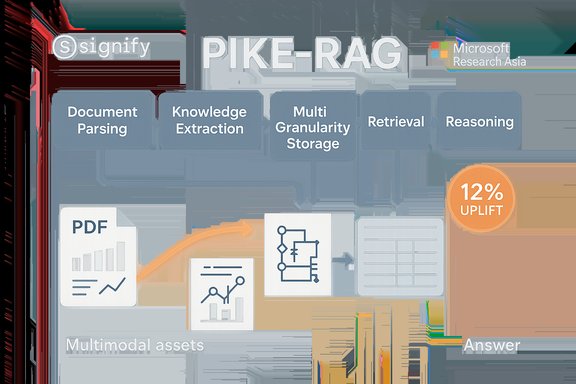
Signify’s recent proof-of-concept with Microsoft Research Asia — integrating PIKE‑RAG into an Azure‑backed knowledge management system — has delivered a measurable uplift in customer‑facing accuracy and, more importantly, a clear blueprint for how industrial knowledge systems can move beyond basic RAG to domain‑aware reasoning at scale. The pilot improved answer accuracy by roughly 12% against Signify’s prior system while tackling the messy reality of multimodal product manuals, engineering diagrams, and multi‑source inconsistencies — a practical milestone that illuminates both the power and the limits of next‑generation Retrieval‑Augmented Generation in industrial contexts.
Industrial knowledge management has always been a different beast from consumer chatbots. Enterprises such as Signify manage thousands of SKUs, multiple document versions, technical diagrams, and tables where a single misread cell can change an engineering decision. Traditional RAG implementations — useful for surfacing relevant passages — frequently stumble when documents are multimodal (charts, curves, wiring diagrams), when reasoning requires chaining facts across sources, or when domain conventions dictate how numbers or parameters should be interpreted.
Microsoft Research Asia’s PIKE‑RAG (sPecIalized KnowledgE and Rationale Augmented Generation) was designed to address these gaps by fusing deeper document intelligence, domain‑aware task decomposition, and iterative, rationale‑building reasoning atop retrieval steps. PIKE‑RAG is offered as a modular framework — document parsing, knowledge extraction, multi‑granularity storage, retrieval, knowledge‑centric reasoning, and dynamic task decomposition — enabling a RAG pipeline that resembles an industrial analyst rather than a generic summarizer. The project’s public materials and open repository document the framework and benchmark performance improvements on multi‑hop Q&A tasks.
This design improves trustworthiness: responses can include the origin of an inference, and the retrieval/ reasoning chain can be audited when a technical customer disputes an answer. The Signify PoC highlights the value of using primary documents and automated citation mapping to reconcile multi‑source discrepancies.
For enterprises wrestling with complex, safety‑sensitive, or regulation‑bounded knowledge domains, PIKE‑RAG offers a compelling architectural direction: treat knowledge as structured, multimodal atoms; prioritize provenance and evidence; and design reasoning pipelines that mirror domain logic. The research and open‑source artifacts now available provide the building blocks — but success in production will be determined by rigorous evaluation, strong governance, and a sustained engineering investment to keep the knowledge loop honest and actionable.
Source: Microsoft When industry knowledge meets PIKE-RAG: The innovation behind Signify’s customer service boost
 Background / Overview
Industrial knowledge management has always been a different beast from consumer chatbots. Enterprises such as Signify manage thousands of SKUs, multiple document versions, technical diagrams, and tables where a single misread cell can change an engineering decision. Traditional RAG implementations — useful for surfacing relevant passages — frequently stumble when documents are multimodal (charts, curves, wiring diagrams), when reasoning requires chaining facts across sources, or when domain conventions dictate how numbers or parameters should be interpreted.Microsoft Research Asia’s PIKE‑RAG (sPecIalized KnowledgE and Rationale Augmented Generation) was designed to address these gaps by fusing deeper document intelligence, domain‑aware task decomposition, and iterative, rationale‑building reasoning atop retrieval steps. PIKE‑RAG is offered as a modular framework — document parsing, knowledge extraction, multi‑granularity storage, retrieval, knowledge‑centric reasoning, and dynamic task decomposition — enabling a RAG pipeline that resembles an industrial analyst rather than a generic summarizer. The project’s public materials and open repository document the framework and benchmark performance improvements on multi‑hop Q&A tasks.
Why Signify’s scenario is a proving ground for PIKE‑RAG
The technical complexity of lighting product knowledge
Signify’s product corpus typifies industrial knowledge challenges:- Thousands of product models and ongoing revisions.
- Multimodal documentation: PDF datasheets with curve plots, wiring diagrams, and non‑standard tables.
- Engineering conventions and shorthand (abbreviations, implicit equivalences across series).
- Customer queries that require multi‑step reasoning (infer compatibility, cross‑reference specs, and normalize abbreviations).
Why that matters for enterprise CX and engineering support
Customer support for professional users is high‑stakes: recommended configurations affect installations, warranties, and safety. Raising answer accuracy by 12% in a constrained domain can reduce escalations, lower mean time to resolution, and preserve brand trust for technical accounts. The PoC also demonstrates that accuracy gains came from algorithmic and architectural changes rather than brittle hand‑tuning — a valuable property for operational scaling.What PIKE‑RAG brings: three technical pillars
PIKE‑RAG’s value in the Signify PoC can be summarized in three technical pillars that directly address industrial pain points.1) Multimodal document parsing + domain pattern learning
PIKE‑RAG couples document intelligence (table and chart recognition, diagram parsing) with LLM‑driven reasoning so the pipeline understands not just words but structures and relationships. For Signify this meant:- Locating a voltage‑current curve in a PDF, identifying the correct current interval, and inferring a voltage range (for example, resolving that a driver’s output at 0.15 A falls in a 40–54 V range) rather than returning fragmented or incorrect text snippets.
- Parsing inconsistent or nonstandard tables into normalized knowledge atoms that the reasoning layer can query.
2) End‑to‑end knowledge loop with provenance and source alignment
One persistent enterprise issue is source drift and inconsistent updates across multiple knowledge systems. PIKE‑RAG treats original artifacts (PDFs, manuals) as primary sources, establishes citation relationships, and uses them directly in multi‑step reasoning. That approach reduces reliance on intermediary, potentially stale databases and supports traceable answers with evidence anchors.This design improves trustworthiness: responses can include the origin of an inference, and the retrieval/ reasoning chain can be audited when a technical customer disputes an answer. The Signify PoC highlights the value of using primary documents and automated citation mapping to reconcile multi‑source discrepancies.
3) Dynamic task decomposition and multi‑hop reasoning
Unlike “one step retrieval → answer” RAG, PIKE‑RAG decomposes complex questions into executable subtasks and constructs a rationale chain. A representative Signify example shows the technique:- Identify implicit equivalence (G7 and G8 same dimensions; bases for G7 apply to G8).
- Retrieve the G7 base list.
- Resolve abbreviations via an abbreviation mapping table.
- Synthesize and present the full G8 base list.
What the PoC proves — and what it doesn’t
Verifiable gains
- The documented improvement in Signify’s PoC was approximately 12% relative to the prior system, achieved via algorithmic changes rather than answer‑specific hardcoding. This is reported in Microsoft Research’s case summary of the collaboration.
- PIKE‑RAG outperforms standard RAG baselines on multi‑hop public benchmarks (HotpotQA, 2WikiMultiHopQA, MuSiQue), indicating a methodological advantage for multi‑step reasoning tasks. These published benchmark numbers appear in PIKE‑RAG’s repository and technical descriptions.
Important caveats and unverified points
- The 12% figure is reported by Microsoft Research in the context of a PoC; the methodology, sample size, evaluation criteria, and real‑world production split are not fully disclosed in the public summary. That means the metric should be interpreted as an indicative improvement in PoC conditions rather than a guaranteed production uplift in all deployments.
- Cost, latency, and operational complexity of PIKE‑RAG at production scale — especially when integrating heavy document intelligence steps and multi‑step reasoning across thousands of documents — were noted as evaluation vectors by Signify but not quantified publicly. Signify reported assessing technical implementation, cost control, and adaptability as part of their next steps. These are governance and procurement issues that require customer‑specific analysis.
Strengths: why PIKE‑RAG matters for industrial knowledge platforms
- Domain fidelity: The framework is specifically designed to preserve domain conventions and engineering logic, not just surface facts. This reduces engineering‑critical hallucinations.
- Multimodal capability: By integrating document intelligence, the system reads graphs, tables, and diagrams — central to engineering specs.
- Modularity and continuous learning: The architecture supports iterative optimization: error logs can seed strategy evolution (different table parsers, weight tuning), enabling self‑improvement without full manual rework.
- Proven multi‑hop reasoning: Benchmarks and the Signify PoC demonstrate the system’s ability to chain reasoning steps across heterogeneous sources — a must for real engineering queries.
Risks, implementation trade‑offs, and governance
Implementing PIKE‑RAG‑style systems introduces new operational considerations that enterprises must plan for.Hallucinations and overconfidence
Even with retrieval and reasoning layers, models can synthesize plausible but incorrect statements. Multi‑hop reasoning can compound errors if upstream extractions are noisy. Enterprises must:- Implement confidence thresholds and human‑in‑the‑loop (HITL) gating for high‑risk outputs.
- Expose provenance and allow agents to trace the reasoning chain for review.
- Add automated sanity checks for numerical ranges and unit consistency.
Data governance and privacy
Industrial systems often process PII or IP‑sensitive schematics. Cloud‑hosted inference and indexing require clear policies on data retention, encryption, and whether model endpoints are eligible to log or learn from private data. Deployers should:- Enforce strict data minimization and anonymization for telemetry sent to model endpoints.
- Use tenant isolation and managed service options that guarantee enterprise controls.
- Balance on‑prem vs cloud components based on regulatory constraints.
Cost, latency, and scalability
Document intelligence and multi‑hop reasoning are compute and I/O heavy. Costs scale with document volume, index granularity, and query concurrency. Operational design choices — e.g., caching parsed knowledge atoms, tiered retrieval strategies, and asynchronous background enrichment — are critical for economical scaling.Maintenance and knowledge drift
Knowledge changes: product revisions, discontinued SKUs, and evolving engineering standards. The PIKE‑RAG architecture supports continuous learning from interaction logs, but teams must still:- Define refresh cadences for source ingestion and re‑parsing.
- Monitor concept drift and set thresholds for manual SME review when patterns change.
- Invest in a governance center (knowledge ops) responsible for provenance and dataset curation.
Skill and governance overhead
Deploying capability‑oriented RAG requires new disciplines: prompt engineering, document intelligence evaluation, and knowledge‑centric testing methodologies. Organizations should budget for training and a cross‑functional knowledge operations team to maintain performance and compliance. Enterprise RAG deployments typically find this governance investment unavoidable.Practical implementation checklist (for product and IT leaders)
- Map your question space
- Identify the most common and highest‑impact queries (compatibility, safety limits, installation steps).
- Audit source artifacts
- Inventory PDFs, drawings, tables, and database sources. Prioritize those that are single points of truth for engineering decisions.
- Choose a staged PIKE‑RAG deployment
- Pilot with a narrow product family and measure precision/recall on a labeled test set.
- Integrate document intelligence
- Ensure robust table/graph parsing and schematic extraction before enabling reasoning modules.
- Implement provenance and HITL gates
- Trace the retrieval and reasoning chain and require SME approval for low‑confidence or high‑impact outputs.
- Monitor and iterate
- Use error logs for automated extraction strategy evolution; tune module weights and parsing strategies.
- Evaluate cost/latency tradeoffs
- Consider caching, hybrid on‑device parsing, or batched enrichment for large corpora.
Broader implications and cross‑industry generalization
PIKE‑RAG’s architecture explicitly targets the general problem enterprises face when private domain knowledge must be interpreted rather than merely retrieved. That promise is not limited to lighting:- Manufacturing: parts compatibility, maintenance procedures.
- Pharmaceuticals: protocol parsing and multi‑document evidence synthesis.
- Mining and heavy industry: regulatory compliance and equipment compatibility.
Critical perspective: what to watch as PIKE‑RAG moves from PoC to production
- Measurement transparency: Vendors and research groups must publish evaluation methodology (dataset sizes, intent breakdowns, human rater guidelines) for enterprise customers to make procurement decisions with clarity.
- Operational engineering: The engineering effort to make PIKE‑RAG fast, reliable, and cost‑effective in production is nontrivial; early adopters should expect significant platform engineering work.
- Regulatory and risk governance: As industrial assistants participate in safety‑sensitive domains, compliance, certification, and explainability become design constraints rather than afterthoughts.
- Vendor lock‑in vs. portability: Enterprises should evaluate how much of the PIKE‑RAG pipeline they can operate with vendor‑managed services versus proprietary, on‑prem components to control data flows and costs.
Conclusion
Signify’s collaboration with Microsoft Research Asia to test PIKE‑RAG represents a pragmatic step forward: it reframes RAG from “retrieve and hope” into a disciplined pipeline that extracts structured knowledge, decomposes tasks, and builds rationale across multimodal sources. The reported ~12% accuracy gain in a real industrial PoC is meaningful, but it must be read alongside operational trade‑offs — cost, latency, governance, and the need for careful evaluation design.For enterprises wrestling with complex, safety‑sensitive, or regulation‑bounded knowledge domains, PIKE‑RAG offers a compelling architectural direction: treat knowledge as structured, multimodal atoms; prioritize provenance and evidence; and design reasoning pipelines that mirror domain logic. The research and open‑source artifacts now available provide the building blocks — but success in production will be determined by rigorous evaluation, strong governance, and a sustained engineering investment to keep the knowledge loop honest and actionable.
Source: Microsoft When industry knowledge meets PIKE-RAG: The innovation behind Signify’s customer service boost
