

The University of Pittsburgh has quietly built a broad, institution‑backed toolbox of generative AI services and training aimed at researchers, instructors, and staff — and that progress has exposed the exact paradox universities face in 2026: access and capability are expanding faster than most of the governance, pedagogy and individual knowledge needed to use them wisely.
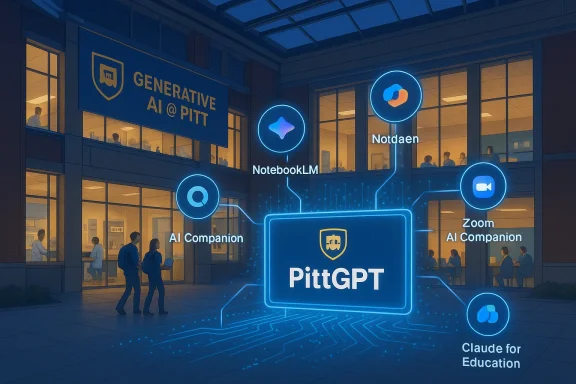
Pitt’s official “Generative AI @ Pitt” program now lists a suite of university‑approved tools — Google Gemini and NotebookLM, Microsoft 365 Copilot Chat, Zoom’s AI Companion and a homegrown PittGPT — supported with training, acceptable‑use standards and a service catalog for faculty and staff. The program is positioned as an enterprise, security‑reviewed alternative to consumer AI accounts: the idea is to let people use powerful generative AI without exposing protected university data to public model training and uncertain vendor reuse policies.
That institutional effort is part of a broader pattern across research universities: central IT groups assemble a menu of vetted tools, train campus users, and try to provide a safe default so that ad‑hoc, unsupported “shadow AI” use doesn’t create regulatory or academic‑integrity problems. Carnegie Mellon, for example, maintains similar approved access pathways (Gemini, NotebookLM, Copilot, Zoom AI Companion) and has documented guidance on when those services can be used with university data. Those parallel practices make clear that Pitt’s approach reflects a sector‑wide shift from prohibition to managed adoption.
Two practical implications flow from that technical reality:
Key operational rules every campus user should internalize:
Caution: archival transcription projects often require bespoke models, careful error analysis, and human post‑editing. Libraries that rush to automation without provenance and validation risk producing unreliable transcriptions that can mislead downstream researchers. Flag those outputs clearly and maintain human curation in the loop.
Those responsibilities are cultural and procedural as much as technical: teaching people how to verify model outputs, redesigning assessments so learning remains authentic, and keeping contractual guardrails up to date with vendor practices. When universities invest in those governance muscles, AI is not merely an efficiency play; it becomes a pedagogical lever that prepares students for the real world while protecting research integrity and privacy.
Pitt’s progress — adding PittGPT into the institutional toolset, integrating multiple vendor services under institutional controls, and running workshops to increase AI literacy — is notable. But the real test will be whether the university can sustain training, equitable access and rigorous auditability as models, vendors and external expectations continue to evolve. Institutions that treat AI rollout as a one‑time procurement will be behind; those that treat it as a continuous institutional competency will win not just in operational safety but in producing graduates who can use, critique and improve the tools that shape modern scholarship.
Conclusion
Generative AI at Pitt is no longer a shadow phenomenon; it is a curated, institutionally supported capability that brings both productivity and responsibility. The university has assembled strong technical building blocks and is actively expanding vendor partnerships and training. Now comes the harder work: making policy operational across thousands of courses and projects, ensuring equitable access, and embedding verification and provenance into everyday academic practice. If those pieces fall into place, Pitt’s approach could be a practical model for other universities trying to convert AI’s promise into sustained, trustworthy academic value.
Source: University of Pittsburgh Request Rejected
 Background / Overview
Pitt’s official “Generative AI @ Pitt” program now lists a suite of university‑approved tools — Google Gemini and NotebookLM, Microsoft 365 Copilot Chat, Zoom’s AI Companion and a homegrown PittGPT — supported with training, acceptable‑use standards and a service catalog for faculty and staff. The program is positioned as an enterprise, security‑reviewed alternative to consumer AI accounts: the idea is to let people use powerful generative AI without exposing protected university data to public model training and uncertain vendor reuse policies.That institutional effort is part of a broader pattern across research universities: central IT groups assemble a menu of vetted tools, train campus users, and try to provide a safe default so that ad‑hoc, unsupported “shadow AI” use doesn’t create regulatory or academic‑integrity problems. Carnegie Mellon, for example, maintains similar approved access pathways (Gemini, NotebookLM, Copilot, Zoom AI Companion) and has documented guidance on when those services can be used with university data. Those parallel practices make clear that Pitt’s approach reflects a sector‑wide shift from prohibition to managed adoption.
What Pitt Provides — At a Glance
The tools and services Pitt advertises are designed to target different use cases. Below are the core items the university lists as part of its institutional offering, with a short explanation of each and what it means for campus users.- PittGPT (University‑managed Chat assistant): a campus‑deployed generative assistant built to operate inside Pitt’s security perimeter and to protect private and restricted university data. Pitt Digital announced campus availability and documentation for PittGPT as part of the Generative AI suite. PittGPT is presented as the option to use when you must handle sensitive or restricted information.
- Google Gemini & NotebookLM (Google’s research and note tools): Gemini is framed as a general‑purpose assistant that can surface and summarize content; NotebookLM is a document‑centric assistant that works only with materials you upload. Both are available through institutional Google Workspace sign‑in flows, which typically restrict vendor reuse of institutional prompts and files when used with a university account.
- Microsoft 365 Copilot Chat: integrated inside Office365, Copilot Chat is pitched at productivity tasks — summarizing emails, drafting documents, automating repetitive workflows — and is offered through the university’s Microsoft accounts. Enterprise deployments emphasize data protection inside the university tenant.
- Zoom AI Companion: embedded inside Zoom for meeting summaries, translations and highlights; included with many campus Zoom licenses and configured to respect institutional data controls when accessed via Pitt accounts.
- Adobe Creative Cloud (with AI features): AI features for image editing, layout, audio and video are available to faculty and students via University licensing, enabling creative work — from image expansion to AI‑assisted audio cleanup. Pitt’s software programs and labs commonly provide access under campus licensing terms.
- Anthropic Claude for Education (institutional agreement): Pitt announced a partnership to bring Claude for Education at scale via an AWS integration — a notable institutional deal intended to provide another vetted option for academic use. This represents the university’s attempt to diversify vendor relationships beyond a handful of big providers.
Why the University Approach Matters (Strengths)
1. Enterprise controls reduce certain classes of risk
By routing access to Gemini, Copilot, NotebookLM and similar services through institutional logins and contracts, Pitt ensures vendors apply contractual protections to data stored or processed under campus accounts. That reduces the risk of prompts and files being harvested to train public models and simplifies compliance for researchers working under sponsored or sensitive data agreements. This is the primary operational benefit of a managed AI portfolio.2. Variety supports different workflows
Not every AI job is the same. NotebookLM is purpose‑built for document‑centric research; Copilot accelerates administrative and productivity tasks; Gemini offers a broad assistant experience; PittGPT aims to sit behind university firewalls for restricted workflows. Providing multiple tools means faculty and staff can choose the best fit rather than contorting a single product to all needs.3. Training and governance are baked in
The university is not only shipping tools — it’s running workshops, publishing acceptable‑use rules and building a service catalog. Those governance measures are essential if AI is to enhance research and learning without creating privacy, compliance or academic‑integrity failures. Pitt’s calendar and training listings show ongoing sessions for researchers and instructors.4. Local innovation and vendor diversification
Pitt’s work with Anthropic and AWS to integrate Claude for Education indicates a strategic move to build institutional partnerships, avoid single‑vendor entrenchment, and experiment with RAG (retrieval‑augmented generation) architectures that accelerate campus‑specific use cases. Those partnerships can enable specialized capabilities — such as fine‑grained access to campus research repositories — that consumer tools cannot safely provide.The Unavoidable Technical Limits: Hallucinations, Data Drift, and Ephemeral Accuracy
Generative AI models are excellent at producing fluent, contextually plausible text — but they are not truth engines. When asked to generate answers about well‑indexed, heavily cited topics, models can be reliable; when asked about edge details, unpublished data, or recent policy changes, they can confidently invent facts. This “hallucination” behavior is a product of how large language models predict plausible word sequences, not a sign of malice or intentional lying. Users must validate outputs, check citations, and treat AI-generated drafts as starting points — not final authority.Two practical implications flow from that technical reality:
- Faculty and students must design assignments that reward process, verification, and critical thinking rather than polished final prose alone.
- Researchers using models for literature surveys or literature synthesis should apply retrieval‑augmented generation patterns, provenance tracking and independent verification steps before relying on model outputs. Both best practices are emphasized in university guidance and recent academic work on responsible AI adoption.
Security, Privacy and Data Classification — The Hard Requirements
Pitt’s Generative AI guidance emphasizes data classification: not all campus data can safely be submitted to external models. The university’s Acceptable Use guidance and service catalog require users to treat private, restricted or sponsored data as out of scope for consumer services unless a vetted, contractual path exists. University logins into Gemini or NotebookLM often include protections (for example, non‑retention of inputs and contract terms forbidding vendor reuse) but these protections are specific to institutional arrangements and must be understood case‑by‑case.Key operational rules every campus user should internalize:
- Do not paste restricted data (e.g., PHI, FERPA‑protected student records, classified research) into a consumer AI chat.
- Prefer university‑contracted services (PittGPT, institutional Google Workspace integrations, Copilot in tenant mode) for internal data.
- Document AI use in research methods sections and in syllabi where AI tools are permitted in coursework.
The Library Use Case: Machine Learning Meets Rare Collections
Academic libraries are among the most promising and simultaneously trickiest places to apply AI. At Pitt, library staff are exploring machine learning to accelerate labor‑intensive tasks such as handwriting transcription and archival indexing. That kind of work — when applied under careful supervision and with high‑quality training data — can turn what would otherwise take decades of human labor into something manageable within projects and grants. The university’s August Wilson Archive and similar collections are natural candidates for those efforts, though project specifics and outcomes often vary by grant, vendor and workflow. Some of the claims about handwriting transcription using machine learning come from internal presentations and institutional reporting; independent, peer‑reviewed documentation of each library project should be sought for research replication and for assessing accuracy.Caution: archival transcription projects often require bespoke models, careful error analysis, and human post‑editing. Libraries that rush to automation without provenance and validation risk producing unreliable transcriptions that can mislead downstream researchers. Flag those outputs clearly and maintain human curation in the loop.
Pedagogy and Academic Integrity: Redesign, Don’t Ban
One of the strongest lessons from institutions that have engaged deeply with AI is that banishment is not an effective long‑term strategy. Students will access tools; universities should teach students how to use them responsibly. That means:- Embedding AI literacy into orientation, first‑year writing, and discipline courses.
- Redesigning assessments to emphasize process, in‑class demonstrations, oral defenses, drafts with tracked edits, and methods that require citation and verification.
- Teaching prompt literacy and critical evaluation: how to generate specific prompts, request sources, cross‑check model claims, and perform post‑generation verification.
Procurement, Vendor Risk and Governing Institutional Contracts
Institutional contracts — and how they handle data, retention and model reuse — are the fulcrum of safe AI deployment. Pitt’s decision to secure institutional arrangements for Gemini, Copilot Chat, Claude for Education and PittGPT reflects the recognition that legal and contractual protections matter as much as technical controls.- Contract language that prevents vendors from re‑using prompts and files for model training is essential.
- Auditability provisions (logs, provenance, access controls) help investigators reconstruct how outputs were created.
- Data residency and encryption practices should match the most restrictive use case expected on campus (sponsored research, clinical data, etc.).
Equity, Access and the Digital Divide
AI tools promise productivity boosts, but they can also widen gaps if adoption strategies aren’t equitable. Considerations include:- Licensing and account availability (who gets paid seats and who doesn’t).
- Hardware and connectivity needs for cloud‑dependent tools.
- Instructional support to ensure students from under‑resourced backgrounds can learn to use AI effectively.
Practical Recommendations for Faculty, Staff and Students
Below are actionable steps for campus users, ranked for immediate effect:- Use institutional accounts for academic work whenever possible. Enterprise logins usually include contractual protections.
- Classify your data before you upload it. If data is private or restricted, do not submit it to consumer models.
- Treat AI outputs like a draft, not a final product. Verify facts, check citations, and run critical sanity checks.
- Record provenance and prompt history for reproducibility. This helps when audit questions or disputes arise.
- Redesign assessments to reward process and verification. Consider oral components, in‑class essays, or scaffolded drafts requiring sources.
- Ask your department or Pitt Digital for a vendor risk assessment before adopting new AI tools. This is the institutional route to safe experimentation.
Notable Gaps and Risks the University Must Still Address
- Transparency and student awareness: Publishing clear, accessible rules in syllabi is uneven across courses. Students need explicit instructions about what is allowed and how to disclose AI use.
- Longitudinal governance: As models and vendor practices change rapidly, procurement and compliance controls must be living documents. Short procurement cycles leave institutions chasing new terms after they’ve already onboarded a tool.
- Overreliance and skill erosion: Academics increasingly warn about students (and professionals) using AI as a crutch rather than a collaborator; curricula need to teach core skills alongside AI fluency.
- Undocumented pilot projects: When research groups or labs run their own small‑scale AI pilots without central IT involvement, they may create privacy or compliance exposures. Centralized tooling and clear escalation pathways reduce that risk.
- Claims that lack independent verification: University reports or local presentations sometimes describe successful pilot outcomes (for example, library projects using ML to transcribe archival handwriting). Those project claims are promising but must be publicly documented, peer reviewed or otherwise substantiated before they are taken as broadly replicable. Where public documentation is absent, treat such project descriptions as indicative rather than definitive.
Where Pitt Should Invest Next (Strategic Priorities)
- Centralized provenance and logging infrastructure so faculty and auditors can reconstruct outputs used in decision‑making or scholarship.
- Low‑cost student access pathways (e.g., subsidized seats or lab stations) to prevent a two‑tier learning environment.
- Robust faculty development programs that focus on redesigning assessment, integrating AI into discipline pedagogy, and teaching verification skills.
- Cross‑unit governance bodies that include legal, IRB, libraries, CTL, and research office representatives to adjudicate complex sponsorship, IP and data‑use questions.
- Public project documentation for major pilot outcomes (e.g., library transcription accuracy metrics, RAG system evaluations) so the university community and external researchers can validate claims.
Final Analysis: An Opportunity That Requires Discipline
Pitt’s measured, service‑catalog approach to generative AI is the right strategic posture for a research university in 2026: it balances faculty and researcher needs with contractual protections and campus governance. The portfolio approach — multiple vendors, a campus‑managed assistant, training, and acceptable‑use rules — reduces several immediate dangers such as accidental data exposure, but it does not remove the deeper, ongoing responsibilities.Those responsibilities are cultural and procedural as much as technical: teaching people how to verify model outputs, redesigning assessments so learning remains authentic, and keeping contractual guardrails up to date with vendor practices. When universities invest in those governance muscles, AI is not merely an efficiency play; it becomes a pedagogical lever that prepares students for the real world while protecting research integrity and privacy.
Pitt’s progress — adding PittGPT into the institutional toolset, integrating multiple vendor services under institutional controls, and running workshops to increase AI literacy — is notable. But the real test will be whether the university can sustain training, equitable access and rigorous auditability as models, vendors and external expectations continue to evolve. Institutions that treat AI rollout as a one‑time procurement will be behind; those that treat it as a continuous institutional competency will win not just in operational safety but in producing graduates who can use, critique and improve the tools that shape modern scholarship.
Conclusion
Generative AI at Pitt is no longer a shadow phenomenon; it is a curated, institutionally supported capability that brings both productivity and responsibility. The university has assembled strong technical building blocks and is actively expanding vendor partnerships and training. Now comes the harder work: making policy operational across thousands of courses and projects, ensuring equitable access, and embedding verification and provenance into everyday academic practice. If those pieces fall into place, Pitt’s approach could be a practical model for other universities trying to convert AI’s promise into sustained, trustworthy academic value.
Source: University of Pittsburgh Request Rejected
