

Paul Thurrott’s short, enthusiastic dispatches about Pixelsnap crystallize a larger shift in how Android phones handle magnetic wireless charging: Google has taken MagSafe-style convenience and baked it into hardware and an ecosystem, and that change is already reshaping accessory choices, buyer decisions, and accessory makers’ roadmaps.
Google’s Pixel 10 family introduced Pixelsnap, its branded implementation of the Qi magnetic charging ecosystem (Qi2 and the Magnetic Power Profile). Pixelsnap aims to deliver the same snap-to-align convenience Apple users have enjoyed with MagSafe for years, but now natively on Pixel hardware without adhesive rings or special cases. Google’s official product pages and support documentation confirm the Pixel 10 product line ships with built-in magnets and Qi2-compatible wireless charging. Why this matters now: two recent technical developments moved magnetic wireless charging from a novelty to a practical daily tool for more people.
(Additional context note: Paul Thurrott’s ongoing Pixel diaries and broader reporting on these devices help illustrate the daily implications of technical choices; forum archives and community threads have already started discussing the ecosystem ramifications for accessories and app workflows as Pixelsnap adoption grows.
Source: Thurrott.com Paul’s Pixel 10 Diaries: More Pixelsnap Magic
 Background / Overview
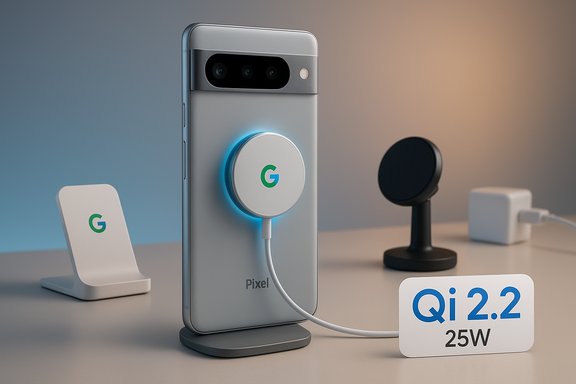
Google’s Pixel 10 family introduced Pixelsnap, its branded implementation of the Qi magnetic charging ecosystem (Qi2 and the Magnetic Power Profile). Pixelsnap aims to deliver the same snap-to-align convenience Apple users have enjoyed with MagSafe for years, but now natively on Pixel hardware without adhesive rings or special cases. Google’s official product pages and support documentation confirm the Pixel 10 product line ships with built-in magnets and Qi2-compatible wireless charging. Why this matters now: two recent technical developments moved magnetic wireless charging from a novelty to a practical daily tool for more people.- The first is broad adoption of the Magnetic Power Profile (MPP) introduced in Qi2, which standardizes magnet-aided alignment and communications between phone and charger.
- The second is the emergence of Qi2.2 (often called Qi v2.2), which raises the realistic sustained power for magnetic wireless charging from about 15W to 25W in compatible pairings—fast enough to be genuinely useful for topping up during the day.
What Google actually shipped: Pixelsnap and Pixel 10 model differences
The line-level picture
Google split wireless charging capability across the Pixel 10 lineup in a way that matters for buyers and accessory makers:- Pixel 10 (base): Supports Qi2 magnetic alignment and up to 15W magnetic wireless charging. Wired charging tops at different values depending on region and configuration; typical documented USB-C fast-charging capability is lower than the Pro XL.
- Pixel 10 Pro: Supports Qi2 magnetic charging but is limited to 15W magnetic wireless speeds; its wired charging ceiling is higher than the base Pixel 10 and varies by model—Google’s product pages indicate up to ~30–45W wired on Pro-class models depending on SKU and market.
- Pixel 10 Pro XL: The standout: supports Qi2.2 and 25W magnetic wireless charging when paired with a Qi2.2 (25W-capable) charger and a high‑power USB-C adapter. Google positions the Pixel 10 Pro XL as the only Pixel in the family able to hit that 25W Pixelsnap peak today.
- Pixel 10 Pro Fold: Includes Pixelsnap alignment but in practice supports the 15W magnetic profile—foldable hardware and thermal constraints mean the Fold doesn’t join the Pixel 10 Pro XL’s 25W club.
Why Google limited some models
Google’s explicit reasoning—echoed by OEMs across the industry—is thermal and longevity management. Wireless charging dissipates heat differently than wired charging and can stress batteries if unmanaged. The Pixel 10 Pro XL benefits from a larger chassis and a thermal design capable of handling higher sustained magnetic charging rates; other Pixel 10 models ship with more conservative limits in the name of long-term battery health and safety. Android Central’s reporting on Google’s statements explains Google’s trade-offs nicely: faster wireless charging can be done safely, but only if cooling and battery tolerance allow it.How Qi2, MPP, and Qi2.2 actually work (practical summary)
Key technical points, in plain language
- Qi2: The modern version of the wireless standard that introduced Magnet Power Profile (MPP). It formalizes magnetic alignment (magnets on both phone and charger) and adds communications to negotiate power safely.
- MPP (Magnetic Power Profile): The part of Qi2 that governs how magnets align devices and how the charger and phone negotiate power and thermal limits. MPP is what makes MagSafe-style accessories reliably snap and center.
- Qi2.2 (or v2.2): An incremental update (market name used by manufacturers) that increases supported magnetic wireless power up to around 25W under the right conditions.
The Pixelsnap ecosystem today: accessories, categories, and quality tiers
Pixelsnap is more than a charger—it's a platform. Expect accessory categories to expand quickly now that Google has integrated magnets into Pixel silicon and chassis.- First-party Google Pixelsnap accessories
- Magnetic chargers (flat puck)
- Charger + stand variants (docks that orient phone in portrait or landscape)
- Magnetic rings, mounts, and other adapters
- Magnetic power banks and travel chargers (some third parties are shipping already)
- Tripod and selfie-stick mounts that use Qi2 magnets for quick magnetized mounting
- Third-party accessories (growing fast)
- Belkin, Anker, Aukey and others have been quick to add Qi2/Qi2.2 products.
- New product types are appearing: modular multi-pad bases, magnetic power spheres/power banks, in-car magnetic vents, and tripod plates designed for shooting with a magnetically mounted phone.
Practical buyer guidance: how to get the most from Pixelsnap
Buying magnetic accessories now requires a little homework to avoid disappointment. Follow these steps to match expectations with reality.- Identify the Pixel 10 model you will use (Pixel 10, Pixel 10 Pro, Pixel 10 Pro XL, or Pixel 10 Pro Fold).
- Decide how fast you need wireless charging to be—convenience top-ups or near-sustained fast charging.
- When shopping for chargers, check for explicit certification:
- Qi2 or Qi2.2 label (Qi2 is baseline; Qi2.2 signals 25W capability).
- Manufacturer notes about MPP or MagSafe‑style compatibility.
- For 25W wireless charging, make sure:
- Your phone is a Pixel 10 Pro XL (the only Pixel 10 phone currently documented to hit 25W).
- The magnetic charger itself advertises Qi2.2 / 25W output.
- The USB-C power adapter feeding the charger is rated high enough (typically 35W or higher on the adapter side to allow the puck to supply 25W wirelessly in real-world testing).
- If you travel, prefer magnetic power banks labeled for Qi2.2 if you want the fastest wireless top-ups on the Pro XL; otherwise a 10,000–20,000 mAh 15W power bank offers broad compatibility and convenience.
- For bedside use: Pixelsnap Charger with Stand for a clean night-stand experience.
- For desktop use: a Pixelsnap Charger + magnetic tripod mount or a third-party Qi2.2 dock if you own a Pro XL.
- For car use: choose purpose-built in-vent or magnetic dash mounts rated for Qi2/MPP.
- For travel: a magnetic power bank that supports passthrough charging and offers firm magnetic coupling.
Strengths: why Pixelsnap is a real improvement
- Immediate convenience: Easier alignment, one-handed mount/dock release, and fewer daily cable fumbles.
- Accessory diversity: Pixelsnap unleashes a large, rapidly growing market of stands, mounts, and chargers already familiar to iPhone users.
- Standardization: Because Qi2 and MPP are industry standards, vendor choice and competition should bring prices down and quality up over time.
- Improved wireless power: Qi2.2’s 25W shift makes magnetic wireless topping-up genuinely useful for busy people who want to reduce cable reliance during the day.
Risks and drawbacks: what to watch out for
- Fragmentation by phone model: The Pixel 10 family’s split in charging capabilities creates buyer confusion. Only the Pro XL reaches 25W magnetic speeds today, and the Fold and other Pro models are capped lower. Buyers who assume “Pixel 10” means the fastest wireless will be disappointed.
- Accessory certification ambiguity: Many chargers will advertise Qi2 compatibility but not support the 25W MPP profile. Some vendors use marketing terminology loosely; insist on exact specifications (Qi2.2 or explicit 25W MPP support).
- Thermal throttling and battery longevity: High-power wireless charging still generates more heat than many wired solutions. Phone vendors often limit speeds to protect battery health, resulting in inconsistent experiences between chargers and phone models. Google’s choice to keep many models at 15W is a deliberate attempt to reduce long-term battery wear and thermal risk.
- Accessory availability and cost: Qi2.2 chargers and power banks are less common than 15W products right now and may command premiums during early adoption phases. Expect the more affordable, high-volume 15W market to persist for months.
Three real-world use cases where Pixelsnap shines
1) Desk and home-office setups
A magnetic charger used with a Pixelsnap stand converts your phone into a neat second-screen companion—notifications, video calls, and quick reference—while charging. The magnetic snap keeps the phone stable for video calls and screen-tilting without fiddly clamps.2) Quick top-ups between errands
A 25W-capable Pixelsnap power bank can give a Pro XL a useful top-up in a coffee stop. For the many users who do lots of short outings, that convenience may reduce battery anxiety and the need to carry a cable everywhere.3) Content creation and livestreaming
Photographers and creators who use tripods or compact gimbals benefit from consistent magnetic mounting. A magnetic tripod plate and Qi2 puck let you shoot, mount and swap the phone between tripod and pocket fast—no clamps, no time wasted fussing with grips.Looking ahead: the broader Android ecosystem and Samsung’s possible move
Multiple industry leaks and rumor outlets suggest Samsung may add broader Qi2 magnetic support to its flagship lineup in early 2026, but that remains a rumor at present. If Samsung adopts native magnetized Qi2 later, Pixelsnap’s advantage as a differentiator narrows—but the overall Android market would win because accessory ecosystems scale faster and cheaper once two major OEMs embrace a standard. Treat those Samsung reports as plausible but unconfirmed.Trouble-shooting and configuration tips
- Always update your Pixel to the latest system software and accessory firmware when available; negotiation and safety profiles can be updated post-launch.
- Use a high‑quality USB-C PD adapter when using Pixelsnap chargers—some pucks rely on the adapter’s wattage headroom to reach 25W output.
- If your phone feels warm on a magnetic charger, expect the system to throttle to protect the battery—don’t try to “force” higher speeds with third-party adapters that exceed recommended specs.
- For car mounts: choose magnet designs with clear torque and pull-off ratings so your phone doesn’t slip during hard braking.
Final analysis: Pixelsnap is a watershed moment, but buy strategically
Pixelsnap—Google’s built-in magnet support plus an explicit ecosystem strategy—represents a rare hardware-level move that immediately improves the daily experience of Pixel owners. The technical maturity of Qi2 and the arrival of Qi2.2 at 25W make magnetic wireless charging practical rather than merely gimmicky for a growing set of users. The Pixel 10 Pro XL stands out as the model that can fully exploit the 25W Pixelsnap promise today. That said, the technology is not uniformly fast across the entire Pixel 10 lineup, and accessory labeling and certification remain patchy. Early buyers must pay attention to exact specs—phone model + charger profile + adapter wattage—to avoid surprises. Google’s cautious approach to limiting wireless speeds on some models is sensible: it reflects the reality that uncontrolled warming shortens battery life. Readers should interpret Pixelsnap as a major usability win that will reach maturity over 12–24 months as more Qi2.2 chargers and power banks become common and prices normalize. Paul Thurrott’s diary entries capture this moment well: they’re hands-on, pragmatic, and focused on daily experience rather than abstract specs. His reporting underscores both the convenience of Pixelsnap and the practical caveats that real users will encounter as the ecosystem scales.Quick takeaway (for readers who skim)
- Pixelsnap brings true MagSafe-style magnetized charging to Pixel phones; it’s a real, usable ecosystem now.
- Only the Pixel 10 Pro XL currently supports 25W Qi2.2 magnetic charging; most other Pixel 10 models top out at 15W for magnetic charging.
- To get 25W wireless charging, you need a Pixel 10 Pro XL, a Qi2.2 (25W) magnetic charger, and a sufficiently capable USB-C adapter.
- Expect the accessory market to expand quickly, but verify exact specs rather than relying on generic “Qi2 compatible” marketing.
(Additional context note: Paul Thurrott’s ongoing Pixel diaries and broader reporting on these devices help illustrate the daily implications of technical choices; forum archives and community threads have already started discussing the ecosystem ramifications for accessories and app workflows as Pixelsnap adoption grows.
Source: Thurrott.com Paul’s Pixel 10 Diaries: More Pixelsnap Magic
