

Plex Media Server’s decision to end support for 32-bit Windows is more than a routine housekeeping update. It is another sign that the software stack around home media servers is finally moving past the era of legacy PCs that could run modern services on aging operating systems indefinitely. The practical result is simple: if you are still running Plex on a 32-bit Windows install, version 1.42.2 is your last stop, and anything after that is a 64-bit-only world. Plex says the old build will keep working for now, but the company has also made clear that the clock has already started ticking on features, fixes, and security updates.
The timing of the move is not accidental. Microsoft ended support for Windows 10 on October 14, 2025, and Plex is now aligning its own maintenance policy with a broader industry shift away from obsolete Windows deployments. Microsoft’s support lifecycle matters because software vendors rely on the operating system’s APIs, security model, and driver ecosystem, and once that foundation ages out, supporting old builds becomes more expensive and less reliable. Plex is effectively saying that the economics and engineering constraints no longer justify carrying 32-bit Windows forward.
What makes the announcement noteworthy is that it hits a user group that often flies under the radar. The phrase “32-bit Windows” sounds quaint in 2026, but there are still real installations out there—older desktops, repurposed family PCs, and niche home servers—that continued to run because they were “good enough” for a media server. Plex is not alone in trimming support for old Windows environments; the broader software world has been converging on 64-bit-only builds, and the last major holdouts are increasingly rare.
There is also a technical story behind the policy change. Plex says its decision is tied to changes in how it builds and ships the software, which is a polite way of saying the codebase, dependencies, and transcode pipeline have become too modern to keep dragging a 32-bit branch behind them. That matters because Plex Media Server is not just a simple file host; it is a compute-heavy application that handles library analysis, metadata processing, streaming sessions, remote access logic, and transcoding. As codec support expands and hardware acceleration expectations rise, the value of a 32-bit Windows build drops sharply.
For consumers, the immediate consequence is straightforward: the server may continue to run, but it will become a static artifact. For enthusiasts, that means fewer moving parts and less surprise. For everyone else, it means no future safety net if a later Plex update assumes capabilities that old 32-bit builds cannot handle. The company’s warning that the final build may eventually stop working altogether is not melodrama; it is an acknowledgment that server software evolves in ways legacy systems cannot always absorb.
The distinction between “still runs” and “still supported” is important. A lot of software survives unsupported for a surprisingly long time, especially if the surrounding environment remains stable. But media servers are exposed to changing browser behavior, remote access services, authentication expectations, codec shifts, and OS-level updates. Once Plex stops shipping updates for a platform, it stops being able to react when any of those external variables change.
That is especially true for a product like Plex, where the server is only one part of a larger experience. The server may live on an old PC, but the client ecosystem includes modern phones, TVs, browsers, and streaming devices. If the server side remains trapped in 32-bit constraints while everything else moves forward, incompatibilities eventually multiply. The result is not usually a single catastrophic failure; it is a slow accumulation of small paper cuts.
The key nuance is that Windows 10 ended support as a product family, but not every installer or edition disappeared at the same time. Some users can still keep systems going through paid or conditional extended security update programs, while others are already outside the supported path. For Plex, though, the issue is less about Microsoft’s willingness to patch the OS and more about whether it makes sense to maintain a separate 32-bit application path for diminishing returns. Once the operating system is no longer part of the normal support lifecycle, the rationale for keeping adjacent software alive shrinks too.
There is also a practical testing issue. Supporting 32-bit Windows means keeping a separate matrix of binaries, installer logic, and regression coverage. That duplication is often invisible to end users, but it consumes real developer time. Once Microsoft’s own platform support moves on, that burden becomes harder to defend internally.
That is especially true when transcoding enters the picture. Plex is not merely storing media files; it is often decoding one format and re-encoding it in real time to fit the needs of a client device. That process benefits from modern CPUs, GPUs, and driver stacks, and it gains even more from codec-specific improvements like AV1 support. The newer the media pipeline, the less appealing it becomes to keep ancient operating-system baggage attached to it.
The same logic applies to dependencies beyond the GPU. Media tools often depend on updated versions of FFmpeg, driver interfaces, and system libraries that are simply more comfortable in a 64-bit environment. Once a vendor starts spending engineering effort on next-gen transcoding features, supporting an old 32-bit Windows branch becomes a distraction.
That kind of warning is common in software lifecycle management. Vendors rarely promise that unsupported software will keep functioning indefinitely because they cannot control future browser changes, OS changes, authentication changes, or service-side changes. The old build might be fine today and fail six months from now because of some upstream dependency nobody thought about when the cutoff was announced.
The good news is that Plex is not instantly abandoning anyone. If you are already running the last supported 32-bit build, your server should continue functioning unless some external change interferes. The bad news is that every new Plex feature, every bug fix in newer releases, and every security improvement will bypass you. Over time, that turns a once-working media server into a riskier and less capable one, even if it still appears operational.
This is where the hidden cost shows up. A lot of people think they are only changing software, but in reality they are hitting a hardware and operating-system inflection point. Plex’s announcement forces that conversation earlier than some users would like, but that may be a good thing. Delaying the upgrade only increases the odds of a rushed migration later.
In a business or lab context, the biggest issue is not whether Plex streams a movie tonight. It is whether the software can still be patched, audited, and kept aligned with policy tomorrow. Unsupported 32-bit Windows software is a liability, especially if the machine also serves other roles on the network. Even if Plex itself is not mission-critical, the presence of an abandoned build can complicate backup routines, security scans, and incident response.
There is also an inventory implication. Many organizations still have old Windows 10-era machines sitting in closets, server racks, or media labs because they were “good enough” for secondary workloads. Once software vendors stop supporting 32-bit builds, those systems start looking like liabilities instead of assets. That may accelerate asset refresh cycles that were already overdue.
AV1 is important because it represents the direction of travel for bandwidth efficiency and streaming quality. As more media gets encoded in AV1, a server that can decode and transcode it effectively becomes more valuable. Plex is clearly investing in that future, and those investments are easier to realize on newer 64-bit systems with current graphics support.
The pace of that hardware evolution reinforces the 64-bit transition. If Plex is prioritizing features that depend on current Intel graphics capabilities, it cannot keep spending resources validating a shrinking legacy Windows branch. In a practical sense, the old platform would hold back the new one.
The broader industry is already there in many ways. Game launchers, desktop productivity apps, driver utilities, and content tools have been shedding 32-bit support for years. Plex’s announcement simply extends that trend into a category that still had a meaningful number of legacy users. It is a reminder that the software world is moving faster than the hardware many enthusiasts are still trying to preserve.
At the same time, there is a customer-retention risk. Some users do choose software platforms precisely because they cling to older environments longer than the competition. When a vendor like Plex drops support, those users may start shopping around for alternatives that promise a longer support tail. Whether that actually works out for them is another question, but the search starts there.
Security risk is not limited to a dramatic remote-code-execution scenario. It can also show up as weaker handling of metadata parsing, token management, web UI behavior, or dependency issues in related components. In a server product, one unpatched weakness can be enough to justify migration. For home users, that is an abstract worry until it isn’t.
That is why the phrase “works for now” should not be interpreted as reassurance. It is a temporary operational statement, not a security endorsement. The moment an application stops receiving fixes, its risk profile changes whether or not the user notices any visible malfunction.
Plex’s longer-term trajectory is likely to keep emphasizing modern hardware acceleration, codec support, and performance optimizations that assume a 64-bit platform. That is consistent with the broader direction of the media ecosystem, where AV1, newer Intel graphics, and increasingly capable integrated GPUs are reshaping what “good streaming hardware” looks like. The users who benefit most will be the ones who upgrade before their old builds become a problem.
Plex’s move closes one more door on legacy Windows, and in doing so it opens a clearer path for the features people actually want next. For users still clinging to old 32-bit installs, the message is blunt but familiar: the server may still start, but the future has already moved on.
Source: How-To Geek Plex Media Server just ended support for old Windows systems
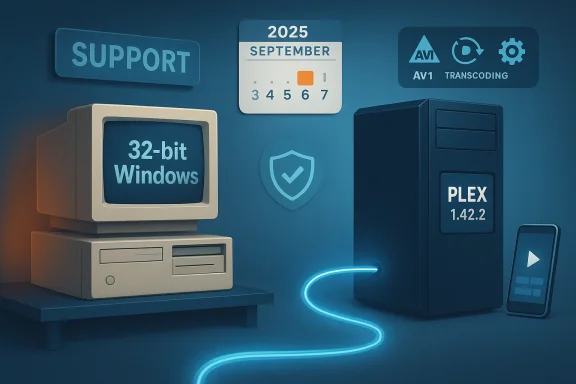 Overview
The timing of the move is not accidental. Microsoft ended support for Windows 10 on October 14, 2025, and Plex is now aligning its own maintenance policy with a broader industry shift away from obsolete Windows deployments. Microsoft’s support lifecycle matters because software vendors rely on the operating system’s APIs, security model, and driver ecosystem, and once that foundation ages out, supporting old builds becomes more expensive and less reliable. Plex is effectively saying that the economics and engineering constraints no longer justify carrying 32-bit Windows forward.What makes the announcement noteworthy is that it hits a user group that often flies under the radar. The phrase “32-bit Windows” sounds quaint in 2026, but there are still real installations out there—older desktops, repurposed family PCs, and niche home servers—that continued to run because they were “good enough” for a media server. Plex is not alone in trimming support for old Windows environments; the broader software world has been converging on 64-bit-only builds, and the last major holdouts are increasingly rare.
There is also a technical story behind the policy change. Plex says its decision is tied to changes in how it builds and ships the software, which is a polite way of saying the codebase, dependencies, and transcode pipeline have become too modern to keep dragging a 32-bit branch behind them. That matters because Plex Media Server is not just a simple file host; it is a compute-heavy application that handles library analysis, metadata processing, streaming sessions, remote access logic, and transcoding. As codec support expands and hardware acceleration expectations rise, the value of a 32-bit Windows build drops sharply.
For consumers, the immediate consequence is straightforward: the server may continue to run, but it will become a static artifact. For enthusiasts, that means fewer moving parts and less surprise. For everyone else, it means no future safety net if a later Plex update assumes capabilities that old 32-bit builds cannot handle. The company’s warning that the final build may eventually stop working altogether is not melodrama; it is an acknowledgment that server software evolves in ways legacy systems cannot always absorb.
What Plex Actually Changed
Plex’s shift is not a dramatic feature removal so much as a support boundary being drawn in a new place. The company is no longer testing, fixing, or updating Plex Media Server for 32-bit Windows, and that means the software is effectively frozen at 1.42.2 for that platform. That last supported release came out in August 2025, which means the cutoff arrived after a long runway rather than as a sudden surprise. For many users, the practical implication is that their current installation will not break overnight, but it will age into irrelevance.The distinction between “still runs” and “still supported” is important. A lot of software survives unsupported for a surprisingly long time, especially if the surrounding environment remains stable. But media servers are exposed to changing browser behavior, remote access services, authentication expectations, codec shifts, and OS-level updates. Once Plex stops shipping updates for a platform, it stops being able to react when any of those external variables change.
Why 32-bit matters less now
The 32-bit Windows ecosystem has been shrinking for years. Even before Microsoft’s October 2025 deadline for Windows 10, most consumer PCs had already moved to 64-bit processors and 64-bit operating systems. The remaining 32-bit installs tend to be older hardware or specialty deployments where memory limits and compatibility concerns are baked in. In 2026, supporting those systems is increasingly a matter of preserving edge cases rather than serving the mainstream.That is especially true for a product like Plex, where the server is only one part of a larger experience. The server may live on an old PC, but the client ecosystem includes modern phones, TVs, browsers, and streaming devices. If the server side remains trapped in 32-bit constraints while everything else moves forward, incompatibilities eventually multiply. The result is not usually a single catastrophic failure; it is a slow accumulation of small paper cuts.
- 1.42.2 is the final supported 32-bit Windows release
- August 2025 was the release window for that cutoff build
- Plex says the old version will keep working for now
- No new features, fixes, or security updates will land for 32-bit Windows
- Future Plex changes may eventually make the old build unusable
Microsoft’s Windows 10 Deadline Changed the Math
Microsoft’s end of support for Windows 10 on October 14, 2025, is the policy anchor behind a lot of these vendor decisions. Microsoft’s own support page makes clear that Windows 10 reached end of support on that date, which means no more standard security updates for the operating system itself. Once that happened, third-party developers had a stronger justification for ending time-consuming compatibility work on older Windows branches.The key nuance is that Windows 10 ended support as a product family, but not every installer or edition disappeared at the same time. Some users can still keep systems going through paid or conditional extended security update programs, while others are already outside the supported path. For Plex, though, the issue is less about Microsoft’s willingness to patch the OS and more about whether it makes sense to maintain a separate 32-bit application path for diminishing returns. Once the operating system is no longer part of the normal support lifecycle, the rationale for keeping adjacent software alive shrinks too.
The ripple effect on third-party software
This kind of change tends to cascade through the software ecosystem. Antivirus vendors, driver makers, codec libraries, and application developers all look at Microsoft’s lifecycle dates when deciding how long to support an older platform. When Windows 10 crossed the finish line in October 2025, it became easier for vendors to say that old configurations now sit outside their mainstream support model. Plex’s announcement fits that pattern neatly.There is also a practical testing issue. Supporting 32-bit Windows means keeping a separate matrix of binaries, installer logic, and regression coverage. That duplication is often invisible to end users, but it consumes real developer time. Once Microsoft’s own platform support moves on, that burden becomes harder to defend internally.
- Microsoft ended standard Windows 10 support on October 14, 2025
- Vendors can use that date as a support justification
- Separate 32-bit testing adds cost and complexity
- Extended support arrangements do not automatically force third-party vendors to continue
- The broader Windows ecosystem is already moving toward 64-bit-only assumptions
The Technical Side of Plex’s Decision
Plex’s statement that its build process has changed is probably the most important technical clue in the whole story. Modern media server software leans on current toolchains, codec libraries, transcoding frameworks, and platform-specific acceleration APIs. Those components are easier to maintain on 64-bit systems because the memory model is larger, the compiler assumptions are more modern, and the hardware support layer is more likely to be current. In short, 32-bit Windows is not just older; it is increasingly incompatible with how contemporary media software is built.That is especially true when transcoding enters the picture. Plex is not merely storing media files; it is often decoding one format and re-encoding it in real time to fit the needs of a client device. That process benefits from modern CPUs, GPUs, and driver stacks, and it gains even more from codec-specific improvements like AV1 support. The newer the media pipeline, the less appealing it becomes to keep ancient operating-system baggage attached to it.
Why transcoding pushes vendors forward
Transcoding has become one of Plex’s most important differentiators, because many users rely on it to make hard-to-play media stream smoothly across a mixed device household. That in turn means the server software has to stay close to current hardware trends. When Intel, AMD, and NVIDIA ship new generations of integrated or discrete graphics, Plex has an incentive to adapt its decoder and encoder paths quickly. Support for 32-bit Windows makes that adaptation slower and more cumbersome.The same logic applies to dependencies beyond the GPU. Media tools often depend on updated versions of FFmpeg, driver interfaces, and system libraries that are simply more comfortable in a 64-bit environment. Once a vendor starts spending engineering effort on next-gen transcoding features, supporting an old 32-bit Windows branch becomes a distraction.
What “will work for now” really means
Plex’s phrase that the legacy build will continue to work for now is careful wording, and it should be read that way. It does not mean the software is safe, future-proof, or guaranteed to survive later ecosystem shifts. It means only that the current codebase is not being actively disabled today. As the company adds new capabilities or alters backend dependencies, the old release may become brittle in ways that are difficult to predict.That kind of warning is common in software lifecycle management. Vendors rarely promise that unsupported software will keep functioning indefinitely because they cannot control future browser changes, OS changes, authentication changes, or service-side changes. The old build might be fine today and fail six months from now because of some upstream dependency nobody thought about when the cutoff was announced.
- Transcoding is one of the biggest drivers of Plex’s platform changes
- Codec and driver updates are easier to support on 64-bit systems
- Older 32-bit builds are more vulnerable to dependency drift
- “Will work for now” is not a long-term guarantee
- Future Plex changes could break compatibility indirectly
Consumer Impact: The Home Server User Problem
For most households, Plex lives somewhere between convenience and necessity. It is the thing that makes a movie library feel organized, portable, and accessible without the friction of manual file browsing. That means the people most affected by this change are not enterprise IT teams but hobbyists, family archivists, and users who turned an old Windows box into a private streaming appliance. For them, a support cutoff is not a line in a changelog; it is a reminder that the machine under the desk finally has a retirement date.The good news is that Plex is not instantly abandoning anyone. If you are already running the last supported 32-bit build, your server should continue functioning unless some external change interferes. The bad news is that every new Plex feature, every bug fix in newer releases, and every security improvement will bypass you. Over time, that turns a once-working media server into a riskier and less capable one, even if it still appears operational.
The upgrade question
For consumer users, the practical decision is usually whether the hardware can move to a 64-bit operating system or whether the whole box needs replacement. If the system already has a 64-bit CPU, the path forward may be as simple as reinstalling Windows in 64-bit form and then upgrading Plex. If the machine is too old to make that transition cleanly, then the most rational answer may be to repurpose it for lighter tasks and move Plex to newer hardware.This is where the hidden cost shows up. A lot of people think they are only changing software, but in reality they are hitting a hardware and operating-system inflection point. Plex’s announcement forces that conversation earlier than some users would like, but that may be a good thing. Delaying the upgrade only increases the odds of a rushed migration later.
When “old but working” stops being enough
There is a psychological trap in server maintenance: if something has worked for years, it feels like it will keep working because it has already proven itself. But unsupported infrastructure is never static. Browser authentication changes, remote access features evolve, and security expectations rise. An old Plex install may keep streaming local files just fine while slowly becoming less reliable in the face of new client behavior and new network conditions.- Old home servers often fail gracefully before they fail completely
- 64-bit Windows is the obvious path forward for most users
- Reinstalling the OS may be easier than preserving a fragile legacy setup
- Unsupported builds increase maintenance anxiety over time
- The sooner users migrate, the lower the chance of data-loss drama later
Enterprise and Power-User Implications
Although Plex is usually discussed as a home-media product, there is a serious power-user and small-business population running it on office leftovers, lab machines, and repurposed server hardware. Those users tend to care less about the consumer angle and more about stability, automation, and predictability. For them, the 32-bit cutoff matters because it changes the maintenance burden of legacy Windows installations that might otherwise have kept running quietly in a corner.In a business or lab context, the biggest issue is not whether Plex streams a movie tonight. It is whether the software can still be patched, audited, and kept aligned with policy tomorrow. Unsupported 32-bit Windows software is a liability, especially if the machine also serves other roles on the network. Even if Plex itself is not mission-critical, the presence of an abandoned build can complicate backup routines, security scans, and incident response.
Why administrators will care
Administrators value standardization, and 64-bit-only software reduces the number of exceptions they must manage. It simplifies deployment scripts, improves compatibility with modern management tools, and reduces the risk of obscure installer behavior. In that sense, Plex’s change is not only a loss; it is also a normalization of the platform.There is also an inventory implication. Many organizations still have old Windows 10-era machines sitting in closets, server racks, or media labs because they were “good enough” for secondary workloads. Once software vendors stop supporting 32-bit builds, those systems start looking like liabilities instead of assets. That may accelerate asset refresh cycles that were already overdue.
The hidden operational benefits of moving on
The upside for power users is that a move to 64-bit often brings tangible stability improvements. Larger memory addressing, broader driver compatibility, and better alignment with current Windows tooling can make Plex behave more predictably under load. The transition may be annoying, but it often pays off in fewer weird failures later.- Less special-case support work
- Better compatibility with modern GPU drivers
- Easier automation and deployment
- Lower risk of unsupported security exposure
- More consistent behavior across client devices
AV1, Transcoding, and Why the New Builds Matter
The same week Plex is telling some users to leave 32-bit Windows behind, it is also pushing features that make the cut even more understandable. The latest server updates have added stronger transcoding support, including decode support for AV1 on Windows desktops using Intel graphics and broader transcoding support on Intel Arc B-series GPUs. That is a good example of why legacy platforms get left behind: the forward path is now defined by modern codecs and modern GPUs, not by old compatibility layers.AV1 is important because it represents the direction of travel for bandwidth efficiency and streaming quality. As more media gets encoded in AV1, a server that can decode and transcode it effectively becomes more valuable. Plex is clearly investing in that future, and those investments are easier to realize on newer 64-bit systems with current graphics support.
Intel graphics are part of the story
Plex’s newer build work reflects the growing importance of Intel’s modern integrated graphics and Arc family. Those devices are increasingly relevant for hardware-accelerated transcoding, which can offload heavy work from the CPU and improve efficiency. That matters in a home-server context where power draw, noise, and thermals matter almost as much as raw speed.The pace of that hardware evolution reinforces the 64-bit transition. If Plex is prioritizing features that depend on current Intel graphics capabilities, it cannot keep spending resources validating a shrinking legacy Windows branch. In a practical sense, the old platform would hold back the new one.
Feature growth requires a cleaner base
Software vendors often talk about innovation, but the unglamorous side of innovation is platform pruning. Each new codec, new GPU family, or new transcoding workflow adds complexity to the testing matrix. A 32-bit Windows build is not just an old target; it is an anchor on that matrix. Plex’s decision suggests the company wants its engineering resources focused on the feature path users are most likely to need next.- AV1 support is becoming more important
- Hardware transcoding is central to Plex’s value proposition
- Intel GPU support keeps expanding
- New features are easier to ship on a modern 64-bit baseline
- Legacy Windows support would slow feature delivery
Competitive Pressure and Market Context
Plex’s move also has competitive implications. Media-server rivals, streaming-adjacent tools, and self-hosted media platforms all have to decide how long to support aging operating systems, and every cut they make nudges the market closer to the same baseline. Once a company of Plex’s size and visibility draws a line under 32-bit Windows, it becomes easier for competitors to do the same without sounding abrupt. That creates a kind of market consensus around 64-bit systems.The broader industry is already there in many ways. Game launchers, desktop productivity apps, driver utilities, and content tools have been shedding 32-bit support for years. Plex’s announcement simply extends that trend into a category that still had a meaningful number of legacy users. It is a reminder that the software world is moving faster than the hardware many enthusiasts are still trying to preserve.
Why rivals benefit too
Competitors benefit because they no longer need to defend old-platform support as a differentiator if the market no longer demands it. That lets them focus on features, performance, and hardware acceleration rather than legacy installer maintenance. It also means users comparing platforms are less likely to choose based on “it still supports my old Windows box” and more likely to choose on transcoding quality, remote access reliability, and ecosystem fit.At the same time, there is a customer-retention risk. Some users do choose software platforms precisely because they cling to older environments longer than the competition. When a vendor like Plex drops support, those users may start shopping around for alternatives that promise a longer support tail. Whether that actually works out for them is another question, but the search starts there.
The ecosystem is converging
A few years ago, 32-bit support was an open issue in many software categories. Today it is a niche courtesy, often retained only where the user base is large enough to justify it. Plex’s decision demonstrates that media server software has crossed the same threshold. The market is converging on a simple assumption: if you want modern capabilities, you need a modern platform.- Competitors will face less pressure to keep 32-bit Windows alive
- Feature comparisons will matter more than compatibility promises
- Users with old PCs will increasingly be pushed toward hardware refreshes
- Modern codec support will become a core differentiator
- Legacy support will shrink into a specialist niche
The Security Dimension Nobody Wants to Think About
Support changes are often framed as convenience decisions, but security is the real shadow behind them. Once Plex stops patching 32-bit Windows builds, the software becomes increasingly exposed to vulnerabilities that may be discovered later. Even if the old version keeps functioning, it becomes a stationary target in a moving threat landscape. That is never ideal for an internet-connected application.Security risk is not limited to a dramatic remote-code-execution scenario. It can also show up as weaker handling of metadata parsing, token management, web UI behavior, or dependency issues in related components. In a server product, one unpatched weakness can be enough to justify migration. For home users, that is an abstract worry until it isn’t.
Why media servers are sensitive
Plex media servers often live on machines that are always on, network reachable, and used by multiple clients and accounts. That makes them attractive targets in a way that simple offline applications are not. Even if a user trusts their home network, the server still communicates with external services and client devices. The more unsupported the install becomes, the more attractive it looks to attackers seeking an easy foothold.That is why the phrase “works for now” should not be interpreted as reassurance. It is a temporary operational statement, not a security endorsement. The moment an application stops receiving fixes, its risk profile changes whether or not the user notices any visible malfunction.
The false comfort of inertia
Many users will do nothing because nothing appears broken. That is understandable, but it is also how legacy risk accumulates. A media server often becomes part of the household background noise, and background systems are the easiest to ignore until they fail. By then, the upgrade is usually more painful than it would have been if done proactively.- Unsupported builds lose security posture over time
- Network-facing services deserve current patches
- Inertia is not a mitigation strategy
- Old software can remain functional while becoming unsafe
- A clean migration is usually cheaper than a crisis migration
Strengths and Opportunities
Plex’s decision has some clear advantages, even if they are easier to see from the vendor side than from the user side. The company can now focus on a simpler, cleaner support matrix, and that should help it ship improvements faster on platforms that matter most. Users who move to 64-bit Windows may also benefit from better performance, more stable transcoding, and a more future-proof setup.- Cleaner engineering pipeline with fewer legacy branches
- Better alignment with Microsoft’s current platform support model
- Improved performance potential on modern 64-bit systems
- More room for AV1 and transcoding innovation
- Reduced maintenance overhead for Plex’s QA and release teams
- Simpler upgrade guidance for new users
- Longer useful life for servers built on current hardware
Risks and Concerns
The downside is obvious to anyone still using an older Windows box as a Plex server. Some users will be pushed into upgrades they were not planning, and a subset may find that their hardware cannot support a clean 64-bit transition. There is also the possibility that the last 32-bit build will become brittle sooner than users expect if future Plex backend changes depend on newer assumptions.- Legacy users are left with fewer options
- Old hardware may not justify a platform upgrade
- Unsupported builds can fail unexpectedly after upstream changes
- Security exposure rises once fixes stop arriving
- Confusion may persist over 32-bit vs 64-bit installations
- DIY migration errors could risk library data or configuration
- Some users may incorrectly assume “still works” means “safe”
Looking Ahead
The next phase will probably be a gradual one rather than a dramatic cutoff. Most 32-bit Windows users will not wake up to a dead server tomorrow; instead, they will encounter oddities, missed fixes, or future compatibility breaks that make staying put less attractive. That slow squeeze is usually what finally forces migration.Plex’s longer-term trajectory is likely to keep emphasizing modern hardware acceleration, codec support, and performance optimizations that assume a 64-bit platform. That is consistent with the broader direction of the media ecosystem, where AV1, newer Intel graphics, and increasingly capable integrated GPUs are reshaping what “good streaming hardware” looks like. The users who benefit most will be the ones who upgrade before their old builds become a problem.
- Watch for future Plex releases that deepen AV1 and GPU support
- Expect more modern hardware assumptions in release notes
- Monitor whether other media-server vendors follow the same 32-bit cutoff
- Check whether old Windows 10 installs are actually 32-bit before planning a migration
- Back up Plex configuration and library metadata before any OS or architecture change
Plex’s move closes one more door on legacy Windows, and in doing so it opens a clearer path for the features people actually want next. For users still clinging to old 32-bit installs, the message is blunt but familiar: the server may still start, but the future has already moved on.
Source: How-To Geek Plex Media Server just ended support for old Windows systems
