

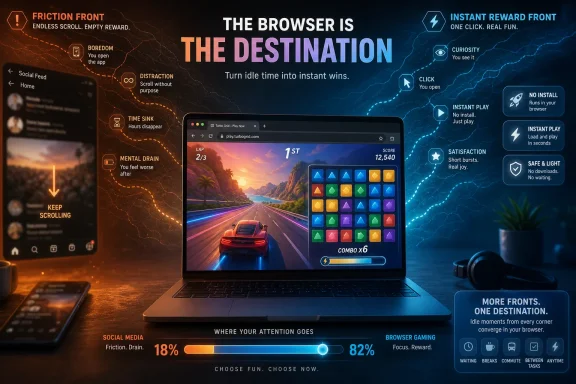
Poki published a web-gaming study on June 29, 2026, based on Atomik Research surveys of 2,000 weekly web-game players and 400 game developers in the United States and United Kingdom, arguing that browser games are taking attention from social media. The interesting part is not that a games platform has produced a bullish report about games. It is that the report lands at a moment when the browser, long treated as the least glamorous gaming surface, is starting to look like a distribution weapon again. The web game is no longer merely the thing you play while waiting for something else to load; it is becoming one more front in the war for idle time.
For two decades, gaming’s center of gravity moved away from the open web. Consoles matured into living-room ecosystems, Steam turned PC gaming into a durable marketplace, smartphones made app stores the dominant casual funnel, and social platforms turned short-form video into the default reflex for boredom. Browser games survived, but often as nostalgia: Flash portals, school-lab distractions, lightweight puzzle loops, and the odd viral oddity that escaped into wider culture.
Poki’s study is an attempt to reframe that old mental model. The company says it reaches 100 million monthly active users, and its commissioned survey suggests those users are not simply passing through by accident. Among surveyed consumers, 71 percent said their web-gaming time relative to social media was stable or increasing, while 28 percent said it was increasing relative to social media use.
That distinction matters. The claim is not that web games have dethroned TikTok, Instagram, YouTube Shorts, or messaging apps. It is subtler and more credible: browser games are competing for the same little pockets of attention that social platforms learned to monetize ruthlessly.
The browser’s advantage is almost embarrassingly simple. No install, no store approval dialogue, no platform dashboard, no update wait, no account ceremony unless the developer insists on one. In an entertainment market optimized for habit, the fastest product to reach can win the next ten minutes.
Web games attack that assumption from a different angle. Social feeds promise novelty, but they often deliver passivity: scroll, react, skim, scroll again. Games, even simple ones, promise agency. The player is not merely consuming the next unit of content; they are doing something, however small.
That agency is one reason browser games can punch above their cultural weight. A two-minute physics game, a racing loop, a dress-up title, a tower defense session, or a puzzle challenge offers a defined action and a measurable result. Social media’s reward cycle is endless by design, but it can also feel shapeless. A game gives the user a tiny contract: start here, attempt this, improve that.
The irony is that modern web gaming does not always replace other media. Poki’s survey found that 90 percent of respondents listen to music, chat with friends, watch streams, use social media, or do something else while playing. That sounds like distraction until you notice the follow-up: 44 percent said the web game had their primary attention while multitasking.
That is the real challenge to social platforms. Web games do not need users to shut everything else off. They only need to become the thing in the foreground while everything else becomes background noise.
HTML5 changed that slowly, then all at once. It made web games less dependent on a single proprietary runtime and better suited to phones, tablets, laptops, Chromebooks, and locked-down machines where installing software is inconvenient or impossible. It also arrived into a world where users already expected rich applications to live inside tabs.
Poki’s study leans hard into that generational shift. According to the report, 92 percent of surveyed web gamers described HTML5 games as high quality. That figure should be read with some caution, because the sample consists of people who already play web games at least weekly. Still, it reveals something important: the audience that actually uses these products is not judging them by 2008 standards.
The technical story matters for Windows users in particular. A modern Windows PC is still the best general-purpose gaming machine, but it is also increasingly a managed endpoint, a school device, a work laptop, or a family machine where installing yet another launcher is not frictionless. Browser games sit neatly in that gap. They do not need to be better than native games to be useful; they need to be available at the exact moment the user wants them.
That availability is especially powerful on machines that are not gaming rigs. A cheap laptop with Microsoft Edge or Chrome can play a surprising amount of web content. For a student, office worker, or casual player, that may be enough to turn a few spare minutes into a session.
Hardware ownership tells the same story. The report says 71 percent of web gamers in the sample own premium gaming hardware, including 42 percent who own a PlayStation 4 or PlayStation 5, 27 percent who own an Xbox model, and 27 percent who own a Switch or Switch 2. These are not mutually exclusive categories, but the point is still clear: browser gaming is not necessarily a substitute for console or PC gaming. It is an additional layer.
That should make the industry wary of the word casual. Casual describes session length, interface complexity, or commitment level; it does not necessarily describe spending power, taste, or identity. A person can raid in an MMO, own a current-generation console, buy indie games on Steam, and still play a browser game during lunch.
This is where the web has a structural advantage. It does not ask the player to declare a platform allegiance. It can coexist with everything. The same player who spends Saturday night in a graphically demanding PC game may still prefer a browser game on Wednesday afternoon because the context is different.
Poki’s report says 56 percent of surveyed players favor web games because they are easy to access, while 58 percent choose them because they are free. That combination is potent. Free-to-play has been controversial for years because of monetization design, but free access paired with instant launch remains one of the strongest discovery mechanics in entertainment.
Making a game is hard; getting anyone to notice it may be harder. App stores are crowded, Steam is crowded, console storefronts are crowded, and paid user acquisition can punish everyone except the most data-driven or well-funded publishers. The industry has become very good at shipping content into marketplaces where visibility is scarce.
Browser play offers a different kind of funnel. It lets a game be sampled with almost no ceremony. The user does not need to search an app store, decide whether to install, approve permissions, wait for a download, and remember to come back later. They can try the thing now.
Poki’s survey says 62 percent of players had downloaded or bought a game after first playing it on the web, rising to 72 percent among the most frequent players. If that behavior holds beyond Poki’s own ecosystem and survey sample, it suggests web gaming can serve as a playable advertisement without feeling like an advertisement. The demo is not a trailer; it is the product in miniature.
This is not a new idea. Shareware, Flash portals, browser demos, web-based prototypes, and game jams all used similar logic. What has changed is the surrounding market. With user attention fragmented and app discovery increasingly expensive, the humble browser build starts to look less like an afterthought and more like a strategic front door.
But biased incentives do not automatically invalidate useful data. The proper reading is not “Poki proved web gaming is replacing social media.” It is “Poki has added evidence that web gaming is competing more seriously for the same attention windows social media once seemed to own.”
The survey design also matters. The consumer sample included people who already play web games at least weekly, so the findings should not be generalized to the entire population. A weekly web-game player is already more likely to value instant access, tolerate browser-based monetization, and see web games as part of their routine. The study tells us about the engaged web-gaming audience, not everyone with a phone or PC.
Still, that audience is commercially meaningful. A 100-million-monthly-user platform does not need to prove that everyone plays browser games. It needs to prove that enough people play them often enough, with enough attention and enough downstream spending, to justify developer investment. On that narrower question, the numbers are much harder to dismiss.
The more interesting uncertainty is causality. Are people playing more web games because they are tired of social media, or are web games simply one of many options filling the same fragmented downtime? The report points toward substitution, especially among daily players, but the broader media environment is messy. A user may play, scroll, stream, chat, and shop within the same half-hour.
For web gaming, that may be enough. A browser game does not need the cinematic immersion of a AAA single-player release or the total focus of competitive esports. It can succeed as the main interaction layer in a multitasking session. Music can run in the background, friends can stay in chat, a stream can play on another screen, and the game can still be where the hands and eyes return.
This is where social media’s own design habits may work against it. Feeds are optimized for rapid switching, but rapid switching can make any single item feel disposable. Games offer persistence, even in tiny increments. A score, a level, a run, a customization choice, a puzzle state — these are small anchors in an otherwise fluid media session.
For advertisers and platform operators, primary attention is the premium commodity. If a user is listening to music while playing, the music may be important, but the game may still own the decision-making loop. That has implications for ad formats, sponsorship, cross-promotion, and brand integrations.
For developers, it suggests design constraints. Browser games that respect interruption, resume quickly, and provide short loops may fit the actual behavior of their audience better than games that pretend every player is sitting down for an uninterrupted hour. The winning format is not necessarily the deepest one. It is the one that matches the user’s available attention.
Microsoft has spent years trying to make Windows more attractive to developers and players through Game Pass, the Microsoft Store, DirectX, cloud gaming, and closer Xbox integration. But the open browser continues to be one of the most important gaming surfaces on Windows because it is not wholly controlled by any single storefront. Edge, Chrome, Firefox, and other browsers all turn the PC into an instant-access game terminal.
That creates opportunities and headaches. For users, it means more playable content without installs. For parents and schools, it means more content that can bypass traditional software controls unless filtering is configured properly. For IT departments, it means “gaming” is not always an executable with an obvious name; it may simply be a tab using network, CPU, GPU, and attention.
The rise of browser games also intersects with hardware acceleration. Modern browsers can use GPUs, support richer graphics APIs, and run complex JavaScript and WebAssembly workloads. That is good for developers, but it also means browser gaming is not always negligible from a performance or battery perspective. A tab can be entertainment, but it can also be a resource consumer.
For Windows enthusiasts, the broader point is cultural. The browser is no longer just a document viewer or app container. It is a gaming runtime, a media player, a productivity shell, and a social surface. When web games gain traction, they reinforce the browser’s role as the operating system inside the operating system.
The web solves some of that by collapsing discovery and trial into the same moment. A link can be a storefront, a demo, a tutorial, and the first session. That is a very old property of the web, but it looks newly valuable in a market where every closed ecosystem has added friction in exchange for control.
This is why the study’s developer findings matter. If web publishing becomes a credible discovery layer, it could change how studios think about launch strategy. A browser version may not replace a mobile app, Steam release, or console SKU. It may become the top of the funnel: the place where a game proves itself before asking for money, storage, or commitment.
There are limits. Not every game translates well to a browser. Monetization can be tricky. Performance varies by device. Browser policies, ad blockers, privacy controls, and platform rules can all affect business models. And web portals themselves can become gatekeepers if they concentrate enough traffic.
But compared with the cost of invisibility, those problems may be acceptable. The industry does not need web gaming to solve every distribution challenge. It needs it to offer another path into players’ routines.
Games can exploit that fatigue without moralizing about it. They offer a different bargain. Instead of endless novelty, they offer repeatable challenge. Instead of passive consumption, they offer interaction. Instead of identity performance, they offer play.
That does not make web games automatically healthier. Free-to-play design can be manipulative, ads can be intrusive, and low-friction access can create its own compulsions. A browser game can waste time as efficiently as any social feed. The difference is that the user may feel more active while doing it.
That feeling matters. Entertainment markets are not governed only by minutes; they are governed by emotional residue. If a user leaves a game feeling amused, competent, or relaxed, that session may be easier to repeat than a doomscroll that ends in irritation. Web gaming’s opportunity is not merely to capture attention, but to make captured attention feel less empty.
 The Browser Is Back Because Friction Became the Enemy
For two decades, gaming’s center of gravity moved away from the open web. Consoles matured into living-room ecosystems, Steam turned PC gaming into a durable marketplace, smartphones made app stores the dominant casual funnel, and social platforms turned short-form video into the default reflex for boredom. Browser games survived, but often as nostalgia: Flash portals, school-lab distractions, lightweight puzzle loops, and the odd viral oddity that escaped into wider culture.Poki’s study is an attempt to reframe that old mental model. The company says it reaches 100 million monthly active users, and its commissioned survey suggests those users are not simply passing through by accident. Among surveyed consumers, 71 percent said their web-gaming time relative to social media was stable or increasing, while 28 percent said it was increasing relative to social media use.
That distinction matters. The claim is not that web games have dethroned TikTok, Instagram, YouTube Shorts, or messaging apps. It is subtler and more credible: browser games are competing for the same little pockets of attention that social platforms learned to monetize ruthlessly.
The browser’s advantage is almost embarrassingly simple. No install, no store approval dialogue, no platform dashboard, no update wait, no account ceremony unless the developer insists on one. In an entertainment market optimized for habit, the fastest product to reach can win the next ten minutes.
Social Media’s Weakness Is the Space Between Intent and Reward
The study’s most provocative number is that 28 percent of web gamers said their gaming time was increasing specifically at the expense of social media, rising to 34 percent among daily players. That is not a mass migration; it is an attention leak. But attention leaks matter because social media businesses are built on the assumption that every bored glance can be captured, extended, and sold.Web games attack that assumption from a different angle. Social feeds promise novelty, but they often deliver passivity: scroll, react, skim, scroll again. Games, even simple ones, promise agency. The player is not merely consuming the next unit of content; they are doing something, however small.
That agency is one reason browser games can punch above their cultural weight. A two-minute physics game, a racing loop, a dress-up title, a tower defense session, or a puzzle challenge offers a defined action and a measurable result. Social media’s reward cycle is endless by design, but it can also feel shapeless. A game gives the user a tiny contract: start here, attempt this, improve that.
The irony is that modern web gaming does not always replace other media. Poki’s survey found that 90 percent of respondents listen to music, chat with friends, watch streams, use social media, or do something else while playing. That sounds like distraction until you notice the follow-up: 44 percent said the web game had their primary attention while multitasking.
That is the real challenge to social platforms. Web games do not need users to shut everything else off. They only need to become the thing in the foreground while everything else becomes background noise.
HTML5 Quietly Did What Flash Could Not Survive to Do
The phrase browser game still carries Flash-era baggage. For many older users, it conjures crude animations, security warnings, school filters, and sites designed with more banner ads than taste. Flash’s death left a cultural hangover, and for years the browser seemed less like a serious gaming platform than an archive of what had been lost.HTML5 changed that slowly, then all at once. It made web games less dependent on a single proprietary runtime and better suited to phones, tablets, laptops, Chromebooks, and locked-down machines where installing software is inconvenient or impossible. It also arrived into a world where users already expected rich applications to live inside tabs.
Poki’s study leans hard into that generational shift. According to the report, 92 percent of surveyed web gamers described HTML5 games as high quality. That figure should be read with some caution, because the sample consists of people who already play web games at least weekly. Still, it reveals something important: the audience that actually uses these products is not judging them by 2008 standards.
The technical story matters for Windows users in particular. A modern Windows PC is still the best general-purpose gaming machine, but it is also increasingly a managed endpoint, a school device, a work laptop, or a family machine where installing yet another launcher is not frictionless. Browser games sit neatly in that gap. They do not need to be better than native games to be useful; they need to be available at the exact moment the user wants them.
That availability is especially powerful on machines that are not gaming rigs. A cheap laptop with Microsoft Edge or Chrome can play a surprising amount of web content. For a student, office worker, or casual player, that may be enough to turn a few spare minutes into a session.
The Casual Audience Is Not as Casual as the Label Suggests
The most useful part of Poki’s study is the audience profile, because it complicates the lazy idea that web gamers are somehow separate from “real” gamers. The survey found that 37 percent of respondents play web games multiple times a day. It also found that 27 percent spend more than $50 per month across the gaming ecosystem, rising to 35 percent among the most frequent players.Hardware ownership tells the same story. The report says 71 percent of web gamers in the sample own premium gaming hardware, including 42 percent who own a PlayStation 4 or PlayStation 5, 27 percent who own an Xbox model, and 27 percent who own a Switch or Switch 2. These are not mutually exclusive categories, but the point is still clear: browser gaming is not necessarily a substitute for console or PC gaming. It is an additional layer.
That should make the industry wary of the word casual. Casual describes session length, interface complexity, or commitment level; it does not necessarily describe spending power, taste, or identity. A person can raid in an MMO, own a current-generation console, buy indie games on Steam, and still play a browser game during lunch.
This is where the web has a structural advantage. It does not ask the player to declare a platform allegiance. It can coexist with everything. The same player who spends Saturday night in a graphically demanding PC game may still prefer a browser game on Wednesday afternoon because the context is different.
Poki’s report says 56 percent of surveyed players favor web games because they are easy to access, while 58 percent choose them because they are free. That combination is potent. Free-to-play has been controversial for years because of monetization design, but free access paired with instant launch remains one of the strongest discovery mechanics in entertainment.
Discovery Has Become the Games Industry’s Most Expensive Problem
The developer side of the study may be more consequential than the consumer side. Poki says 46 percent of surveyed developers identified discovery as a core benefit of publishing to web platforms, while 53 percent said web gaming offered a way to reach new users. Those numbers speak directly to the anxiety hanging over the modern games business.Making a game is hard; getting anyone to notice it may be harder. App stores are crowded, Steam is crowded, console storefronts are crowded, and paid user acquisition can punish everyone except the most data-driven or well-funded publishers. The industry has become very good at shipping content into marketplaces where visibility is scarce.
Browser play offers a different kind of funnel. It lets a game be sampled with almost no ceremony. The user does not need to search an app store, decide whether to install, approve permissions, wait for a download, and remember to come back later. They can try the thing now.
Poki’s survey says 62 percent of players had downloaded or bought a game after first playing it on the web, rising to 72 percent among the most frequent players. If that behavior holds beyond Poki’s own ecosystem and survey sample, it suggests web gaming can serve as a playable advertisement without feeling like an advertisement. The demo is not a trailer; it is the product in miniature.
This is not a new idea. Shareware, Flash portals, browser demos, web-based prototypes, and game jams all used similar logic. What has changed is the surrounding market. With user attention fragmented and app discovery increasingly expensive, the humble browser build starts to look less like an afterthought and more like a strategic front door.
Poki Is Selling a Market, but the Market Still Looks Real
Every commissioned study deserves skepticism, especially when its conclusions support the commissioner’s business model. Poki benefits if developers believe the web is underappreciated, if advertisers believe browser players are engaged, and if the wider industry sees web platforms as discovery engines rather than leftovers. The report is not neutral terrain.But biased incentives do not automatically invalidate useful data. The proper reading is not “Poki proved web gaming is replacing social media.” It is “Poki has added evidence that web gaming is competing more seriously for the same attention windows social media once seemed to own.”
The survey design also matters. The consumer sample included people who already play web games at least weekly, so the findings should not be generalized to the entire population. A weekly web-game player is already more likely to value instant access, tolerate browser-based monetization, and see web games as part of their routine. The study tells us about the engaged web-gaming audience, not everyone with a phone or PC.
Still, that audience is commercially meaningful. A 100-million-monthly-user platform does not need to prove that everyone plays browser games. It needs to prove that enough people play them often enough, with enough attention and enough downstream spending, to justify developer investment. On that narrower question, the numbers are much harder to dismiss.
The more interesting uncertainty is causality. Are people playing more web games because they are tired of social media, or are web games simply one of many options filling the same fragmented downtime? The report points toward substitution, especially among daily players, but the broader media environment is messy. A user may play, scroll, stream, chat, and shop within the same half-hour.
Multitasking Does Not Mean the Game Is Losing
The multitasking figure is easy to misread. If 90 percent of respondents are doing something else while playing web games, it might seem that browser games are merely background content. But that interpretation assumes attention works like a single spotlight. In reality, modern media consumption is more like a messy desk: several things are open, but one thing is being handled.For web gaming, that may be enough. A browser game does not need the cinematic immersion of a AAA single-player release or the total focus of competitive esports. It can succeed as the main interaction layer in a multitasking session. Music can run in the background, friends can stay in chat, a stream can play on another screen, and the game can still be where the hands and eyes return.
This is where social media’s own design habits may work against it. Feeds are optimized for rapid switching, but rapid switching can make any single item feel disposable. Games offer persistence, even in tiny increments. A score, a level, a run, a customization choice, a puzzle state — these are small anchors in an otherwise fluid media session.
For advertisers and platform operators, primary attention is the premium commodity. If a user is listening to music while playing, the music may be important, but the game may still own the decision-making loop. That has implications for ad formats, sponsorship, cross-promotion, and brand integrations.
For developers, it suggests design constraints. Browser games that respect interruption, resume quickly, and provide short loops may fit the actual behavior of their audience better than games that pretend every player is sitting down for an uninterrupted hour. The winning format is not necessarily the deepest one. It is the one that matches the user’s available attention.
Windows Remains the Quiet Beneficiary of the Browser Game Revival
This story is not Windows-specific, but Windows users should care about it. The PC remains the most flexible gaming device precisely because it supports both extremes: high-end native games on powerful hardware and instant lightweight experiences in a browser. Web gaming strengthens the second half of that identity.Microsoft has spent years trying to make Windows more attractive to developers and players through Game Pass, the Microsoft Store, DirectX, cloud gaming, and closer Xbox integration. But the open browser continues to be one of the most important gaming surfaces on Windows because it is not wholly controlled by any single storefront. Edge, Chrome, Firefox, and other browsers all turn the PC into an instant-access game terminal.
That creates opportunities and headaches. For users, it means more playable content without installs. For parents and schools, it means more content that can bypass traditional software controls unless filtering is configured properly. For IT departments, it means “gaming” is not always an executable with an obvious name; it may simply be a tab using network, CPU, GPU, and attention.
The rise of browser games also intersects with hardware acceleration. Modern browsers can use GPUs, support richer graphics APIs, and run complex JavaScript and WebAssembly workloads. That is good for developers, but it also means browser gaming is not always negligible from a performance or battery perspective. A tab can be entertainment, but it can also be a resource consumer.
For Windows enthusiasts, the broader point is cultural. The browser is no longer just a document viewer or app container. It is a gaming runtime, a media player, a productivity shell, and a social surface. When web games gain traction, they reinforce the browser’s role as the operating system inside the operating system.
The App Store Era Made the Web Look Useful Again
The strongest argument for web gaming is not nostalgia; it is distribution fatigue. Users are tired of installs for things they may use once. Developers are tired of paying to acquire users who churn. Platforms are crowded with products that have to be marketed before they can even be tried.The web solves some of that by collapsing discovery and trial into the same moment. A link can be a storefront, a demo, a tutorial, and the first session. That is a very old property of the web, but it looks newly valuable in a market where every closed ecosystem has added friction in exchange for control.
This is why the study’s developer findings matter. If web publishing becomes a credible discovery layer, it could change how studios think about launch strategy. A browser version may not replace a mobile app, Steam release, or console SKU. It may become the top of the funnel: the place where a game proves itself before asking for money, storage, or commitment.
There are limits. Not every game translates well to a browser. Monetization can be tricky. Performance varies by device. Browser policies, ad blockers, privacy controls, and platform rules can all affect business models. And web portals themselves can become gatekeepers if they concentrate enough traffic.
But compared with the cost of invisibility, those problems may be acceptable. The industry does not need web gaming to solve every distribution challenge. It needs it to offer another path into players’ routines.
The Social Feed Is No Longer the Default Escape Hatch
Poki’s framing of web gaming as a competitor to social media is clever because it taps into a wider mood. Many users still spend enormous time on social platforms, but the experience has become heavier: more ads, more algorithmic repetition, more creator economy churn, more outrage bait, more short video optimized for compulsion rather than satisfaction. The feed remains powerful, but it is not always pleasurable.Games can exploit that fatigue without moralizing about it. They offer a different bargain. Instead of endless novelty, they offer repeatable challenge. Instead of passive consumption, they offer interaction. Instead of identity performance, they offer play.
That does not make web games automatically healthier. Free-to-play design can be manipulative, ads can be intrusive, and low-friction access can create its own compulsions. A browser game can waste time as efficiently as any social feed. The difference is that the user may feel more active while doing it.
That feeling matters. Entertainment markets are not governed only by minutes; they are governed by emotional residue. If a user leaves a game feeling amused, competent, or relaxed, that session may be easier to repeat than a doomscroll that ends in irritation. Web gaming’s opportunity is not merely to capture attention, but to make captured attention feel less empty.
The Numbers That Should Survive the Hype Cycle
The most concrete lesson from Poki’s study is that web gaming should be treated as part of the mainstream games ecosystem, not as a side alley. The report is self-interested, but the behavior it describes fits what users and developers are already signaling across the market: instant access, cross-platform reach, and playable discovery are increasingly valuable.- Poki’s study was published on June 29, 2026, and was based on surveys of 2,000 weekly web-game players and 400 developers in the US and UK.
- The surveyed audience reported that web gaming is holding or gaining time relative to social media, with daily players especially likely to say it is taking time away from social platforms.
- The report portrays browser players as broader games consumers, with many respondents owning consoles or premium gaming hardware and spending money across the wider gaming ecosystem.
- Developers in the survey pointed to discovery and new-user reach as major reasons to publish on web platforms.
- The strongest practical case for web gaming is not that it replaces native games, but that it reduces friction at the exact moment a player is deciding what to try.
References
- Primary source: IT Brief UK
Published: 2026-06-29T22:50:39.808041
Loading…
itbrief.co.uk