

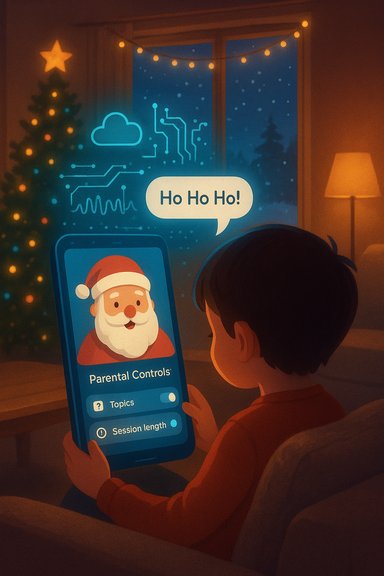
Portable North Pole this week rolled out a major upgrade to its seasonal app: a live, AI‑driven “Talk to Santa” experience that the company says uses Microsoft Azure Cognitive Services Speech to deliver real‑time, two‑way voice conversations between children and a Santa persona.
Background / Overview
Portable North Pole (PNP), a UGroupMedia property known for personalized Santa videos and scheduled calls, has expanded its holiday catalog for the 2025 season to include a live conversational product called Talk to Santa. The feature is advertised across the PNP app listings and press distributions as a real‑time interactive voice session in which a child speaks, the system transcribes and interprets the utterance, and Santa replies with a warm, persona‑consistent response. App store descriptions list Talk to Santa alongside video calls and bedtime stories as part of PNP’s seasonal offering. PNP’s public materials tout the integration of cloud speech technology, with an EIN Presswire distribution explicitly stating the service is “built on Microsoft Azure Cognitive Services Speech technology.” That PR describes features including real‑time personalization (recognizing a child’s name and wishes), age‑appropriate responses, and options for one‑on‑one or group conversations. The same announcement repeats PNP’s historic usage claims — tens of millions of app downloads and hundreds of millions of personalized messages delivered — metrics presented as company figures. At the same time, multiple syndicated copies of PNP’s launch appear in presswire feeds and trade outlets. Independent hands‑on writeups and consumer coverage have also tested and described the live experience, while at least one consumer review noted the feature’s monetization model and real‑time behavior. These independent writeups corroborate that Talk to Santa is live to consumers through app distribution channels.What Talk to Santa says it does
- Live two‑way voice sessions — a child speaks in the app and receives an instant, synthesized reply in a Santa voice persona.
- Personalization — conversations reportedly reference supplied parental data (name, age, topics) so Santa can make remarks that feel personal.
- Safety and parental controls — parents are presented as the gatekeepers: they configure topics, choose session length, and control what personal details are shared.
- Supporting content — the 2025 rollout also includes narrated Santa stories, “Write Your Own Topic” calls, and Magic Gift Tag QR features that link physical gifts to personalized Santa moments.
Verification: what is confirmed and what remains open
Confirmed- Portable North Pole has publicly launched a live “Talk to Santa” product and is promoting it through app stores and syndicated press channels. Independent app listings and media writeups show the feature exists and is available to consumers.
- The company’s distributed press release explicitly states the feature is integrated with Microsoft Azure Cognitive Services Speech; that phrasing appears in multiple PR syndications.
- There is no public, named confirmation from Microsoft (for example, a Microsoft blog post, Azure case study, or corporate announcement) that independently verifies a formal partnership, the exact Azure services used, or contractual details such as sub‑processor lists and data residency. Independent audits or vendor confirmations have not been located in the public record at the time of writing. Readers who need procurement or compliance certainty should request written confirmation directly from PNP or Microsoft.
Technical anatomy: how a safe, real‑time “Talk to Santa” is typically constructed
Core components (industry pattern)
- Automatic Speech Recognition (ASR) — low‑latency speech‑to‑text optimized for noisy home environments and children’s voices.
- Dialogue manager / conversational engine — persona tuning (Santa tone), prompt templates to bound content, and retrieval‑augmented generation (RAG) or curated response libraries to avoid hallucinations.
- Text‑to‑Speech (TTS) — neural TTS produce a consistent Santa voice; some platforms support custom neural voice models to maintain brand timbre.
- Safety filters & moderation stack — classifiers to detect inappropriate input or risky topics, plus heuristics to block or divert disallowed content.
- Session & parental controls — server‑side session tracking, duration limits, topic whitelists, and parental opt‑ins.
- Scalable hosting / hybrid options — cloud back end to handle holiday peaks, with containerized/offline options where regulatory requirements demand local processing.
How Azure would fit (if the claim is accurate)
Microsoft Azure Cognitive Services Speech provides all the technical plumbing required by such a product: real‑time ASR, neural TTS (including custom voice features), containerized speech runtimes for local processing, and enterprise SLAs for scale. These capabilities make Azure a plausible infrastructure choice for a multilingual, high‑traffic seasonal activation — but plausibility is not the same as confirmation. The presence of those services means a vendor could implement the Talk to Santa stack on Azure; it does not prove PNP has done so without explicit vendor disclosure.Privacy, safety and regulatory considerations
A live voice product aimed at children triggers immediate and specific privacy and safety obligations. The following areas deserve scrutiny before families or institutions permit use.Legal & regulatory axes
- COPPA (U.S. — services directed at children under 13 require verifiable parental notice and consent, minimize data collection, and provide deletion/access rights. Any recording or transcript retention should be clearly declared.
- GDPR (EU) — processing minors’ data can require parental consent and careful lawful‑basis selection; member states have differing thresholds that complicate pan‑European services.
- Data residency & sub‑processors — whether audio is streamed to specific cloud regions (and whether transcripts are stored or used to train models) affects contractual obligations and cross‑border transfer rules.
Safety engineering: what to look for
- Age gating and verifiable parental consent before any recording or personalization.
- Minimized retention — ephemeral processing with short or zero retention of raw audio and transcripts unless explicitly required and consented to.
- Human‑in‑the‑loop escalation — rapid review workflows for flagged edge cases to prevent harmful outputs.
- Clear labeling that the persona is AI‑generated (an “explainable Santa” toggle helps younger kids understand the experience).
- Opt‑out for model training — allow parents to prevent their children’s interactions from being used to improve the service.
Strengths: where PNP’s launch gets the basics right
- Parent‑first product framing. PNP emphasizes parental configuration and explicit choices about personalization and topics. This is a pragmatic and necessary UX for family adoption.
- Scoped interactions reduce risk. By framing sessions as short, scripted‑but‑adaptive replies rather than open‑ended information channels, PNP minimizes exposure to unconstrained model outputs and simplifies moderation.
- Established brand and distribution. With a long history of personalized seasonal content and large install base, PNP can seed adoption, social sharing, and viral moments more easily than a new entrant. App listings and press reports confirm broad availability on iOS, Android and web.
- Monetization with a low barrier to trial. The free trial + credit/pass model reduces the friction for parents to test the feature while enabling revenue capture from repeat interactions. This is a proven seasonal funnel.
Risks and open‑questions
- Vendor & sub‑processor transparency. Although PR copies claim Azure is used, no independent Microsoft confirmation or technical whitepaper has been publicly posted at the time of writing. That absence matters for those who must verify data residency, deletion, or DPA clauses. Request named confirmation and contractual DPA language if vendor identity matters.
- Data retention and training use. PNP has not published granular retention windows or explicit opt‑outs for training; these points are essential for compliance with COPPA and GDPR and for parental trust.
- Model hallucinations. Even heavily constrained personas can produce unexpected answers. For children, misleading statements may carry more weight; conservative engineering (RAG, answer templates, conservative fallback responses) is necessary to reduce this risk.
- Monetization & access equity. Locking more immersive sessions behind paid credits or passes can turn a “magical” childhood moment into a paywalled experience, raising equity concerns. PNP’s freemium approach mitigates immediate barriers, but premium gating remains a consideration for public or institutional deployments.
- Operational scale & latency during peaks. Holiday spikes create extreme load profiles; if the back end is not stress‑tested under realistic peak loads, latency or degraded quality could harm the experience. Scalable cloud architecture and load testing are necessary.
Practical checklist — what parents and institutions should do before use
For parents- Read the app’s privacy policy and the parental‑control settings before activating Talk to Santa.
- Confirm whether audio or transcripts are retained, and for how long.
- Prefer supervised, short trial sessions and treat the experience as entertainment rather than an information source.
- Ask PNP support whether interactions are used to improve internal models and whether there’s an opt‑out.
- Require a Data Processing Agreement (DPA) listing sub‑processors and data residency.
- Insist on deletion guarantees and audit rights for any retained user artifacts.
- Verify COPPA/GDPR compliance in writing before deployment.
- Prefer deployments with regional processing or containerized options if cross‑border transfers are a blocker.
- Verify vendor claims before repeating platform attributions — request a named confirmation from PNP and/or Microsoft.
- Ask for a technical transparency summary that lists ASR/TTS engines, model filtering layers, and retention windows.
- When possible, examine app manifests or network telemetry for evidence of third‑party SDK endpoints.
Business logic and market context
Seasonal persona activations are effective short‑term engagement drivers. They generate social sharing, boost daily active users during critical windows, and serve as testbeds for persona design, moderation pipelines, and monetization experiments. For platform owners, the payoff is immediate engagement uplift and long‑term learning about how families respond to expressive AI personas.PNP’s move from scripted video messages to live, AI‑driven voice conversations is a natural evolution aligned with broader industry efforts to make AI interactions feel more human and emotionally expressive. However, transforming seasonal virality into durable trust and long‑term product use requires transparent operations and rigorous safety audits. The economic model — free trial to credit/pass conversion — is well understood and likely to yield short‑term revenue; the longer‑term challenge is maintaining parental trust post‑transaction.
A nuanced verdict
Portable North Pole’s Talk to Santa represents a sensible, low‑risk extension of a beloved seasonal brand into conversational AI. The product’s conservative design — parental controls, bounded interactions, persona tuning, and an entertainment‑first framing — is the pragmatic path for family audiences.But two gaps temper the enthusiasm:
- First, vendor transparency: the specific claim that the system “leverages Microsoft Azure” appears in the company’s press distribution and syndicated PR, yet no independent Microsoft confirmation or detailed Azure architecture has been published. Until PNP or Microsoft issues an explicit, named confirmation and supporting technical documentation, treat the Azure claim as a vendor assertion that requires verification for compliance‑sensitive use.
- Second, operational transparency: PNP should publish retention windows for raw audio and transcripts, state whether interactions are used to train or improve models (and offer opt‑outs), and disclose the architecture of safety filters and human‑review thresholds. Publishing these details would materially increase parental trust and remove ambiguity about vendor risk.
Final recommendations for readers
- Try the free trial in a supervised setting first and keep early sessions short.
- Ask PNP for a copy of the DPA or a technical summary if you require confirmation about cloud vendors, retention, and opt‑out for model training.
- Treat presswire assertions about third‑party vendors (including Azure) as company statements until an independent vendor confirmation is published.
- For institutions with regulatory exposure (schools, hospitals), require contractual guarantees on data residency, deletion, and audit rights before deployment.
Source: ABC27 https://www.abc27.com/business/pres...-santa-experience-leveraging-microsoft-azure/
