

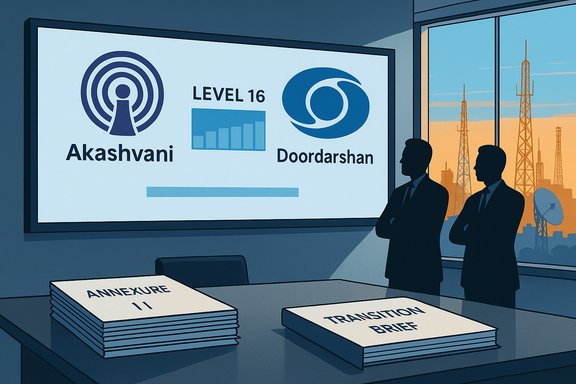
Prasar Bharati has officially invited advance applications for the posts of Director General (Akashvani) and Director General (Doordarshan) for the 2026 vacancy year, a recruitment move that spotlights India’s public broadcasting overhaul and raises fresh questions about governance, workforce strategy and editorial leadership at the national broadcaster.
Prasar Bharati’s announcement—circulated as a vacancy circular—seeks senior candidates through promotion, deputation or short-term contractual arrangements for two Level‑16 posts on the 7th CPC pay matrix. The media reporting on the circular places the minimum and maximum basic pay for these posts at ₹2,05,400–₹2,24,400 (Level‑16) and notes an application advance-deadline of 5:00 PM on December 15, 2025. This recruitment occurs against a wider set of administrative pressures: the organisation has been reported to be carrying large-scale vacancies and undergoing HR transformation recommendations from consultancy work, which includes a plan to fill a tranche of posts through 2026 while proposing structural streamlining across the workforce. Media coverage has highlighted an audit of sanctioned vs. filled posts and recommendations produced by external advisers.
For prospective applicants and sponsoring authorities: verify the circular text on Prasar Bharati’s recruitment channel, assemble the required documentation well in advance of the reported deadline, and ensure that deputation/contract terms are explicitly negotiated to permit strategic decision‑making once appointed.
Source: Storyboard18 Prasar Bharati opens applications for Director General posts at Akashvani, Doordarshan for 2026
 Background
Prasar Bharati’s announcement—circulated as a vacancy circular—seeks senior candidates through promotion, deputation or short-term contractual arrangements for two Level‑16 posts on the 7th CPC pay matrix. The media reporting on the circular places the minimum and maximum basic pay for these posts at ₹2,05,400–₹2,24,400 (Level‑16) and notes an application advance-deadline of 5:00 PM on December 15, 2025. This recruitment occurs against a wider set of administrative pressures: the organisation has been reported to be carrying large-scale vacancies and undergoing HR transformation recommendations from consultancy work, which includes a plan to fill a tranche of posts through 2026 while proposing structural streamlining across the workforce. Media coverage has highlighted an audit of sanctioned vs. filled posts and recommendations produced by external advisers. Who can apply (headline eligibility)
- Group A officers, including All India Services and Central Services, who hold an analogous post on a regular basis or who have served at least one year in Level‑15 or four years in Level‑14 on the 7th CPC pay matrix.
- Officers from autonomous bodies, statutory organisations, PSUs, universities, and recognised research institutions with equivalent seniority and service patterns.
- Media reports noted an age ceiling in earlier recruitment rounds (cited in coverage) and recommend checking the circular for exact age/experience cut‑offs and other conditions.
Why this vacancy matters
Strategic leadership for India’s public broadcaster
The DG roles for Akashvani (All India Radio) and Doordarshan are apex operational and editorial leadership positions within Prasar Bharati. They command broad responsibility across content strategy, platform transformation (including broadcast-to-digital convergence), statutory compliance, and coordination with the Ministry of Information & Broadcasting. Filling these posts with experienced administrators or media leaders is central to stabilising day‑to‑day operations and executing longer‑term digital migration plans.A human‑resource pinch point
Prasar Bharati has been reported to have severe staffing shortfalls across technical, editorial and administrative cadres. Consultancy recommendations and parliamentary committee observations both emphasise the dual challenge of sustaining operations while re‑architecting the workforce towards a leaner, digitally adept model. The DG appointments are therefore not only leadership replacements but also potential levers for implementing HR reform and reshaping institutional priorities.Compensation and seniority: what Level‑16 means
The posts are placed at Level‑16 of the 7th CPC pay matrix, which media reports and pay‑matrix references confirm corresponds to a basic pay range with minimum ₹205,400 and maximum ₹224,400 (basic pay, before allowances). That salary band signals parity with other high‑level central government leadership posts and frames the DG roles as senior administrative appointments rather than mid‑career operational roles. Independent pay‑matrix tables corroborate this Level‑16 range.What the circular (as reported) says — key points
- The recruitment route includes promotion/deputation and short‑term contractual appointments.
- Applications are to be forwarded in a prescribed format, with required annexures (eligibility details in Annexure I; application format in Annexure II).
- The broadcaster has urged ministries, departments and state governments to circulate the notification widely among eligible officers.
- The advertised posts carry the Level‑16 pay band; earlier coverage reiterates that appointments will generally follow established recruitment rules for central public agencies and that incomplete or late applications will not be considered.
Timeline and practical application guidance
Deadlines and submission
- Reported application deadline: December 15, 2025, 5:00 PM for advance applications. This should be treated as the immediate operational deadline for eligible officers and sponsoring departments. Confirm the final deadline on the official circular before submitting.
Documents typically required (standard for senior deputation/promotion cases)
- Application in the prescribed Annexure form (Annexure II as cited in media coverage).
- Complete CR/APAR dossiers or performance appraisal records for the prescribed period.
- Vigilance clearance or a certificate of no disciplinary/criminal proceedings.
- Integrity certificate and list of prior penalties or a “No penalty” certificate where applicable.
- Attested copies of educational and service records.
- The submission route is usually through proper departmental channels to the specified Prasar Bharati officer (often the Deputy Director or equivalent in the Personnel/Recruitment cell). Confirm the postal and email submission instructions in the circular.
Who should sponsor and how
- Ministries and departments typically circulate the vacancy to eligible officers; state governments, PSU HR teams, and autonomous bodies with eligible candidates are asked to forward applications via the proper channel.
- Candidates from PSUs and autonomous bodies must ensure their eligibility is certified by their organisation and that deputation/contract terms (duration, remuneration, resettlement) are agreed upon prior to submission.
Cross‑checking the facts: independent verification
To ensure accuracy, the pay scale and Level‑16 classification referenced by press outlets was confirmed against independent 7th CPC pay‑matrix resources, which list Level‑16 basic pay as ₹205,400–₹224,400. That pay‑matrix confirmation is consistent across multiple independent pay tables and government‑pay references. Media reports covering the vacancy—while consistent about pay level and recruitment route—are not a substitute for the official circular text. Trade outlets such as Storyboard18 and Exchange4Media have published initial reports summarising the vacancy; these items serve as timely public notice but applicants must corroborate with the formal Prasar Bharati notification.Institutional context and administrative risks
The governance squeeze
Prasar Bharati’s HR audit and the wider recommendations to rationalise staff and roles create an operational tension: the public broadcaster must simultaneously reduce structural overheads (as advised by some consultants) and plug persistent capability gaps. Appointing DGs with the right mix of administrative authority, media expertise and digital transformation experience is therefore critical. The risk is that short‑term or interim appointments will fail to marshal the political and administrative capital needed to drive the reform agenda.Political and regulatory exposure
Public broadcasting in India sits at the intersection of editorial autonomy, statutory governance and ministerial oversight. DG appointments that are perceived as politically motivated or administratively mismanaged can exacerbate concerns about independence, hiring practice transparency and long‑term strategic planning. The DGs will need to manage both editorial credibility and compliance with statutory procurement, transmission and platform policies.Operational continuity vs transformation
A common shortcoming in large public broadcasters is leaning too heavily on interim hires while awaiting full structural reform. Interim tenures can preserve continuity but rarely supply the impetus for deep change. Given the scale of technology refresh, OTT rollout and staffing shortfalls reported in recent audits, the incoming DGs will need a clear mandate and the ability to commit to multi‑year projects, ideally supported by stable board and ministry backing.Strengths and opportunities
- Institutional profile: Akashvani and Doordarshan remain the largest public broadcast networks in the country; a focused DG can leverage that reach to modernise public service broadcasting and experiment with cross‑platform distribution.
- Budgetary focus and policy attention: High‑level government interest in digital modernization and the earmarking of funds for broadcast‑to‑digital initiatives give incumbents a policy window to accelerate modernization.
- Talent infusion: Deputation and contract routes enable Prasar Bharati to attract external leaders with private‑sector digital or platform experience, offering an opportunity to infuse product‑thinking and platform management capabilities into a traditionally broadcast‑centric culture.
Key risks and vulnerabilities
- Fragmented HR strategy: If talent gaps are patched through short‑term hires without a coherent long‑term HR plan, the broadcaster risks recurring operational instability and loss of institutional memory.
- Unclear authority during deputation: Deputation/contract terms can limit an incumbent’s ability to make tough strategic calls—especially in procurement, restructuring or long‑term vendor commitments—unless the appointment letter explicitly grants necessary authorities.
- Reputational exposures: Any perception of politicised appointments or opaque selection processes can erode public trust and the credibility of editorial outputs.
- Implementation risk for digital projects: Large platform and OTT projects require sustained funding, product and engineering teams; stop‑gap leadership risks starting initiatives that stall mid‑flight.
What a successful DG should deliver (practical scorecard)
- Reconstitute a clear transformation roadmap with specific milestones (transmission upgrades, OTT feature parity, metadata & archiving).
- Stabilise HR by combining immediate hires for mission‑critical technical roles with a medium‑term reskilling and redeployment plan.
- Improve editorial governance and transparency frameworks to protect impartiality and rebuild public trust.
- Deliver measurable operational KPIs within 12–18 months: uptime targets, OTT user engagement, monetisation corridors, and reduced reliance on contractual staffing for core functions.
- Strengthen procurement and vendor governance to avoid repeated rollouts and mid‑project vendor churn.
Practical recommendations for applicants and sponsoring departments
- Verify the circular on Prasar Bharati’s official portal and secure the prescribed Annexure forms before compiling the dossier. Media reports are useful for headlines but the circular contains the legal and administrative requirements.
- Prepare a clean dossier: APAR/CRs, vigilance clearance, integrity certificate and attested service records should be assembled well before the deadline.
- Clarify deputation/contract terms with the sponsoring organisation: confirm whether the deputation is with service retention, the terms of resignation/return, and compensation alignment.
- Frame a transition brief: candidates should prepare a concise 2–3 page transformation brief outlining first‑120‑days priorities and one‑year deliverables—this helps selection panels assess readiness for both continuity and change.
- Engage the sponsoring ministry early: ensure endorsement letters and administrative clearances are transmitted through the proper channels to avoid procedural rejection.
Media verification and transparency caveats
- Multiple trade and industry outlets have published summaries of the vacancy circular; these are consistent on pay level and recruitment route, but the formal notification and annexures are the authoritative documents for eligibility rules and submission instructions. Applicants should treat press summaries as signals and the circular itself as the operative instrument.
- Reporting has linked the DG recruitment to broader HR recommendations and vacancy statistics contained in consultancy and parliamentary assessments. Those data points are drawn from separate reporting streams; while they provide useful context about institutional strain, they are not part of the DG vacancy circular itself and should be corroborated against the original committee report or official consultancy deliverables where policy decisions are in question.
- At the time of reporting, a searchable, downloadable copy of the vacancy circular on the Prasar Bharati website was not located; applicants should therefore seek the formal circular through official channels (Prasar Bharati recruitment cell or departmental placement offices) for complete legal compliance.
Wider implications for India’s media ecosystem
- A credible, well‑run appointment at the DG level could act as a catalyst for faster digital adoption and commercial rationalisation across public broadcasting assets, including more coherent use of the DD Free Dish platform, expansion of OTT capabilities and improved content syndication pipelines.
- Conversely, rushed or interim appointments without authority could slow reforms, entrench stop‑gap contractual models and prolong the dependency on temporary workforce structures—outcomes that would hamper competitiveness and service quality.
Conclusion
Prasar Bharati’s call for applications to the Director General positions at Akashvani and Doordarshan is a consequential administrative moment for India’s public broadcasting sector. The posts are senior, framed at Level‑16 of the 7th CPC pay matrix and carry responsibilities that span editorial stewardship, platform migration, and organisational transformation. While media reports provide timely awareness of the vacancy and a reported deadline of December 15, 2025, the formal circular and annexures remain the authoritative references for applicants and sponsoring departments. The success of the appointments will depend not only on candidate calibre but on granting the DGs sufficient authority, a clear multi‑year mandate and alignment with a strategic HR plan that balances immediate continuity with long‑term reform.For prospective applicants and sponsoring authorities: verify the circular text on Prasar Bharati’s recruitment channel, assemble the required documentation well in advance of the reported deadline, and ensure that deputation/contract terms are explicitly negotiated to permit strategic decision‑making once appointed.
Source: Storyboard18 Prasar Bharati opens applications for Director General posts at Akashvani, Doordarshan for 2026