

The Premier League’s digital playbook has been rewritten: a five‑year partnership with Microsoft has migrated core systems to Azure, stitched together decades of match data and editorial archives, and launched a Copilot‑powered “Premier League Companion” that promises personalized, near‑real‑time fan experiences — a shift Microsoft and the League say has driven roughly a 20% uplift in engagement and reached tens of millions of fans in the early months.
The Premier League’s move to a single cloud and AI partner is both tactical and strategic. The competition sits on a deep trove of historical material — the partners cite more than 30 seasons of structured stats, roughly 300,000 editorial articles and some 9,000 video assets — but legacy systems and siloed platforms limited how that material was surfaced to fans. Microsoft’s published case study explains how Azure, Microsoft Foundry, and Azure OpenAI are being used to consolidate, index and serve that corpus in conversational and feed formats. At the same time, mainstream outlets confirmed the formal five‑year agreement: Microsoft is the League’s official cloud and AI partner, with ambitions that span fan‑facing products, broadcast overlays and internal workflow modernization. Independent reporting echoed the archive figures and the migration-to‑Azure plan, validating the institutional facts of the deal.
The partnership reflects three converging trends:
Failure would look like early hype followed by inconsistent answers, visible hallucinations during major fixtures, contractual disputes over content reuse, or heavy‑handed personalization that alienates large segments of the fanbase. Those outcomes would erode trust quickly — and sport rights holders need trust as a core asset.
Source: Microsoft Premier League Deepens Fan Connection Using AI | Microsoft Customer Stories
 Background
The Premier League’s move to a single cloud and AI partner is both tactical and strategic. The competition sits on a deep trove of historical material — the partners cite more than 30 seasons of structured stats, roughly 300,000 editorial articles and some 9,000 video assets — but legacy systems and siloed platforms limited how that material was surfaced to fans. Microsoft’s published case study explains how Azure, Microsoft Foundry, and Azure OpenAI are being used to consolidate, index and serve that corpus in conversational and feed formats. At the same time, mainstream outlets confirmed the formal five‑year agreement: Microsoft is the League’s official cloud and AI partner, with ambitions that span fan‑facing products, broadcast overlays and internal workflow modernization. Independent reporting echoed the archive figures and the migration-to‑Azure plan, validating the institutional facts of the deal. What was announced — the essentials
- A five‑year strategic partnership naming Microsoft as the Premier League’s official cloud and AI partner, including a formal commitment to migrate core digital infrastructure to Azure.
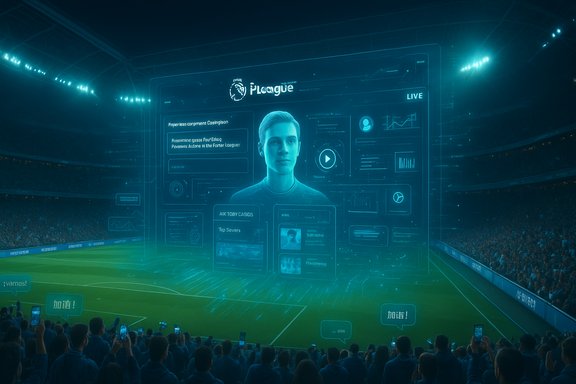
- The launch of the Premier League Companion — a Copilot‑style assistant built into the League’s app and website, designed to answer free‑text questions, surface archival clips and feed personalized stories.
- A technology backbone combining Azure Data Factory, Azure Databricks, Azure Cosmos DB, Microsoft Foundry and Azure OpenAI in Foundry Models, plus caching and orchestration layers to meet live match‑day latency demands.
- Early performance claims from the League and Microsoft: roughly a 20% year‑on‑year increase in engagement on owned channels and “60 million users” active within the first weeks of the rollout, figures presented in Microsoft’s customer story and quoted League executives. These numbers are material to commercial evaluation, but the 60‑million figure is a vendor/league‑declared metric that requires third‑party audit to be independently verified.
Overview: why this matters now
The Premier League sits at global scale: millions of casual viewers, hundreds of millions of fans, and complex commercial partnerships with broadcasters, clubs and sponsors. Converting passive viewership into engaged digital relationships is the principal lever for long‑term growth — not only in ad and sponsorship yield but in merchandise, subscriptions and the data that fuels personalization.The partnership reflects three converging trends:
- Rights owners are centralizing data and archives to create productized, searchable knowledge.
- Hyperscale cloud providers have built enterprise AI stacks (model hosting, RAG pipelines, governance) that let rights holders offer conversational and personalized experiences.
- Audiences increasingly expect second‑screen, multilingual and just‑in‑time context when they watch live sport, turning historical archives into immediate engagement tools.
How the technology is put together
Architecture snapshot
The published case study outlines a layered platform:- Data ingestion and ETL with Azure Data Factory and Azure Databricks to pull match telemetry, editorial feeds and video metadata.
- A central catalog and operational store in Azure Cosmos DB to hold structured stats, vector indexes, precomputed prompts and anonymized interaction logs.
- Model and orchestration services built on Microsoft Foundry and Azure OpenAI in Foundry Models to power agentic behaviors and retrieval‑augmented generation (RAG).
- Orchestration and latency improvements through Semantic Kernel, Azure Managed Redis (for sub‑500ms live responses) and a combination of caching strategies to sustain peak‑match concurrency.
Performance claims and what they imply
Microsoft’s materials describe an environment engineered to handle “more than 8,000 transactions per second” and to serve millions of concurrent users with individualized feeds. If those numbers are sustained in production, they indicate significant investment in throughput, caching and geographic distribution — particularly important for live match overlays and in‑broadcast enrichment. Independent coverage confirmed the architectural direction even where third‑party outlets stopped short of replicating specific TPS numbers.Fan experience: what the Companion does today
The Companion is described as a multi‑capability assistant:- Free‑text Q&A about clubs, players and historic moments.
- Short‑form contextual stories built from archived editorial pieces and highlight clips.
- Near‑real‑time match insights and in‑broadcast overlays that update with live telemetry.
- Planned extensions to Fantasy Premier League assistance (AI manager help), multilingual voice/text queries and user‑driven creative features.
Commercial implications
New monetization vectors
Personalization and real‑time overlays create obvious opportunities:- Sponsored, personalized activations (e.g., club‑specific sponsor cards or smart overlays tailored by fan preferences).
- Premium Fantasy integrations where AI assistance becomes part of a subscription tier.
- Archive productization: paywalled clips, curated highlight packages and data feeds for partners or broadcasters.
Operational modernization
Behind the scenes, the migration to Microsoft 365, Dynamics 365 and Power Platform is intended to reduce friction in editorial workflows and speed feature rollouts. That internal efficiency is often overlooked in public coverage but is essential: faster iteration gives the League a commercial advantage in testing monetization hypotheses and localizing content for key markets.Governance, rights and legal considerations
This program sits on a legal minefield unless proactively managed.- Copyright and content reuse: The Companion ingests editorial articles and broadcast clips that are rights‑managed. Using those assets in generative outputs or remixed video features raises questions about royalties, excerpt allowances and downstream reuse rights. Contracts with media owners must explicitly allow transformation, excerpting and distribution in AI‑generated contexts.
- Provenance and transparency: To preserve trust, the Companion should attach provenance indicators (source links, timestamps, confidence bands) to factual answers. Enterprises mitigate hallucination risk via conservative RAG settings, snippet quotas and explicit source surfacing; the League has described traceability in Foundry as a design goal, but public evidence of provenance coverage and accuracy KPIs remains an area to watch.
- Privacy and player data: Any extension into player health, biometrics or scouting stats would demand explicit consent frameworks and medical‑ethics compliance. The published architecture emphasizes anonymized conversation logs and data minimization, but ongoing governance and third‑party audits should be mandatory if the scope expands.
Risks, limitations and real‑world constraints
Hallucinations, over‑confidence and editorial risk
Generative agents can produce confident‑sounding but inaccurate outputs. For sport coverage, that’s particularly sensitive: an incorrect injury status, misattributed quote or fabricated statistic can cascade into reputational and legal harms. Independent media experiments that published Copilot‑generated predictions alongside human pundits showed the novelty of the approach — but also its brittleness when models lacked live feeds or last‑minute updates. Editorial teams should treat AI outputs as assistive and not authoritative without rapid human validation for sensitive claims.Data freshness and live reliability
Exact‑score forecasts and live overlays require tight SLAs. The engineering challenge is nontrivial: ingesting live telemetry, ensuring sub‑second retrieval, and delivering consistent results across geographies and devices during mass concurrent events demands robust fallback strategies and disaster‑recovery playbooks. Azure’s global footprint helps, but service‑level guarantees for live features were not fully publicized; the League and Microsoft need to publish operational SLAs for high‑profile match windows to reassure partners and fans.Vendor dependence and exit risk
Locking a single hyperscaler into a five‑year deal brings scale and integration benefits — but it also concentrates risk. Contractual protections are essential: data portability clauses, independent audit rights, and clear transition plans in the event of commercial or technical disputes. The League’s negotiation posture should preserve the ability to migrate or diversify compute/model vendors if market conditions shift.Verification and independent checks
Key claims and their corroboration status:- Five‑year partnership and Azure migration — corroborated by Microsoft and independent news outlets.
- Archive footprint (30+ seasons, ~300,000 articles, ~9,000 videos) — asserted publicly by the League and Microsoft and reported in independent coverage. This is a concrete inventory figure that appears in both parties’ public statements.
- Technology stack (Foundry, Azure OpenAI, Cosmos DB, Databricks, Data Factory) — detailed in Microsoft’s case study and aligns with known Azure product capabilities; technical feasibility is credible based on product functionality.
- Engagement uplift (~20% YOY) — reported by the League in Microsoft materials and independently referenced in sports‑tech coverage and conference reporting (20–25% range). This is reasonably corroborated, though longitudinal measurement details (cohorts, channels, geo‑breakdowns) were not published in full.
- “60 million users” active in early months — stated in the League/Microsoft narrative but not yet independently audited in public reporting. Treat this as a vendor/league metric awaiting third‑party verification or detailed methodology disclosure.
Practical recommendations for rights holders and platform teams
- Publish a short, rolling transparency report that includes key accuracy and provenance metrics for the Companion (e.g., percentage of answers with source links, third‑party verified accuracy rates).
- Phase rollouts conservatively: start with read‑only summarization and curated Q&A, then expand to live overlays and active monetization once validated accuracy thresholds are met.
- Bake human‑in‑the‑loop checkpoints into any output that could cause reputational or legal risk (player health claims, contractual content reuse).
- Embed verifiable provenance in the UI for any factual claim and attach confidence bands so users understand uncertainty.
- Negotiate contractual protections: data export formats, portability tests, independent audits and an agreed exit plan to reduce long‑term vendor lock risk.
What success — and failure — will look like
Success will be measured by durable, not binary, indicators: a sustained lift in session time and retention, monetization tied to personalized activations that fans tolerate (not reject), and a transparent accuracy track record that builds trust across languages and regions. The technology will be deemed a win when the Companion adds incremental commercial value (sponsorship yield, premium subscriptions, higher merchandise conversion) without generating a backlash driven by inaccurate outputs or intrusive monetization.Failure would look like early hype followed by inconsistent answers, visible hallucinations during major fixtures, contractual disputes over content reuse, or heavy‑handed personalization that alienates large segments of the fanbase. Those outcomes would erode trust quickly — and sport rights holders need trust as a core asset.
Final analysis
Technically, the Premier League’s approach is sensible: consolidate archives, serve them through a managed AI stack, and expose the results via conversational and feed‑based experiences. Microsoft brings the required global scale, enterprise governance features (Foundry), and a product ecosystem that simplifies internal modernization work. Independent reporting confirms the partnership, the archive scale and the early positive engagement signals; the architecture choices mirror industry best practice for scalable RAG systems. At the same time, the project’s long‑term success depends more on governance, accuracy and measured transparency than on launch window metrics. Vendor‑declared numbers such as “60 million users” are useful directional markers but should be accompanied by audited KPIs and published methodologies. The technology opens compelling new fan experiences — from multilingual Copilot Q&A to AI‑assistant Fantasy managers — but it also raises legal, ethical and operational challenges that will determine whether the Companion becomes an industry blueprint or a cautionary tale. The Premier League and Microsoft have delivered a credible technical foundation and early commercial momentum; now the hard work begins — proving accuracy at scale, keeping provenance visible, and converting short‑term curiosity into long‑term, trustable engagement that benefits fans, clubs and commercial partners alike.Source: Microsoft Premier League Deepens Fan Connection Using AI | Microsoft Customer Stories
