

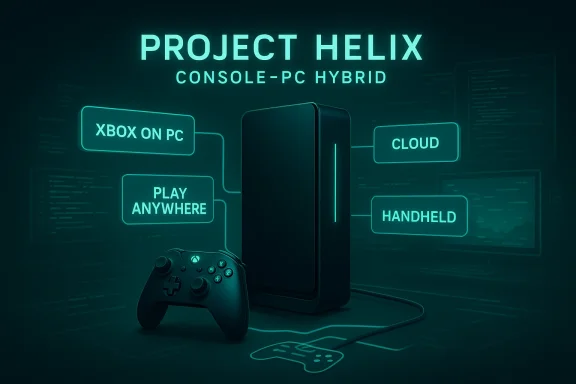
Microsoft’s next Xbox is no longer being framed as “just another console.” Instead, Project Helix is being positioned as a console-PC hybrid that could reshape how developers build for Xbox, Windows, handhelds, and cloud surfaces all at once. That shift matters because Xbox is no longer asking studios to think in terms of a single box under a TV; it is asking them to think in terms of a shared platform layer that spans multiple device classes and input models. The clearest message to developers is simple but consequential: if you want to be ready for the next generation, start by building for Xbox on PC today.
Xbox’s strategy has been evolving for years, but 2026 makes the direction unmistakable. Microsoft has spent the current generation turning Xbox into a brand that lives across console, PC, handheld, and cloud rather than a closed hardware silo, and Project Helix appears to be the hardware expression of that strategy. The company’s own GDC messaging emphasized that the future of Xbox is about making games available across more screens, while still preserving the familiar couch-first console experience players still expect.
That context explains why Chris Charla’s guidance to developers is so important. When Xbox’s publishing lead says studios should be developing for Xbox console today, developing for Xbox on PC, and supporting Xbox Play Anywhere, he is not just offering platform advice; he is describing the likely architecture of the next Xbox era. In practical terms, Microsoft appears to want a world where a single build pipeline can serve multiple endpoints with minimal rework.
The timing also tells us something about Microsoft’s priorities. The company is pushing new Windows gaming experiences, improving its Game Development Kit, expanding Play Anywhere, and making it easier to onboard PC games into the Xbox ecosystem. Those moves all point toward the same destination: a more unified development model where a game that is already sound on PC can become “Xbox-ready” with fewer platform-specific hurdles.
What makes Project Helix especially interesting is that it seems designed to remove a historic divide in Xbox development. Traditional console cycles force developers to target a fixed hardware profile, while PC development often demands broader scalability and more configuration work. Microsoft’s hybrid vision appears to merge those worlds, creating a platform that is simultaneously easier to target like console and more flexible like PC. That is ambitious, but it could also be a very powerful simplification if Microsoft executes it well.
That advice also reveals how Microsoft sees risk. If a game already behaves well in the Xbox PC environment, then the company can more easily expect it to run on Project Helix without forcing teams to rebuild from scratch. This is classic platform engineering: reduce the number of unique code paths, reduce certification pain, and make the whole ecosystem more attractive to studios that are already stretched thin.
The important phrase here is “native”. Charla’s comments imply that Microsoft does not merely want compatibility; it wants native execution on Helix, meaning the game should feel like a first-class Xbox title rather than a bridged or emulated experience. That distinction matters, because it suggests the company is planning for a future where the console is still a console in user experience terms, even if its internals are closer to a PC-like platform model.
That matters because Play Anywhere is more than a convenience feature. It teaches both players and developers that Xbox identity is tied to the account and the ecosystem, not merely the box. The result is a platform story that feels increasingly modern: buy once, play across devices, and keep progress synchronized. That is a different value proposition from the old “buy for console only” era.
For Microsoft, Play Anywhere also functions as a de-risking tool. If a title already supports shared ownership and shared progress on console and PC, then Helix can inherit that logic instead of inventing a new cross-device model from scratch. That means Play Anywhere is doing strategic work far beyond consumer convenience; it is becoming part of the technical and commercial fabric of next-gen Xbox.
That said, hybrid platforms are never free. They bring compatibility advantages, but they also risk complexity in the user experience, certification expectations, and performance tuning. Microsoft’s job is to make Helix feel as effortless as a console while quietly preserving the openness and scale of a PC underneath. That is harder than it sounds.
This is where the distinction between the player-facing shell and the developer-facing platform becomes crucial. If Xbox can hide the Windows complexity behind a tuned, console-style front end, it could get the best of both worlds. But if the hybrid identity leaks into day-to-day usage, with app inconsistencies or compatibility headaches, the brand could end up saddled with the worst stereotypes of both console and PC gaming.
The best-case scenario is obvious: fewer “porting projects” and more “same codebase, different packaging.” That would help independent developers and mid-sized studios in particular, because it reduces the need for specialist console engineering at every stage. For large publishers, it may also simplify how they think about launch sequencing across Xbox, PC, and future hybrid hardware.
There is also a strategic wrinkle here for studios already focused on Steam, Epic, or standalone PC releases. If Microsoft’s tooling and store integration improve enough, the Xbox PC path may become a low-friction way to add Xbox reach without reconstructing a game around traditional console-only assumptions. That could make Xbox more attractive than it has been in years for PC-first developers.
The “Xbox mode” narrative is especially important because it shows Microsoft trying to solve a long-standing complaint about PC gaming: too much friction. If Windows can present a console-like shell when used as a game machine, then the distinction between Xbox hardware and Xbox software becomes much less rigid. That could make the next console feel familiar on day one while still being fundamentally more open than prior generations.
This also helps explain why Microsoft is emphasizing launch-day readiness and faster onboarding for developers. The company wants the Xbox developer experience to feel less like a separate kingdom and more like a shared surface with PC. That is a subtle but powerful change in tone, and it could determine whether Helix becomes a platform standard or just a clever experiment.
For PlayStation, the challenge is different. Sony still benefits from a clearly distinct console identity and strong exclusives, but Microsoft’s hybrid approach could gradually reduce the technical gulf between building for Xbox and building for PC. If that happens, more studios may start to see Xbox as a near-zero-friction extension of their PC strategy rather than a separate business case.
Nintendo is likely less directly affected, because its platform value has historically depended on different strengths: first-party IP, family appeal, and handheld-console integration. Still, if Helix blurs the line between console and PC in a convincing way, it could pull some enthusiast attention away from “closed ecosystem” thinking and toward broader device flexibility. That is not an immediate threat, but it is a meaningful trend to watch.
The other key thing to watch is whether Microsoft keeps improving the day-to-day Xbox on PC experience fast enough to support the next hardware wave. If the software layer becomes smoother, then Charla’s advice will look prescient rather than aspirational. If it stalls, then Helix may inherit some of the same reputation problems that have dogged Xbox’s PC efforts so far.
Source: Windows Central https://www.windowscentral.com/gami...t-helix-console-by-developing-for-xbox-on-pc/
 Overview
Xbox’s strategy has been evolving for years, but 2026 makes the direction unmistakable. Microsoft has spent the current generation turning Xbox into a brand that lives across console, PC, handheld, and cloud rather than a closed hardware silo, and Project Helix appears to be the hardware expression of that strategy. The company’s own GDC messaging emphasized that the future of Xbox is about making games available across more screens, while still preserving the familiar couch-first console experience players still expect.That context explains why Chris Charla’s guidance to developers is so important. When Xbox’s publishing lead says studios should be developing for Xbox console today, developing for Xbox on PC, and supporting Xbox Play Anywhere, he is not just offering platform advice; he is describing the likely architecture of the next Xbox era. In practical terms, Microsoft appears to want a world where a single build pipeline can serve multiple endpoints with minimal rework.
The timing also tells us something about Microsoft’s priorities. The company is pushing new Windows gaming experiences, improving its Game Development Kit, expanding Play Anywhere, and making it easier to onboard PC games into the Xbox ecosystem. Those moves all point toward the same destination: a more unified development model where a game that is already sound on PC can become “Xbox-ready” with fewer platform-specific hurdles.
What makes Project Helix especially interesting is that it seems designed to remove a historic divide in Xbox development. Traditional console cycles force developers to target a fixed hardware profile, while PC development often demands broader scalability and more configuration work. Microsoft’s hybrid vision appears to merge those worlds, creating a platform that is simultaneously easier to target like console and more flexible like PC. That is ambitious, but it could also be a very powerful simplification if Microsoft executes it well.
The big strategic shift
Microsoft is no longer talking about Xbox as a single destination. It is talking about a network of Xbox experiences connected by account, progress, and store ecosystem, with console still acting as the emotional center. That makes the next console less of a reinvention of the old model and more of a convergence layer for the model Xbox has been building for several years.- Console remains central, but not exclusive.
- PC parity is becoming a core requirement, not an afterthought.
- Cross-progression is now a strategic default, not a premium feature.
- Handheld support is becoming part of Xbox’s mainstream developer story.
What Microsoft Is Telling Developers
Charla’s message is unusually direct for a platform transition. He is effectively telling developers that the safest route to next-gen readiness is to build against the Xbox on PC pipeline now, because that path should map most naturally to Project Helix later. For studios, that suggests Microsoft wants current PC work to double as future console work, reducing the need for expensive, late-stage platform ports.That advice also reveals how Microsoft sees risk. If a game already behaves well in the Xbox PC environment, then the company can more easily expect it to run on Project Helix without forcing teams to rebuild from scratch. This is classic platform engineering: reduce the number of unique code paths, reduce certification pain, and make the whole ecosystem more attractive to studios that are already stretched thin.
The important phrase here is “native”. Charla’s comments imply that Microsoft does not merely want compatibility; it wants native execution on Helix, meaning the game should feel like a first-class Xbox title rather than a bridged or emulated experience. That distinction matters, because it suggests the company is planning for a future where the console is still a console in user experience terms, even if its internals are closer to a PC-like platform model.
Why “build once” matters
The appeal of a one-build future is obvious: fewer engineering branches, fewer regression bugs, and fewer platform-specific QA matrices. For smaller studios, especially indie teams, that can be the difference between releasing on Xbox or skipping it entirely. For bigger publishers, it can make Xbox less of a special-case port and more of a standard distribution target.- Lower engineering overhead for multi-platform releases.
- Less duplication across PC and console code paths.
- Faster certification readiness if platform expectations align.
- Better reuse of QA, saves, and services across devices.
Why Xbox Play Anywhere Is the Key Bridge
If Project Helix is the destination, Xbox Play Anywhere is the bridge. Microsoft has been steadily expanding the program, and its own developer materials now describe a catalog of more than 1,500 Play Anywhere games, which is a meaningful base for a strategy built around cross-device continuity. In other words, the company has already spent years normalizing the idea that a purchase and a save file should travel across Xbox and Windows without friction.That matters because Play Anywhere is more than a convenience feature. It teaches both players and developers that Xbox identity is tied to the account and the ecosystem, not merely the box. The result is a platform story that feels increasingly modern: buy once, play across devices, and keep progress synchronized. That is a different value proposition from the old “buy for console only” era.
For Microsoft, Play Anywhere also functions as a de-risking tool. If a title already supports shared ownership and shared progress on console and PC, then Helix can inherit that logic instead of inventing a new cross-device model from scratch. That means Play Anywhere is doing strategic work far beyond consumer convenience; it is becoming part of the technical and commercial fabric of next-gen Xbox.
The business side of cross-device ownership
The business value here is obvious but easy to underestimate. When users can continue a game on another device without repurchasing it, Microsoft increases the probability that the Xbox account becomes the player’s primary identity anchor. That can improve retention, store engagement, and the perceived value of Game Pass and Xbox-linked services.- Higher player retention across devices.
- Stronger account stickiness within the Xbox ecosystem.
- More incentive to buy digitally through Microsoft’s stores.
- Better lifetime value when players remain in the ecosystem longer.
Project Helix as a Console-PC Hybrid
The phrase console-PC hybrid is doing a lot of work here. It suggests a device that blends a living-room-friendly Xbox experience with the broader compatibility and flexibility of a Windows-based gaming environment, which is precisely why developers are being told to think in PC terms now. If that hybrid model succeeds, Xbox could become the first major console brand to make PC development the default on-ramp to its next hardware generation.That said, hybrid platforms are never free. They bring compatibility advantages, but they also risk complexity in the user experience, certification expectations, and performance tuning. Microsoft’s job is to make Helix feel as effortless as a console while quietly preserving the openness and scale of a PC underneath. That is harder than it sounds.
This is where the distinction between the player-facing shell and the developer-facing platform becomes crucial. If Xbox can hide the Windows complexity behind a tuned, console-style front end, it could get the best of both worlds. But if the hybrid identity leaks into day-to-day usage, with app inconsistencies or compatibility headaches, the brand could end up saddled with the worst stereotypes of both console and PC gaming.
The promise and the problem
The promise is enormous: one device class that can play Xbox games, Windows games, cloud titles, and maybe even act as a better bridge to portable play. The problem is that each of those categories comes with its own expectations around performance, inputs, stores, saves, and user interface behavior. If Microsoft wants Helix to feel unified, it will need to standardize those layers aggressively.- Unified account behavior is essential.
- Consistent controller support must be first-class.
- Clear store and entitlement rules are non-negotiable.
- Performance tuning will need to be much more predictable than on typical PC hardware.
What This Means for Studios
For developers, the immediate takeaway is that Xbox is trying to compress the distance between console and PC production pipelines. Studios that already ship Windows builds, or that can rebase their Xbox work on a PC-first architecture, are likely to be in the best position when Helix arrives. That is especially true for teams already using scalable engines and modern content pipelines.The best-case scenario is obvious: fewer “porting projects” and more “same codebase, different packaging.” That would help independent developers and mid-sized studios in particular, because it reduces the need for specialist console engineering at every stage. For large publishers, it may also simplify how they think about launch sequencing across Xbox, PC, and future hybrid hardware.
There is also a strategic wrinkle here for studios already focused on Steam, Epic, or standalone PC releases. If Microsoft’s tooling and store integration improve enough, the Xbox PC path may become a low-friction way to add Xbox reach without reconstructing a game around traditional console-only assumptions. That could make Xbox more attractive than it has been in years for PC-first developers.
Developer priorities by studio type
Not every studio will respond the same way, and that is where the practical analysis gets interesting. Some teams will treat Helix as a simple expansion of the Xbox target matrix, while others will see it as a reason to re-architect for broader device support. Microsoft seems to want the latter outcome, but will happily accept the former if it gets more games into the ecosystem.- Indies will care most about reduced porting cost.
- AA studios will care about predictable certification and account handling.
- AAA publishers will care about platform reach and cross-device monetization.
- PC-first teams will care about whether Xbox support adds meaningful sales with manageable overhead.
The Role of Xbox on PC and Windows Mode
Microsoft has been steadily investing in the Xbox on PC experience, and that work now looks like a foundation rather than a side project. Recent developer messaging around Windows gaming, Xbox mode, and streamlined GDK workflows suggests the company is trying to make Windows itself behave more like an Xbox environment when appropriate. That makes Helix feel less like a surprise and more like the inevitable result of long-term convergence.The “Xbox mode” narrative is especially important because it shows Microsoft trying to solve a long-standing complaint about PC gaming: too much friction. If Windows can present a console-like shell when used as a game machine, then the distinction between Xbox hardware and Xbox software becomes much less rigid. That could make the next console feel familiar on day one while still being fundamentally more open than prior generations.
This also helps explain why Microsoft is emphasizing launch-day readiness and faster onboarding for developers. The company wants the Xbox developer experience to feel less like a separate kingdom and more like a shared surface with PC. That is a subtle but powerful change in tone, and it could determine whether Helix becomes a platform standard or just a clever experiment.
Why the workflow matters
A better workflow is not just a quality-of-life upgrade. It directly affects how many studios will even consider the platform, because every reduction in setup friction expands the pool of eligible developers. In a market where teams are increasingly stretched, the difference between “half an hour to get started” and “weeks of platform prep” can decide where games ship.- Faster onboarding lowers the barrier to entry.
- Standard x64 build paths reduce technical overhead.
- Shared tooling improves consistency across devices.
- Better docs and templates can increase Xbox participation.
Competitive Implications for PlayStation, Nintendo, and PC
Project Helix could have broad competitive effects even before launch. If Xbox becomes more closely aligned with PC development, Microsoft may gain an advantage in attracting studios that already prioritize Windows as a shipping target. That would be particularly significant in a market where PC remains a major revenue channel and where many publishers already treat Xbox as the console most naturally adjacent to that channel.For PlayStation, the challenge is different. Sony still benefits from a clearly distinct console identity and strong exclusives, but Microsoft’s hybrid approach could gradually reduce the technical gulf between building for Xbox and building for PC. If that happens, more studios may start to see Xbox as a near-zero-friction extension of their PC strategy rather than a separate business case.
Nintendo is likely less directly affected, because its platform value has historically depended on different strengths: first-party IP, family appeal, and handheld-console integration. Still, if Helix blurs the line between console and PC in a convincing way, it could pull some enthusiast attention away from “closed ecosystem” thinking and toward broader device flexibility. That is not an immediate threat, but it is a meaningful trend to watch.
The PC market angle
The biggest competitive story may be on the PC side itself. If Microsoft can make Xbox software, identity, and commerce feel cleaner on Windows, it strengthens the argument that Xbox is not competing with PC but folding into it. That could matter a great deal in a market where storefront loyalty and account persistence are increasingly important.- Microsoft gains leverage if PC and Xbox development converge.
- Publishers gain efficiency if one build serves more surfaces.
- Players gain convenience if ownership and progress travel cleanly.
- Rivals may be forced to respond with more cross-device flexibility.
Strengths and Opportunities
Microsoft’s Project Helix strategy has several clear strengths. It builds on existing Xbox investments rather than discarding them, which means the company is not starting from scratch but compounding years of work on Play Anywhere, Xbox on PC, and cross-device services. It also gives developers a more rational path into the next generation, which could improve the health of the Xbox catalog over time.- Existing ecosystem momentum from Play Anywhere and Xbox on PC.
- Lower porting friction for studios that already support Windows.
- Stronger player continuity across console, PC, and handhelds.
- Potentially wider game library at launch if PC-ready titles map well.
- Better developer retention if onboarding becomes simpler.
- A cleaner long-term story for Xbox as a platform, not just hardware.
Risks and Concerns
The main risk is that hybrid complexity could undermine the very simplicity Xbox is trying to preserve. A console-PC model can become confusing fast if the user experience fragments across apps, stores, settings, or performance expectations. Microsoft has made progress, but the Xbox on PC experience still carries enough rough edges that skepticism is justified.- User experience inconsistency across devices and shells.
- Developer confusion if standards are not clearly documented.
- Performance variance if Helix’s hardware profile is too PC-like.
- Compatibility gaps for legacy console assumptions.
- Certification complexity if one build still needs many special cases.
- Brand dilution if “Xbox” starts to mean too many different things.
Looking Ahead
The next few months should clarify whether Project Helix is mainly a branding evolution or a deeper platform reset. Microsoft has already signaled that more hardware details and developer guidance are coming, and that will matter because the success of a console-PC hybrid depends heavily on how clearly the rules are defined. Developers need to know not just what Helix is, but what assumptions they can safely make about input, performance, storage, storefront behavior, and save data.The other key thing to watch is whether Microsoft keeps improving the day-to-day Xbox on PC experience fast enough to support the next hardware wave. If the software layer becomes smoother, then Charla’s advice will look prescient rather than aspirational. If it stalls, then Helix may inherit some of the same reputation problems that have dogged Xbox’s PC efforts so far.
What to watch next
- More detailed Helix hardware disclosures from Microsoft.
- Developer tooling updates that simplify cross-platform builds.
- Expansion of Xbox mode on Windows and its rollout cadence.
- Further growth in Xbox Play Anywhere support across major releases.
- Evidence of stronger Xbox PC app performance and stability.
- Publisher reactions to the new platform guidance.
Source: Windows Central https://www.windowscentral.com/gami...t-helix-console-by-developing-for-xbox-on-pc/
Last edited:
