

Microsoft’s next Xbox is no longer rumor — it’s a deliberate industry pivot that treats a living‑room console like a Windows PC with a console‑first skin, a custom AMD system‑on‑chip, and a rendering pipeline built around machine learning, neural rendering, and aggressive ray‑tracing ambitions.
Microsoft used the Game Developers Conference (GDC) to move Project Helix from tease to roadmap: the company confirmed the platform will be powered by a custom AMD SoC co‑designed for the “next generation” of DirectX, will run both Xbox and Windows PC games, and will lean heaaling, neural texture work, and ray/path tracing improvements.
Those public remarks add technical color to broader signals we’ve been tracking for months: Microsoft has steadily integrated console‑grade UX into Wind app and Full Screen Experience, and deepened its engineering partnership with AMD. What was once a set of experimental features now looks like the scaffolding for a hybrid Xbox‑PC product.
That’s one of the most consequential statements in Microsoft’s remarks, and it deserves careful unpacking.
But real results depend on multiple factors:
But this is not magical: denoisers may hide detail or introduce temporal artifacts if not tuned. The fidelity/time tradeoffs and the quality threshold players accept will determine whether claimed multipliers deliver meaningful gameplay improvements.
That pairs with the Xbox Mode / Windows 11 integration Microsoft is rolling out to make the overall experience feel console‑like on PCs while ensuring the same asset pipeline can be used across devices. Reduced RAM and VRAM pressure is one of the practical engineering goals here.
Separately, chips leaked under the codename Magnus have been floated by multiple rumor sources as the APU inside Project Helix — typically described as Zen 6 CPU cores plus an RDNA 5 GPU, a unified GDDR7 pool, and an on‑die NPU. Those specs come from supply‑chain leaks and analysis rather than Microsoft confirmation, so treat them as plausible but unverified.
2.) Invest in GPU‑centric profiling and debugging. GPU‑directed work graphs change where bugs can appear and how you measure performance.
3.) Plan multiple upscaling/denoising fallbacks. Expect variability across PC GPUs and across generational support; build toggles and graceful fallbacks to preserve experience across older hardware.
4.) Consider storage and asset streaming earlier. Neural texture compression plus DirectStorage‑style streaming enables bigger worlds but requires rethinking content pipelines and patch delivery strategies.
Project Helix is the clearest signal yet that Microsoft views the next console generation as a cross‑platform engineering project — a Windows‑rooted, Microsoft‑curated PC with a TV‑first experience on top. The combination of a custom AMD SoC, native ML rendering primitives via FSR Diamond, ambitious ray‑tracing promises, and GPU‑directed execution could unlock genuinely new classes of games and worlds — but only if the ecosystem, pricing, and developer support land in a way that matches the rhetoric. In the short term, treat vendor statements as the baseline, treat leak claims as scenarios, and expect meaningful clarity only after the 2027 alpha devkit wave and subsequent developer reporting.
Source: TechSpot Next-gen Xbox sounds a lot like a PC with an Xbox UI and AMD's FSR Diamond
 Background
Microsoft used the Game Developers Conference (GDC) to move Project Helix from tease to roadmap: the company confirmed the platform will be powered by a custom AMD SoC co‑designed for the “next generation” of DirectX, will run both Xbox and Windows PC games, and will lean heaaling, neural texture work, and ray/path tracing improvements.Those public remarks add technical color to broader signals we’ve been tracking for months: Microsoft has steadily integrated console‑grade UX into Wind app and Full Screen Experience, and deepened its engineering partnership with AMD. What was once a set of experimental features now looks like the scaffolding for a hybrid Xbox‑PC product.
What Microsoft actually annouect Helix: core claims (what’s confirmed)
- Project Helix is powered by a custom AMD SoC and is co‑designed with the next generation of DirectX. (videocardz.com)
- Microsoft told developers that alpha developer kits for Project Helix will begin going out in 2027, which places a consumer launch plausibly in late 2027–2028 depending on supply, testing, and certification cycles.
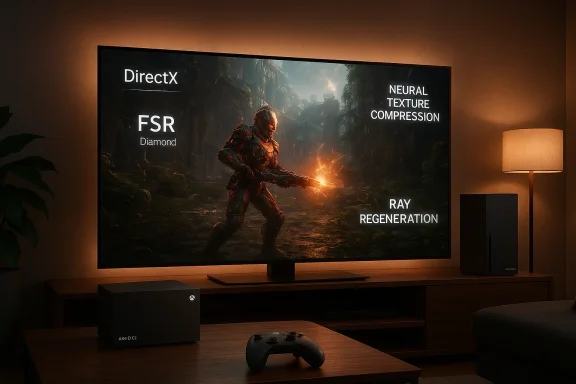
- The platform will emphasize neural rendering, ML upscaling, ML multi‑frame generation, neural texture compression, and a new ML denoising approach Microsoft calls Ray Regeneration to dramatically raise ray‑traced performance and enable path tracing scenarios.
Xbox Mode and Windows integration
Microsoft will begin rolling out a rebranded, controller‑friendly Full Screen Experience — now called Xbox Mode — to Windows 11 devices in selected regions starting in April. The move is explicitly positioned to make Windows a first‑class target for console‑style gaming and to smooth the shared development model between PC and Helix.FSR Diamond: AMD’s next FidelityFX, co‑designed for Helix
What FSR Diamond is claimed to be
AMD’s graphics lmed the next FSR evolution FSR Diamond, and Microsoft said Helix will integrate this next‑gen FidelityFX stack natively into its GDK and DirectX pipeline. FSR Diamond was presented as more than an upscaler — a suite of ML primitives that include:- ML upscaling (single‑ and multi‑frame modes)
- ML frame generation (multi‑frame interpolation/augmentation)
- Neural texture compression / Deep Texture Compression (ML‑driven compressed assets streamed with DirectStorage)
- Ray Regeneration: an ML denoiser to support higher‑fidelity ray tracing and path tracing
Where the announcement came from
AMD’s SVP and GM for Computing and Graphics, Jack Huynh, acknowledged the codename “FSR Diamond” on social channels during GDC and described it as jointly engineered to be native to Project Helix and the updated GDK. Multiple outlets reported Huynh’s remarks and Microsoft slides from the GDC session.What’s verified vs. what’s a rumor
- Verified: AMD and Microsoft publicly signalled a deep engineering collaboration and the “FSR Diamond” name appeared in company remarks and industry reporting.
- Unverified / Rumored: claims that FSR Diamond will be exclusive to RDNA 5 hardware come from independent leakers (most prominently accounts known as Kepler_L2) and community reporting — not from AMD or Microsoft themselves. Those leaks are being amplified by enthusiast sites but should be treated as unconfirmed until AMD or Microsoft clarifies hardware compatibility for PC GPUs.
Ray tracing, Ray Regeneration and “an order of magnitude” claim
Microsoft’s GDC slides and Jason Ronald’s session included a striking line: Project Helix will deliver ray tracing performance and capability up to an order of magnitude higher than the Xbox Series X, and it will support path tracing through a combination of hardware and ML denoising (Ray Regeneration).That’s one of the most consequential statements in Microsoft’s remarks, and it deserves careful unpacking.
What “order of magnitude” means in practice
“An order of magnitude” = roughly 10×. Applied to ray‑tracing workloads, that could mean a 10× increase in ray‑sample throughput, denoising efficiency, or a combination of hardware+software gains that yield ray‑traced scenes that were previously impractical at target frame rates and resolutions.But real results depend on multiple factors:
- How Microsoft and AMD define the baseline (Series X hardware, which has a fixed RT throughput).
- Whether the comparison is theoretical peak performance vs. real‑world, full‑scene path tracing.
- The degree to which ML denoisers and reconstruction mask variance vs. enabling genuinely higher ray counts.
How ML denoising changes the calculation
Ray denoisers and reconstruction networks (NVIDIA’s DLSS Ray Reconstruction and AMD’s Ray Regeneration equivalents) let engines do far fewer ray samples per pixel while producing an image that looks closer to a higher‑sample solution. That reduces raw ray budget needs and — when coupled with specialized hardware (NPU/AI blocks, tensor cores, or matrix engines) — can yield large gains in usable ray tracing throughput.But this is not magical: denoisers may hide detail or introduce temporal artifacts if not tuned. The fidelity/time tradeoffs and the quality threshold players accept will determine whether claimed multipliers deliver meaningful gameplay improvements.
GPU‑directed work graph execution: shifting work from CPU to GPU
One of the more technical, but consequential, announcements was that DirectX and Helix will support GPU‑directed work graph execution — essentially allowing the GPU to generate and manage workloads dynamically instead of waiting for the CPU to schedule every job.Why that matters
Traditional rendering pipelines treat the GPU as a worker that executes tasks the CPU composes. With GPU‑directed work graphs, the GPU can:- Spawn and schedule its own tasks in response to runtime conditions
- Offload simulation work (e.g., physics, large numbers of small agents) to GPU threads without tight CPU synchronization
- Enable more complex, dynamic, and larger‑Microsoft framed this as a tool to eliminate CPU bottlenecks and unlock larger, simulation‑heavy game worlds. The practical upside is an increase in parallelism and lower CPU overhead for some classes of work — but that comes with engineering cost for game developers and engine makers.
Developer implications
- Engines will need new scheduling and debugging tools to reason about GPU‑spawned tasks.
- Non‑trivial platform testing is required: race conditions, determinism for netcode, and profiling pipelines will change.
- Studios with strong GPUce (or deep engine partners) will exploit this faster than smaller teams.
Deep Texture Compression, DirectStorage, and the storage stack
Project Helix’s stack combines DirectStorage + Zstd‑style (Xstd) streaming with ML‑driven texture compression the company calls Deep Texture Compression. The pitch: smaller, neural‑compressed texture assets streamed efficiently over fast storage will make higher resolution assets practical in memory‑constrained consoles and enable faster load times.That pairs with the Xbox Mode / Windows 11 integration Microsoft is rolling out to make the overall experience feel console‑like on PCs while ensuring the same asset pipeline can be used across devices. Reduced RAM and VRAM pressure is one of the practical engineering goals here.
Timeline, hardware rumors, and the “Magnus” codename
Microsoft confirmed alpha devkits land in 2027; that’s the single most reliable timetable clue we have so far. Multiple outlets and Microsoft’s developer messaging said the same, and AMD’s previous comments to investors included a 2027 support window for Micwork.Separately, chips leaked under the codename Magnus have been floated by multiple rumor sources as the APU inside Project Helix — typically described as Zen 6 CPU cores plus an RDNA 5 GPU, a unified GDDR7 pool, and an on‑die NPU. Those specs come from supply‑chain leaks and analysis rather than Microsoft confirmation, so treat them as plausible but unverified.
Pricing and competition context
Speculation in enthusiast reporting suggests that if throughput approaches high‑end PC GPUs (some outlets compared Magnus to an RTX 5080‑class performance level), Helix could be pricier than the PlayStation 6. That’s a direct function of silicon cost, memory architecture (GDDR7 unified memory is expensive), and the inclusion of dedicated NPU/AI blocks. Those are market expectations and rumor‑based horsepower comparisons — not Microsoft price confirmations. Expect Microsoft to trade off raw silicon cost against platform strategy, Game Pass economics, and supply chain realities.Business and strategic analysis: why Microsoft is doing this
Microsoft’s play is coherent: unify developer tooling across Windows and Xbox, make Windows feel like a plug‑and‑play living‑room platform (Xbox Mode), and build a hardware platform that can run both PC and console titles natively. The likely aims are:- Reduce friction for developers to target both PC and console
- Increase value and lock‑in for Game Pass / Xbox ecosystem by offern host all forms of Windows content
- Differentiate on breadth of ML rendering tooling, not just raw rasterization power
Risks, unknowns, and realistic caveats
No platform pivot this large is without downside. Here are the main risks and open questions you should weigh:- Exclusivity and fragmentation risk: If FSR Diamond features are limited to RDNA 5 hardware or Helix‑only implementations, AMD risks fragmenting the PC ecosystem, and developers might face additional work to support multiple upscaling/denoising paths. Kepler‑style leaks hint at RDNA 5 exclusivity but those claims are unverified and contested. Treat exclusivity reports as rumors until AMD clarifies compatibility for existing RDNA 3/4 GPUs.
- Quality vs. performance tradeoffs: ML denoisers and reconstruction can hide sampling insufficiency, but they also introduce temporal and detail artifacts. Real‑world effectiveness will be visible only after high‑quality demos and independent testing. Microsoft’s “order of magnitude” claim is a platform goal, not a measured bench figure we caamesradar.com](https://www.gamesradar.com/hardware...-war-before-it-even-starts/?utm_source=openai))
- Developer burden: New pipeline primitives (GPU‑directed graphs, neural texture formats) mean studios must adapt toolchains, which takes time and engineering dollars. The winners will be studios that invest upfront; smaller teams may lag.
- Price & supply: Ambitious silicon (GDDR7, NPUs, RDNA5 class blocks) pushes BOM costs up. Microsoft will need pricing elasticity or subscription strategies (Game Pass bundles) to meet consumer expectations. Rumors that Helix could sit in a premium price bracket are plausible but unconfirmed.
- PC ecosystem reaction: If Microsoft tightly integrates Xbox Mode with some first‑party features or privileged telemetry, it could rekindle debates about openness and storefront choice on Windows. The company’s messaging emphasizes openness but the commercial defaults matter enormously.
What this means for developers
1.) Start evaluating neural‑first pipelines now. If your engine pipeline still assumes only rasterization + fixed R years will require new tooling for ML upscaling, denoising, and texture compression. Microsoft’s GDC message explicitly advised developers to treat Helix more like PC development than a traditional closed console.2.) Invest in GPU‑centric profiling and debugging. GPU‑directed work graphs change where bugs can appear and how you measure performance.
3.) Plan multiple upscaling/denoising fallbacks. Expect variability across PC GPUs and across generational support; build toggles and graceful fallbacks to preserve experience across older hardware.
4.) Consider storage and asset streaming earlier. Neural texture compression plus DirectStorage‑style streaming enables bigger worlds but requires rethinking content pipelines and patch delivery strategies.
Advice for consumers and enthusiasts
- Be skeptical of early performance claims. Microsoft’s language is ambitious and designers have every incentive to emphasize platform potential. Real proof will require devkits in hand, shipping hardware tests, and independent benchmarks.
- Expect PC/console convergence in UX. If you value a pure, locked console experience, Helix’s hybrid Windows foundations may be less appealing than a sealed appliance. Conversely, power users will likely appreciate the openness.
- Watch AMD’s messaging about RDNA 5 compatibility. If FSR Diamond features are initially limited to new RDNA 5 silicon, current Radeon owners may see slower benefits from the new stack; AMD and Microsoft must be clearer on which features will migrate to older families and on what timeline.
How to read the early coverage: separating signal from noise
There are three classes of public statements you’ll see in the immediate coverage cycle:- Company confirmations and slides from Microsoft/AMD: these are the baseline (co‑design, FSR Diamond name, major feature list, devkit timing). Treat what Microsoft and AMD said as the starting truth.
- Independent reporting that quotes the session and slides: useful for context and interpretation, and good for corroboration. Multiple outlets reported the same slide deck text after the GDC session.
- Leaks and enthusiast claims (hardware specs, exclusivity, pricing): helpful to shape expectations but inherently uncertain. These should be treated as possible scenarios, not facts — especially when they come from single leakers or unnamed supply‑chain sources.
Final assessment — strengths and strategic risks
Notable strengths
- Clear platform strategy: Microsoft is tying hardware, DirectX, and the GDK together with an explicit aim: make console and PC development converge. That lowers friction for studios and creates a single target for first‑party investment.
- Ambitious GPU/ML stack: Native ML primitives (upscaling, frame gen, texture compression, denoising) are exactly where rendering is headed. Making those primitives part of the official pipeline accelerates adoption and provides consistent quality baselines.
- Developer toolchain continuity: Rolling Xbox Mode into Windows and shipping alpha devkits in 2027 signal Microsoft wants a single developer story across form factors. That’s a long‑term win for cross‑platform titles.
Material risks
- Ecosystem fragmentation if exclusivity holds: If next‑gen FSR features remain limited to RDNA 5 or Helix exclusively, developers will face more branching paths to support PC GPU diversity. That harms adoption and complicates cross‑platform releases.
- Overpromised performance vs. installed base reality: “Order of magnitude” claims are dramatic and will drive expectations. Delivering measured, repeatable gains across real game workloads is a complex engineering problem.
- Engineering & QA cost: New primitives and GPU‑directed execution models require new testing, certs, and mitigations for regressions; that increases time‑to‑market risk for some studios.
What to watch next (immediate signals)
- Microsoft and AMD’s follow‑up technical deep dives and SDK releases at GDC sessions and online developer portals. Those will clarify APIs, NPU usage models, and developer onboarding timelines.
- Clarification from AMD on RDNA 5 vs older GPU compatibility for FSR Diamond features; an FAQ or compatibility table from AMD would quickly reduce speculation.
- First hands‑on reports and benchmarks when alpha devkits reach selected partners in 2027. Those will be the first practical validation of Microsoft’s performance claims.
Project Helix is the clearest signal yet that Microsoft views the next console generation as a cross‑platform engineering project — a Windows‑rooted, Microsoft‑curated PC with a TV‑first experience on top. The combination of a custom AMD SoC, native ML rendering primitives via FSR Diamond, ambitious ray‑tracing promises, and GPU‑directed execution could unlock genuinely new classes of games and worlds — but only if the ecosystem, pricing, and developer support land in a way that matches the rhetoric. In the short term, treat vendor statements as the baseline, treat leak claims as scenarios, and expect meaningful clarity only after the 2027 alpha devkit wave and subsequent developer reporting.
Source: TechSpot Next-gen Xbox sounds a lot like a PC with an Xbox UI and AMD's FSR Diamond
