

Microsoft unveiled Project Solara at Build 2026 on June 2 as a chip-to-cloud platform for agent-first workplace devices, using an Android Open Source Project base through Microsoft Device Ecosystem Platform rather than Windows, with Qualcomm and MediaTek reference designs for badge and desk hardware. The surprise is not that Microsoft wants AI agents everywhere; that has been the company’s public strategy for years. The surprise is that, when Microsoft sketched a new class of AI-native devices, Windows was not the foundation. Project Solara is a pragmatic admission that the next fight over computing may happen less on the desktop than in the messy edge territory where badges, speakers, clinical tools, retail devices, and industrial endpoints live.
Project Solara is Microsoft’s attempt to turn the AI agent from a software feature into a device category. The company describes it as a platform for agent-first devices, meaning hardware designed around invoking, supervising, and handing off work to AI agents rather than launching traditional applications.
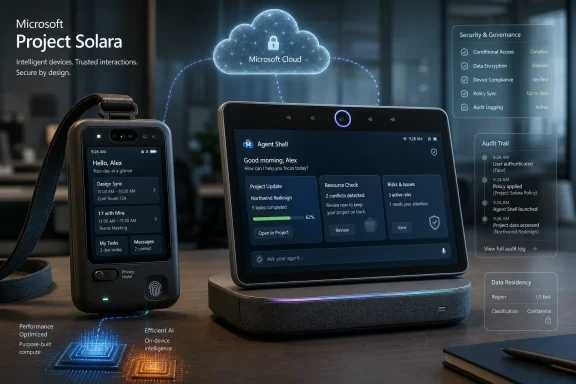
That framing matters because Microsoft is not merely adding Copilot to another screen. It is proposing a different kind of endpoint: lighter than a PC, more enterprise-managed than a consumer gadget, and more specialized than a phone. In Microsoft’s own examples, Solara shows up as a smart workplace badge and a desk companion device, both designed to keep agents close to the user without forcing that user back into the full Windows desktop.
This is why the Android base is the headline. Microsoft could have presented Solara as a variant of Windows IoT, a Windows 365 appliance, or an embedded extension of Copilot+ PCs. Instead, the platform relies on Microsoft Device Ecosystem Platform, an enterprise-oriented operating system built on the Android Open Source Project. The decision says that Microsoft wants the broad device compatibility, power profile, and embedded ecosystem of Android more than it wants the symbolic purity of extending Windows into every corner.
For Windows loyalists, that may sting. For IT buyers, it may simply sound familiar. The enterprise edge is already full of Android-based scanners, kiosks, panels, meeting-room devices, and rugged handhelds, many of them managed alongside PCs rather than pretending to be PCs.
That is a significant shift in posture. The old Microsoft instinct was to extend Windows downward into tablets, phones, embedded devices, and appliances. The modern Microsoft is more willing to wrap identity, management, cloud services, and developer tooling around whatever operating system best fits the form factor.
Solara fits that newer model. Entra ID provides identity. Intune provides management. Windows Hello for Business provides biometric authentication. Azure and Microsoft 365 provide the agent substrate. Windows 365 can appear when the desk device is connected to an external display. Windows remains in the constellation, but it is no longer the only planet.
This is a very Microsoft 2026 move. The company is less interested in winning an operating-system purity contest than in making sure the management plane, cloud plane, AI plane, and developer plane all point back to Redmond. If the device underneath is Android-based, Microsoft can live with that so long as the tenant, policy, agents, and data flow through Microsoft’s stack.
There are obvious useful scenarios. A nurse could capture a clinical conversation without returning to a workstation. A field worker could document a site condition hands-free. A retail employee could ask an inventory agent for the right answer in front of a customer. A developer could get status from GitHub Copilot without opening a laptop.
There are also obvious reasons to be uneasy. A workplace badge is not a neutral form factor. It is already a symbol of access control and institutional oversight, and adding microphones, cameras, and cloud-connected AI agents to that object changes the social contract around it. Microsoft emphasizes privacy indicators, physical mute controls, user permission, and enterprise governance, but the device category itself will invite scrutiny.
That scrutiny is not paranoia. The history of workplace technology is full of tools sold as productivity aids that later became measurement systems. A badge that can help an employee remember, summarize, and act could also become a badge that tracks presence, interactions, responsiveness, and ambient context. The difference between assistance and surveillance will be set less by the hardware than by policy, defaults, auditability, and labor norms.
Windows carries enormous strengths, but lightweight embedded diversity is not one of them. It is too heavy for many of these devices, too tied to PC assumptions, and too burdened by decades of application compatibility expectations. Project Solara is aimed at hardware where battery life, cameras, microphones, radios, biometrics, sensors, and cost curves matter more than running Excel locally.
This is where the decision becomes strategically honest. Microsoft does not need Solara devices to run Windows apps. It needs them to invoke agents, authenticate users, render adaptive interfaces, respect enterprise policy, and hand off work to cloud or PC environments. If the application model is no longer the center of the device, Windows compatibility becomes less compelling.
That does not make Windows irrelevant. It makes Windows specialized in the opposite direction: the high-capability general-purpose environment where complex work still happens. Solara is for the moments before, after, and around the PC. It is Microsoft trying to own the connective tissue.
That is a radical claim disguised as a usability improvement. The app launcher has been the organizing metaphor for personal computing for decades. Even smartphones, for all their sensors and notifications, still revolve around icons, app stores, permissions, and app-specific user interfaces. Solara imagines an environment where the interface is generated or adapted around the task rather than prebuilt as a full application.
Microsoft calls part of this just-in-time UI. Today, that likely means semi-structured cards, adaptive layouts, and known content types that can render across different screen sizes and input methods. In the long run, Microsoft gestures toward more dynamic and generative interfaces, though wisely stops short of claiming that fully generated UI is ready for enterprise-critical work.
The risk is that agent-first interfaces can become unpredictable. Administrators like consistency because consistency is supportable. Users like familiarity because familiarity lowers cognitive load. If every agent interaction becomes a bespoke little interface, Microsoft will need strong design constraints, logging, accessibility guarantees, and fallback paths. Otherwise, just-in-time UI becomes just-in-time confusion.
For sysadmins, the appeal is obvious if the platform works as advertised. A fleet of agent devices that can be enrolled, authenticated, updated, locked down, and governed like other endpoints is far easier to consider than a zoo of unmanaged AI gadgets. If a hospital, warehouse, retailer, or professional-services firm is going to experiment with wearable or desk-based agents, IT will demand exactly this kind of control plane.
The harder questions come after enrollment. What data does each agent access? Where is audio processed? How are recordings retained? Can users inspect what was captured and why? Can administrators disable cameras by policy? Can a unionized workplace distinguish user assistance from productivity monitoring? Can third-party agents be certified, sandboxed, and revoked quickly?
Microsoft’s advantage is that it already owns much of the enterprise trust machinery. Its disadvantage is that AI agents make the blast radius of a bad policy decision larger. A conventional endpoint leaks files when something goes wrong. An agentic endpoint may observe context, infer intent, initiate workflows, and move across systems. That demands a higher bar than ordinary mobile-device management.
That matters because Solara is not about a single Microsoft-branded product. It is a reference-design strategy. Microsoft wants OEMs and vertical-market device makers to build specialized hardware for healthcare, retail, hospitality, financial services, legal work, industrial settings, and field service. In those markets, the winning device is often not the most powerful one; it is the one that fits a workflow, survives procurement, and can be managed without heroic effort.
The desk concept is the safer of the two initial designs. It resembles a smart display for work: touchscreen, microphones, speaker, face authentication, presence sensing, USB-C, and the ability to become a Windows 365 client when attached to a display. It is easy to imagine it as a Teams Rooms cousin, a Copilot terminal, or a front-office appliance.
The badge is riskier and therefore more interesting. It pushes Microsoft into a category where the device is worn, socially visible, and close to sensitive human interactions. If Solara succeeds there, it could become a platform for many specialized endpoints. If it fails there, it will likely be because the social and governance model could not keep up with the technical ambition.
This is an important evolution because many high-value workflows do not happen neatly inside a desktop application. Healthcare workers move between patients and systems. Retail workers move between customers, inventory, and point-of-sale terminals. Field technicians move between physical equipment and documentation. In those contexts, the PC is often a station to return to, not the place where the work itself happens.
Solara’s promise is to move the interface closer to the work. That is not a new dream; mobile computing and IoT have chased it for years. What is new is Microsoft’s belief that agents reduce the need to build a custom app experience for every device and workflow. If the agent can understand context and render just enough interface, the economics of specialized hardware may improve.
That is the bet. It is not guaranteed. Agents are still unreliable in ways that ordinary software is not. They can misunderstand, overreach, hallucinate, or take action with misplaced confidence. A purpose-built device does not eliminate those risks; it puts them into environments where mistakes may be more consequential.
The better comparison is Microsoft’s broader post-Windows strategy: embrace the platform that exists, then make Microsoft services indispensable on top of it. Office on iOS and Android was once heresy. Now it is normal. Microsoft Defender, Intune, Teams, Edge, and Copilot all operate across platforms because the company learned that control at the service layer can matter more than control at the kernel layer.
Solara takes that logic into hardware. If AOSP is the fastest way to get agent devices built, then AOSP is the base. Microsoft can still define the management model, the agent model, the identity layer, and the developer experience. That is where the money and lock-in live.
The unresolved question is whether device makers and customers will see Solara as an open platform or as another Microsoft funnel. The company says it expects a multi-agent world where organizations can bring their own agents. But openness in enterprise platforms is always a matter of implementation, not aspiration. The real test will be how well non-Microsoft agents work, how much policy control customers get, and whether Solara devices remain useful outside the Microsoft 365 orbit.
Microsoft is pointing developers toward Copilot Studio, Microsoft 365 agent tooling, agent SDKs, and cloud-based orchestration. The obvious near-term opportunity is for organizations that have already built internal agents against Microsoft 365 data. Solara gives those agents new endpoints without requiring a full mobile or desktop application for every workflow.
But developers should be cautious about the abstraction. “Build once, adapt everywhere” has been promised many times in computing, and it usually works only within disciplined constraints. A badge, a desk display, a wall panel, and a handheld scanner have different ergonomics, attention models, privacy expectations, and failure modes. Agents may reduce interface work, but they do not repeal product design.
The deeper opportunity is not porting apps to tiny screens. It is building task-specific agents that can survive in constrained, interrupt-driven environments. That means designing for confirmation, handoff, recovery, audit trails, and graceful failure. The agent that works in a Teams chat may not be safe enough for a clinical badge or a factory-floor device.
A physical mic mute switch is good. Clear recording indicators are good. Biometric authentication is good. Intune policy is good. None of those controls is sufficient if users do not understand when an agent is listening, what it can see, what it can do, and when an action has been taken on their behalf.
The most dangerous failures may not look like classic malware. They may look like ambiguous consent, accidental capture, prompt injection through environmental data, malicious QR codes, unsafe summarization, or an agent taking a plausible but wrong next step. The security model must account for the fact that these devices exist in public and semi-public spaces, not just on desks behind locked screens.
That is especially true for healthcare and frontline work, two areas Microsoft clearly has in mind. A device that records a hallway conversation, summarizes a patient interaction, or surfaces clinical context can be useful only if trust is preserved among workers, patients, administrators, and regulators. In those settings, privacy is not a settings page. It is the condition for deployment.
That may actually strengthen Windows in some scenarios. The desk concept’s ability to become a Windows 365 client shows how Microsoft can use Solara-class devices as lightweight portals into full Windows environments. A worker may interact with agents on a desk display all day, then attach a monitor and drop into a Cloud PC when deeper work is required.
At the same time, Solara makes clear that Microsoft will not force Windows into every future form factor just to satisfy platform pride. That is a mature decision, but it also narrows Windows’ symbolic role. The operating system is no longer the universal answer to Microsoft’s device ambitions. It is the heavyweight environment in a portfolio increasingly organized around identity, management, agents, and cloud execution.
The practical result is that Windows admins may end up managing more non-Windows Microsoft endpoints, not fewer. Intune already pushed many organizations in that direction. Solara could accelerate it by adding a new class of devices that are Microsoft-governed but Android-based, AI-forward, and deeply tied into Microsoft 365.
That permission has several layers. Device makers need a reference architecture. Developers need agent tooling. IT departments need enrollment and policy. Security teams need authentication and controls. Executives need a story about productivity. Workers need confidence that the device is not a surveillance trap.
If any one of those layers fails, Solara becomes another futuristic demo. If enough of them hold, Microsoft gets a new beachhead at the enterprise edge. That is why the Android-versus-Windows debate, while important, is not the whole story. The operating system is the substrate; the trust model is the product.
Microsoft has been here before in adjacent ways. Teams Rooms, Surface Hub, Windows 365, Intune-managed mobile devices, and vertical cloud offerings all tried to make specific work environments more Microsoft-shaped. Solara is broader and more speculative, but it follows the same pattern: define the enterprise control plane first, then let hardware categories form around it.
 Microsoft Picks the Edge Over the Desktop
Project Solara is Microsoft’s attempt to turn the AI agent from a software feature into a device category. The company describes it as a platform for agent-first devices, meaning hardware designed around invoking, supervising, and handing off work to AI agents rather than launching traditional applications.That framing matters because Microsoft is not merely adding Copilot to another screen. It is proposing a different kind of endpoint: lighter than a PC, more enterprise-managed than a consumer gadget, and more specialized than a phone. In Microsoft’s own examples, Solara shows up as a smart workplace badge and a desk companion device, both designed to keep agents close to the user without forcing that user back into the full Windows desktop.
This is why the Android base is the headline. Microsoft could have presented Solara as a variant of Windows IoT, a Windows 365 appliance, or an embedded extension of Copilot+ PCs. Instead, the platform relies on Microsoft Device Ecosystem Platform, an enterprise-oriented operating system built on the Android Open Source Project. The decision says that Microsoft wants the broad device compatibility, power profile, and embedded ecosystem of Android more than it wants the symbolic purity of extending Windows into every corner.
For Windows loyalists, that may sting. For IT buyers, it may simply sound familiar. The enterprise edge is already full of Android-based scanners, kiosks, panels, meeting-room devices, and rugged handhelds, many of them managed alongside PCs rather than pretending to be PCs.
Windows Is Still the Center, but It Is No Longer the Whole Map
The most useful way to read Solara is not as a betrayal of Windows but as a boundary marker. Microsoft still wants Windows to be the power user’s workspace, the developer’s local environment, the gaming platform, the endpoint for corporate productivity, and the front door to Windows 365. But it is no longer pretending that every future computing surface must be a Windows machine.That is a significant shift in posture. The old Microsoft instinct was to extend Windows downward into tablets, phones, embedded devices, and appliances. The modern Microsoft is more willing to wrap identity, management, cloud services, and developer tooling around whatever operating system best fits the form factor.
Solara fits that newer model. Entra ID provides identity. Intune provides management. Windows Hello for Business provides biometric authentication. Azure and Microsoft 365 provide the agent substrate. Windows 365 can appear when the desk device is connected to an external display. Windows remains in the constellation, but it is no longer the only planet.
This is a very Microsoft 2026 move. The company is less interested in winning an operating-system purity contest than in making sure the management plane, cloud plane, AI plane, and developer plane all point back to Redmond. If the device underneath is Android-based, Microsoft can live with that so long as the tenant, policy, agents, and data flow through Microsoft’s stack.
The Badge Is the Provocation
The badge concept is the device that makes Solara feel less like another developer-platform announcement and more like a workplace argument waiting to happen. Microsoft describes a portable badge-like device with a touchscreen, fingerprint authentication, camera, microphone array, speaker, wireless connectivity, and a privacy switch. In plain English, that is an employee credential that can also listen, see, authenticate, display context, and summon agents.There are obvious useful scenarios. A nurse could capture a clinical conversation without returning to a workstation. A field worker could document a site condition hands-free. A retail employee could ask an inventory agent for the right answer in front of a customer. A developer could get status from GitHub Copilot without opening a laptop.
There are also obvious reasons to be uneasy. A workplace badge is not a neutral form factor. It is already a symbol of access control and institutional oversight, and adding microphones, cameras, and cloud-connected AI agents to that object changes the social contract around it. Microsoft emphasizes privacy indicators, physical mute controls, user permission, and enterprise governance, but the device category itself will invite scrutiny.
That scrutiny is not paranoia. The history of workplace technology is full of tools sold as productivity aids that later became measurement systems. A badge that can help an employee remember, summarize, and act could also become a badge that tracks presence, interactions, responsiveness, and ambient context. The difference between assistance and surveillance will be set less by the hardware than by policy, defaults, auditability, and labor norms.
Android Is the Practical Choice Microsoft Would Rather Not Overexplain
The Android foundation is not mysterious. AOSP gives Microsoft and device makers a mature base for low-power, connected, sensor-rich hardware. It comes with a vast chip and driver ecosystem, a known embedded-device story, and years of manufacturer familiarity. For badges, desk displays, meeting devices, scanners, and field-service tools, that matters more than compatibility with Win32.Windows carries enormous strengths, but lightweight embedded diversity is not one of them. It is too heavy for many of these devices, too tied to PC assumptions, and too burdened by decades of application compatibility expectations. Project Solara is aimed at hardware where battery life, cameras, microphones, radios, biometrics, sensors, and cost curves matter more than running Excel locally.
This is where the decision becomes strategically honest. Microsoft does not need Solara devices to run Windows apps. It needs them to invoke agents, authenticate users, render adaptive interfaces, respect enterprise policy, and hand off work to cloud or PC environments. If the application model is no longer the center of the device, Windows compatibility becomes less compelling.
That does not make Windows irrelevant. It makes Windows specialized in the opposite direction: the high-capability general-purpose environment where complex work still happens. Solara is for the moments before, after, and around the PC. It is Microsoft trying to own the connective tissue.
The Agent Shell Replaces the App Launcher
Solara’s most important software idea is not the Android base; it is the Agent Shell. Microsoft’s concept is that devices will dynamically surface agents and agent-driven experiences instead of asking users to navigate through conventional apps. The user expresses intent, the platform finds or activates the right agent, and the interface appears only as much as needed.That is a radical claim disguised as a usability improvement. The app launcher has been the organizing metaphor for personal computing for decades. Even smartphones, for all their sensors and notifications, still revolve around icons, app stores, permissions, and app-specific user interfaces. Solara imagines an environment where the interface is generated or adapted around the task rather than prebuilt as a full application.
Microsoft calls part of this just-in-time UI. Today, that likely means semi-structured cards, adaptive layouts, and known content types that can render across different screen sizes and input methods. In the long run, Microsoft gestures toward more dynamic and generative interfaces, though wisely stops short of claiming that fully generated UI is ready for enterprise-critical work.
The risk is that agent-first interfaces can become unpredictable. Administrators like consistency because consistency is supportable. Users like familiarity because familiarity lowers cognitive load. If every agent interaction becomes a bespoke little interface, Microsoft will need strong design constraints, logging, accessibility guarantees, and fallback paths. Otherwise, just-in-time UI becomes just-in-time confusion.
Enterprise IT Gets the Pitch It Was Waiting For
Microsoft has clearly learned from the backlash that follows consumer-style AI features when they arrive without sufficient enterprise framing. Solara is being introduced with the language IT departments expect: Intune management, Entra ID, Hello for Business, hardware requirements, privacy controls, approved chipsets, and reference designs. That does not solve every problem, but it shows Microsoft knows who must approve these devices.For sysadmins, the appeal is obvious if the platform works as advertised. A fleet of agent devices that can be enrolled, authenticated, updated, locked down, and governed like other endpoints is far easier to consider than a zoo of unmanaged AI gadgets. If a hospital, warehouse, retailer, or professional-services firm is going to experiment with wearable or desk-based agents, IT will demand exactly this kind of control plane.
The harder questions come after enrollment. What data does each agent access? Where is audio processed? How are recordings retained? Can users inspect what was captured and why? Can administrators disable cameras by policy? Can a unionized workplace distinguish user assistance from productivity monitoring? Can third-party agents be certified, sandboxed, and revoked quickly?
Microsoft’s advantage is that it already owns much of the enterprise trust machinery. Its disadvantage is that AI agents make the blast radius of a bad policy decision larger. A conventional endpoint leaks files when something goes wrong. An agentic endpoint may observe context, infer intent, initiate workflows, and move across systems. That demands a higher bar than ordinary mobile-device management.
Qualcomm and MediaTek Signal the Hardware Microsoft Wants
The first named silicon partners, Qualcomm and MediaTek, tell us what kind of ecosystem Microsoft is courting. Qualcomm brings wearables, mobile connectivity, and efficient on-device AI acceleration. MediaTek brings breadth in IoT, displays, smart devices, and cost-sensitive embedded platforms. This is not the silicon map of the traditional Windows PC business.That matters because Solara is not about a single Microsoft-branded product. It is a reference-design strategy. Microsoft wants OEMs and vertical-market device makers to build specialized hardware for healthcare, retail, hospitality, financial services, legal work, industrial settings, and field service. In those markets, the winning device is often not the most powerful one; it is the one that fits a workflow, survives procurement, and can be managed without heroic effort.
The desk concept is the safer of the two initial designs. It resembles a smart display for work: touchscreen, microphones, speaker, face authentication, presence sensing, USB-C, and the ability to become a Windows 365 client when attached to a display. It is easy to imagine it as a Teams Rooms cousin, a Copilot terminal, or a front-office appliance.
The badge is riskier and therefore more interesting. It pushes Microsoft into a category where the device is worn, socially visible, and close to sensitive human interactions. If Solara succeeds there, it could become a platform for many specialized endpoints. If it fails there, it will likely be because the social and governance model could not keep up with the technical ambition.
The Copilot Strategy Moves Out of the Browser Tab
For the past several years, Microsoft has pushed Copilot into the places users already work: Windows, Edge, Office, Teams, GitHub, and Azure. Solara extends that strategy into physical space. Instead of making the PC the sole container for AI assistance, Microsoft is asking what happens when the agent is available at the desk, on the body, in the clinic, at the counter, or in the field.This is an important evolution because many high-value workflows do not happen neatly inside a desktop application. Healthcare workers move between patients and systems. Retail workers move between customers, inventory, and point-of-sale terminals. Field technicians move between physical equipment and documentation. In those contexts, the PC is often a station to return to, not the place where the work itself happens.
Solara’s promise is to move the interface closer to the work. That is not a new dream; mobile computing and IoT have chased it for years. What is new is Microsoft’s belief that agents reduce the need to build a custom app experience for every device and workflow. If the agent can understand context and render just enough interface, the economics of specialized hardware may improve.
That is the bet. It is not guaranteed. Agents are still unreliable in ways that ordinary software is not. They can misunderstand, overreach, hallucinate, or take action with misplaced confidence. A purpose-built device does not eliminate those risks; it puts them into environments where mistakes may be more consequential.
The Ghost of Windows Phone Is Not the Right Analogy
It is tempting to see an Android-based Microsoft platform and immediately reach for Windows Phone. That analogy is emotionally satisfying and strategically lazy. Windows Phone failed because Microsoft was late to a consumer smartphone platform war defined by apps, carriers, developers, and consumer ecosystems. Solara is aimed at enterprise-managed specialized devices in a world where Microsoft already owns much of the identity and productivity infrastructure.The better comparison is Microsoft’s broader post-Windows strategy: embrace the platform that exists, then make Microsoft services indispensable on top of it. Office on iOS and Android was once heresy. Now it is normal. Microsoft Defender, Intune, Teams, Edge, and Copilot all operate across platforms because the company learned that control at the service layer can matter more than control at the kernel layer.
Solara takes that logic into hardware. If AOSP is the fastest way to get agent devices built, then AOSP is the base. Microsoft can still define the management model, the agent model, the identity layer, and the developer experience. That is where the money and lock-in live.
The unresolved question is whether device makers and customers will see Solara as an open platform or as another Microsoft funnel. The company says it expects a multi-agent world where organizations can bring their own agents. But openness in enterprise platforms is always a matter of implementation, not aspiration. The real test will be how well non-Microsoft agents work, how much policy control customers get, and whether Solara devices remain useful outside the Microsoft 365 orbit.
Developers Are Being Asked to Build for Places, Not Screens
For developers, Solara reframes the target. The traditional question was which operating system or app framework to support. The Solara question is where an agent should appear, what context it should understand, and how little interface it can get away with. That is a different design discipline.Microsoft is pointing developers toward Copilot Studio, Microsoft 365 agent tooling, agent SDKs, and cloud-based orchestration. The obvious near-term opportunity is for organizations that have already built internal agents against Microsoft 365 data. Solara gives those agents new endpoints without requiring a full mobile or desktop application for every workflow.
But developers should be cautious about the abstraction. “Build once, adapt everywhere” has been promised many times in computing, and it usually works only within disciplined constraints. A badge, a desk display, a wall panel, and a handheld scanner have different ergonomics, attention models, privacy expectations, and failure modes. Agents may reduce interface work, but they do not repeal product design.
The deeper opportunity is not porting apps to tiny screens. It is building task-specific agents that can survive in constrained, interrupt-driven environments. That means designing for confirmation, handoff, recovery, audit trails, and graceful failure. The agent that works in a Teams chat may not be safe enough for a clinical badge or a factory-floor device.
Security Becomes a Human-Factors Problem
Microsoft is emphasizing security controls because it has to. A Solara device may include microphones, cameras, biometrics, cloud connectivity, enterprise identity, and access to sensitive organizational data. That combination makes endpoint security inseparable from human-factors design.A physical mic mute switch is good. Clear recording indicators are good. Biometric authentication is good. Intune policy is good. None of those controls is sufficient if users do not understand when an agent is listening, what it can see, what it can do, and when an action has been taken on their behalf.
The most dangerous failures may not look like classic malware. They may look like ambiguous consent, accidental capture, prompt injection through environmental data, malicious QR codes, unsafe summarization, or an agent taking a plausible but wrong next step. The security model must account for the fact that these devices exist in public and semi-public spaces, not just on desks behind locked screens.
That is especially true for healthcare and frontline work, two areas Microsoft clearly has in mind. A device that records a hallway conversation, summarizes a patient interaction, or surfaces clinical context can be useful only if trust is preserved among workers, patients, administrators, and regulators. In those settings, privacy is not a settings page. It is the condition for deployment.
The Windows Community Should Pay Attention, Not Panic
For WindowsForum readers, the instinctive question is whether Solara diminishes Windows. The more accurate answer is that it reveals Microsoft’s hierarchy. Windows is still central to productivity, development, gaming, management, and enterprise computing. But Microsoft increasingly sees Windows as one surface in a larger agent-and-cloud system.That may actually strengthen Windows in some scenarios. The desk concept’s ability to become a Windows 365 client shows how Microsoft can use Solara-class devices as lightweight portals into full Windows environments. A worker may interact with agents on a desk display all day, then attach a monitor and drop into a Cloud PC when deeper work is required.
At the same time, Solara makes clear that Microsoft will not force Windows into every future form factor just to satisfy platform pride. That is a mature decision, but it also narrows Windows’ symbolic role. The operating system is no longer the universal answer to Microsoft’s device ambitions. It is the heavyweight environment in a portfolio increasingly organized around identity, management, agents, and cloud execution.
The practical result is that Windows admins may end up managing more non-Windows Microsoft endpoints, not fewer. Intune already pushed many organizations in that direction. Solara could accelerate it by adding a new class of devices that are Microsoft-governed but Android-based, AI-forward, and deeply tied into Microsoft 365.
The Real Product Is Governance
The most revealing part of Project Solara is that the hardware concepts are less important than the governance model around them. Badges and desk companions are attention-grabbing, but the real product is a way to make agent devices acceptable to enterprises. Microsoft is selling not just a device platform, but permission to experiment.That permission has several layers. Device makers need a reference architecture. Developers need agent tooling. IT departments need enrollment and policy. Security teams need authentication and controls. Executives need a story about productivity. Workers need confidence that the device is not a surveillance trap.
If any one of those layers fails, Solara becomes another futuristic demo. If enough of them hold, Microsoft gets a new beachhead at the enterprise edge. That is why the Android-versus-Windows debate, while important, is not the whole story. The operating system is the substrate; the trust model is the product.
Microsoft has been here before in adjacent ways. Teams Rooms, Surface Hub, Windows 365, Intune-managed mobile devices, and vertical cloud offerings all tried to make specific work environments more Microsoft-shaped. Solara is broader and more speculative, but it follows the same pattern: define the enterprise control plane first, then let hardware categories form around it.
The Solara Bet Comes With a Short List of Hard Truths
Project Solara is early, and Microsoft is careful to describe its devices as concepts and reference designs rather than finished products. Still, the announcement is concrete enough to draw several conclusions about where the company is heading.- Microsoft is no longer treating Windows as the default base for every new intelligent device category.
- Project Solara is built for enterprise-managed agent endpoints, not consumer gadgets chasing the next smartphone moment.
- The Android Open Source Project base is a practical choice for low-power, sensor-rich, connected hardware.
- The badge concept is both the most compelling and the most socially sensitive example Microsoft showed.
- Intune, Entra ID, Hello for Business, Microsoft 365, Azure, and Windows 365 are the real strategic anchors of the platform.
- The success of Solara will depend less on AI demos than on privacy, governance, developer discipline, and worker trust.
References
- Primary source: 디지털투데이
Published: Tue, 02 Jun 2026 20:22:59 GMT
Loading…
www.digitaltoday.co.kr - Independent coverage: Devdiscourse
Published: Tue, 02 Jun 2026 18:52:43 GMT
Loading…
www.devdiscourse.com - Official source: commandline.microsoft.com

Composing a new platform for agent-first devices - Command Line
New interaction technology enables new types of computers. Learn more about Microsoft’s Project Solara. commandline.microsoft.com
- Official source: blogs.microsoft.com
Loading…
blogs.microsoft.com - Related coverage: techbuzz.ai
Loading…
www.techbuzz.ai - Official source: blogs.windows.com
Advancing Windows for AI development: New platform capabilities and tools introduced at Build 2025
We’re excited to be back at Build, a special moment each year to connect with the global developer community. It’s energizing to share what we’ve been working on, and just as important, to hear how developers are using Microsoft platforms to bu blogs.windows.com
- Related coverage: thenextweb.com

Microsoft unveils Project Solara: an OS for agent-first devices
Microsoft's Project Solara is a new platform for devices that run AI agents instead of apps. Two concept designs, a badge and desk device, are piloting with Best Buy, CVS, Levi's, and Target. thenextweb.com
- Related coverage: pcworld.com

An AI agent in a security badge? That’s Microsoft’s Project Solara pitch
From smart speakers to smart security badges, AI agents could be coming out into the world in a wide variety of devices, and Project Solara is Microsoft’s platform for it. www.pcworld.com
- Related coverage: heise.de

Microsoft "Project Solara": The vision of agent-centric hardware
Microsoft's Project Solara aims to establish a new device category with AI agents instead of apps. The focus is on the business sector.www.heise.de
- Related coverage: redmondmag.com

Microsoft Uses Build 2026 To Put AI Agents at the Center of Windows -- Redmondmag.com
Microsoft used Build 2026 to position Windows as a platform for building and running AI agents, expanding its developer focus beyond AI-assisted apps and into agents that can act across local devices, cloud environments and enterprise systems. redmondmag.com
- Related coverage: ebisuda.net
Microsoft Build 2026:WindowsがAIエージェント実行基盤に進化、Azure Agent Meshでオンプレ・クラウド横断の分散エージェント管理を実現
Build 2026でMicrosoftがWindows Agent RuntimeとAzure Agent Meshを発表。WindowsをAIエージェントのOSレベル実行プラットフォームとして正式に位置づけた。 www.ebisuda.net
- Related coverage: arstechnica.com
Loading…
arstechnica.com - Related coverage: techcrunch.com

Microsoft is working on yet another OpenClaw-like agent | TechCrunch
The new features would be geared toward enterprise customers, with better security controls than the famously risky open source OpenClaw agent. techcrunch.com
- Official source: info.microsoft.com
Loading…
info.microsoft.com - Official source: techcommunity.microsoft.com
Loading…
techcommunity.microsoft.com