

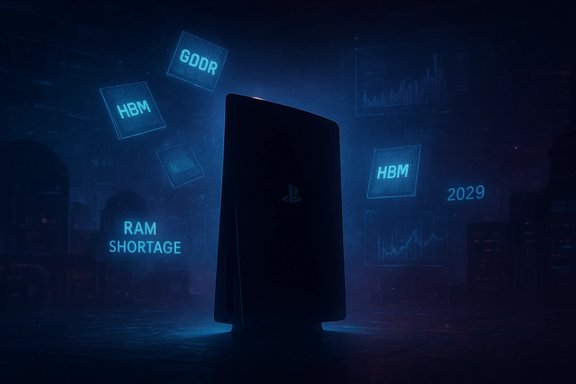
Sony’s next console could slip off the 2027–2028 roadmap and drift into 2029 as an industry‑wide RAM squeeze forces hardware makers to rethink production schedules and price targets, a scenario now circulating across trade press and the gaming press landscape. The memory crunch is not a single‑vendor hiccup but a structural reallocation of wafer capacity toward high‑bandwidth memory and AI datacenter customers — a shift that has already driven supply shortages, supplier strategy changes, and concrete corporate moves such as Micron’s announced exit from its Crucial consumer business through February 2026.
The PlayStation 5 launched in late 2020 and has remained Sony’s flagship platform through an extended lifecycle, with shipments surpassing 80 million units as of mid‑2025 — a sales footprint that explains both Sony’s willingness to prolong the PS5 generation and the stakes in timing a PS6 launch. At the same time, component inflation and allocation have changed the economics of console launches: Sony raised recommended U.S. pricing for PS5 SKUs in August 2025 (the standard PS5 to $549.99 and the PS5 Pro to $749.99), a move that signals both margin pressure and the reality that hardware costs can no longer be absorbed quietly. Across the semiconductor supply chain, memory manufacturers are prioritizing HBM and enterprise DRAM to satisfy AI infrastructure orders. The result: longer lead times, elevated contract prices for DDR5 and related consumer memory, and an effective thinning of the retail aftermarket. Industry trackers and financial outlets report sharp DRAM price rises and constrained inventories through 2026, with capacity additions not meaningfully alleviating shortages until later fab ramps come online in 2027–2029.
Acknowledging the uncertainty, the responsible course for consumers and industry watchers is to follow supplier earnings, official OEM statements, and confirmed product announcements — and to prepare procurement and upgrade plans with both scenarios (on‑time next‑gen launch vs. delayed launch due to RAM shortages) in mind.
Source: Technobezz Sony PlayStation 6 Faces Potential Delay to 2029 Due to RAM Shortages
 Background
The PlayStation 5 launched in late 2020 and has remained Sony’s flagship platform through an extended lifecycle, with shipments surpassing 80 million units as of mid‑2025 — a sales footprint that explains both Sony’s willingness to prolong the PS5 generation and the stakes in timing a PS6 launch. At the same time, component inflation and allocation have changed the economics of console launches: Sony raised recommended U.S. pricing for PS5 SKUs in August 2025 (the standard PS5 to $549.99 and the PS5 Pro to $749.99), a move that signals both margin pressure and the reality that hardware costs can no longer be absorbed quietly. Across the semiconductor supply chain, memory manufacturers are prioritizing HBM and enterprise DRAM to satisfy AI infrastructure orders. The result: longer lead times, elevated contract prices for DDR5 and related consumer memory, and an effective thinning of the retail aftermarket. Industry trackers and financial outlets report sharp DRAM price rises and constrained inventories through 2026, with capacity additions not meaningfully alleviating shortages until later fab ramps come online in 2027–2029. Why RAM matters for console launches
Console design is a delicate trade between GPU performance, memory bandwidth/capacity, storage speed, and controlled BOM (bill of materials) cost. Memory plays two distinct roles in a modern console:- High‑bandwidth local RAM (e.g., GDDR6/7 for GPUs) determines texture pools, streaming performance, and how much data can be fed to the GPU with low latency.
- System memory (DDR variants or unified memory architectures) supports OS, background services, and CPU workloads.
The production reality
- Memory fabs and advanced packaging lines are capital‑intensive and slow to expand. Announced fabs typically take multiple years to reach full yield and volume.
- Hyperscalers and AI vendors can place long, high‑priority contracts that absorb large fractions of capacity; these commitments crowd out spot sales and retail supply.
- For a mass‑market console launch, OEMs need predictable, high‑volume supply across multiple months to ramp manufacturing, hold retail stock, and run promotional launches.
What the reporting actually says — and what it doesn’t
Multiple outlets, aggregators, and industry insiders now report that Sony is evaluating later production windows for PlayStation 6 because of RAM allocation and price volatility. These reports reference industry contacts and the shifting memory market rather than an official Sony postponement. That distinction matters: the claim about a PS6 launch slipping to 2029 is a risk scenario supported by market evidence, not a confirmed release date from Sony. Key, verifiable facts underpinning the claims:- DRAM and HBM demand: Analysts and media outlets report that HBM demand from AI customers has surged, pushing DRAM markets into a tighter cycle and raising prices across categories. This creates lead‑time and pricing risk for consumer device manufacturers.
- Micron business pivot: Micron publicly announced plans to exit its Crucial consumer business and focus on enterprise/HBM customers, with consumer shipments ending at the close of fiscal Q2 (February 2026). That corporate move removes a major consumer‑facing source of modules and signals how suppliers are reprioritizing allocations.
- PS5 install base & price history: The PS5 remains Sony’s primary gaming platform, shipped at scale and recently subject to a U.S. price increase that changes consumer upgrade calculus.
- Exact PS6 release date or official postponement: No official Sony schedule has been published committing to a 2029 launch window. Industry commentary calling 2029 a plausible manufacturing horizon should be treated as projection and planning analysis rather than a corporate announcement.
- Specific PS6 hardware specs (e.g., RDNA 5 details, GDDR7 capacity): These are leak‑driven and vary across reports; they should be flagged as unconfirmed until confirmed by AMD/Sony or seen in official documentation.
Strategic consequences for Sony and console buyers
The memory squeeze reshapes several strategic variables for Sony — and for customers deciding whether to upgrade now or wait.- Price sensitivity: Sony must choose between passing memory cost increases to consumers (higher MSRP) or preserving price points and accepting tighter margins on hardware. Recent PS5 price rises illustrate how component economics can force market price adjustments. If Sony ships PS6 hardware with expensive next‑gen memory at scale, the MSRP could climb well above prior console launches — a politically and commercially risky move.
- Timing and first‑mover dynamics: Microsoft’s confirmed multi‑year partnership with AMD to co‑engineer next‑generation silicon increases competitive pressure for early reveals or launches. An early, successful launch can create software and marketing momentum; a delayed launch risks surrendering narrative and consumer mindshare.
- Software window and content alignment: Major tentpole releases — now most notably Grand Theft Auto VI, pushed to November 19, 2026 — create launch opportunities that could influence console rollouts. A PS6 timing that aligns with blockbuster titles would be strategically advantageous, but it also raises the stakes for hardware readiness.
- Extended PS5 lifecycle: With a healthy install base and continual updates to first‑party services and pricing, Sony could intentionally prolong the PS5 generation to allow component markets to normalize and to give developers time to migrate to a new hardware baseline.
Financial and supply‑chain implications
The memory cycle is inherently multi‑year. Manufacturing capacity expansion — new fabs, packaging and testing lines — takes time and significant capital. Analysts and trade coverage now forecast tightness through at least 2026 and possibly into 2027–2028, with some capacity ramps not meaningfully easing pressure until 2027–2029. This timing is the precise window that fuels speculation about a 2029 PS6 volume ramp rather than mid‑2027. Micron’s exit from the retail Crucial brand is a canary in the coal mine: it reduces aftermarket liquidity for memory and signals supplier prioritization of enterprise orders over consumer channel fulfillment. That means:- OEMs will be forced to negotiate long‑lead allocation deals and to commit earlier to component purchases.
- Smaller PC and console accessory manufacturers may find retail RAM scarce or significantly more expensive.
- End‑user prices for upgrades and prebuilt systems could remain elevated, compressing the upgrade cycle for price‑sensitive buyers.
What it means for developers and the gaming ecosystem
For studios and middleware providers, a delayed console generation offers mixed outcomes.- Opportunity: An extended PS5 generation gives developers more time to extract performance from existing hardware, refine cross‑gen engines, and avoid a rushed generational transition that fragments development talent and tools.
- Constraint: Game engines and design ambitions that count on increased memory and bandwidth in next‑gen hardware may need to be deferred or rearchitected for backward compatibility with PS5. Titles optimized for projected PS6 capabilities might be delayed or scaled back to ship on the larger PS5 install base.
- Marketing alignment: Major third‑party releases that would benefit from PS6’s raw power (e.g., those with massive open worlds, higher‑resolution textures, or advanced AI features) may either push for delayed launches, staggered releases, or targeted PC optimizations. The GTA VI release schedule and its technical demands are one example of how software calendars intersect with hardware readiness.
Strengths of the current scenario for Sony
- Large installed PS5 base reduces urgency: Shipments above 80 million provide a revenue cushion and help justify measured timing. Sony can focus on maximizing PS5 lifecycle revenue while waiting for memory markets to stabilize.
- Time to innovate system architecture: A longer development and production window gives Sony more runway to refine memory subsystems, compression algorithms, and new silicon collaborations (e.g., Project Amethyst leaks indicating neural assistive hardware). These technical gains can deliver more compelling generational leaps rather than incremental upgrades.
- Avoiding overpriced launch PR damage: Launching an over‑expensive console risks alienating consumers; delaying to avoid an MSRP north of consumer tolerance may preserve long‑term brand goodwill.
Risks and trade‑offs
- Competitive timing: If Microsoft or another platform captures an earlier market window with a compelling value proposition, Sony could face perceptual headwinds even if the PS6 is technically superior.
- Consumer fatigue and expectations: Extended waits risk fan frustration, second‑hand rumor fatigue, and speculative pricing—especially where leaks suggest expensive premium SKUs.
- Supply concentration risk: Relying on a narrow set of memory suppliers raises geopolitical and production risk. Single‑vendor problems or localized disruptions could cascade across global console production.
- Software generation split: A long tail for PS5 combined with a delayed PS6 could create a chasm in tooling, certification, and cross‑platform parity that developers must manage.
Practical guidance for buyers and WindowsForum readers
- If immediate gaming or PC upgrades are necessary, consider acting now rather than delaying entry-level purchases; supply and price windows can tighten further. Where possible, choose platforms and SKUs that allow future expansion (user‑upgradeable RAM, modular storage).
- For console buyers: weigh whether the current PS5 ecosystem — now with continued first‑party support and blockbuster releases on the horizon — satisfies your needs through the rest of the decade. If so, waiting for a well‑timed PS6 with stable pricing may be a sound decision.
- For PC builders and integrators: consider contract hedging, alternate suppliers, or slightly different module specs that meet performance needs at better price points. Enterprise and large OEM purchasers should prioritize staged procurement and long‑term allocation commitments.
What to watch next (roadmap checklist)
- Official Sony communications — any formal PS6 date, partner announcements, or production milestones.
- Memory supplier statements and contract price indices — Samsung, SK Hynix, Micron earnings calls and guidance will be telltale signals for allocation and price trends.
- AMD and Microsoft roadmap events — details on next‑gen silicon partnerships and chip timelines can shift OEM strategic decisions.
- Major launch titles timing — if multiple publisher tentpoles target 2027 launches, OEMs may accelerate or delay to match software windows (GTA VI is a case to monitor).
- Retail and aftermarket module availability — sustained shortages or Micron’s Crucial exit effects will be observable in retail channels and module pricing.
Final assessment — cautious optimism with caveats
The PlayStation 6 delay narrative is a credible and pragmatic industry scenario grounded in measurable memory market dynamics rather than pure rumor. The structural reallocation of DRAM and HBM capacity toward AI customers and the strategic choices of major suppliers (notably Micron’s withdrawal from the Crucial consumer channel) materially raise the probability of later mass production windows for any hardware that depends on high volumes of next‑generation memory. At the same time, a delayed PS6 is not an inevitability. Memory markets can rebalance if new capacity ramps faster than expected or if long‑term contracts loosen. Sony retains the strategic flexibility to adjust BOMs, stagger SKUs, and use software-driven features (compression, upscaling, neural assist) to reduce absolute memory demands at launch — all levers that mitigate risk but come with design and marketing trade‑offs. Readers should treat the 2029 figure as a planning horizon — useful for thinking about procurement, development timelines, and price expectations — but not as a confirmed release date. Where reporting references leaks or insider commentary, those items should be considered provisional and flagged accordingly. The console market will reflect a broader truth over the next 12–36 months: hardware timing is once again being shaped by memory economics, and that has meaningful consequences for OEMs, developers, and gamers alike.Acknowledging the uncertainty, the responsible course for consumers and industry watchers is to follow supplier earnings, official OEM statements, and confirmed product announcements — and to prepare procurement and upgrade plans with both scenarios (on‑time next‑gen launch vs. delayed launch due to RAM shortages) in mind.
Source: Technobezz Sony PlayStation 6 Faces Potential Delay to 2029 Due to RAM Shortages
