Valve has told customers it can no longer lock in exact launch dates or prices for the Steam Machine family because AI-driven memory and storage shortages have materially changed component availability and costs since the devices were announced, and the company will “revisit our exact shipping schedule and pricing” as a result. ([store.steampowersteampowered.com/news/group/45479024/view/625565405086220583))
When Valve unveiled the new Steam Machine, the Steam Frame VR headset, and a redesigned Steam Controller in November, the company and partners presented a coherent plan: ship all three devices in early 2026 (the public window later described as the first half of 2026) and provide final pricing and preorder details in the months that followed. Early hands‑on coverage emphasized a compact, living‑room‑focused hardware design built around a semi‑custom AMD Zen 4 CPU and an RDNA‑derived GPU block, and promised a performance target centered on 4K60 thrr native rendering.
Since that reveal, global memory and NAND supply dynamics have shifted sharply. Large memory suppliers and industry analysts report that datacenter AI buildouts and high‑bandwidth memory (HBM) demand have consumed wafer capacity and packaging resources historically available for consumer DDR and GDDR products. That reallocation has pushed lead times up and contract/spot pricing sharply higher, forcing OEMs and device makers to reconsider the economics of launching hardware that depends on commodity DRAM, GDDR, and NVMe parts.
Valve’s short, public-facing FAQ update frames the decision plainly: Valve’s goal to ship in the first half of 2026 remains, but the company cannot yet commit to specific dates or MSRPs because memory and storage shortages “have rapidly increased” since November, creating uncertainty for its bill of materials. Valve said it will keep customers informed as it finalizes plans. (store.steampowered.com)
This is not just theoretical: memory manufacturers and market commentators have documented that DRAM contract prices surged through late 2025 and into 2026, and several vendors have signaled they are reprioritizing wafer and backend capacity toward enterprise/HBM products over commodity DDR/GDDR supply. That allocation dynamic creates a zero‑sum situation where every wafer used for a high‑margin HBM stack is one less wafer available for consumer modules. The result is longer lead times and higher pricing for the parts Valve needs to make a competitively priced, living‑room appliance.
The upshot: even well‑funded device plans are vulnerable when the upstream supply base reprioritizes capacity to the very largest buyers. Valve’s modest product run sizes compared with hyperscale AI customers mean it competes for wafers and backend packaging in an allocation market that favors server and accelerator buyers. That is not a short‑term blip; capacity expansion for advanced memory takes years and billions in capital, and the initial fab ramps will primarily serve advanced and HBM segments.
For the wider PC hardware market, Valve’s situation is an early example of a broader tug‑of‑war between AI datacenter priorities and consumer device availability. That tug the shape of PC hardware launches across 2026: some devices will be delayed, others will ship at higher prices, and some manufacturers will pursue SKU rationalization to survive the allocation squeeze. Valve’s public step back is a pragmatic acknowledgment that small‑appliance economics do not exist in a vacuum — they exist inside a global memory market that currently favors the biggest spenders.
Source: Windows Central Valve's Steam Machine PC is delayed by AI-driven component shortages
 Background
When Valve unveiled the new Steam Machine, the Steam Frame VR headset, and a redesigned Steam Controller in November, the company and partners presented a coherent plan: ship all three devices in early 2026 (the public window later described as the first half of 2026) and provide final pricing and preorder details in the months that followed. Early hands‑on coverage emphasized a compact, living‑room‑focused hardware design built around a semi‑custom AMD Zen 4 CPU and an RDNA‑derived GPU block, and promised a performance target centered on 4K60 thrr native rendering.Since that reveal, global memory and NAND supply dynamics have shifted sharply. Large memory suppliers and industry analysts report that datacenter AI buildouts and high‑bandwidth memory (HBM) demand have consumed wafer capacity and packaging resources historically available for consumer DDR and GDDR products. That reallocation has pushed lead times up and contract/spot pricing sharply higher, forcing OEMs and device makers to reconsider the economics of launching hardware that depends on commodity DRAM, GDDR, and NVMe parts.
Valve’s short, public-facing FAQ update frames the decision plainly: Valve’s goal to ship in the first half of 2026 remains, but the company cannot yet commit to specific dates or MSRPs because memory and storage shortages “have rapidly increased” since November, creating uncertainty for its bill of materials. Valve said it will keep customers informed as it finalizes plans. (store.steampowered.com)
Why the shortage matters for a compact appliance like the Steam Machine
The supply shock is not abstract — it hits the Steam Machine’s economics directly
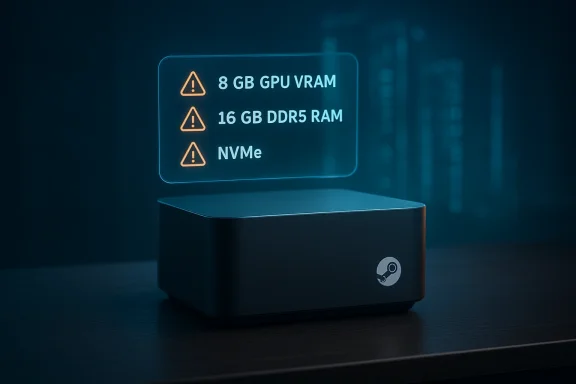
The Steam Machine’s value proposition depends on predictable BOM (bill‑of‑materials) economics. Valve’s announced design is intentionally compact: a semi‑custom AMD Zen 4 CPU, a midrange RDNA3‑style GPU block with roughly 8 GB of GDDR6 VRAM, 16 GB of DDR5 system memory, and NVMe storage options in a small chassis. Those memory figures matter because both system memory and GPU VRAM are direct inputs to perceived gaming quality — texture pools, streaming behavior, shader cache sizes and upscaling budgets all depend on them. If the cost or availability of DDR5, GDDR6, or NVMe components swings wildly, the device either becomes more expensive, loses capability via downgraded specs, or suffers both.This is not just theoretical: memory manufacturers and market commentators have documented that DRAM contract prices surged through late 2025 and into 2026, and several vendors have signaled they are reprioritizing wafer and backend capacity toward enterprise/HBM products over commodity DDR/GDDR supply. That allocation dynamic creates a zero‑sum situation where every wafer used for a high‑margin HBM stack is one less wafer available for consumer modules. The result is longer lead times and higher pricing for the parts Valve needs to make a competitively priced, living‑room appliance.
Small chassis design multiplies the impact
Small form‑factor designs like the Steam Machine are sensitive to per‑unit cost changes. There’s less margin flexibility compared to high‑end boutique SFF systems where customers may accept a premium for me, that tight envelope means a modest GDDR6 price jump or an NVMe cost spike can push the product into a pricing bracket that competes unfavorably with consoles or established SFF PCs — undermining the original consumer value proposition. Valve’s explicit mention that it’s revisiting pricing and schedules makes commercial sense in that context.Technical reality check: performance claims, VRAM, and upscaling
Valve’s performance messaging — what they actually promised
Valve’s early materials claim the Steam Machine can deliver “the majority of Steam titles” at 4K/60 with AMD FSR (upscaling) and that the hardware is multiple times faster than a Steam Deck‑class APU ns. Those are tightly couched claims: Valve repeatedly points to upscaling as the method to hit 4K60, not native 4K on max settings across the entire AAA catalog. Upscaling is a valid approach, but success depends on which generation of upscaling, game engine behavior, and how memory pressure affects texture streaming.FSR, Redstone/FSR 4, and the GPU generation gap
AMD’s FSR stack has evolved rapidly. The newest generation — branded by AMD as FSR “Redstone” (sometimes referenced as FSR 4 in earlier messaging) — bundles ML‑powered upscaling, frame generation, and ray‑regeneration features and is optimized for the latest RDNA4 silicon. Redstone can provide substantial quality and performance improvements, but it requires driver and hardware support that is best realized on RDNA4‑class GPUs. The Steam Machine’s semi‑custom GPU block appears to be RDNA3‑derived; that makes full Redstone parity unlikely on day one and suggests the device may rely on older FSR variants (FSR 3.1 / FSR Upscaling fallbacks) for many titles. That compromise would blunt some of the most dramatic upscaling gains Redstone advertises for RDNA4 devices.VRAM is the tightest constraint in many modern games
Even with excellent upscaling, 8 GB of GPU VRAM is a material vulnerability for modern AAA workloads at 4K internal resolutions or heavy texture pools. VRAM pressure causes texture thrashing, stuttering, and long shader or stream stalls that reduce perceived smoothness even if raw frame rates appear acceptable. Upscaling reduces the number of pixels the GPU must render, but it does not eliminate the need for sufficient VRAshader working sets. For Valve’s claim to hold up in real‑world conditions across a broad catalog, the software stack (driver memory management, Proton/Mesa shader caches), game engine settings (texture pool caps), and selective developer support will all need to be carefully tuned. Those software fixes can help, but they are not a free or instantaneous substitute for additional VRAM.Commercial and engineering options Valve faces
Valve has a few pragmatic paths forward — each with tradeoffs.- Ship as planned but accept a higher MSRP. That preserves the spec sheet but risks sidelining mainstream buyers who compare the Steam Machine to consoles or cheaper SFF machines. Higher launch prices also risk long‑term perception issues even if component price normalization later reduces BOM costs.
- Ship a lower‑spec baseline (e.g., reduced system RAM, smaller SSD) and keep the GPU VRAM at 8 GB. This keeps price down but worsens the device’s longevity and increases the likelihood of early perceptual disappointments for demanding titles.
- Introduce a second SKU with more VRAM (e.g., a 16 GB GPU variant), but that adds complexity to supply and inventory and may not be feasible if GDDR6 allocations are constrained.
- Delay final launch until supply and pricing stabilize, absorbing the marketing and opportunity costs of a later release but protecting long‑term brand perception and value expectations.
Broader industry context: memory companies and the AI pivot
The Steam Machine’s troubles are a slice of a larger industry shift. Memory manufacturers — most notably the largest DRAM/NAND suppliers — are prioritizing server and AI markets because HBM and server DRAM command substantially higher margins, and hyperscalers are locking multiyear commitments. Public commentary from industry leaders confirms that the reallocation and production lead times will keep consumer DRAM tight through 2026 and beyond absent a demand slow‑down. Micron and other OEMs have warned that supply constraints tied to AI demand could persist well into the coming year(s), and third‑party analyses document dramatic year‑over‑year price increases and extended lead times for DDR5 and NVMe parts. Those structural dynamics are the engine behind Valve’s commercial uncertainty.The upshot: even well‑funded device plans are vulnerable when the upstream supply base reprioritizes capacity to the very largest buyers. Valve’s modest product run sizes compared with hyperscale AI customers mean it competes for wafers and backend packaging in an allocation market that favors server and accelerator buyers. That is not a short‑term blip; capacity expansion for advanced memory takes years and billions in capital, and the initial fab ramps will primarily serve advanced and HBM segments.
What this means for buyers and the WindowsForum community
If you planned to buy
- Be cautious about preorder enthusiasm until Valve announces MSRP and shipping windows. Valve’s intent to “keep you updated” is sincere but not a guarantee that launch pricing will match initial expectations. (store.steampowered.com)
- If your library includes texture‑heavy, open‑world or anti‑cheat‑sensitive multiplayer titles, test those games where possible on low‑VRAM systems or SteamOS/Proton previews so you can assess compatibility and smoothness yourself. Valve’s early claims are credible on many titles but will not be universal.
- Consider alternative buys in the near term if you need guaranteed native fidelity or upgradeability: small SFF builds with discrete 16 GB GPU cards or current‑gen consoles remain less risky options for full native 4K play in the short run.
If you were going to build a DIY alternative
The shortages that affect Valve also affect DIY builders. Spot market volatility means RAM and NVMe prices are currently unreliable; if an upgrade or build is urgent, buy parts you need when you find acceptable prices. For non‑urgent builds, waiting for supply stabilization could yield better value, but that window is uncertain and may extend into 2026 or beyond.Engineering caveats and verification checklist for independent reviewers
Valve’s claims hinge on a suite of verifiable technical and operational points that independent reviewers must test and publish:- Sustained thermal performance under multi‑hour 4K sessions ttling behavior, and fan/noise profile).
- Real‑world 4K60 experience across a representative AAA sample set using the Steam Machine’s upscaling presets and driver stack.
- Shader‑cache behavior and stutter profile during cold starts and first runs in popular engines.
- VRAM‑related edge cases: texture stream stalls, quality fallbacks, and frame‑time variance at target resolutions.
- Proton/SteamOS compatibility for networked, anti‑cheat‑protected multiplayer titles.
- Final MSRP and available SKUs (8 GB vs 16 GB VRAM variants) and regional availability.
Strengths in Valve’s position — and why a delay could be defensible
Valve has several practical strengths that make it reasonable to pause and finalize commercial details rather than rush a launch into unfavorable unit economics:- Vertical control of software and platform. Because the Steam Machine is a Valve‑controlled SteamOS endpoint, Valve can coordinate drit updates in ways traditional OEMs can’t, enabling targeted memory and shader mitigations specific to this platform.
- Ecosystem leverage. Steam’s enormous digital library, existing Proton compatibility work, and Valve’s relationships with developers give it the ability to prioritize fixes and partner implementations for a set of high‑value titles on the new hardware.
- Clear communication. Publicly acknowledging market realities and waiting until pricing and supply are predictable helps prevent reputational damage that follows launching an over‑priced or underperforming device.
Risks and downside scenarios
There are several credible negative outcomes Valve must guard against:- Price anchoring. If Valve announces a high MSRP in 2026 due to component costs and then prices normalize, the initial price becomes the perceived baseline and could suppress uptake even after market recovery.
- Competitive timing. Missing a late‑Q2/holiday 2026 launch window hands momentum to consoles and OEM SFF partners who can offer more competitive value if Valve’s timing slips.
- Software compatibility traps. Anti‑cheat adoption on Proton, driver regressions, or late developer support for Redstone/FSR features could make the living‑room experience uneven for popular multiplayer titles.
- Public perception. Repeated schedule changes or SKU confusion tends to erode early adopter confidence; Valve will need to manage messaging tightly to avoid fatigue.
Bottom line
Valve’s decision to pause and refine launch timing and pricing for the Steam Machine family is a conservative and sensible reaction to a genuine market dislocation: AI-driven memory and storage demand is reshaping the economics and availability of the very components that define the product’s value proposition. The company’s public update does not cancel the product — it preserves flexibility so Valve can choose the SKU and price structure that best matches market reality and consumer expectations. For buyers, the sensible posture is to wait for the final MSRPs and independent reviews before committing.For the wider PC hardware market, Valve’s situation is an early example of a broader tug‑of‑war between AI datacenter priorities and consumer device availability. That tug the shape of PC hardware launches across 2026: some devices will be delayed, others will ship at higher prices, and some manufacturers will pursue SKU rationalization to survive the allocation squeeze. Valve’s public step back is a pragmatic acknowledgment that small‑appliance economics do not exist in a vacuum — they exist inside a global memory market that currently favors the biggest spenders.
Quick checklist for readers (what to do next)
- If you planned to buy: wait for Valve’s MSRP and independent thermal/compatibility reviews. (store.steampowered.com)
- If you need a new console‑class living‑room device now: favor consoles or SFF PCs with larger VRAM budgets to avoid early engine and texture limitations.
- If you build: consider locking in memory and NVMe at acceptable prices now only if the upgrade is necessary; otherwise, watch market signals over the next few quarters.
Source: Windows Central Valve's Steam Machine PC is delayed by AI-driven component shortages