

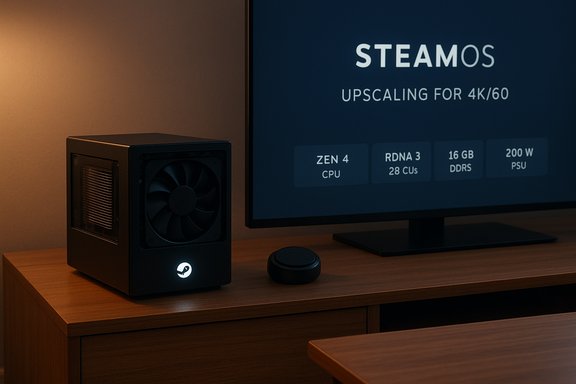
Valve's living-room return to PC gaming landed as a compact, SteamOS-powered cube that promises a console‑style plug‑and‑play experience with desktop-class silicon — a six‑core Zen 4 CPU, 16 GB DDR5, and a semi‑custom RDNA 3 GPU with 28 compute units and 8 GB of GDDR6 — engineered to hit 4K/60 with upscaling and to occupy the space between a console and a small form‑factor PC.
Valve first tried to place PCs under the TV with the original Steam Machine experiments in the 2010s, but those early efforts were fragmented and vendor‑dependent. The arrival of the Steam Deck in 2022 changed the calculus: Valve’s investment in SteamOS and Proton turned a Linux‑based platform into a real competitor for Windows in many gaming scenarios. The new Steam Machine takes that software foundation and assembles it with more powerful, semi‑custom AMD silicon to target living‑room 4K gaming while keeping the simplified setup and UI that made the Deck appealing. Valve’s public spec sheet lists the core hardware succinctly: a 6‑core/12‑thread AMD Zen 4 CPU, 16 GB DDR5 system RAM, and a semi‑custom RDNA 3 GPU built from a Navi 33 derivative — 28 CUs and roughly 2.4–2.5 GHz boost targets, paired with 8 GB of GPU memory. Storage options are 512 GB or 2 TB NVMe (2230 form factor), plus a microSD slot and accessible NVMe expansion. The unit is intentionally compact and uses an internal power supply rated around 200 W, with a reported GPU power envelope in the 110–130 W range.
Key trade‑offs Valve accepted in the cooling design:
Source: PC Gamer https://www.pcgamer.com/hardware/gaming-pcs/steam-machine-specs-availability/
 Background / Overview
Valve first tried to place PCs under the TV with the original Steam Machine experiments in the 2010s, but those early efforts were fragmented and vendor‑dependent. The arrival of the Steam Deck in 2022 changed the calculus: Valve’s investment in SteamOS and Proton turned a Linux‑based platform into a real competitor for Windows in many gaming scenarios. The new Steam Machine takes that software foundation and assembles it with more powerful, semi‑custom AMD silicon to target living‑room 4K gaming while keeping the simplified setup and UI that made the Deck appealing. Valve’s public spec sheet lists the core hardware succinctly: a 6‑core/12‑thread AMD Zen 4 CPU, 16 GB DDR5 system RAM, and a semi‑custom RDNA 3 GPU built from a Navi 33 derivative — 28 CUs and roughly 2.4–2.5 GHz boost targets, paired with 8 GB of GPU memory. Storage options are 512 GB or 2 TB NVMe (2230 form factor), plus a microSD slot and accessible NVMe expansion. The unit is intentionally compact and uses an internal power supply rated around 200 W, with a reported GPU power envelope in the 110–130 W range. Hardware deep dive
CPU and memory
- CPU: AMD Zen 4, 6 cores / 12 threads. This choice balances strong single‑thread performance for game engines with modest thermals in a compact box. The Zen 4 family offers far better IPC and clocking headroom than the Zen 2 cores used in the Steam Deck, which helps explain much of the raw performance uplift Valve quotes.
- Memory: 16 GB DDR5 in SO‑DIMM format. Valve expects this to be user‑replaceable, though access requires partial disassembly and removal of a heatsink system. The SO‑DIMM approach mirrors laptop designs and allows for some future upgrades, but it’s not as trivial as popping open a tower.
GPU: semi‑custom RDNA 3
Valve’s GPU is the headline: a semi‑custom RDNA 3 block with 28 compute units and 8 GB GDDR6. Based on the published details, this GPU is clearly a derivative of AMD’s Navi 33 silicon used across mid‑range Radeon 7000 series parts. Independent device and GPU databases show that Navi 33 chips in consumer cards vary (for example, RX 7400 and RX 7600 family parts), but the Steam Machine’s clock and power targets place its GPU between a mobile RX 7600M and a desktop RX 7400/7600 in sustained wattage and performance. Tech databases confirm Navi 33’s presence in 28‑CU mobile and desktop parts, making Valve’s specification plausible.- Reported clock: around 2.4–2.5 GHz (boost region).
- Reported GPU TDP/sustained draw: ~110–130 W.
- VRAM: 8 GB GDDR6.
Storage and expandability
Valve ships the Steam Machine with a single NVMe in 2230 form factor (512 GB or 2 TB) and provides a 2230 → 2280 standoff for hobbyists willing to swap and clone drives. The device also supports microSD (SDXC) cards — a practical expansion route that Valve explicitly supports for game libraries, though performance will depend on card speed and the nature of game assets. In short: convenient, but users seeking the fastest load times should plan to buy the faster NVMe SKU or install a high‑end 2280 if they’re comfortable with hardware work.I/O, wireless and chassis
The Steam Machine adopts a TV‑centric port set: HDMI 2.0, DisplayPort 1.4, gigabit Ethernet, USB‑C (10 Gbps), several USB‑A ports, and Wi‑Fi 6E / Bluetooth connectivity. There’s also an integrated low‑latency 2.4 GHz radio for Valve’s new Steam Controller puck, and a removable faceplate for dust access and optional cosmetic customization. Physically, Valve chose a compact cube optimized around thermal efficiency, using the power supply as part of the chassis to save space and improve RF shielding. The cooling core uses a large heatsink and a single custom 120 mm fan intended to be quiet while moving the required airflow.Software: SteamOS, Proton and the compatibility picture
The Steam Machine ships with Valve’s modern SteamOS — the same lineage that powers the Deck — so users get the Big Picture/TV‑first UI, fast suspend/resume, cloud saves, Steam Input, and the Proton compatibility layer that runs Windows games on Linux. Proton’s dramatic evolution since the early Steam Machine days is what makes Valve confident the library will run well on this device. Valve engineers call Proton “the secret sauce” because it reduces the friction for developers and users alike. Practical realities to note:- SteamOS delivers measurable overhead reductions versus Windows on certain systems. Independent benching on SteamOS‑compatible handhelds (for example, the Lenovo Legion Go S) has shown SteamOS can raise frame rates by double‑digit percentages in modern titles versus Windows 11 on identical hardware in many tests. That advantage is real and repeatable across multiple outlets.
- Anti‑cheat remains the primary compatibility Achilles’ heel. Titles that rely on kernel‑level anti‑cheat tooling that doesn't run under Proton can be restricted or unsupported on Linux. Valve has made progress with some vendors, but not all large multiplayer titles are guaranteed to work out of the box. Valve acknowledges the risk and points out users can install Windows if needed — but that effectively removes SteamOS benefits and is a pragmatic caveat for competitive gamers.
Performance claims: parsing the "6x faster" headline
Valve and early hands‑on previews say the Steam Machine is “over six times faster than the Steam Deck.” This headline is a compact marketing shorthand that requires nuance.- Why the number is plausible: the Steam Deck’s custom APU is a low‑power Zen 2 + RDNA2 design with an extremely constrained thermal envelope. Moving from that APU to a Zen 4 CPU and a larger RDNA 3 GPU block with sustained tens of watts more TDP raises the theoretical TFLOPS and real‑world throughput substantially. Valve’s quoted aim — to hit 4K/60 using spatial/temporal upscaling like FSR — is achievable in many titles with the Steam Machine’s spec envelope, particularly when comparing raw shader throughput and clocks.
- Why the number is misleading if taken literally: “6x” likely refers to a synthetic or peak compute comparison rather than a guarantee of native 4K/60 across the Steam catalog. Real games are limited by texture streaming, CPU logic, driver maturity, ray tracing costs, and thermal sustainment. Several early hands‑on sessions (including a brief Cyberpunk 2077 demo) show the Steam Machine can reach playable frame rates in 4K with FSR, but sustained, silky 60 fps in the most demanding AAA titles often still required reducing settings or dropping to 1080p for fully fluid motion. Treat “6x” as an indicator of substantial uplift over Pocket‑class silicon, not as an ironclad promise of native maximum settings at 4K in every game.
- SteamOS helps: Valve and independent reviewers note that SteamOS itself can deliver material performance gains against Windows on the same hardware, which effectively widens the margin between the Deck and the Steam Machine in real world gaming. Multiple testbeds (Lenovo Legion Go S and others) documented SteamOS performance uplifts in the 10–30% range in certain titles compared to Windows 11. Those gains are meaningful in a mid‑range GPU like Valve’s semi‑custom part.
Acoustic and thermal engineering: the cube design
Valve deliberately shaped the Steam Machine into a near‑cube to balance shelf‑fit, airflow, and sound signature. The company uses a sandwich‑style chassis with the PSU forming part of the structural shell, a large heatsink that cools CPU, GPU and power delivery, and a single 120 mm fan designed for low noise. Early hands‑on reports describe the unit as surprisingly quiet on the Cyberpunk demo, but engineers caution that sustained 4K/60 workloads will test thermal headroom and may force lower sustained clocks than short‑burst peaks. Independent reviewers will need to verify how the machine behaves over multiple hours of gameplay.Key trade‑offs Valve accepted in the cooling design:
- Single fan → quieter idle and lower audible signatures, but potential limits on long‑term thermal headroom.
- Internal PSU as structural element → smaller footprint and fewer brackets, but makes power‑delivery servicing or repair harder.
- Compact cube → fits many entertainment centers, but dense packaging increases the importance of effective airflow and dust management (Valve supplies a removable faceplate for cleaning).
Upgradeability, repairability and longevity
Valve positions the Steam Machine as more like a console appliance than a traditional PC, but they left some upgrade paths open:- Easy: NVMe expansion — the 2230 slot is user‑accessible; Valve also supports microSD for cheap capacity increases.
- Harder: RAM replacement — the 16 GB SO‑DIMM sticks are replaceable but require disassembly and heatsink removal.
- Not practical: CPU/GPU upgrades — the semi‑custom SOC and integrated thermal design make swapping major silicon impossible for consumers.
Price, launch timing and regional availability
Valve is targeting a 2026 release window but has not published final MSRP at the time of early previews. The company ships the Steam Machine to the same regions where the Steam Deck is already available — the USA, Canada, the UK, Germany, France, Australia (direct), Japan, South Korea, Taiwan and Hong Kong via Komodo in some regions. Pricing will be decisive: a sub‑$700 sticker would position the Steam Machine as an attractive console alternative; anything near or above $1,000 would place it firmly against higher‑end SFF PCs and current‑gen consoles, complicating its value proposition.Comparison: Steam Machine vs console rivals and SFF PCs
- Versus current consoles (PS5 / Xbox Series X): The Steam Machine’s flexibility (modding, multiple storefronts, configurable settings) is a strength, but for pure cost‑to‑performance, consoles that subsidize hardware against game and service ecosystems will remain competitive at certain price points. Native 4K/60 at max settings remains more consistent on consoles for many titles due to optimization and fixed hardware targets.
- Versus small form‑factor PCs: Boutique SFF desktops often outpace integrated appliances in raw performance and upgradeability, but they require more assembly, management and often cost more at equivalent spec levels. Valve is pitching convenience and a locked‑down living‑room experience as the differentiator.
- Versus the Steam Deck: Different form factors and roles. The Deck is portable and optimized for battery life and handheld ergonomics; the Steam Machine is a docked, living‑room box optimized for quiet acoustics and higher wattage compute. The “6x” claim communicates the gap in raw potential, but each device solves different problems.
Risks, unknowns and verification checklist
Even with impressive early previews, several open questions require verification before recommending purchase:- Sustained thermal performance under multi‑hour 4K loads and the resulting frame‑time consistency.
- Real‑world performance across a representative AAA set (native 4K, upscaling at various presets, RT on/off).
- Anti‑cheat and online multiplayer compatibility for major live‑service titles.
- Final MSRP and bundled options (controller, puck, storage).
- Longevity and repair options — how Valve will handle RMA and extended support for a semi‑custom integrated product.
Who should pay attention — and who should wait
- Enthusiast living‑room PC fans who want the Steam UI and easy setup but dislike towers: the Steam Machine looks ideal, provided the final price is reasonable and Proton covers the titles you play most.
- Console buyers who want modding and PC features: consider the device only if the MSRP undercuts or matches the console + subscription economics you expect to pay; otherwise a console remains a safer, cheaper plug‑and‑play box.
- Competitive online players dependent on specific anti‑cheat stacks: wait until verified compatibility is confirmed for your favorite titles.
- SFF DIY builders and upgraders: likely to prefer a small tower for long‑term flexibility unless the Steam Machine’s convenience and integration are uniquely attractive to you.
Verdict: a practical rebirth, but not a miracle
Valve’s Steam Machine is a clear, pragmatic second attempt to place PC gaming in the living room without the tower annoyances. It pairs the matured SteamOS + Proton software stack with a semi‑custom AMD Zen 4 + RDNA 3 silicon block to deliver significantly more performance than the Steam Deck — a margin Valve quantifies as “over six times” in marketing terms. The hardware choices (16 GB DDR5, 28‑CU RDNA 3, internal PSU, custom fan, removable faceplate) show careful attention to acoustics, shelf fit and the TV‑first experience Valve wants to own. But important caveats remain. The 6x claim compresses a lot of nuance about workloads, driver maturity, upscaling dependence, and anti‑cheat exceptions. Independent benchmarks and real‑world multi‑hour stress tests are essential to separate peak numbers from sustainable experience. Price will ultimately decide whether Valve found a sweet spot between convenience and value or simply built a compelling but niche appliance.Final notes for buyers and reviewers
- Test the titles you play. Check ProtonDB and early community reports for anti‑cheat and multiplayer support before buying.
- Expect the Steam Machine to excel at practical 4K: mixed native rendering plus upscaling, not a universal native‑4K solution across the entire Steam catalog.
- If you value upgradeability above all else, a DIY SFF PC remains the best long‑term choice.
- Watch for independent thermal endurance and noise testing — these will be the clearest validators of Valve’s design claims.
Source: PC Gamer https://www.pcgamer.com/hardware/gaming-pcs/steam-machine-specs-availability/
