

Valve’s new Steam Machine is being presented as a compact, living‑room‑friendly way to run your Steam library — built and sold by Valve, powered by SteamOS and Proton, and explicitly positioned as a reference device that Valve hopes will invite other companies, modders, and everyday PC builders to “have a crack” at shipping their own SteamOS machines.
Valve’s hardware strategy since the Steam Deck has shifted from one‑off experiments toward a small family of devices that reuse the same software foundations: SteamOS, Proton, and a deck‑inspired Big Picture/TV interface. The Steam Machine — a compact black box designed for living‑room use — is intended to sit between a console and a conventional PC: plug it into your TV, pair a controller, and get the “Steam experience” without a Windows license or a tower‑build. Valve stresses the product is its own hardware and will be sold by Valve, yet Valve is actively encouraging third parties to port SteamOS to other form factors. Why this matters now is twofold. First, Valve’s software stack has matured significantly since the first Steam Machines a decade ago: Proton has become a robust compatibility layer for many Windows games, and SteamOS (derived from Linux) now benefits from direct Valve investment and a community of compatibility contributors. Second, chip vendors and OEMs have produced efficient, high‑performance mobile APUs (notably AMD’s Z‑series and Intel’s Lunar Lake family), which make compact, quiet consoles viable without the thermal compromises that hampered earlier small consoles.
This article explains what the Steam Machine promises, what Valve’s openness to third parties realistically means, where SteamOS and Proton are today, and the technical and commercial obstacles that will determine whether this actually becomes a growing ecosystem or remains a niche alternative for enthusiasts.
Key points:
But do commercial OEMs have incentives to go all‑in on SteamOS?
But the path from a reference device to a thriving, diverse SteamOS desktop/console ecosystem depends on several non‑trivial factors:
Practical takeaways for readers considering a SteamOS living‑room box:
Source: PC Gamer The Steam Machine is made by Valve, but it says the door is open for other companies to have a crack at building their own
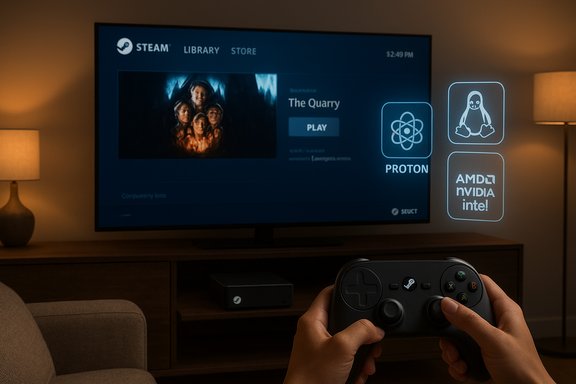 Background / Overview
Valve’s hardware strategy since the Steam Deck has shifted from one‑off experiments toward a small family of devices that reuse the same software foundations: SteamOS, Proton, and a deck‑inspired Big Picture/TV interface. The Steam Machine — a compact black box designed for living‑room use — is intended to sit between a console and a conventional PC: plug it into your TV, pair a controller, and get the “Steam experience” without a Windows license or a tower‑build. Valve stresses the product is its own hardware and will be sold by Valve, yet Valve is actively encouraging third parties to port SteamOS to other form factors. Why this matters now is twofold. First, Valve’s software stack has matured significantly since the first Steam Machines a decade ago: Proton has become a robust compatibility layer for many Windows games, and SteamOS (derived from Linux) now benefits from direct Valve investment and a community of compatibility contributors. Second, chip vendors and OEMs have produced efficient, high‑performance mobile APUs (notably AMD’s Z‑series and Intel’s Lunar Lake family), which make compact, quiet consoles viable without the thermal compromises that hampered earlier small consoles.This article explains what the Steam Machine promises, what Valve’s openness to third parties realistically means, where SteamOS and Proton are today, and the technical and commercial obstacles that will determine whether this actually becomes a growing ecosystem or remains a niche alternative for enthusiasts.
What the Steam Machine is — and what it isn’t
The Steam Machine is a Valve‑designed living‑room box running SteamOS and shipping with Valve’s controller and ecosystem support. Valve positions it as:- A plug‑and‑play, TV‑first way to play the Steam library with console‑style simplicity.
- A showcase for SteamOS + Proton: the OS experience Valve has refined on the Steam Deck and, more recently, the Steam Frame VR headset.
- A reference platform that Valve hopes OEMs and the modding community will adapt to other form factors and specs. Valve engineers have explicitly said they want to see other companies bring SteamOS to different iterations and that SteamOS already runs on third‑party handhelds like the Lenovo Legion Go S.
- It is not a device designed primarily to ship with Windows; Valve says the first units will ship with SteamOS and will not be flipped to Windows at the last minute.
- It is not a turnkey guarantee that every Windows game will run flawlessly — anti‑cheat and kernel‑level middleware remain an unresolved compatibility surface on Linux.
The software stack: SteamOS, Proton, and why it’s relevant
SteamOS: a lean, gaming‑first Linux
SteamOS is Valve’s Linux distribution tuned for a curated, living‑room style experience. It reduces background overhead, ships a console‑style launcher, and includes performance and power management optimizations that benefit small form factors. That lighter runtime is one reason reviewers found SteamOS‑based devices like the Legion Go S often outperform identical Windows SKUs on raw frame rate and battery life. Valve’s approach is pragmatic: ship a polished front end and keep the underlying OS open enough that OEMs and hobbyists can install it on diverse hardware. The company is also iteratively expanding driver and hardware support (for example, work to support Intel Lunar Lake class chips), but it remains a work in progress. Valve engineers acknowledge SteamOS currently has the strongest out‑of‑the‑box support for AMD hardware — Valve even maintains its own AMD driver team — and that support for Nvidia and some Intel graphics requires more work.Proton: the compatibility bridge
Proton, Valve’s Windows‑to‑Linux compatibility layer (based on Wine, DXVK, vkd3d, and many other projects), is the technical reason SteamOS can run much of the Windows Steam library. Proton + ongoing community variants (Proton‑GE) regularly receive fixes that make previously incompatible titles playable; Proton releases and community builds continue to add major compatibility and feature updates. Proton’s progress is one of the biggest reasons Valve now feels comfortable shipping living‑room hardware that relies on Linux.- Benefits: reduced background services, better thermal behavior in constrained devices, and the ability to ship without a Windows license cost.
- Limits: anti‑cheat systems (kernel‑level EAC/BattlEye variants) and some DRM toolchains remain problematic and can block certain multiplayer titles on Linux.
Hardware and driver reality: what works well and what needs work
Valve’s engineers have been candid: SteamOS has historically been strongest on AMD platforms because Valve actively develops and tests AMD driver stacks for the Deck‑class hardware. Supporting an arbitrary PC with, say, an RTX‑class GPU or a variety of Intel GPUs is a different engineering task — driver packaging, kernel‑module compat, and vendor cooperation are the gating issues.Key points:
- AMD: Valve has in‑house driver expertise and a close alignment with AMD’s mobile APUs, which is why the Steam Deck and many SteamOS ports perform well on AMD hardware. This is a strategic advantage for Valve as third‑party handhelds and small consoles increasingly choose AMD APUs.
- Intel: Valve has started explicitly improving support for Intel’s Lunar Lake family on SteamOS, reflecting a push to broaden hardware compatibility. Intel support has improved but still requires close work with Intel and OEMs.
- Nvidia: Proprietary Linux driver packaging, kernel module issues, and historic friction with open‑source ecosystems mean Nvidia remains the trickiest vendor for a "plug‑and‑play" SteamOS experience. Valve notes it will need extra engineering time to bring Nvidia parity to the level AMD enjoys. Reviewer and community reporting also highlights lingering rough edges when running Nvidia cards under some Linux setups.
The Lenovo Legion Go S case study: why SteamOS as a differentiator matters
Lenovo’s Legion Go S — offered by Lenovo both as a Windows device and as an official SteamOS variant — provides an early real‑world demonstration of Valve’s vision: identical hardware, different OS, noticeable differences in performance and battery life favoring SteamOS. Multiple independent reviews found consistent performance gains on SteamOS vs Windows for the Legion Go S hardware, sometimes in the 5–15% frame‑rate range depending on title and power mode, while battery life also improved due to reduced background processes and more efficient suspend/resume handling on SteamOS. What we learn from the Legion Go S:- SteamOS can outperform Windows on identical hardware in many titles, especially when the OS is optimized for the platform.
- SteamOS is not universally superior: driver gaps, input or OEM feature support, and particular edge bugs (e.g., device‑specific LED or input bugs) can still make the Windows build preferable for some users or uses.
- The existence of an OEM shipping SteamOS SKU proves Valve’s licensing model for the OS is practical — but it also surfaces the engineering work OEMs must commit to for a smooth shipping experience.
Will OEMs and third parties actually ship Steam Machines?
Valve’s public messaging is deliberately open: the company wants other players to adopt SteamOS for handhelds and small consoles. That openness includes official ports on devices such as Lenovo’s Legion Go S and examples from the hobbyist community (Framework laptops, DIY minis) running Valve’s recovery images.But do commercial OEMs have incentives to go all‑in on SteamOS?
- Pros:
- Lower software licensing cost (no Windows license), potentially better battery and thermal behavior on handhelds.
- A differentiated product for Steam‑centric gamers and living‑room use.
- Direct alignment with a growing Linux tooling and Proton compatibility ecosystem.
- Cons:
- The engineering cost of driver support, especially for Nvidia or broad Intel GPU coverage.
- Limited market reach for an OS that cannot run every Windows multiplayer title because of anti‑cheat restrictions.
- Consumer expectations and retail channels that are used to Windows desktops and consoles.
- Enthusiast OEMs and specialty boutique builders will produce SteamOS variants or customizable mini‑PCs.
- Larger OEMs will likely ship both Windows and SteamOS SKUs in some lineups (as Lenovo did) to hedge market preferences.
- The bulk of small form‑factor PCs will remain Windows‑first unless Valve can materially close the Nvidia and anti‑cheat gaps.
Compatibility risks: anti‑cheat, DRM, and the marketing hype trap
Two compatibility vectors remain significant risks for a broader SteamOS ecosystem.- Anti‑cheat and multiplayer reliability. High‑profile competitive titles often use kernel‑level anti‑cheat that isn’t trivially compatible with Linux + Proton. While workarounds and vendor cooperation have improved in many cases, some titles remain unreliable or blocked on SteamOS. That alone will dissuade competitive multiplayer players from switching their living‑room PC to Linux.
- Marketing claims vs. real‑world performance. Valve and partners may advertise large uplift figures (for example, the “6x more powerful than the Steam Deck” headline seen in some early Steam Machine briefings), but those numbers often describe synthetic metrics or peak compute comparisons rather than “native 4K/60 in every AAA title.” Treat such multipliers as directional marketing claims until independent benchmarks measure sustained clocks, thermals, and perceptual trade‑offs (e.g., reliance on upscaling like FSR or frame generation).
- Independent sustained performance tests (not just peak TFLOPS).
- Real‑world thermal throttling behavior under prolonged sessions.
- Compatibility lists for popular anti‑cheat‑protected multiplayer titles.
- Verified driver support for the specific GPU/SoC combination shipping in the unit.
The DIY and modder angle: a fertile but fragmented ecosystem
Valve’s openness is likely to spur hobbyists and boutique vendors. Community ports of SteamOS onto Framework laptops, mini‑PCs, and other hardware already demonstrate the ecosystem’s flexibility. That grassroots activity will:- Produce niche form factors (home‑theatre oriented mini‑cubes, fanless SFF options, hybrid dockable devices).
- Drive community patches and Proton tweaks that expand the playable catalog.
- Pressure OEMs and driver vendors to improve Linux packaging and support.
What Valve and partners still need to do
To make a genuine third‑party SteamOS ecosystem viable at scale, Valve and partners should prioritize:- Robust driver packaging and vendor cooperation (especially with Nvidia and Intel) to ensure broad hardware parity and easier out‑of‑the‑box experiences.
- Continued investment in Proton and close collaboration with anti‑cheat vendors to reduce game‑blocking incompatibilities. Proton updates and community builds show steady progress; formal industry cooperation would accelerate it.
- Clear OEM documentation, verified hardware lists, and a Ship‑Verified program (beyond Deck Verified) that makes it clear which configurations OEMs can ship with predictable results.
- Transparent communication about performance targets and the limitations of marketing multipliers, to prevent buyer disappointment and ensure independent review cycles match consumer expectations.
Market positioning: where Steam Machines fit among consoles, Windows PCs, and handhelds
The Steam Machine sits in a narrow but defensible niche:- For players who want a TV‑first, Steam‑centric experience without Windows overhead, Steam Machines and SteamOS OEMs can deliver a clean solution.
- For enthusiasts who value openness, modding, and the ability to run multiple storefronts or custom Linux tooling, SteamOS offers a compelling alternative.
- For competitive multiplayer players or those reliant on every Windows app/launcher, Windows remains the safer bet — at least until anti‑cheat and middleware compatibility gaps close.
Conclusion — cautious optimism, not inevitability
Valve’s Steam Machine is the logical next chapter in a multi‑device strategy built around SteamOS and Proton. The idea of a Valve‑designed, living‑room‑ready Steam Machine shipped alongside tools and licensing that make it easy for OEMs and hobbyists to adopt SteamOS is compelling — and early real‑world evidence (Lenovo’s SteamOS Legion Go S, community Framework ports, consistent Proton progress) shows the technical foundations are meaningful and improving.But the path from a reference device to a thriving, diverse SteamOS desktop/console ecosystem depends on several non‑trivial factors:
- Driver parity (particularly for Nvidia and some Intel lines).
- Anti‑cheat and middleware cooperation to ensure multiplayer titles work reliably.
- OEM willingness to invest engineering resources in testing and packaging SteamOS images that match consumer expectations.
- Transparent marketing that avoids deceptively simple performance multipliers and sets realistic expectations.
Practical takeaways for readers considering a SteamOS living‑room box:
- If you primarily play single‑player or non‑anti‑cheat multiplayer Steam games, Steam Machine and SteamOS are a promising path.
- If competitive or anti‑cheat‑protected multiplayer titles are core to your library, verify compatibility on ProtonDB and vendor notes before switching.
- Watch independent review benchmarks (sustained framerate and thermals) rather than marketing multipliers before committing to buy.
- If you like tinkering, expect a flourishing DIY and boutique market of SteamOS machines — but be prepared for variance in polish and support.
Source: PC Gamer The Steam Machine is made by Valve, but it says the door is open for other companies to have a crack at building their own
