

PUBG is adding an AI teammate that can listen, loot, drive, and fight much like a human player — a first public example of NVIDIA’s ACE (Autonomous Character Engine) being used to create a “co‑playable” squadmate called PUBG Ally — a feature that promises to reshape solo play, onboarding, and multiplayer design while raising hard questions about fairness, privacy, and long‑term player behaviour.
NVIDIA announced ACE — a suite of RTX‑accelerated technologies that combine small language models, game‑aware perception, and local or hybrid inference — with the explicit goal of producing autonomous in‑game characters that can perceive the world, converse naturally, and act with human‑like agency. ACE characters are built to read a game’s visuals and audio, interpret game state, plan actions, and speak or type naturally to players. The platform is already being used in multiple titles, and NVIDIA positioned PUBG Ally as a marquee example of a “co‑playable character” that blurs the line between NPC and teammate. Krafton — PUBG’s developer and publisher — has also signalled a major corporate pivot toward AI, committing large GPU investments and reorganising parts of its development pipeline under an “AI‑first” strategy. That investment is meant to support agentic AI systems (capable of planning and multi‑step reasoning) and in‑game services that scale across its franchises. However, some specific rollout details reported by media outlets (for example, exact start dates for public tests and the initial language/region gating) have not yet been exhaustively confirmed by multiple official channels.
However, the promise comes with tradeoffs. Industry players must navigate competitive fairness, privacy and consent, labor impacts inside studios, and the social effect of normalising AI companionship. Companies like Krafton investing heavily in GPU infrastructure are buying capability, but they also shoulder the governance burden of how those capabilities should be used.
For now, players should welcome experimentation but treat early features as iterative: expect frequent tuning, regional rollouts, and explicit guidance from publishers about where AI companions fit into ranked play and tournaments. The most important metric will be whether studios adopt ACE-driven features in a way that augments human play without eroding competitive fairness or player trust — that balance will determine whether AI squadmates become a beloved option or a contentious wedge in online gaming.
Source: Windows Central PUBG adds AI squadmates that listen, loot, and fight like real players — powered by NVIDIA’s ACE tech
 Background / Overview
NVIDIA announced ACE — a suite of RTX‑accelerated technologies that combine small language models, game‑aware perception, and local or hybrid inference — with the explicit goal of producing autonomous in‑game characters that can perceive the world, converse naturally, and act with human‑like agency. ACE characters are built to read a game’s visuals and audio, interpret game state, plan actions, and speak or type naturally to players. The platform is already being used in multiple titles, and NVIDIA positioned PUBG Ally as a marquee example of a “co‑playable character” that blurs the line between NPC and teammate. Krafton — PUBG’s developer and publisher — has also signalled a major corporate pivot toward AI, committing large GPU investments and reorganising parts of its development pipeline under an “AI‑first” strategy. That investment is meant to support agentic AI systems (capable of planning and multi‑step reasoning) and in‑game services that scale across its franchises. However, some specific rollout details reported by media outlets (for example, exact start dates for public tests and the initial language/region gating) have not yet been exhaustively confirmed by multiple official channels. What PUBG Ally is and how it works
Core behaviors and player-facing features
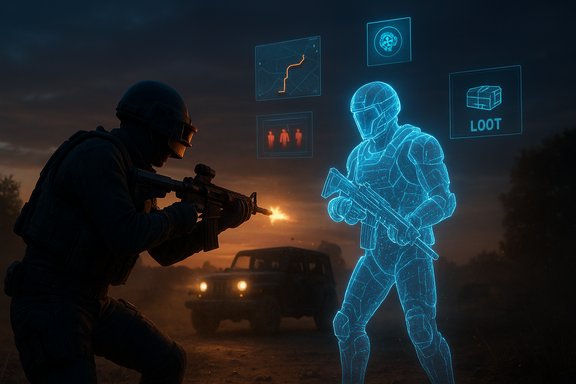
PUBG Ally is presented as an AI squadmate that can:- Understand voice and text commands and respond naturally.
- Perceive the game world in real time (spot enemies, identify items, and react to dynamic situations).
- Act autonomously: loot, share items, drive vehicles, and engage in combat with human‑grade decision making.
- Coordinate with the player (follow orders, prioritize requests, and assist with tactical plays).
Interaction modalities: voice and text
ACE supports both text and voice inputs, meaning a player can issue orders by hotkey, typed chat, or natural speech. The system is designed to respond with spoken lines or text and act on orders without constant micromanagement. This multi‑modal approach is aimed at accessibility (voice control for players who can’t type) and immediacy (saying “drive us to the ridge” is faster than menu navigation).Autonomy level and control
ACE’s design permits agents to act autonomously but be directed by players. That model attempts to strike a balance between a fully independent bot and a simple scripted AI: Ally should be a reliable partner that still accepts orders and supports tactical requests rather than a puppet under constant input.The technical foundations: what ACE actually uses
Models, runtime, and local vs cloud tradeoffs
NVIDIA’s ACE documentation indicates the use of compact, game‑oriented models and a stack optimised for RTX hardware. Public material references small language models (SLMs) such as variants in the Mistral / Nemo family tailored for game instruction usage, combined with high‑frequency perceptual inference (vision/audio) accelerated by Tensor cores and on‑device libraries. This lets certain ACE features run locally on RTX‑capable GPUs to keep latency low and avoid heavy cloud dependency for moment‑to‑moment gameplay. That said, developers can pick hybrid architectures: some reasoning (longer‑context planning or non‑latency‑sensitive tasks) may be cloud‑assisted while immediate perception and action loops run on‑device. The practical effect is that NVIDIA expects ACE to be flexible — local for speed and privacy when possible, cloud‑augmented when more context or heavier compute is needed.Example of a model cited by NVIDIA
In NVIDIA’s technical announcements, the ACE stack for some co‑playable characters is described as using a game‑tailored instruct SLM (example: Mistral‑Nemo‑Minitron‑8B‑128k‑instruct in NVIDIA developer notes). This is an example of an SLM tuned for game language, short‑context planning, and instruction following — smaller and more task‑focused than general large language models to keep inference feasible on consumer‑grade GPUs.Hardware implications
Running ACE features locally requires GPU compute, efficient Tensor‑core usage, and memory for model weights and perceptual buffers. NVIDIA emphasises RTX‑accelerated inference but ACE is offered as a toolkit for developers to target the right mix of local and cloud compute depending on user hardware. Game studios will need to weigh feature availability against minimum GPU footprints and provide fallback behavior for lower‑end systems.Who else is adopting ACE — a growing ecosystem
NVIDIA lists multiple partner projects adopting ACE capabilities in different ways:- inZOI: ACE powers more life‑like NPCs (Smart Zoi) that pursue goals and routines, making simulation worlds feel lived‑in.
- NARAKA: Bladepoint (and its mobile/PC variants) is adding AI teammates that can join lobbies, loot, and fight alongside players.
- MIR5 / Wemade: using ACE for adaptive boss encounters that learn from player tactics and evolve over time.
- Additional indie and mid‑tier titles (ZooPunk, Dead Meat and others) are experimenting with ACE for companions, bosses, or emergent NPCs.
Industry and studio-level context: Krafton’s AI pivot
Krafton has proclaimed an “AI‑first” reorientation and committed substantial capital to GPU infrastructure and agentic AI workflows. Reported investments — roughly 100 billion KRW (~$70 million USD) for a GPU cluster plus ongoing annual budgets for tooling — show a strategic bet that agentic systems will speed development and enable new player‑facing features like Ally. Krafton describes these moves as infrastructure for agentic systems that plan and act autonomously across creative and operational tasks. Krafton’s stated goals — faster iteration, improved tooling, and new in‑game AI services — are plausible outcomes of such an investment, but they also import risks: operational cost, workforce reskilling, and governance questions around training data provenance and IP. The hardware and software commitments (enterprise‑class GPU backends and on‑device RTX inference) create capability but do not remove hard human decisions about editorial control, quality assurance, and the limits of automation.What this means for players — benefits and use cases
- Immediate, reliable teammates for solo players or players in regions with poor matchmaking.
- Faster onboarding and learning: Ally can explain mechanics, point out loot, and demonstrate tactics in real time.
- Accessibility boost: natural voice control and a dependable AI partner reduce friction for players with disabilities or those new to battle royales.
- More immersive single‑player-like experiences inside multiplayer sessions: companions that speak, plan, and react plausibly reduce the loneliness of solo queue.
The risks and unresolved questions
1) Competitive fairness and anti‑cheat
Any agent that perceives the game state and offers tactical advice, or that acts autonomously inside a competitive match, raises anti‑cheat and tournament governance questions. Organizers and publishers will have to decide whether AI teammates are permitted in ranked or tournament play, and anti‑cheat systems must be audited to ensure agents cannot gain or leak unfair telemetry. Historically, overlays or assistants that read a game’s screen have been treated cautiously in competitive settings. Expect explicit restrictions or special server modes for AI companions in ranked play.2) Privacy and data usage
Multi‑modal features that use voice and screenshots raise data‑retention, telemetry, and training concerns. Platforms that store conversations or use inputs to refine models need clear, transparent user controls. Past experiences with in‑overlay assistants show that privacy toggles and opt‑outs are required for trust — and independent verification of retention policies is essential.3) Player behaviour and social effects
If AI teammates become reliable and socially rewarding, some players may prefer them to human partners. That could accelerate a shift away from human‑to‑human multiplayer and reduce opportunities for social play. Conversely, AI teammates could simply make matchmaking less frustrating and increase overall playtime. Both outcomes are plausible; the direction depends heavily on design choices (e.g., matchmaking incentives, social tools that encourage human squad formation).4) Balancing and “too good” AI
An AI partner that outperforms most human teammates could unbalance casual play or create mismatch dynamics. Conversely, an underpowered Ally would be useless. Developers will need to tune AI competence across modes, offer settings for assistance levels, and provide clear expectations for what Ally can and cannot do. Extensive, iterative testing and telemetry analysis will be required to avoid a “dominant bot” problem.5) Hardware fragmentation and accessibility
ACE’s performance profile will vary by GPU, and while NVIDIA markets ACE for RTX cards, studios must provide fallback paths for players on older GPUs or different vendors. Early ACE adopters have faced complaints that features are RTX‑first, and some players on other hardware families expressed frustration. Developers should build graceful degradation and cloud‑assisted fallbacks so features don’t split communities by hardware.What’s verified and what still needs confirmation
- NVIDIA has publicly released ACE and shown co‑playable characters (PUBG Ally, Smart Zoi, NARAKA teammates) being built with the toolkit. This is confirmed in NVIDIA developer posts and public demos.
- Krafton’s move to an “AI‑first” strategy and a large GPU investment has been announced by the company and reported by independent outlets; the headline figures (~100 billion KRW initial investment plus ongoing annual budgets) are confirmed by multiple news outlets.
- NVIDIA’s ACE design uses small, game‑oriented models and RTX acceleration; NVIDIA has named specific model families in technical notes and emphasised on‑device inference options. This is verifiable in NVIDIA’s materials.
- Specific rollout details reported by some media (for instance, a Windows Central claim that PUBG Ally testing will begin “early 2026 through PUBG Arcade and start with English, Korean, and Chinese players”) could not be independently verified in NVIDIA’s or Krafton’s official posts as of October 31, 2025; treat such schedule details as provisional until confirmed by Krafton or PUBG’s official channels. This scheduling note is flagged as unverified.
How developers should approach ACE integration (editorial guidance)
- Prioritise human‑in‑the‑loop oversight for creative outputs and gameplay‑critical decisions.
- Provide transparent player settings: competence sliders, privacy toggles, and explicit ranked/match declarations about AI use.
- Build graceful degradation so non‑RTX players aren’t excluded from core gameplay.
- Instrument telemetry to detect balancing issues early and measure social impact (player retention, matchmaking patterns).
- Publish clear documentation on training data provenance and whether player inputs are used for ongoing model updates.
Practical takeaways for PUBG players (and multiplayer gamers generally)
- Expect public tests and staged rollouts: NVIDIA and partner studios are focusing on phased experiments rather than instant sweeping changes.
- If you value competitive integrity, avoid using AI companions in ranked play until publishers clarify rules — tournament and ranked server policies will probably disallow or restrict AI assistants.
- For casual and accessibility‑oriented players, ACE companions can be meaningful: better onboarding, fewer toxic or inconsistent teammates, and a friendlier solo experience.
- Hardware matters: some ACE features are optimised for RTX hardware; watch for in‑game settings and optional server‑side fallbacks to maintain playability on weaker GPUs.
Looking forward — the long view
ACE represents a pragmatic step toward agents that are not merely chatbots but integrated gameplay actors: they see, speak, plan, and act. If studios adopt ACE with thoughtful guardrails, this could unlock genuinely new forms of multiplayer design: smaller teams augmented by reliable companions, more adaptive PvE encounters, and richer single‑player experiences inside live services.However, the promise comes with tradeoffs. Industry players must navigate competitive fairness, privacy and consent, labor impacts inside studios, and the social effect of normalising AI companionship. Companies like Krafton investing heavily in GPU infrastructure are buying capability, but they also shoulder the governance burden of how those capabilities should be used.
Conclusion
PUBG Ally and NVIDIA ACE mark a turning point: autonomous, conversational, perceptive in‑game characters are moving from research demos into commercial games. The immediate upside is concrete — better solo play, accessible onboarding, and new gameplay possibilities — while the costs are systemic: balancing, anti‑cheat policy, privacy, and hardware fragmentation will demand clear policies and careful engineering.For now, players should welcome experimentation but treat early features as iterative: expect frequent tuning, regional rollouts, and explicit guidance from publishers about where AI companions fit into ranked play and tournaments. The most important metric will be whether studios adopt ACE-driven features in a way that augments human play without eroding competitive fairness or player trust — that balance will determine whether AI squadmates become a beloved option or a contentious wedge in online gaming.
Source: Windows Central PUBG adds AI squadmates that listen, loot, and fight like real players — powered by NVIDIA’s ACE tech
