
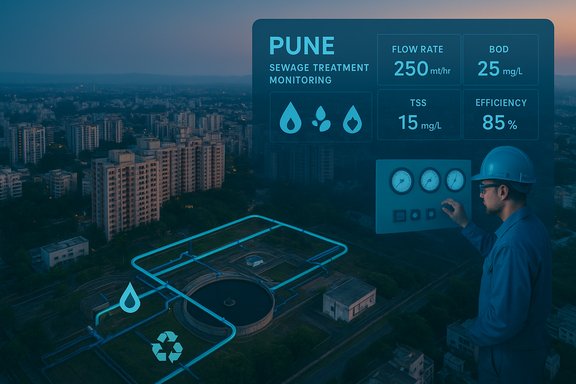
In the hidden currents beneath Pune’s streets, a quiet crackdown is forming: the Pune Municipal Corporation will begin active monitoring of in‑house sewage treatment plants (STPs) in housing societies and impose penalties where these systems are non‑functional or treated water is not being reused, a move that reframes domestic wastewater from an overlooked nuisance into a municipal priority and a resource to be reclaimed.
Pune’s municipal leadership has long required large residential developments to install on‑site sewage treatment systems as part of their building approvals. The stated rule: residential projects with more than 100 apartments must provide a small‑capacity STP on the premises and implement reuse of the treated effluent to lower demand on municipal potable supplies. Recent audits and inspections, however, revealed a recurring pattern — systems installed to satisfy statutory checks are often not commissioned, poorly maintained, or simply bypassed, with raw or partially treated sewage discharged into local drains and streams. The City Engineer’s office reports that in the past five years the corporation mandated roughly 772 small‑capacity STPs intended to treat about 1,11,373 kilolitres of sewage created by new large apartment complexes. Yet the operational picture is patchy: many STPs lie idle or underperform, and civic authorities say this is increasing load on the city’s main treatment network even as water scarcity pressures rise. At the same time, Pune’s overall sewage treatment capacity remains a challenge. The civic body operates several large STPs with a combined capacity widely reported in municipal briefings at about 477 million litres per day (MLD), while estimated sewage generation across the city is substantially higher — a gap that forces planners to consider decentralized solutions more seriously.
Key takeaways for residents and property managers:
Source: Trak.in Penalty For Pune Housing Societies If In-House Sewage Tratement Plant Missing - Trak.in - Indian Business of Tech, Mobile & Startups
 Background
Pune’s municipal leadership has long required large residential developments to install on‑site sewage treatment systems as part of their building approvals. The stated rule: residential projects with more than 100 apartments must provide a small‑capacity STP on the premises and implement reuse of the treated effluent to lower demand on municipal potable supplies. Recent audits and inspections, however, revealed a recurring pattern — systems installed to satisfy statutory checks are often not commissioned, poorly maintained, or simply bypassed, with raw or partially treated sewage discharged into local drains and streams. The City Engineer’s office reports that in the past five years the corporation mandated roughly 772 small‑capacity STPs intended to treat about 1,11,373 kilolitres of sewage created by new large apartment complexes. Yet the operational picture is patchy: many STPs lie idle or underperform, and civic authorities say this is increasing load on the city’s main treatment network even as water scarcity pressures rise. At the same time, Pune’s overall sewage treatment capacity remains a challenge. The civic body operates several large STPs with a combined capacity widely reported in municipal briefings at about 477 million litres per day (MLD), while estimated sewage generation across the city is substantially higher — a gap that forces planners to consider decentralized solutions more seriously. Why this matters: water, health, and civic infrastructure
Sewage is not merely a sanitation problem — it’s a systems problem that touches public health, water security, urban drainage, and municipal budgets. When in‑house STPs are working correctly they:- Reduce demand on potable water supplies by enabling reuse for flushing, landscaping, and HVAC makeup.
- Lower the volumetric burden on central STPs, delaying costly capacity expansions or land acquisitions.
- Cut environmental contamination risks from raw sewage dumped into streams, which otherwise degrades river health and raises disease vectors.
- Provide localized resilience during water stress or supply interruptions.
What the PMC will do: monitoring, empanelment, and penalties
The Pune Municipal Corporation has indicated a three‑pronged approach:- Proactive monitoring of small STPs in housing societies to identify non‑operation and failure to reuse treated water.
- Empanelment of specialised private agencies to design, install, commission, and — crucially — operate or handhold societies in running small‑capacity STPs. These agencies would be authorised to enter five‑year maintenance agreements with societies and provide technical guidance on technology selection, noise control, and power optimisation.
- Penalties for non‑compliance where societies do not operate their STPs or discharge untreated sewage, with the PMC clarifying it will develop a policy to govern enforcement and standards.
Technical and operational gaps the policy targets
Several recurring technical failings explain why many small STPs underperform:- Incorrect sizing at design stage or installation of inappropriate technologies to cut costs.
- Lack of early commissioning tests and absence of operator training for resident welfare committees.
- High energy consumption and noise complaints prompting societies to shut plants down or run them intermittently.
- Poor maintenance budgets once developers exit after handing over buildings to residents.
- Weak or absent monitoring of treated water quality and reuse pathways.
Strengths of the approach: why the policy could work
- Enforcement plus enablement — pairing penalties with technical support reduces the moral hazard where developers install equipment only to secure completion certificates and exit. Empanelled operators can ensure systems are commissioned and maintained rather than abandoned.
- Decentralisation relieves central load — functioning on‑site STPs reduce inflows to centralised plants and can be scaled more quickly without large land acquisition packages.
- Water conservation and cost savings — societies that reuse treated effluent reduce potable water purchases, saving residents money and preserving reservoir stocks during shortages.
- Standardised procurement and oversight — a vetted panel of agencies lowers the barrier for housing societies to obtain competent services and gives PMC a clearer basis for periodic performance audits.
Risks, trade‑offs, and implementation challenges
No policy is risk‑free. Several issues could blunt the effectiveness of the PMC’s plan unless proactively managed:- Penalty without support backfires: Penalising societies that lack capacity without offering affordable maintenance options or subsidies risks public resentment and legal challenges. Local federations have urged that developers be made responsible for operations for the initial years, or that PMC subsidise empanelment fees.
- Quality of empaneled agencies: Empanelment must be rigorous — weak vendors could make matters worse by recommending inappropriate technologies or performing token commissioning. PMC’s oversight framework must include independent verification of performance and clear termination clauses.
- Energy and footprint considerations: Some STP technologies increase electrical loads; shifting pollution from one system to another without considering energy trade‑offs can create new problems. Expert consultants must evaluate energy‑efficient processes and encourage passive/low‑power designs where possible.
- Affordability for societies: The recurring cost of operation and power may be a deterrent for resident bodies with limited budgets. Transparent cost models and possibly graded subsidies for low‑income housing could be necessary.
- Regulatory enforcement complexity: Detecting non‑use and proving deliberate discharge into drains require monitoring infrastructure and evidence collection protocols that are resource‑intensive for the civic body. Automated telemetry, process logs, and surprise inspections will be important.
What success looks like: KPIs for municipal and society performance
A results‑focused programme should measure both technical and behavioural outcomes. Suggested KPIs include:- Percentage of mandated STPs that are commissioned and operational within 90 days of project completion.
- Reuse rate of treated effluent (litres/day reused as a percentage of treated output).
- Energy consumption per kilolitre treated (kWh/kL) to ensure energy‑efficient operation.
- Number of enforcement actions vs number of successful remediations after empanelment.
- Reduction in raw sewage flows to civic mains from monitored zones.
Practical guidance for housing societies and developers
To prepare for the new regime and avoid penalties, societies and developers should consider the following steps:- Verify the STP’s commission certificate and ensure commissioning reports, start‑up logs, and lab results are available.
- Engage an empanelled or certified operator under a documented maintenance contract covering five years, spare parts, and energy optimisation.
- Install basic telemetry: power meters, flow meters, and a simple treated water quality log for parameters like BOD, TSS, and residual chlorine to demonstrate compliance.
- Train at least two resident operators and the society’s technical committee on routine checks and emergency procedures.
- Create a reuse plan that channels treated effluent to toilets, horticulture, and cooling towers where permissible, documenting volumes reused monthly.
Policy design suggestions for PMC (practical, implementable)
- Publish a transparent empanelment framework with minimum technical qualifications, audited references, and penalty‑backed performance bonds for vendors.
- Require developers to operate and guarantee STP performance for a fixed handover period (recommendation: five years) before transfer to residents.
- Subsidise initial telemetry and training through a revolving fund or a time‑limited grant to incentivise early adoption.
- Implement a graded penalty matrix: warnings → technical support requirement → monetary fines → disconnection of water supply for persistent, malicious discharge.
- Roll out a pilot in a few wards with full telemetry before citywide enforcement to refine enforcement protocols and vendor selection criteria.
Environmental justice and social equity considerations
Mandating and enforcing STP operation is an environmental good, but it can also produce regressive effects if not designed equitably. Low‑income cooperative societies may struggle to pay maintenance contracts; unaffordable penalties could push costs onto residents. The PMC should consider:- Differential fee structures or subsidies for marginal housing sectors.
- A social impact review before strict penalties kick in, with mandatory remedial assistance for societies that demonstrate inability rather than unwillingness.
- Public awareness campaigns led in partnership with resident federations to overcome misinformation and inertia.
What remains unclear and where caution is warranted
Several operational specifics reported in media accounts remain under-specified in publicly available documents. Notably:- The exact penalty amounts, modalities of penalty imposition, and appeal mechanisms were not detailed in the municipal briefings cited in the press coverage. This raises the need for a formal PMC policy document that spells out enforcement procedures before enforcement is widely applied. Treat references to future penalties as policy intent rather than fully codified law until the corporation publishes the formal rulebook.
- The mechanics of empanelment (procurement method, selection criteria, vetting process, dispute resolution) are still to be published. Until these are public, societies should be cautious in contracting non‑empanelled consultants.
Bigger picture: decentralised water management as urban strategy
Pune’s push is part of a broader municipal trend across Indian cities: decentralise treatment to reduce transmission and land pressures, treat wastewater as a local resource, and pair regulation with service delivery. When effectively implemented, small‑scale STPs distributed across housing estates, commercial complexes, and campuses form a resilient mesh that:- Lowers capital needs for mega STPs and reduces dependence on expensive land parcels.
- Encourages circular water economies at the neighbourhood level.
- Enables faster, incremental gains in water reuse and pollution control.
Conclusion
Pune’s decision to actively monitor and penalise non‑operational in‑house STPs for housing societies is a significant policy pivot that recognises wastewater as both a liability and an opportunity. The proposal to empanel expert agencies, pair enforcement with handholding, and push treated water reuse could reduce municipal treatment burdens, conserve potable water, and protect local waterways — if executed with transparency, clear performance metrics, and prorated support for residents with limited resources. The municipal intent is clear; the outcome will depend on three critical factors: the quality of empanelment and oversight, the affordability of reliable operations for resident communities, and the publication of clear, enforceable rules that balance penalties with practical assistance. Where those pieces come together, Pune can transform neglected flows into sustainable local water cycles — but where they do not, enforcement risks becoming a punitive spectacle that leaves systems idle and pollution unresolved.Key takeaways for residents and property managers:
- Confirm whether your society’s STP is commissioned, monitored, and on a maintenance contract.
- Seek empanelled operators and insist on telemetry and treated‑water reuse plans.
- Engage the developer and member federation to demand clear handover and operational warranties.
- Watch for official PMC notices that will specify the penalty framework and compliance timelines.
Source: Trak.in Penalty For Pune Housing Societies If In-House Sewage Tratement Plant Missing - Trak.in - Indian Business of Tech, Mobile & Startups
