
CPU shipments and PC sell‑in climbed sharply in Q3 2025 as a deadline-driven refresh — not normal seasonality — became the dominant market force: Jon Peddie Research (JPR) reports client CPU shipments rose 2.2% quarter‑on‑quarter while server CPU shipments jumped roughly 13–14% year‑on‑year, and multiple industry trackers conclude the movement was driven mainly by Microsoft’s Windows 10 end‑of‑support and large institutional refresh programs rather than a sudden revival in consumer demand.
Microsoft set a hard lifecycle cutoff for Windows 10: mainstream support ended on October 14, 2025. That calendar anchor converted what had been a gradual replacement cadence into a procurement trigger for enterprises, education, and many consumers who prefer supported, patched platforms. Microsoft’s own guidance directs users toward upgrading to Windows 11 or enrolling in Extended Security Updates (ESU) as a short bridge. At the same time, the PC industry in 2025 was dealing with two supply‑side distortions: earlier “buy‑ahead” behavior tied to proposed import tariffs and a strategic pivot by OEMs to position new models as AI‑capable PCs with on‑device accelerators. The result is a lumpy, front‑loaded pattern of shipments that shows a clear EOL effect layered on top of residual tariff-induced inventory moves.
The confluence of a hard Windows 10 end‑of‑support date, lingering tariff‑driven inventory effects, and an industry pivot toward AI‑capable machines produced a real — if uneven — surge in CPU and PC shipments in Q3 2025. JPR’s CPU shipment data, Microsoft’s lifecycle deadlines, and multiple tracker reads together form a consistent narrative: the market moved because Microsoft set the calendar, buyers responded rationally to compliance risk, and OEMs executed at scale — but the gains are subject to inventory digestion, deployment strain, and environmental trade‑offs that will define whether this quarter becomes the start of durable recovery or a temporary trough‑to‑spike cycle.
Source: TechnoSports Media Group CPU Shipments Surge in Q3 2025: Windows 10 EOL Drives Growth
 Background
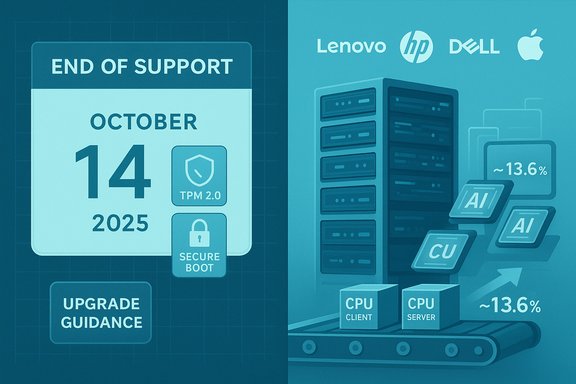
Microsoft set a hard lifecycle cutoff for Windows 10: mainstream support ended on October 14, 2025. That calendar anchor converted what had been a gradual replacement cadence into a procurement trigger for enterprises, education, and many consumers who prefer supported, patched platforms. Microsoft’s own guidance directs users toward upgrading to Windows 11 or enrolling in Extended Security Updates (ESU) as a short bridge. At the same time, the PC industry in 2025 was dealing with two supply‑side distortions: earlier “buy‑ahead” behavior tied to proposed import tariffs and a strategic pivot by OEMs to position new models as AI‑capable PCs with on‑device accelerators. The result is a lumpy, front‑loaded pattern of shipments that shows a clear EOL effect layered on top of residual tariff-induced inventory moves. What the Q3 data actually show
Client and server CPU shipments: the headline numbers
- Client CPUs: JPR reports a +2.2% quarter‑on‑quarter increase in client CPU shipments in Q3 2025 — the third consecutive quarterly increase in 2025 — though the client market remained mixed on a year‑over‑year basis in some tracker reads.
- Server CPUs: server CPU shipments rose ~13.6% year‑on‑year, reflecting stronger data‑centre spending and enterprise refresh activity.
Broader PC shipment context: multiple trackers
Independent tracker snapshots converge on a directional story: Q3 2025 was a recovery quarter driven by migration and refresh cycles.- Gartner (preliminary): reported ~69.9 million global PC units shipped in Q3 2025 (~+8.2% YoY), and noted that the Windows 10 EOL was a principal short‑term demand driver.
- IDC (preliminary): published a higher tally — roughly 75.8 million units (~+9.4% YoY) — illustrating how methodology (sell‑in vs sell‑through windows, regional coverage) alters headline totals.
- Counterpoint Research (preliminary): reported +8.1% YoY growth and explicitly linked the uplift to Windows 10’s impending end-of‑support; it also estimated that roughly 40% of the installed PC base remained on Windows 10 at the time, underscoring the scale of addressable refresh demand. Counterpoint’s vendor breakdown called out Lenovo’s strong year‑over‑year growth (~17.4%) among the top OEMs.
Why Windows 10’s end‑of‑support moved the needle
Technical gatekeepers: TPM 2.0, Secure Boot and CPU whitelists
Windows 11 enforces a tighter minimum platform baseline than Windows 10: TPM 2.0, UEFI Secure Boot and a list of approved 64‑bit CPUs are core checks for upgrade eligibility. Microsoft’s public documentation lists these requirements clearly; machines that can’t meet them without hardware or firmware changes cannot claim a supported Windows 11 upgrade path. For many fleets — especially older desktops and specialty devices — satisfying those checks requires motherboard replacement or buying new systems, not just installing a new OS.Real‑world outcomes: buy vs retrofit vs ESU
Organizations and cautious consumers faced three principal options:- Attempt firmware or registry workarounds (unsupported and risky for production);
- Retrofit TPM hardware where a compatible header and module exist (not universally available and often impractical for large fleets);
- Replace devices with Windows 11–capable systems or enroll in Extended Security Updates to buy time.
Who gained — vendor winners and the channel picture
OEMs and market share shifts
- Lenovo, HP, Dell, Apple and ASUS dominated the top‑five vendor table in Q3, capturing most of the replacement activity. Multiple trackers and press snapshots place Lenovo at the top, with preliminary Counterpoint and media reads highlighting Lenovo’s ~17% YoY jump in shipments for Q3.
- Apple recorded double‑digit MacBook growth as some buyers switched platforms during replacement planning. Counterpoint and independent trackers noted strong Mac momentum in the quarter.
Channel and inventory dynamics
An important corollary: Q2’s tariff‑driven front‑loading (buyers ordering early to avoid potential import duties) pushed a meaningful volume into earlier quarters and reduced some later quarter sell‑through — a pattern visible in the channel‑level data. By Q3, the tariff pull‑forward had largely worked through channels, meaning Q3’s uplift reflects more genuine migration demand than panic buying. Analysts warn that this pull‑forward effect will temper growth in subsequent quarters as inventory digests.Server market: enterprise refreshes and AI infrastructure
Server CPU shipments saw a stronger YoY gain in Q3 2025. Several factors explain this:- Data‑centre capacity expansions and refresh cycles continuing after earlier procurement pauses;
- Enterprise investments in server platforms to support AI workloads, ML training, virtualization consolidation, and cloud‑adjacent hardware modernization;
- Replacement of older servers that had reached end‑of‑service or that were being upgraded to support new on‑prem AI appliances or hybrid cloud strategies.
The sustainability and deployment risks
E‑waste and responsible disposal
Large, deadline‑driven replacement programs raise immediate e‑waste risks. Analysts and procurement advisors emphasized the need for trade‑in, refurbishment and secure data‑wiping programs to avoid undue environmental harm and regulatory exposure in jurisdictions tightening circularity rules. PC refresh windows that are executed rapidly without lifecycle commitments invite scrutiny and potential reputational costs for vendors and public buyers.Deployment capacity and support load
Mass replacements ramp support tickets, imaging tasks, and application compatibility testing. IT teams that attempted to run compressed migrations often faced higher cost and risk: warranty and staging windows are compressed, software compatibility and driver testing may be rushed, and user training/support costs spike. Analysts recommended treating the refresh as a programme, not a panic, with prioritized rollouts for high‑risk endpoints.What to verify and what remains uncertain
Important caveats and items that required triangulation:- Tracker variance is real: Gartner (~69.9M) vs IDC (~75.8M) vs Counterpoint (~75M equivalent) show methodological divergence. Use multiple trackers to get a balanced view.
- JPR’s CPU shipment metrics are sell‑in measures; they do not equate to immediate retail activation. Expect channel digestion to influence Q4 and early‑2026 results.
- Some vendor‑level claims (e.g., precise growth rates in final audited results, trade‑in volumes, or the exact share of devices eligible for free Windows 11 upgrades) may be revised in final quarterly disclosures; treat preliminary PRs as directional. Where public filings are later released, those should be consulted for final confirmation.
Practical guidance for IT teams and buyers
For IT leaders managing migration and hardware refresh programmes, a practical, prioritized approach reduces risk and cost:- Inventory and classify: map all endpoints by Windows 10 image, TPM/UEFI status, CPU family and business criticality. Prioritise high‑risk systems first.
- Validate upgrade paths: use Microsoft’s PC Health Check and vendor‑provided compatibility tools to confirm which devices can upgrade in place safely.
- Pilot Windows 11 and AI‑capable hardware in small, representative user groups to test compatibility and to measure actual productivity gains from on‑device AI features.
- Use ESU as a controlled bridge only where necessary; plan to retire ESU‑covered devices within the ESU timeframe.
- Contract lifecycle commitments with vendors and partners: insist on trade‑in, refurbishment, and secure data‑erasure to limit e‑waste and meet compliance expectations.
Short‑term outlook and what to watch next
- Q4 2025: expect moderation. With many organizations having hit replacement deadlines or bought ESU, growth in Q4 is likely to be lower; channel digestion of Q2/Q3 stock could suppress further sell‑through. JPR and other analysts warned that the three‑quarter growth streak may not be sustainable without new demand drivers.
- 2026: migration tailwinds will continue as large enterprise fleets are fully refreshed on staggered timelines, and AI PC features may begin to shift from marketing claims to measurable ROI where specific workloads benefit from on‑device inference. Track software and ISV readiness for on‑device models — that’s the real gating factor for broad AI PC premiumisation.
- Supply and policy risks: potential tariff reversals, regulatory e‑waste rules, or further trade actions could reintroduce inventory distortions. Watch vendor earnings and distributor inventory commentary for signs of overstock or sell‑through weakness.
Final assessment — strengths, pitfalls and strategic takeaways
The Q3 2025 spike in CPU shipments and PC sell‑in represents a legitimate, calendar‑driven refresh wave with measurable winners and foreseeable downsides.- Strengths: OEMs and distributors capitalised on a predictable Microsoft deadline; enterprise security posture improves as older, unsupported systems are retired; server and AI‑oriented investments support medium‑term digital transformation plans. JPR’s chip‑level data and major trackers both document the momentum.
- Risks: the recovery is lumpy and partly tactical — tariff‑led front‑loading and channel inventory moves complicate reading of sustained demand. Rapid refreshes risk poor deployment outcomes, increased support load, and elevated e‑waste if lifecycle commitments are weak. Analysts caution against equating Q3 shipment strength with durable consumer appetite.
- Strategic takeaway: treat the 2025 migration as a multi‑year program rather than a one‑off sales event. Prioritise business impact, governance for AI features, and responsible lifecycle management to convert short‑term displacement into long‑term value.
The confluence of a hard Windows 10 end‑of‑support date, lingering tariff‑driven inventory effects, and an industry pivot toward AI‑capable machines produced a real — if uneven — surge in CPU and PC shipments in Q3 2025. JPR’s CPU shipment data, Microsoft’s lifecycle deadlines, and multiple tracker reads together form a consistent narrative: the market moved because Microsoft set the calendar, buyers responded rationally to compliance risk, and OEMs executed at scale — but the gains are subject to inventory digestion, deployment strain, and environmental trade‑offs that will define whether this quarter becomes the start of durable recovery or a temporary trough‑to‑spike cycle.
Source: TechnoSports Media Group CPU Shipments Surge in Q3 2025: Windows 10 EOL Drives Growth
