Q4 2025 Cloud Results: Google Cloud Leads Growth Amid AI Demand

  • Thread Author
The cloud market has flipped from steady expansion to a sprint: Q4 results from Amazon, Microsoft, and Alphabet show cloud revenue reaccelerating sharply on the back of AI demand, but while all three posted impressive growth, Google Cloud emerged as the short‑term growth leader — and the earnings season laid bare both the enormous opportunity and the mounting risks tied to massive capex and supply constraints.

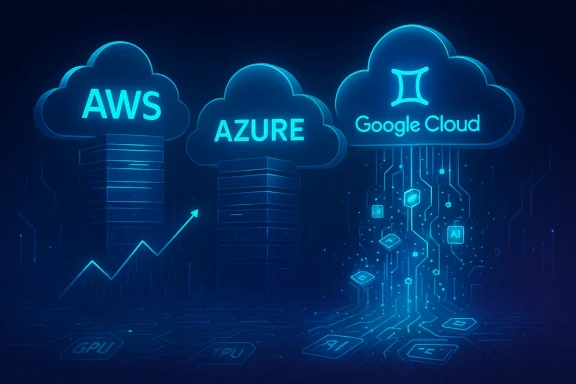
Neon blue clouds labeled AWS, AZURE, and Google Cloud connected by circuit lines.Background: why Q4 2025 matters for the cloud era​

The fourth quarter of 2025 felt like a milestone more than a routine reporting period. Industry tracking firms estimated global cloud infrastructure services at roughly $119 billion for the quarter, up about 30% year‑over‑year, a marked reacceleration attributed primarily to generative AI workloads and the surge in enterprise AI projects.
That market dynamic turned corporate earnings into a proxy fight for the economic value of AI: cloud vendors that can host massive model training and inference while controlling serving costs stand to win not only market share but also outsized operating leverage. The Big Three — Amazon Web Services (AWS), Microsoft Azure, and Google Cloud — are now the epicenter of that contest, and Q4 results exposed how different strategies (scale, partnerships, full‑stack models, custom silicon) are playing out in revenue growth, margins, and capital commitments.

Overview of the results: three distinct narratives from the Big Three​

Amazon Web Services: scale, monetization, and a headline capex number​

Amazon reported AWS revenue of about $35.6 billion in Q4, up 24% year‑over‑year, with management calling it the fastest AWS growth rate in 13 quarters. That acceleration, the company says, was driven by AI workload adoption plus continued growth in core infrastructure.
But the story that dominated headlines was Amazon's jaw‑dropping capex plan: management announced an intention to invest roughly $200 billion in capital expenditures for 2026, saying the spend would be concentrated “predominantly in AWS” to meet what it called exceptionally high demand. Management framed the commitment as necessary to monetize AI capacity as it is installed. The market reaction was swift and negative in the immediate term, reflecting investor worry about execution risk and the timing of returns on such an outsized deployment.
Key points:
  • AWS remains the largest cloud by revenue and capacity, leveraging decades of incumbency to monetize enterprise migrations and AI workloads.
  • Amazon’s $200B capex plan dwarfs peer guidance and signals a bet on rapid scale as the core defense/attack mechanism in AI infrastructure.

Microsoft Azure: partnership leverage, strong bookings, and supply balancing​

Microsoft’s fiscal Q2 2026 results showed Azure and other cloud services growing about 39% year‑over‑year (38% in constant currency), a very robust figure that reflects the company’s early and deep commercial integration with large AI customers, including its strategic relationship with OpenAI. Microsoft highlighted a massive remaining performance obligation (RPO) and huge commercial bookings, and management repeatedly said that customer demand continues to exceed supply, particularly for GPU capacity and other short‑lived AI assets. Capital spending in the quarter was sizable (reported capex of $37.5 billion for the period) with a plan to increase capex growth to satisfy demand.
Key points:
  • Microsoft is translating strategic partnerships and a broad enterprise stack into high‑value, long‑duration commitments, boosting RPO and revenue visibility.
  • The tradeoff is supply management: Microsoft must decide how to allocate constrained GPU capacity across customers and products, and it’s willing to expand capex to reduce that bottleneck.

Google Cloud: the acceleration winner, powered by Gemini and falling serving costs​

Alphabet reported Google Cloud revenue of $17.7 billion in Q4 — up 48% year‑over‑year — the fastest growth rate among the Big Three for the quarter. Management attributed the surge to enterprise AI demand and the commercial adoption of its Gemini family of models. Alphabet disclosed several headline metrics: more than 8 million paid seats of Gemini Enterprise sold since its launch, the Gemini app surpassing 750 million monthly active users, and a claimed 78% reduction in Gemini serving unit costs over 2025 due to model and infrastructure optimizations. Alphabet guided to a very large 2026 capex range of $175–$185 billion, aimed at servers, data centers, and AI infrastructure.
Key points:
  • Google Cloud’s growth outpaced peers in Q4 and the segment reported meaningful margin improvement year‑over‑year.
  • Alphabet’s combination of in‑house models (Gemini), custom chips/TPUs, and a vertically integrated stack appears to be delivering both demand and cost efficiency — at least according to company disclosures.

Why Google looks like the “winner” (for now)​

There’s a specific set of empirical facts that underlie the claim that Google was the clear winner in Q4:
  • Fastest cloud growth rate: Google Cloud’s 48% year‑over‑year revenue growth overtook AWS and Azure on a percentage basis for the quarter. That acceleration matters because it signals not just near‑term demand but the potential for market share movement if the trend persists.
  • Commercial traction for first‑party AI: Alphabet reported strong uptake for Gemini across consumer and enterprise surfaces — large paid seat counts and explosive user growth in the Gemini app. That suggests both top‑line monetization vectors (subscription/seats) and large ad/product engagement benefits.
  • Serving cost improvements: Alphabet’s claim of a 78% reduction in serving unit cost for Gemini over 2025 is a game changer if sustained: lower inference costs improve unit economics and make broader deployment of large models viable across lower‑margin enterprise use cases. That is a direct lever on margin expansion for cloud AI services.
  • Backlog and committed revenue: Google reported a sizable cloud backlog (reported at $240 billion), and Alphabet’s commentary around more large, multi‑year enterprise commitments underscores durable demand. When customers sign large‑scale commitments that include model hosting and enterprise agents, it raises the ceiling for future revenue recognition.
Taken together, those pieces make a persuasive short‑term case that Google’s stack is clicking: strong demand, improving unit economics, and a route to durable enterprise contracts. That combination explains why analysts and commentators called Google Cloud the standout performer of the quarter.

But the picture is more nuanced: strengths, caveats, and risks​

Strengths across the three vendors​

  • Scale and reliability (AWS): Amazon’s decades of cloud operation deliver unmatched scale, a broad product catalog, and a deep partner ecosystem. AWS’s revenue base still dwarfs the others, and growing at 24% on a $142B annualized run rate is materially different than higher percentages on smaller bases.
  • Commercial commitments and platform breadth (Microsoft): Microsoft’s book of business (huge RPO, large enterprise customers, and tight partnerships) gives it revenue visibility and high‑value recurring streams. Its ability to reallocate fungible fleet capacity and monetize enterprise workflows is a durable advantage.
  • First‑party model momentum and cost optimization (Google): Google’s integrated model‑to‑inference stack (Gemini + data centers + TPUs + software optimizations) can simultaneously offer product differentiation and margin improvement if the company continues to lower serving costs and prove its model economics.

Material caveats and execution risks​

  • Capex chases supply and ROI timing: All three companies signaled that demand exceeds supply for AI compute, and each is increasing capex substantially. Amazon’s $200B plan and Alphabet’s $175–$185B range for 2026 are on a scale previously unseen in corporate capex programs. Those commitments carry execution risk: supply chain constraints, component price volatility, permitting and energy costs for data centers, and the multi‑year timeline for realizing returns create the potential for temporary margin pressure and investor scrutiny.
  • Concentration and counterparty risk: Microsoft’s sizable exposure to a few mega‑customers (OpenAI is cited as a large single commitment) raises questions about concentration and negotiating leverage. If a large customer changes priorities or in‑sources, the effects on bookings and utilization could be material.
  • Model economics and cost claims need independent scrutiny: Alphabet’s 78% cost reduction claim is dramatic and, if true, transformative. But the company’s statement is internal and not third‑party audited. Independent verification over subsequent quarters will be critical; investors should watch inferred metrics such as cloud gross margins, operating income, and unit economics disclosed in future quarters to corroborate the claim. Until then, treat the number as a management disclosure that requires corroboration. Caution: this is currently a company claim awaiting independent confirmation.
  • Competitive intensity and pricing dynamics: The massive capex commitments increase the risk of a race to the bottom in pricing for commodity GPU inference if vendors prioritize utilization over margin. That dynamic could benefit hyperscale customers and erode near‑term margins if not balanced by higher value services and large enterprise contracts.
  • Regulatory and geopolitical headwinds: As these platforms become infrastructure for national‑scale AI, regulatory scrutiny will intensify — from data localization to export controls on advanced chips. That can raise compliance costs and constrain international deployment. These are policy risks outside company control but with direct business impact. (This is a forward‑looking, high‑uncertainty area.)

What the numbers imply for enterprise adopters and buyers​

If you are an IT leader choosing where to run your AI workloads, here is a practical take:
  • For maximum raw scale and the broadest service catalog, AWS remains the predictable choice; however, expect Amazon to expectably prioritize customers that commit to long‑term consumption as it monetizes new capacity.
  • For integrated enterprise product scenarios (M365, Dynamics, GitHub) and large commitment programs that may include custom SLAs, Azure offers strong traction and deep enterprise relationships — but supply allocation (GPU availability) may be a gating factor in the short run. Plan for capacity negotiation and consider booking commitments if latency and availability are crucial.
  • If you need tight integration with first‑party LLMs and a model‑centric stack that may deliver better inference economics, Google Cloud is increasingly compelling — especially if Alphabet’s cost improvements translate into lower prices for enterprise inference. But buyers should demand clear SLAs, transparent pricing on inference, and pilot validation against workloads before scaling.
Practical checklist for CIOs evaluating vendor AI offers:
  • Map expected token volumes and peak concurrency to vendor pricing and anticipated unit serving costs.
  • Ask vendors for trial credits on both training and inference to benchmark real costs on your workloads.
  • Negotiate multi‑year commitments only after validating supply allocation guarantees for GPU/TPU access.
  • Factor in data gravity: running inference close to where the data lives can reduce latency and cost.
  • Insist on transparent cost reporting for model serving (cost per 1k tokens or cost per inference).

Financial and market implications: winners, losers, and the path forward​

From a market perspective, the Q4 results should be read as both opportunity and a leveling field:
  • Market share movement is possible but slow. Amazon still controls the largest share of cloud infrastructure, Microsoft holds a powerful enterprise position, and Google is accelerating from a smaller base. If Google keeps growing at high double digits while maintaining cost reductions, it can narrow the gap over years, but scale effects favor incumbents. Synergy estimates placed the Big Three’s combined share north of two‑thirds of the public cloud market in Q4, underscoring the high barrier for new entrants.
  • Capital intensity is the new competitive moat. The winner is likely the vendor that can optimize capex deployment to deliver both the lowest inference cost and the best differentiated AI services. That requires not just money but supply chain agility, software efficiency (model serving optimizations), and energy access. Alphabet’s claim of 78% serving cost decline — if sustained and verifiable — would be a strategic advantage; but delivering it at scale across geographies is a separate challenge.
  • Margins will be lumpy. Heavy up‑front capex will depress near‑term free cash flow and could compress margins until utilization ramps. Investors should expect quarterly variability as vendors balance capacity additions, depreciation, and demand realization. Microsoft’s large RPO and Amazon’s AWS backlog provide visibility, but that doesn’t eliminate near‑term margin risk.

How to read the “winner” narrative without falling into hype​

The press cycle loves a single winner narrative, but a disciplined read requires separating (a) one‑quarter growth rates on smaller bases from (b) durable competitive advantage that sustains share gains over time.
  • Relative growth percentages are scale‑sensitive. A smaller base can grow faster in percentage terms; this is true for Google Cloud versus AWS. Amazon’s CEO explicitly noted that higher percentage growth on a smaller base is not the same as high‑percentage growth on a much larger base — a mathematically correct point that should temper simplistic winner declarations.
  • Confirm management claims with operational metrics. For any sweeping claim (e.g., “78% reduction in serving cost”), investors and customers should look for corroborating proof in subsequent quarterly margins, unit economics disclosures, and third‑party performance benchmarks. Treat headline efficiency numbers as directional until validated.
  • Watch bookings and committed revenue, not just current quarter revenue. Large multi‑year commitments (RPO/backlog) are more indicative of durable demand than one quarter’s spike in API calls. Microsoft’s and Alphabet’s reported backlogs and RPO growth are meaningful signals; AWS’s backlog and monetization pace are comparable indicators to watch.

Strategic takeaways for investors, IT buyers, and competitors​

  • Investors: expect a multi‑quarter period of heavy capex, uneven margins, and headline volatility. Favor vendors that combine strong demand, measurable unit cost improvements, and execution discipline on data center builds and supply chains.
  • IT buyers: prioritize contractual clarity around capacity access and cost transparency for inference; pilot before committing millions to a single provider; use multi‑cloud strategies where viable to hedge supply and bargaining power risk.
  • Competitors and partners: niche or vertical cloud providers that specialize in GPU/GPU‑adjacent workloads (and those with flexible pricing models) can exploit short‑term supply tightness by offering differentiated service levels — a viable route to relevance despite the Big Three’s dominance. Synergy’s data show a rise of specialized providers in the top ten cloud rankings, reflecting this dynamic.

Looking ahead: three metrics to track next quarter​

  • Cloud gross margins and operating margin progression — will cost reductions claimed by Google show up as improved margins, and can AWS and Azure match on unit economics?
  • Committed bookings / RPO trajectory — growth in multi‑year commitments is the clearest signal of sticky enterprise demand.
  • Capex deployment and utilization — how quickly capex translates into usable GPU/TPU capacity and how utilization ramps on that capacity will determine the timing of returns. Keep an eye on supplier constraints (chip supply), data center build timelines, and depreciation trends.

Conclusion​

Q4 2025 was a definitive proof point that AI is not a sideline; it's the primary accelerator for cloud growth. The Big Three delivered strong results, but for different reasons: AWS with scale and monetization, Microsoft with enterprise commitment and platform breadth, and Google with model‑driven momentum and claimed cost breakthroughs. Alphabet’s Google Cloud posted the fastest growth rate and presented striking efficiency claims that, if validated over time, will shift the economics of AI hosting.
That said, the marketplace is entering a capital‑intensive phase. The next year will be defined by how effectively each vendor converts astronomical capex into usable, competitively priced capacity; how they manage supply constraints; and whether claimed model cost improvements translate into lower, sustainable prices for enterprise inference. For buyers and investors alike, the prudent posture is skeptical optimism: AI is real and lucrative, but durable leadership requires disciplined execution across infrastructure, software, and economics — not just headline growth percentages.

Source: AOL.com Amazon, Microsoft, and Alphabet All Reported Robust Cloud Growth. 1 Was a Clear Winner
 

The fourth quarter of 2025 changed the conversation about cloud: revenue re‑accelerated across the hyperscalers, AI shifted from experiment to production for large enterprises, and one vendor—Google Cloud—emerged as the short‑term growth leader while all three committed to an unprecedented capex sprint to support AI workloads. The numbers tell a simple story: demand for AI is driving cloud consumption, but the economic, technical, and regulatory consequences of that growth are complex and far from settled.

Neon cloud above a city connects three glass towers, with dashboards showing CAPEX and utilization.Background / Overview​

The cloud market entered 2026 after a renewed surge in Q4 2025, when global quarterly cloud infrastructure revenues surpassed $119 billion and growth rates jumped markedly versus prior quarters. Analysts and providers attribute the lift mostly to generative AI and enterprise rollouts of model‑driven services, which consume orders of magnitude more compute, memory, and networking than typical enterprise workloads. That surge has reshaped the competitive dynamics among Amazon Web Services (AWS), Microsoft Azure, and Google Cloud—often described as the “Big Three.”
Each hyperscaler posted impressive top‑line cloud growth for the December quarter, but the pattern was not uniform. AWS remains the largest by revenue, Microsoft’s Azure shows the deepest enterprise integrations and backlog, and Google Cloud displayed the fastest percentage growth while also reporting dramatic reductions in the cost of serving AI workloads—an unusual combination that explains why many commentators called Google the quarter’s winner. The details matter, because one-off base effects, differing accounting periods, product mix, and capital commitments shape who benefits most over the next 12–36 months.

What each hyperscaler reported​

Amazon Web Services (AWS): scale, steady acceleration, and a colossal capex pledge​

  • AWS recorded $35.6 billion in cloud revenue in Q4 (quarter ended Dec. 31, 2025), up 24% year‑over‑year—the fastest growth the unit has posted in 13 quarters, according to Amazon’s results. The company reported a $142 billion annualized run rate for AWS and highlighted a growing pipeline of multi‑year commitments. Amazon positioned that growth as AI‑driven demand monetizing newly installed capacity.
  • In parallel, Amazon announced an extraordinary capital expenditure plan: approximately $200 billion in capex for 2026, with management saying the bulk is directed to AWS (data centers, servers, chips, and AI infrastructure). That figure—unusually large compared with historical hyperscaler guidance—signals Amazon’s intent to build and monetize massive AI capacity but also raises questions about execution, timing of returns, and investor patience.
Why it matters: AWS’s size gives it structural advantages—breadth of services, a massive partner ecosystem, and pricing flexibility—but very large base numbers make high percentage growth harder. AWS’s acceleration to 24% growth on $142B run‑rate revenue is meaningful, but scale breeds different economics: sustaining that growth requires continued innovation and very large incremental capital deployment.

Microsoft Azure: enterprise depth, gargantuan backlog, and capacity constraints​

  • Microsoft reported fiscal Q2 2026 results (quarter ended Dec. 31, 2025) showing Azure and other cloud services revenue increased 39% year‑over‑year (38% in constant currency), contributing to Intelligent Cloud revenue of $32.9 billion. The company emphasized strong enterprise adoption of Copilot and other Azure AI services, and highlighted a surge in remaining performance obligations (RPO), a measure of contracted but not yet recognized revenue.
  • Management said customer demand continues to exceed supply, prompting higher capex expectations and capacity expansion plans. Microsoft’s disclosures and investor commentary paint a picture of a company scaling data center capacity and investing heavily in GPUs, networking, and the long lead‑time infrastructure needed for AI workloads.
Why it matters: Microsoft’s advantage is enterprise integration—Office, Teams, Dynamics, LinkedIn, and direct commercial relationships—all of which accelerate Azure adoption when AI features are embedded. The huge RPO/backlog gives Microsoft near‑term revenue visibility, but capacity constraints and very high near‑term capex introduce execution and margin risks if supply chain or grid limitations surface.

Google Cloud: fastest percentage growth, model‑driven demand, and efficiency gains​

  • Alphabet reported Google Cloud revenue of $17.7 billion in Q4 2025, up 48% year‑over‑year—the fastest rate among the Big Three in that quarter. Management attributed the acceleration directly to demand for its Gemini family of models and integrated AI services. Alphabet also disclosed a cloud backlog that grew meaningfully, reflecting large enterprise contracts.
  • Two headline metrics underline Google’s momentum: more than 8 million paid seats of Gemini Enterprise sold, and the Gemini app surpassed 750 million monthly active users, with Alphabet claiming substantially higher engagement since the launch of Gemini 3. Perhaps most notable for investors and operators: Alphabet said it reduced Gemini serving unit costs by 78% during 2025 through model optimizations, utilization improvements, and efficiency gains—an unusually large reduction in the cost to serve high‑intensity AI workloads.
  • Like its peers, Google also committed to very large capex: management communicated a 2026 capex range of $175–$185 billion aimed primarily at servers and data centers to meet AI and cloud demand. That size of investment stunned many observers because it marks an order‑of‑magnitude jump relative to prior years.
Why it matters: Google’s combination of rapid revenue growth plus large serving‑cost reductions is compelling. If sustained, that leverage can produce outsized margin improvement and accelerate enterprise adoption by lowering the effective cost of running models. But Google starts from a smaller base than AWS or Azure; percentage gains look large on a smaller denominator. Still, the quarter’s data make a persuasive case that Google Cloud is the fastest‑growing business among the three in the near term.

Cross‑checks and independent confirmation​

Major parts of the narrative are corroborated by multiple independent sources:
  • Synergy Research Group’s Q4 analysis estimated quarterly cloud infrastructure services revenues at roughly $119.1 billion and confirmed the hyperscalers’ strong re‑acceleration in Q4. That independent market telemetry aligns with each vendor’s reported growth and with the idea that generative AI — and its demand for infrastructure — is the principal driver.
  • Each vendor’s own investor relations materials substantiate company‑level figures: Amazon’s Q4 press release (AWS $35.6B, 24% growth) and Microsoft’s FY26 Q2 press release (Azure +39%) are primary sources for the headline numbers. Google’s Q4 shareholder letter and CEO communications documented the 48% cloud growth and Gemini adoption metrics. Using primary filings and the Synergy market view gives a consistent cross‑section of the quarter’s reality.
  • Reputable financial press and analysis outlets independently reported the same core facts and added color on capex plans, customer wins, and the broader competitive narrative; those outlets provide useful interpretive context while the companies’ releases deliver the canonical financials.

Why some observers called Google Cloud the “winner” — and why that label needs nuance​

On raw percentage growth and recent quarter momentum, Google Cloud was the clear short‑term leader: +48% in Q4 outpaced Microsoft’s +39% and AWS’s +24%. But there are several layers to unpack before declaring a structural victor.
  • Faster growth on a smaller base: Google’s higher percentage reflects a smaller revenue base ($17.7B vs. AWS’s $35.6B and Azure’s larger segment contribution). Higher percentages are easier to achieve from a smaller starting point; scale parity would require sustaining those rates over many quarters. That caveat is valid, and Amazon’s leadership highlighted it during discussions of the results.
  • Cost and margin leverage: Google’s claim of a 78% reduction in Gemini serving unit costs over 2025 is unusual and consequential. Cost reductions of that magnitude—if accurate and repeatable—immediately improve unit economics for model hosting and inference, allowing Google to pursue aggressive pricing or higher margins. That efficiency story is a substantive differentiator when measured against peers. Still, investors should probe the underlying assumptions (workload mix, accounting, amortization of model training costs, caching strategies, and GPU utilization) before assuming the figure scales linearly.
  • Enterprise traction and contracts: Microsoft’s deep enterprise footprint and Microsoft 365/Copilot integration create stickier demand and a larger contracted backlog, which matters for revenue predictability. AWS’s breadth and product depth make it the safe default for many workloads, and its long history with infrastructure and specialized chips remains a strategic advantage. Google’s momentum could translate to long‑run market share gains, but it must convert growth into durable enterprise relationships and differentiated product offerings.
In short: Google Cloud won the quarter in growth rate and—if the cost improvements persist—unit economics. But structural leadership still belongs to the company that combines growth, durable enterprise adoption, margin resilience, and manageable capital intensity. That contest continues.

The capex arms race: why hyperscalers are spending like never before​

One of the most striking takeaways from Q4 2025 was the scale of announced capital commitments:
  • Amazon told investors it expects roughly $200 billion in capital expenditures for 2026, primarily directed at AWS.
  • Alphabet indicated $175–$185 billion of capex for 2026 to scale servers and data centers for AI and cloud workloads.
  • Microsoft likewise signaled materially higher capex for 2026 to meet customer demand and backlog, with public statements that capex growth would be higher than in fiscal 2025; quarterly filings and conference calls confirmed multi‑billion dollar investments in GPUs, datacenter builds, and power infrastructure.
Why the surge? Training and serving large generative models require massive GPU fleets (and increasingly custom silicon), enormous memory and networking throughput, and low‑latency global footprints. Building that infrastructure is capital‑intensive and slow—the industry now faces parallel bottlenecks: GPU supply, grid and permitting limits for data centers, and long lead times for specialized networking and power. The capex war is partly defensive (ensuring capacity) and partly offensive (seeking cost advantages and differentiation).
Economic and policy implications:
  • These capex commitments push hyperscalers into an infrastructure‑heavy phase where returns will be realized over many years; they increase sensitivity to utilization and pricing dynamics.
  • The scale of data‑center power consumption is non‑trivial: AI‑driven data centers materially increase regional electricity demand, raising permitting and community acceptance risks and requiring major grid upgrades. Independent analyses warn that data center electricity use could rise sharply by the end of the decade unless offsetting efficiency gains or energy investments occur.

Risks, friction points, and open questions​

  • Capital intensity vs. returns: Spending hundreds of billions requires that incremental utilization and pricing support acceptable returns. If model‑hosting utilization is lower than expected, or if increased competition compresses prices, ROI may fall short of investor expectations. Company statements emphasize monetizing capacity "as fast as we can install it," but that’s an execution risk.
  • Power and permitting bottlenecks: Data centers demand lots of power and cooling. Local grid constraints, permitting delays, and community pushback are real, and public‑private investments in transmission may be needed to unlock planned expansions. Analysts estimate major transmission and grid upgrades will be required to meet hyperscaler expansions. Failure to secure power or permits in key geographies could slow deployment and limit growth.
  • Chip and hardware supply: GPUs and accelerators are central to training and inference. Supply constraints, price inflation for accelerators, and vendor concentration (a few chip vendors dominate the supply chain) pose ongoing risk. Companies are investing in custom silicon (e.g., AWS Trainium/Graviton, Google TPUs) to hedge this, but custom chips have their own R&D and manufacturing timelines and costs.
  • Regulatory and competition scrutiny: Large hyperscalers face antitrust and regulatory scrutiny in multiple jurisdictions; the UK’s competition authorities and other regulators are actively reviewing hyperscaler conduct and market position. Regulatory actions could alter go‑to‑market behaviors or impose obligations that affect margins and partnerships.
  • Sustainability and social license: Local communities and policymakers worry about the environmental footprint—electricity, water for cooling, and land use. Public sentiment and regulation could force additional costs or constraints on expansion plans. Hyperscalers are investing in renewables and energy partnerships, but the balance of growth and sustainability is an unresolved challenge.

What the numbers mean for enterprise IT and investors​

For enterprise CIOs and cloud architects:
  • Expect vendor differentiation to shift from pure infrastructure to pre‑integrated model stacks, developer tooling, and verticalized AI offerings. As AI becomes the primary workload, enterprises will value model‑centric services that reduce integration and inference costs. Google’s cost reductions for Gemini are precisely the kind of operational improvement that can tilt procurement decisions.
  • Capacity planning must now consider not just compute but regional power reliability and sustainability commitments. Contracts and SLAs will increasingly include capacity commitments, token limits, and pricing terms tied to AI‑specific usage patterns.
For investors:
  • Short term: growth narratives favor Google Cloud for percentage acceleration, Microsoft for durable enterprise contract visibility, and AWS for scale and ecosystem dominance. Monitor three metrics closely: (1) cloud revenue growth, (2) serving‑cost trends (unit economics for model serving), and (3) capex pacing vs. utilization.
  • Medium term: returns will hinge on utilization. If hyperscalers can sustain high utilization of new AI capacity while preserving pricing discipline, the capex will compound into strong profits. If utilization lags or price competition intensifies, margin pressure will follow. The capex slide is a bet on transformation; outcomes will unfold over multiple years.

Actionable checklist: what to watch next (1–6 months)​

  • Quarterly results cadence: Compare subsequent quarters’ cloud revenue growth and unit economics (serving cost per inference/1000 tokens) across the three providers. Significant divergence from Q4 momentum will be telling.
  • Capex realizations and disclosures: Watch quarterly capex pacing—are hyperscalers spending the announced sums, and what is the timeline to full deployment? Delays or accelerations will change capacity dynamics.
  • GPU/accelerator supply signals: Monitor manufacturing and supply chain announcements from chip vendors and hyperscalers’ custom silicon rollouts. Tight supply will limit growth despite capex.
  • Regional permitting and grid capacity updates: Pay attention to public notices on data‑center permitting and major utility transmission investments; these will determine where capacity can realistically expand.
  • Customer case studies and churn: Evaluate whether new Gemini/Co‑pilot/Copilot contracts convert into wider enterprise deployments and recurring revenue, rather than short pilot projects.
  • Regulatory developments: Track antitrust reviews and competitive remedies that could impact bundling or cross‑product leveraging. These could materially change the competitive calculus.

Strengths and potential blind spots in the Q4 narrative​

Strengths:
  • The Q4 results show a clear, measurable re‑acceleration of cloud revenue driven by AI workloads—this is not a transient re‑rating but a demand shift with structural implications. Synergy Research Group’s market numbers confirm that the whole market re‑accelerated in Q4.
  • Google’s cost reductions on Gemini and Azure’s enterprise integrations demonstrate that the hyperscalers are not only buying capacity but also investing in software and optimization to lower run costs—an essential step to scale AI commercially.
  • Hyperscalers’ large, visible backlogs and enterprise deals provide revenue visibility that supports a multi‑year cloud growth thesis even if short‑term macro volatility persists.
Potential blind spots:
  • The enormous capex figures announced are both a signal of commitment and a source of risk: the timing of returns, the need for continued high utilization, and the dependence on external factors (chip supply, grid upgrades, permitting) create execution fragility. Independent analysts have noted that transmission and permitting are real constraints that could throttle capacity rollouts.
  • Cost declines like Google’s 78% Gemini serving improvement are compelling, but the methodology and sustainability deserve scrutiny. Are the gains due to short‑term software optimizations, initial caching and warm‑pool effects, different workload mixes, or permanent architectural improvements? Each has very different implications for future performance.
  • Competitive price pressure and product commoditization risk: as more vendors attempt to capture AI workloads, pricing pressure could erode the margin upside from scale—particularly in commodity inference services. Differentiation will matter more for high‑value enterprise features and integration.

Verdict: short‑term winner; long‑term race still open​

Q4 2025 belonged to Google Cloud in the sense that it posted the fastest growth rate and announced large efficiency gains on Gemini, which together make a strong near‑term case for market momentum. But the larger contest is structural and multi‑year: scale, enterprise integration, supply chain control, and capital discipline will determine ultimate leadership.
  • AWS remains the dominant scale player with the deepest service catalog and an ability to monetize massive installed capacity, but growth percentages will naturally be lower because of the base effect. Amazon’s $200B capex plan signals massive ambition—but also the highest absolute capital risk.
  • Microsoft’s Azure has exceptional enterprise depth and a vast contracted backlog—RPO and commercial commitments give it visibility and stickiness that matter for durable revenue—however, it needs to execute on capacity expansion without materially compressing margins.
  • Google Cloud showed the quarter’s best combination of growth and cost improvement—if those trends persist and convert into durable enterprise relationships, Google could materially close the long‑running gap. But its starting base is smaller and will require sustained execution and continued efficiency gains to change the market share equation.
Ultimately, the Q4 results confirm a broad thesis for IT leaders: the transition to AI‑native production workloads is real, cloud will remain the primary home for those workloads, and hyperscalers will compete on three axes—scale, software and model stack, and economics. For practitioners and investors alike, the relevant question shifts from “who won this quarter?” to “who can turn AI‑driven demand into predictable, profitable growth over the next several years?”

Conclusion
Q4 2025 did more than add a quarter of good numbers to a long spreadsheet: it crystallized a new industry phase. Hyperscalers are racing to build the infrastructure, optimize model serving, and win enterprise distribution. Google Cloud’s quarter was the clearest moment of momentum, but the hyperscalers’ capex races, grid and supply constraints, and the need to convert pilots into enterprise scale mean the field is wide open. Over the next several quarters, investors and IT leaders should treat the capex commitments, unit‑cost trajectories, and contract backlogs as the most reliable signals that a vendor’s AI cloud story is durable rather than transient.

Source: AOL.com Amazon, Microsoft, and Alphabet All Reported Robust Cloud Growth. 1 Was a Clear Winner
 

The fourth quarter of calendar 2025 crystallized a clear industry inflection: cloud revenue re‑accelerated across the hyperscalers as enterprises moved from AI experiments to large‑scale production, and while Amazon Web Services (AWS), Microsoft Azure, and Google Cloud each posted impressive results, Google Cloud emerged as the short‑term growth leader—but not without important caveats about scale, capital intensity, and supply constraints.

Futuristic cityscape with neon cloud-shaped towers above a control room analyzing 200B CAPEX.Background: why Q4 2025 matters​

The cloud market went from steady expansion to sprint in the calendar fourth quarter of 2025. Synergy Research Group’s industry tallies show infrastructure services spending spiking to roughly $119 billion in Q4—about a 30% year‑over‑year increase—driven in large part by AI‑centric demand for compute, storage, and networking. That surge reversed a period of slower expansion and set the tone for an unprecedented build‑out cycle across hyperscale providers.
The three companies that matter most in that market—Amazon (AWS), Microsoft (Azure), and Alphabet (Google Cloud)—reported earnings in late January and early February that revealed similar dynamics: surging demand, accelerating cloud growth rates, and a shared conclusion that capacity is a bottleneck. Each vendor answered this with sweeping capital‑expenditure plans for 2026, signaling a new phase of capital intensity in technology infrastructure. What follows is a granular look at the numbers, the drivers, and the risks behind this narrative.

Market snapshot: the numbers at a glance​

  • Synergy Research: Q4 2025 cloud infrastructure revenue ≈ $119 billion; +30% YoY.
  • AWS (Amazon): Q4 2025 revenue for AWS = $35.6 billion; +24% YoY; annualized run rate ≈ $142 billion; fastest growth in 13 quarters. Management flagged capacity constraints and announced aggressive capex plans.
  • Microsoft (Azure and cloud): FY26 Q2 (quarter ended Dec. 31, 2025) — Azure and other cloud services grew 39% YoY; Microsoft Cloud revenue $51.5 billion for the quarter. Management emphasized a growing backlog and said customer demand exceeds supply.
  • Google Cloud (Alphabet): Q4 2025 revenue = $17.7 billion; +48% YoY (accelerating from ~34% in Q3); Gemini‑driven adoption was central to the surge. Alphabet guided 2026 capex to $175–$185 billion to scale AI and cloud infrastructure.
These topline numbers illuminate two facts simultaneously: cloud growth is broad‑based across the hyperscalers, and AI is the proximate cause for the spike in consumption and the jump in planned capital investment.

Deep dive: Amazon Web Services (AWS)​

Q4 performance and positioning​

AWS remains the largest cloud provider by a wide margin and continues to be the profit engine for its parent company. The division’s Q4 2025 revenue of $35.6 billion represented a 24% year‑over‑year increase—the highest growth rate AWS has reported in over three years—while operating margins remained healthy in the quarter. Management described the quarter as supply‑constrained but demand‑rich, and framed AWS as monetizing capacity as quickly as it can be installed.

Strategy: scale, custom silicon, and full‑stack services​

AWS’s advantage is structural: the broadest product catalog, the most mature enterprise ecosystem, and the largest installed base of cloud customers. Amazon has invested heavily in proprietary silicon (Trainium, Graviton families) and in integrated services that keep enterprises inside its ecosystem. On the Q4 call, leadership emphasized that AWS is adding capacity at scale and that much of the company’s planned 2026 capex—announced at roughly $200 billion—will be directed toward AWS infrastructure. That planned spend dwarfs historical levels and signals an attempt to sustain a long lead on raw capacity.

Strengths and immediate risks​

  • Strengths: unmatched revenue base, strong margins, diverse product suite, mature partner ecosystem.
  • Risks: capex intensity that must be justified by multiyear utilization; heavy competition from Microsoft and Google on high‑value AI workloads (where performance, interoperability, and price/performance matter); and chip supply dependency.

Deep dive: Microsoft Azure​

Q4 / fiscal Q2 snapshot​

Microsoft reported fiscal Q2 results (quarter ended Dec. 31, 2025) showing Azure and other cloud services up 39% YoY, driving Intelligent Cloud revenue higher and contributing to Microsoft’s strong earnings beat. Management highlighted a growing commercial backlog (remaining performance obligations) and reiterated that customer demand for Azure and AI‑related services is outstripping available capacity.

Strategy: OpenAI, enterprise reach, and software leverage​

Microsoft’s strategic edge is threefold: (1) a close commercial partnership with OpenAI that gives it privileged access to leading models and integration pathways; (2) an entrenched relationship with enterprise customers through Microsoft 365, Dynamics, and Azure; and (3) a cross‑product monetization strategy that embeds generative AI into everyday productivity workflows. That vertical integration—a productivity stack married to cloud compute and models—has allowed Microsoft to capture AI spend both through infrastructure and software subscriptions.

Strengths and immediate risks​

  • Strengths: enterprise foothold, unique OpenAI partnership, sticky seat‑based monetization models.
  • Risks: high service expectations from enterprise customers for reliability and security; a rising commercial backlog that requires steady capex and disciplined deployment; and potential regulatory and procurement friction as governments scrutinize AI and cloud contracts.

Deep dive: Google Cloud — the short‑term winner​

The Q4 surge​

Google Cloud posted a 48% year‑over‑year revenue increase in Q4 2025 to about $17.7 billion—faster than the rates reported by AWS and Microsoft for comparable periods. Management explicitly tied the acceleration to AI adoption, citing Gemini 3 and rapid enterprise uptake of Gemini Enterprise, which Alphabet said had sold more than eight million paid seats within months of launch. Alphabet also reported the Gemini consumer app surpassed roughly 750 million monthly active users, and that serving‑unit costs for Gemini fell dramatically (management cited a 78% reduction in 2025 through model, utilization, and efficiency improvements).

Why Google is winning this moment​

Google’s advantage in this particular cycle is a tight coupling of three assets:
  • A vertically integrated AI stack: model development (Gemini), custom accelerators (TPUs), and public cloud infrastructure.
  • Rapid productization: Gemini has been integrated into Workspace, Search, and Cloud APIs, producing monetizable workloads.
  • Efficiency gains: Alphabet reported sharp reductions in serving costs, improving the economics of scaling the model across consumer and enterprise workloads.
Those factors produced both top‑line acceleration and margin leverage for the Cloud unit in Q4.

Scale caveat—why “fastest growth” is a relative metric​

Growth percentages can be misleading without context. Alphabet’s Cloud base is meaningfully smaller than AWS’s: a faster percentage increase from a smaller base does not immediately translate into greater absolute revenue or sustained competitive advantage. AWS’s $142 billion annualized run rate is many multiples of Google Cloud’s current run rate. As Amazon’s CEO put it on the earnings call, “it’s very different having 24% year‑over‑year growth on a $142 billion annualized run rate than to have a higher percentage growth on a meaningfully smaller base.” That observation is analytically sound; Google’s hot streak matters, but raw scale still favors AWS in absolute dollars.

Strengths and immediate risks​

  • Strengths: superior model portfolio, close integration of Gemini with consumer and enterprise products, and dramatic cost improvements on inference serving.
  • Risks: capital‑intensive scaling (Alphabet guided $175–$185 billion in capex for 2026), exposure to model safety and regulatory scrutiny, and the classic challenge of converting high engagement into durable enterprise revenue per user.

The capex arms race: what the numbers mean​

The hyperscalers are committing to staggering capital deployment in 2026:
  • Amazon: ~$200 billion capex guidance for 2026 (management said the spend will be predominantly in AWS).
  • Alphabet: guided $175–$185 billion for 2026, with the majority targeted to servers, TPUs, and data center build‑outs to support Gemini and Google Cloud.
  • Microsoft: flagged higher capex for fiscal 2026 relative to fiscal 2025 and continues to ramp data center and AI infrastructure spending to meet Azure demand.
Those numbers are historically large and represent a coordinated step‑change in the capital intensity of the cloud industry. The immediate implications:
  • Supply chain pressure: the race for GPUs, advanced packaging, and clean‑energy power capacity will tighten procurement windows and keep component prices volatile.
  • Unit economics will matter: the ability to lower serving costs (as Alphabet reports) or to get better price/performance from custom silicon will determine which vendor can monetize demand at attractive margins.

Enterprise adoption, product mix, and the AI workload footprint​

AI workloads are not monolithic. They vary across training, fine‑tuning, and inference—each with distinct compute, memory, and networking profiles. Hyperscalers are racing to optimize product offerings for those workloads:
  • Training: large, episodic, extremely compute‑intensive; often the domain of cloud providers with access to latest GPU fleets and TPUs.
  • Fine‑tuning / agents: smaller but persistent workloads requiring throughput and access to customer data.
  • Inference / embedding serving: massive‑scale, latency‑sensitive traffic where serving unit cost reductions and caching strategies are crucial.
Google’s reported 78% reduction in Gemini serving costs materially improves economics for inference‑heavy productization. Microsoft’s integration of models into productivity software multiplies monetization pathways (seat‑based pricing, Copilot SKUs). AWS’s massive installed base and enterprise relationships mean it captures a broad swath of non‑AI and AI workloads alike. The result is that hyperscalers capture AI spend differently, and those differences shape both revenue composition and future margin profiles.

What investors and enterprise buyers should watch next​

  • Capacity vs. demand: Are the capex plans translating into usable capacity quickly enough to meet contracted backlog? Watch the record of delivered capacity and backlog trends quarterly.
  • GPU and accelerator supply: Chip availability, pricing, and the speed of custom silicon deployment (TPUs, Trainium/Graviton) will shape inference costs and margin.
  • Unit economics: Serving‑unit cost declines (like Google’s 78% figure) must be sustained as load increases. If cost reductions stall, margins will compress quickly with rising utilization.
  • Enterprise contract composition: Are cloud providers converting free or low‑margin consumer AI engagement into high‑value enterprise contracts? Backlog growth and “bookings” signals are critical.
  • Regulatory and geopolitical pressure: National security, data residency, and antitrust reviews can slow procurement and shift pricing dynamics for certain government or regulated industry deals.

Critical analysis: strengths, limits, and systemic risks​

Notable strengths in this cycle​

  • Market demand is real and quantifiable: Synergy’s $119B Q4 tally and massive backlogs reported by hyperscalers confirm that AI is a durable revenue driver, not a transient fad.
  • Vertical integration matters: Alphabet’s tight coupling of models, accelerators, and cloud enabled rapid monetization of Gemini. Microsoft’s software ecosystem and OpenAI relationshe monetization pathways. AWS’s scale and partner network remain a formidable moat.
  • Cost improvement trajectory: Alphabet’s claim of a 78% serving cost reduction is significant if verifiable and repeatable; it shows the potential for AI models to get cheaper to operate rapidly through software and utilization improvements.

Material caveats and risks​

  • Scale asymmetry: percentage‑point growth rates are seductive headlines, but absolute dollars still matter. Google Cloud’s rapid growth is powerful evidence of product‑market fit—but closing the absolute revenue gap with AWS will take time and heavy investment. Investors should not conflate faster growth on a smaller base with immediate parity in market power.
  • Capital intensity and liquidity risk: the combined capex plans—measured in the hundreds of billions—create a scenario where capital discipline matters. If macro conditions tighten or unit economics falter, hyperscalers may face margin and free‑cash‑flow pressure. Several outlets noted investor unease after capex announcements.
  • Supply chain and chip concentration: most training and inference workloads are GPU‑hungry; NVIDIA remains a key choke point. Any disruption or preferential supply arrangements could skew competitive dynamics. Custom silicon helps, but it is not a full offset for all workloads today.
  • Regulatory and reputational risk: as AI systems scale, so do the stakes for safety, privacy, and antitrust scrutiny. Large governments and regulators are already scrutinizing search and advertising platforms; adding AI infrastructure and agents increases exposure.

Why the “winner” label is nuanced (and how to read the headlines)​

Labeling a single “winner” from a single quarter simplifies a more complex reality. Alphabet’s Google Cloud deserves the short‑term badge for growth rate and margin acceleration in Q4 2025—those are real and material achievements, driven by effective product launches and efficiency gains. However:
  • AWS’s sheer scale and profitability create a high bar for conversion of new workloads into meaningful absolute market share gains. A 24% growth rate on a $142 billion run rate yields far more incremental revenue in dollars than a 48% rate on a much smaller base.
  • Microsoft’s enterprise ecosystem and OpenAI partnership give it a differentiated pathway to monetize AI inside productivity and vertical workflows, producing durable revenue streams that are not purely infrastructure.
In short: Google Cloud won the quarter on growth momentum and improving economics; AWS won the scale and incumbent economics battle; Microsoft won the enterprise‑productivity monetization angle. Each narrative is true simultaneously—and each has different implications for customers, investors, and competitors.

Actionable takeaways for WindowsForum readers (IT leaders, architects, and investors)​

  • For IT leaders: evaluate AI workload profiles carefully. Training vs. inference vs. agent hosting have different cost, latency, and security requirements—pick a provider that aligns to the workload plus your procurement constraints. Consider multi‑cloud strategies for resiliency and negotiation leverage.
  • For architects: watch for new instance types and regional capacity announcements; provider pricing and available accelerators will shift rapidly as capex delivers new capacity. Plan for model pipeline portability to avoid vendor lock‑in.
  • For investors: treat growth rates as signals but focus on absolute revenue and cash‑flow trends. Capex commitments are a double‑edged sword: necessary to capture demand but a source of short‑term investor anxiety if utilization and margins don’t keep pace.

What to watch next (quarterly checklist)​

  • Quarterly capacity deliveries and utilization metrics from Amazon, Microsoft, and Alphabet.
  • Backlog / bookings trends (commercial remaining performance obligation for Microsoft, backlog figures for Google Cloud). Rapid backlog growth without delivery can presage a future supply bottleneck or profit lag.
  • Unit serving costs for key models and the direction of GPU pricing; if serving costs stop falling, margins will be tested.
  • Material regulatory developments around AI governance, data residency, and procurement rules in major markets.

Conclusion​

The fourth quarter of 2025 marked the moment AI became a dominant driver of cloud economics. Hyperscalers responded with outsized revenue gains and matching capital commitments that will reshape the industry for years. Google Cloud earned the “quarterly winner” label by accelerating faster and improving cost economics aggressively, but victory in a single quarter is not the same as market dominance: AWS’s scale and Microsoft’s enterprise integration remain powerful counterweights. The coming quarters will be defined less by proclamations of a single winner and more by three measurable questions: who can deliver capacity fastest, who can sustain and improve model serving economics, and who can translate AI adoption into durable, cash‑generating contracts.
Readers should treat the Q4 headlines as a clear signal—AI is now fueling a new cloud growth chapter—but also as a reminder that infrastructure winners are determined over years, not quarters.

Source: AOL.com Amazon, Microsoft, and Alphabet All Reported Robust Cloud Growth. 1 Was a Clear Winner

 

Back
Top