

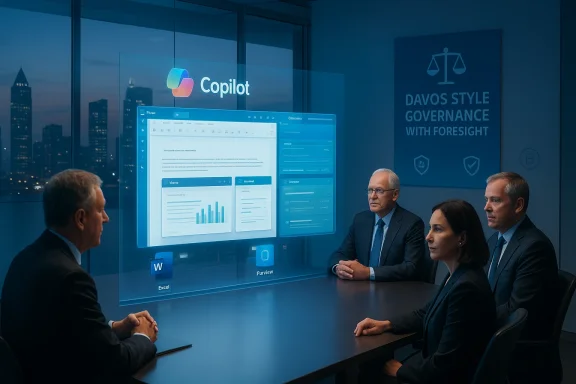
Qatar’s public sector quietly accelerated its AI agenda this week with two complementary moves: the Ministry of Education and Higher Education ran an introductory, hands‑on workshop to place Microsoft’s Copilot tools into the daily workflows of ministry directors and department heads, while the National Planning Council framed a Davos panel around “Governance with Foresight”, arguing for institutionalized predictive analytics and data‑driven planning as pillars of long‑term national strategy. Together these events reveal a deliberate national posture — one that marries operational AI adoption insidentity government with strategic, anticipatory planning at the policy level — but they also expose the hard governance, privacy, and technical choices that will determine whether Copilot and similar tools become productivity multipliers or unmanaged risk vectors.
For organizations that need in‑app Copilot capabilities, Microsoft lists a commercial price point for the full Microsoft 365 Copilot product tier; Copilot Chat, meanwhile, is included at no extra charge for many eligible Microsoft 365 education and commercial licenses. Copilot functionality continues to be rolled out in waves, with some features — such as on‑cell Excel COPILOT functions and advanced agent capabilities — reaching Beta or limited channel availability before general release. Microsoft itself and many IT teams caution that Copilot is a powerful assistant but not a substitute for human validation on accuracy‑critical tasks.
These moves take place inside an existing Qatari legal framework for data protection: Qatar enacted a Personal Data Privacy Protection law (Law No. 13 of 2016) that governs collection, processing, and storage of personal data and assigns enforcement responsibilities to national ministries and authorities. That statutory backdrop imposes specific obligations on public bodies when they bring cloud‑hosted AI tools into production.
But success is not automatic. Technical controls and vendor features are necessary but not sufficient. Real success will depend on measurable governance: transparent DPIAs, procurement that protects public data, mandatory training, and a credible measurement regime that ties Copilot adoption to documented service improvements. The legal framework in Qatar imposes clear data protection obligations; meeting them while unlocking AI’s productivity upside will require persistent attention from IT, legal, education specialists, and political leadership.
If implemented with discipline, the ministry’s workshop is the right kind of first step: practical, hands‑on, scoped, and governed. If rolled out without those guardrails — or if procurement and policy fail to keep pace with technical deployment — the same tools that boost productivity can amplify risk. The road ahead is manageable, but only for organizations willing to pair technological ambition with the structures of governance, foresight, and continuous measurement.
Source: Gulf Times Ministry of Education is organizing an introductory workshop on the Microsoft Copilot program
 Background
What is Microsoft Copilot — and why governments are adopting it
Microsoft’s Copilot portfolio ranges from the freely available Copilot Chat built into eligible Microsoft 365 tenants to the paid Microsoft 365 Copilot add‑on that embeds contextual AI inside Word, Excel, PowerPoint, Outlook, and Teams. The paid version is positioned as a productivity assistant that can reason over work data, produce drafts, generate slide decks, summarize email threads, and assist with data analysis. Microsoft markets Copilot as “work‑grounded” AI that respects user identity and tenant permissions, and that can be integrated with governance tools such as Microsoft Entra ID, Microsoft Purview sensitivity labels, and Double Key Encryption to protect enterprise data.For organizations that need in‑app Copilot capabilities, Microsoft lists a commercial price point for the full Microsoft 365 Copilot product tier; Copilot Chat, meanwhile, is included at no extra charge for many eligible Microsoft 365 education and commercial licenses. Copilot functionality continues to be rolled out in waves, with some features — such as on‑cell Excel COPILOT functions and advanced agent capabilities — reaching Beta or limited channel availability before general release. Microsoft itself and many IT teams caution that Copilot is a powerful assistant but not a substitute for human validation on accuracy‑critical tasks.
The governance context in Qatar
Qatar’s national strategy repeatedly foregrounds digital transformation and long‑term planning. The Ministry of Education’s workshop was framed as part of that broader agenda — connecting AI adoption to operational efficiency, skills development, and the Qatar National Vision 2030. On the strategic front, the National Planning Council used the World Economic Forum platform to argue that anticipatory planning and embedded foresight must be institutionalized across government so that policy, budgets, and initiatives remain coherent amid geopolitical and technological shifts.These moves take place inside an existing Qatari legal framework for data protection: Qatar enacted a Personal Data Privacy Protection law (Law No. 13 of 2016) that governs collection, processing, and storage of personal data and assigns enforcement responsibilities to national ministries and authorities. That statutory backdrop imposes specific obligations on public bodies when they bring cloud‑hosted AI tools into production.
What happened at the Ministry workshop — practical aims and immediate outcomes
Audience and objectives
The Ministry’s session targeted senior officials: undersecretaries, department directors, assistants, and heads of sections. The stated goals were straightforward:- Introduce the capabilities and mechanics of Microsoft Copilot.
- Demonstrate practical workflows that save time and improve coordination.
- Emphasize information security, data protection, and governance controls.
- Equip ministry leaders to think about institutional rollout, training, and use‑case selection.
Typical demos and use cases shown
The workshop focused on scenarios that are immediately beneficial to administrative and educational workflows:- Drafting and editing official communications in Word using Copilot-generated drafts and style alignment.
- Summarizing long email threads and extracting action items in Outlook and Teams.
- Creating slide decks and presentation outlines from short briefs in PowerPoint.
- Performing quick data analysis and pivot‑style assistance in Excel, including early previews of an on‑cell COPILOT function that can process ranges and return summaries.
- Automating meeting‑minute capture and turning unstructured notes into organized action lists.
Immediate operational steps the ministry can take
The workshop appears to have been accompanied by a “training‑then‑activate” approach: after hands‑on sessions, participants were expected to trial Copilot within the ministry tenant under supervised conditions, with IT teams monitoring usage and highlighting governance controls. This staged activation — training first, licenses second, supervised use third — is the sound risk‑reduction model many IT leaders recommend when deploying generative AI in production.The Davos panel: National Planning Council’s foresight agenda
Panel thrust and why it matters
At the World Economic Forum, the National Planning Council convened a policy‑level discussion under the theme “Governance with Foresight: Designing Institutions for the Next Decades.” The panel argued for two core principles:- Institutionalize foresight methodologies so governments can shift from reactive policy‑making to anticipatory, coordinated action.
- Embed data‑driven analytics into daily government operations so that long‑term strategic directions are clear and resilient under shifting global dynamics.
How foresight links to AI adoption
Foresight and AI are complementary. Copilot‑style tools streamline operational tasks and surface near‑term insights, while foresight disciplines ensure those operational changes align with strategic outcomes (for example, workforce development, education outcomes, or economic diversification targets). In practice, this requires end‑to‑end governance: data quality and lineage must be managed, use cases prioritized, and policies updated so that tactical AI adoption does not fracture strategic alignment.Why these developments matter: opportunities for Qatar
- Rapid productivity gains: Copilot can reduce time spent on drafting, formatting, summarization, and routine data work, freeing senior staff for higher‑value tasks.
- Skills acceleration: Training sessions scale digital skills across administrative ranks and create internal Copilot champions who can coach colleagues.
- Faster decision cycles: Automated synthesis of reports and meeting notes reduces friction in interdepartmental coordination.
- Strategic alignment: Embedding AI tools within a foresight‑driven national planning architecture can help ensure automation supports long‑term outcomes rather than short‑term convenience.
- Vendor platform benefits: Using Microsoft’s cloud and identity stack brings established enterprise controls — Entra ID for identity, Purview for data classification, Double Key Encryption for extra protection — that are often harder to build in bespoke systems.
Hard realities and risk profile
No rollout is risk‑free. The practical and policy risks to consider include:- Data privacy and protection: Public sector documents can contain personal and sensitive data covered by Qatar’s PDPL. Any Copilot prompt or connector that exposes controlled data must be evaluated through formal privacy assessments.
- Model hallucinations and accuracy limits: AI assistants can produce plausible but incorrect content. Microsoft and independent observers caution that Copilot should not be used for tasks requiring legal‑grade accuracy or financial reproducibility without human validation.
- Exposure of sensitive records: Independent AI risk research has shown enterprise AI products can have access to very large volumes of sensitive files if governance is lax. Unrestricted sharing and misconfigured connectors increase that exposure risk.
- Vendor lock‑in and contractual clarity: Cloud AI tools are powerful, but procurement must make data handling, model training, and auditability explicit — including guarantees about whether tenant data can be used to train vendor models.
- Operational brittleness and quota limits: New features (for example, Excel’s on‑cell COPILOT function) are often in Beta and subject to quota limits, rollout windows, or capability constraints that affect large‑scale automation plans.
- Student safety and academic integrity: In education contexts, student use of AI raises concerns about plagiarism, assessment design, and appropriate age gating.
Concrete technical and governance mitigations
Public institutions can adopt a practical risk‑management stack to pair with Copilot deployments. The following checklist is a practical starting point for any ministry, education body, or government agency.1. Pre‑deployment: policy, DPIA, and procurement
- Conduct a formal Data Protection Impact Assessment (DPIA) for every major Copilot use case. Identify data classes, sensitivity ratings, risks, and mitigations.
- Define permitted use cases in procurement documents and contracts. Require vendor commitments that tenant content will not be used for model training unless explicitly consented and auditable.
- Include explicit SLAs and audit rights covering data handling, incident response, and forensics.
2. Technical controls and configuration
- Enforce identity and access controls with Microsoft Entra ID; require multifactor authentication for admin functions.
- Apply Microsoft Purview sensitivity labels to classify data; use label enforcement to prevent Copilot from accessing confidential content.
- Implement Double Key Encryption (DKE) for the most sensitive content so the vendor cannot read protected material without the customer‑held key.
- Disable or restrict connectors (SharePoint, OneDrive, third‑party storage) until they are reviewed and mapped to policy.
- Configure logging and telemetry to capture Copilot calls, prompt context, and outputs for audit and incident response.
3. Operational and human controls
- Staged rollout: pilot with IT, legal, and a small set of business units; expand only after evaluation.
- Training and certification: require completion of a verified Copilot governance and usage curriculum before staff receive active licenses.
- Output verification: mandate human review of AI‑generated drafts for any content that affects legal standing, financial reporting, or students’ official records.
- Incident response: add AI‑specific playbooks to existing cyber incident response plans; include communication templates and legal escalation paths.
4. Ongoing governance and measurement
- Form a cross‑functional AI governance council (IT, privacy, legal, pedagogy) to review use‑cases, incidents, and measurement results.
- Instrument productivity claims: collect baseline metrics (time per task, turnaround, error rates) and measure the delta after Copilot adoption to assess ROI.
- Regular audits: conduct periodic privacy and security audits — including third‑party reviews — of Copilot configurations and access paths.
Education‑specific guidance (practical and policy)
- Age gating and admin steps: Microsoft requires additional tenant admin actions to enable Copilot Chat for students aged 13 and older; younger students are not eligible. Education tenants must follow the published enablement procedures to ensure legal and safe access.
- Academic integrity: redesign assessment models so AI‑generated content is not the default, and teach students how to use AI responsibly — as a drafting and research tool, with clear expectations for attribution and verification.
- Teacher enablement: prioritize teacher training on Copilot pedagogy — how to create prompt templates that scaffold student learning, how to critique AI outputs, and how to detect misuse.
- Privacy by design: avoid using real student IDs, sensitive personal data, or health details in prompts. Use redaction or synthetic datasets for class exercises that demonstrate Copilot capabilities.
- Curriculum integration: pair AI literacy modules with national curricula so students learn critical evaluation, bias recognition, and digital ethics alongside subject content.
Procurement and vendor management: clauses that matter
When public institutions buy Copilot licenses or agent capacity, procurement documents must explicitly cover:- Data residency and cross‑border transfer rules consistent with national law.
- Prohibition or explicit controls over vendor use of tenant data for model training.
- Right to audit and review model handling of tenant data; logging and export capabilities.
- Minimum security controls and encryption standards (FIPS‑level where required).
- Incident notification obligations with concrete timelines and remediation expectations.
- Termination and data deletion procedures: how to ensure tenant data is returned or destroyed on contract termination.
Trade‑offs and unanswered questions
- How aggressively should ministries enable connectors to enterprise content stores? The operational gains are real, but connectors expand the attack surface.
- How will measurement be standardized across government? Productivity claims must be reproducible and based on transparent metrics if national strategy is to be credible.
- What is the timeline for full, in‑app Copilot adoption in education? Features are rolling out in stages globally; education tenants may face staggered availability for certain capabilities, and that timing will affect national rollout plans.
- Will model performance degrade on domain‑specific content (legal language, educational rubrics)? Institutions should run domain tests and calibration before large‑scale deployment.
A practical 8‑point implementation roadmap for public institutions
- Define the strategic outcomes Copilot adoption must support (e.g., reduce administrative processing time by X%, improve response time to parental inquiries, accelerate curriculum content creation).
- Identify and prioritize use cases with the highest benefit/lowest sensitivity trade‑off.
- Run DPIAs and legal reviews for those use cases; map obligations under national data protection law.
- Configure tenant controls: Entra conditional access, Purview labels, DKE for high‑risk content.
- Pilot with a limited group, instrumenting performance and error metrics.
- Create mandatory training and certification for users and Copilot champions.
- Scale with a staged license activation tied to compliance sign‑off from the AI governance council.
- Reassess quarterly: update policies, measure outcomes, and publish transparent performance reports.
Final analysis: aligning ambition with discipline
The Ministry of Education’s workshop and the National Planning Council’s Davos panel are two sides of the same national coin. One operationalizes AI inside government workflows; the other insists that institutions evolve so strategic clarity and long‑term decision‑making are preserved. That combination — operational adoption coupled with institutional foresight — is a strong playbook for governments that want to harness generative AI without surrendering control.But success is not automatic. Technical controls and vendor features are necessary but not sufficient. Real success will depend on measurable governance: transparent DPIAs, procurement that protects public data, mandatory training, and a credible measurement regime that ties Copilot adoption to documented service improvements. The legal framework in Qatar imposes clear data protection obligations; meeting them while unlocking AI’s productivity upside will require persistent attention from IT, legal, education specialists, and political leadership.
If implemented with discipline, the ministry’s workshop is the right kind of first step: practical, hands‑on, scoped, and governed. If rolled out without those guardrails — or if procurement and policy fail to keep pace with technical deployment — the same tools that boost productivity can amplify risk. The road ahead is manageable, but only for organizations willing to pair technological ambition with the structures of governance, foresight, and continuous measurement.
Source: Gulf Times Ministry of Education is organizing an introductory workshop on the Microsoft Copilot program
