

Qatar’s participation in the Joint Periodic Exhibition for the Antiquities of GCC States, opened at the National Museum in Riyadh on December 1 and running through December 30, is both a cultural statement and a practical test of how Gulf museums are using cooperation, curation and digital engagement to make shared heritage visible to domestic and international audiences. Qatar Museums curated a focused selection for the Riyadh display — reported as a group of 25 artifacts spanning the Stone Age through Islamic periods — that positions Doha as an active partner in shared Gulf heritage initiatives while highlighting the technical and institutional work needed to sustain, interpret and protect those objects in the years ahead.
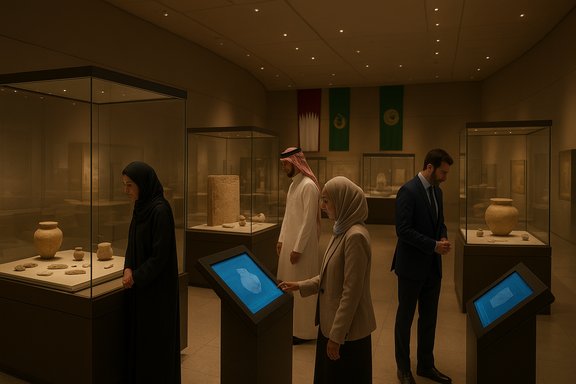
The Joint Periodic Exhibition for the Antiquities of the Gulf Cooperation Council (GCC) has become a recurring regional platform where member states rotate exhibits that highlight archaeological continuity, cross-border trade routes, and shared cultural forms across millennia. The 2025 Riyadh edition — described by official organisers as the eighth such exhibition — congregates museum authorities from GCC states under the auspices of Saudi Arabia’s Heritage Commission and the National Museum, with programming that explicitly blends traditional displays and interactive, technology-enabled interpretation. Qatar’s role at the Riyadh exhibition is twofold. First, it is a lending and curatorial participant, showing artifacts selected and prepared by Qatar Museums that narrate the peninsula’s prehistoric and historic arcs. Second, Qatar’s presence is a diplomatic and cultural signal: participation underscores the Gulf states’ preference for collaborative frameworks that foreground regional continuity rather than fragmented national narratives. That framing matters in public-facing exhibitions where interpretive choices — which objects to show, which narratives to emphasise, and how to present provenance or contested histories — shape both scholarly debates and popular understanding.
Source: Qatar Tribune https://www.qatar-tribune.com/artic...exhibition-for-antiquities-of-gcc-states/amp/
 Background / Overview
The Joint Periodic Exhibition for the Antiquities of the Gulf Cooperation Council (GCC) has become a recurring regional platform where member states rotate exhibits that highlight archaeological continuity, cross-border trade routes, and shared cultural forms across millennia. The 2025 Riyadh edition — described by official organisers as the eighth such exhibition — congregates museum authorities from GCC states under the auspices of Saudi Arabia’s Heritage Commission and the National Museum, with programming that explicitly blends traditional displays and interactive, technology-enabled interpretation. Qatar’s role at the Riyadh exhibition is twofold. First, it is a lending and curatorial participant, showing artifacts selected and prepared by Qatar Museums that narrate the peninsula’s prehistoric and historic arcs. Second, Qatar’s presence is a diplomatic and cultural signal: participation underscores the Gulf states’ preference for collaborative frameworks that foreground regional continuity rather than fragmented national narratives. That framing matters in public-facing exhibitions where interpretive choices — which objects to show, which narratives to emphasise, and how to present provenance or contested histories — shape both scholarly debates and popular understanding. What the public record says (facts and verification)
- Opening date and venue: The exhibition opened at the National Museum in Riyadh on December 1, 2025, and is scheduled to run until December 30, 2025.
- Qatar’s contribution: Qatar Tribune reports that Qatar Museums curated and presented a set of 25 artifacts spanning the Stone Age, the Bronze Age, the first millennium BCE and Islamic periods. This number appears in the Qatar Tribune report; however, the official Qatari or Saudi press releases available in the public record do not explicitly confirm the “25” figure, so that exact tally should be treated as reported rather than independently corroborated. This specific numeric claim therefore requires confirmation from Qatar Museums’ loan records or the exhibition catalogue.
- Organisers and format: The exhibition is organised by the Saudi Heritage Commission in cooperation with the National Museum and the Museums Authority, with the GCC Secretariat listed as a strategic partner; the program includes not only static artifacts but daily interactive programs that leverage digital technologies and modern media to reconstruct historical scenes and enhance visitor learning.
Why this exhibition matters: cultural diplomacy, conservation and narratives
The Riyadh exhibition is not only a museum event; it is a deliberate piece of cultural diplomacy. For Gulf states, joint exhibitions serve several strategic functions:- Cultural diplomacy and soft power: A rotating Gulf exhibition helps states project historical depth and cultural stewardship, shaping international perceptions while reinforcing intra‑Gulf ties.
- Shared narrative building: Exhibitions that collate artifacts across state boundaries construct a regional narrative that foregrounds continuity across the peninsula, which can be both scholarly and politically useful.
- Capacity building and technical exchange: The logistics of loans, conservation, packing, insurance, and display create opportunities for museum professionals to share best practice and harmonise standards around documentation, transport and climate-control protocols. Qatar’s participation — and Qatar Museums’ role in curating objects — places Qatari conservators and curators in the operational conversation around such standards.
Strengths in the Riyadh exhibition and Qatar’s participation
- Regional cooperation at scale. The exhibition’s design — coordinated by a central heritage commission with partner museums across GCC states — demonstrates logistical maturity and an ability to mobilise collections across borders.
- A curated, cross-chronological story. Selecting material that spans long chronological arcs (Stone Age → Bronze Age → First Millennium BCE → Islamic Ages) creates a coherent civilisational narrative that helps visitors connect discrete objects to a larger human story.
- Investment in interpretation and digital outreach. The inclusion of interactive programs and digital media shows that organisers are not relying solely on vitrines and labels; they’re trying to meet modern audiences where attention is shaped by screens and narrative layers.
Risks, blind spots and red flags (institutional, technical and ethical)
High-level cultural events of this nature bring clear benefits, but they also raise operational and ethical risks that deserve scrutiny:- Unverified claims and transparency. Public reporting sometimes includes detailed claims (for example, a precise artifact count or provenance statement) that are not mirrored in official catalogues or loan records. The “25 artifacts” figure for Qatar’s contribution is reported in the press but not yet confirmed in available institutional releases; transparency about loans, provenance and insurance terms remains essential.
- Provenance and legal exposure. Museums must ensure that each object’s provenance is documented and defensible. For Gulf exhibitions — where collections include archaeological finds, trade goods and everyday objects — undisclosed or poorly documented provenance can expose lenders and hosts to legal challenges or reputational risk.
- Climate and conservation vulnerabilities. Many artifacts are sensitive to humidity, light and temperature fluctuation. Cross-border loans increase transit exposure; museums must meet international conservation and packing standards to avoid irreversible damage.
- Soft‑power instrumentalisation. High-profile cultural diplomacy events can be framed as national prestige projects. That does not in itself invalidate them, but it places a premium on ensuring community voices and scholarly standards are not subordinated to spectacle. Independent, peer-reviewed cataloguing and open access to exhibition data reduce the risk of instrumentalisation.
- Digital security and access control risks. As museums digitise collections and create online portals or 3D models, they must balance public access with risk mitigation: sensitive metadata (site coordinates, excavation team identities, sacred object contexts) should be protected, and platform security must be robust against data exfiltration or unauthorized reuse.
The technology and standards that should accompany modern exhibitions
For WindowsForum’s readership — IT and digital preservation professionals — the Riyadh show is a useful case study for recommended technical approaches that museums should adopt when staging cross-border exhibitions.Metadata, schemas and interoperability
- CIDOC-CRM is the accepted ontology for cultural heritage metadata integration and should be used to model relationships among objects, events, actors and places. Mapping local collection records to CIDOC‑CRM (ISO 21127) makes long-term integration and research queries far more robust.
- IIIF (International Image Interoperability Framework) enables high-fidelity image delivery, deep zoom and international interoperability for object images and facsimiles. Museums leveraging IIIF can offer researchers and the public dynamic, linked access to image derivatives without proliferating file copies.
- Support standard preservation metadata (PREMIS), packaging (METS) and descriptive Dublin Core or MODS where appropriate to ensure archival compatibility.
Imaging, 3D capture and file formats
- Use high-resolution TIFF (uncompressed or lossless) for master imaging, with JPEG2000 or WebP derivatives for web delivery. TIFF masters preserve color and bit-depth for future reprocessing.
- For 3D objects, adopt photogrammetry or structured-light capture with preservation-grade outputs (OBJ, PLY) and archival derivatives documented with checksums.
- Embed checksums (SHA-256) and record fixity metadata in the object catalogue to support integrity checks.
Storage, backup and cloud strategy
- Maintain a multi-site storage strategy: primary live servers for public delivery (CDN-backed), and separate, geographically redundant archival storage (cold storage such as AWS Glacier, Azure Archive, or equivalent) for preservation. Ensure encryption at rest and in transit.
- Implement automated integrity checks and scheduled restoration drills to validate archived files.
Access controls and sensitive metadata
- Use granular access controls for restricted data: sensitive excavation coordinates, sacred-use artifacts, or personal data should be compartmentalised and exported only under NDA or research request workflows.
- Implement role-based identity (e.g., Azure AD or equivalent SSO) for museum staff and external researchers. Apply Conditional Access and MFA for privileged roles.
Content delivery and public engagement
- Host IIIF endpoints for images to enable compatible viewers like Mirador or Universal Viewer. This encourages cross-institutional comparisons and scholarly reuse.
- Provide downloadable research packets (metadata + image derivatives) with machine-readable licensing and provenance statements.
- Where possible, publish an open, citable exhibition catalogue and dataset (CSV + IIIF manifests + CIDOC-CRM mappings) that researchers can use to validate claims and reproduce analyses.
Practical, actionable checklist for museums and IT teams (1–12 steps)
- Confirm the exhibition loan list and acquire official loan agreements and condition reports for every object being transported. Ensure signed checks on provenance and legal title.
- Capture master digital surrogates for each object before transit: TIFF for 2D, high-resolution photogrammetry for 3D meshes, with documented capture settings and color targets.
- Map collection records to CIDOC‑CRM and create IIIF manifests for visual assets. Publish these manifests where public access is approved.
- Generate and store checksums (SHA‑256) and record fixity values in a central preservation database. Schedule weekly fixity audits.
- Use a multi-tier storage strategy: active CDN-backed hosting for visitors, with cold-archive redundancy and regular retrieval tests.
- Encrypt sensitive metadata and restrict access using role-based identity controls (SSO + MFA + Conditional Access).
- Review packing and transit protocols with conservators: vibration-damping crates, inert gas padding where needed, and environmental monitoring tags (temperature, humidity, shock).
- Prepare an incident response plan covering transit damage, cyber-security incidents affecting the exhibition CMS, and media queries about provenance.
- Publish a compact, machine-readable exhibition catalogue with object-level provenance notes, photography credits and licensing terms.
- Implement IIIF viewers in the exhibition’s online presence to support comparisons and scholarly analysis.
- Train front‑of‑house and digital staff on object sensitivity, legal constraints, and protocols for research requests.
- Within 30 days after closing, publish an outcomes brief listing loans returned, any conservation actions undertaken, and post‑exhibition access plans for digital surrogates.
Institutional recommendations and policy implications
- Require that every loan includes a publicly accessible, machine-readable provenance and condition record, unless redaction is necessary for safety or legal reasons.
- Tie exhibition sponsorship and public‑private partnership contracts to preservation and access commitments — sponsors should not control scholarly access or interpretive framing.
- Invest in staff training for digital preservation, CIDOC‑CRM knowledge and IIIF deployment; these are the skills that allow museums to do more with less while protecting collections.
- Publish a post‑exhibition accountability report that lists loans, conservation incidents (if any), and digital publication actions to reduce speculation and increase trust.
A critical reading of the public narrative
Qatar’s visible participation in Riyadh is strategically sensible: it reaffirms cultural partnership and expands the reach of Qatari curatorial work. But the public record also reveals a pattern that merits scrutiny:- Media reports often emphasise attendance, object lists and diplomatic presence, but less often publish the underlying loan agreements, provenance documentation or digital asset plans.
- Regional forums and exhibitions sometimes conflate ceremonial visibility with long-term capacity-building. The real test will be whether exhibition outcomes are followed by published datasets, conservation follow-through, and demonstrable community engagement beyond a ceremonial opening.
Conclusion: heritage as memory, museums as infrastructure
The Joint Periodic Exhibition at Riyadh is a valuable public gesture: it places Gulf heritage on a visible, collaborative stage and allows national institutions like Qatar Museums to share curated narratives with regional partners. The use of digital programs and interactive media in Riyadh suggests organisers are aware that modern museum audiences expect layered experiences that combine object scholarship and digital storytelling. Yet real, durable value from such exhibitions emerges only when curators, conservators and IT teams treat loans not as publicity tokens but as components of distributed cultural infrastructure: high-integrity digital surrogates, interoperable metadata (CIDOC‑CRM), IIIF‑enabled imaging, secure and redundant preservation workflows, and transparent public reporting. For museums in the Gulf — and for Qatar Museums specifically — the challenge is to convert a successful exhibition appearance into stronger professional networks, shared technical standards, and published data that advance scholarship and protect collections for future generations. In short: the Riyadh exhibition is an opportunity. With disciplined transparency, modern digital practice and a commitment to measurable follow‑up, that opportunity can pay lasting dividends for research, education and the long-term stewardship of Gulf heritage. If institutional actors seize that opportunity, the objects on display in Riyadh will have done more than tell old stories — they will have helped build the systems and skills needed to keep those stories trustworthy, accessible and resilient.Source: Qatar Tribune https://www.qatar-tribune.com/artic...exhibition-for-antiquities-of-gcc-states/amp/
