

Qatar’s Ministry of Communications and Information Technology (MCIT) has moved from pilot to scale: the ministry launched the second phase of its national “Adopt Microsoft Copilot” programme while publicly honouring the first cohort of graduates — a twin announcement that signals both operational momentum for government AI adoption and an urgent need for measurable governance and technical safeguards.
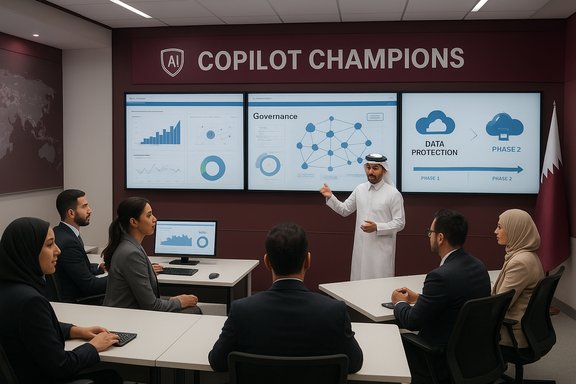
Qatar’s digital transformation agenda has emphasized workforce readiness, public-sector productivity and rapid adoption of cloud-enabled services as pillars of the national strategy. The Adopt Microsoft Copilot programme was introduced earlier in 2025 as a vendor‑partnered, training-led pilot to embed Microsoft 365 Copilot into routine government workflows. The initiative pairs licensing with role-based courses delivered through the Qatar Digital Academy and establishes institutional adoption mechanisms such as internal “Copilot Champions” and an AI Council intended to oversee governance. Concurrently, Qatar’s justice leadership has been underscoring the legal architecture that frames modern security work. In remarks delivered at a Police Academy event, HE Minister of Justice and Minister of State for Cabinet Affairs Ibrahim bin Ali Al Mahmoud stressed the constitutional basis of security duties, the necessity of judicial oversight, and the integration of new legislation to confront transnational organized crime, money laundering, and cybercrime — confirming that legislative modernization is a deliberate, state‑level priority. These twin tracks — rapid AI adoption on one hand and legal modernization on the other — set the context in which Copilot will be used inside government. (Minister’s remarks as reported by national press and public briefings.
Key verification points that remain outstanding publicly:
Source: Qatar news agency Qatar news agency
 Background
Qatar’s digital transformation agenda has emphasized workforce readiness, public-sector productivity and rapid adoption of cloud-enabled services as pillars of the national strategy. The Adopt Microsoft Copilot programme was introduced earlier in 2025 as a vendor‑partnered, training-led pilot to embed Microsoft 365 Copilot into routine government workflows. The initiative pairs licensing with role-based courses delivered through the Qatar Digital Academy and establishes institutional adoption mechanisms such as internal “Copilot Champions” and an AI Council intended to oversee governance. Concurrently, Qatar’s justice leadership has been underscoring the legal architecture that frames modern security work. In remarks delivered at a Police Academy event, HE Minister of Justice and Minister of State for Cabinet Affairs Ibrahim bin Ali Al Mahmoud stressed the constitutional basis of security duties, the necessity of judicial oversight, and the integration of new legislation to confront transnational organized crime, money laundering, and cybercrime — confirming that legislative modernization is a deliberate, state‑level priority. These twin tracks — rapid AI adoption on one hand and legal modernization on the other — set the context in which Copilot will be used inside government. (Minister’s remarks as reported by national press and public briefings. MCIT’s “Adopt Microsoft Copilot” — What the ministry announced
Phase one: the headline metrics
MCIT reported several headline outcomes from the first phase:- Adoption rate of roughly 62% among target users.
- More than 9,000 active users across the participating entities.
- Approximately 1.7 million tasks executed through Copilot during the pilot period.
- An estimated >240,000 working hours saved attributed to Copilot‑assisted work.
What the rollout actually includes
The second phase is not only a license expansion: it is a combined skilling and governance effort that, according to MCIT and partner statements, includes:- Role-based training tracks and hundreds of short workshops delivered by Qatar Digital Academy.
- Governance constructs such as an AI Council to oversee institutional adoption and internal Copilot Champions to accelerate diffusion.
- Technical onboarding steps tied to license activation, and staged deployments to achieve “full license activation.”
Verifying the claims: cross‑checks and documented caveats
The headline metrics above were consistently reported across Qatar’s national press outlets, which themselves cite MCIT/QNA briefings. Independent coverage by The Peninsula and Qatar Tribune repeats the same figures, establishing a consistent public narrative about adoption and impact. However, independent validation of the measurement methodology is not yet public. The ministry’s figures appear to be self‑reported program outcomes; public reporting has not (yet) released the sampling approach, baselines or an independent audit that explains how a “task” is defined, how time‑saved estimates were measured, or whether the calculations are based on self‑reported user surveys, automated telemetry, or modeled extrapolations. This distinction matters: similar public‑sector pilots elsewhere have shown that small per‑user time savings, when extrapolated across an organization, can produce large headline numbers — but the precise measurement method alters the confidence you can place in those extrapolations.Key verification points that remain outstanding publicly:
- A published methodology for “tasks executed” and the calculation of “hours saved.”
- Third‑party auditing or representative sample validation of reported productivity gains.
- A public list of use cases where Copilot outputs translated into measurable service‑level improvements or citizen outcomes.
Technical and data‑protection realities — what Microsoft’s enterprise guidance says
When governments adopt Copilot-like services, questions about data usage, residency and training are fundamental. Microsoft’s enterprise guidance and official documentation make several crucial statements that directly affect government procurement and governance:- Microsoft states that customer data, prompts and tenant content used by Copilot are not used to train Microsoft’s foundational models unless the customer explicitly opts in. This non-training default for enterprise tenants is a central privacy assurance for regulated deployments.
- Microsoft provides commercial data protection features for Entra‑authenticated users that can limit retention, prevent “eyes‑on” review and flag a “Protected” badge in the UI when enabled.
- Enterprise Copilot capabilities integrate with Microsoft compliance tooling (e.g., Microsoft Purview) to enable classification, retention and eDiscovery of Copilot interactions — but these controls must be configured and enforced by the tenant, not assumed by default.
Strengths: what MCIT’s programme does well
- Training-first approach: Pairing licensing with role‑based training via Qatar Digital Academy reduces the common gap between supply (licenses) and demand (skills). Role differentiation increases the probability that staff will use Copilot safely and effectively.
- Visible senior sponsorship: Public ceremonies and ministerial support create the institutional momentum required for cross‑agency adoption.
- Structured governance concepts: MCIT’s stated plans for AI Councils and Copilot Champions align with global best practice: organise governance horizontally and create local champions for diffusion.
- Strategic alignment: The programme is aligned with Qatar’s Digital Agenda 2030 and national development priorities, increasing the odds that adoption will remain policy‑driven rather than vendor‑driven.
Risks and failure modes MCIT must manage
- Measurement and attribution risk
- Without a published methodology, large “hours saved” claims can be questioned. Extrapolations from self‑reported savings or small sample telemetry are fragile. MCIT should publish how “task” and “hours saved” are defined and validated.
- Data sovereignty and sensitive workflows
- Even with tenant‑scoped processing, Copilot outputs may reference internal documents. Agencies must classify data, create “no‑Copilot” zones (e.g., active investigations, unredacted medical records), and enforce Purview labels and DLP.
- Vendor lock‑in and vendor‑centric skilling
- Training that focuses solely on Microsoft tooling accelerates adoption but can reinforce long‑term dependence. A parallel vendor‑agnostic governance curriculum is advisable.
- Operationalization gap
- Certificates and graduation ceremonies do not guarantee sustained capability. Graduates must be slotted into institutional roles, projects and retention programs to avoid skill attrition.
- Model‑hallucination and public trust
- Generative AI can hallucinate plausible but incorrect outputs. Any Copilot‑influenced public communication or legal drafting must include mandatory human verification and provenance logging.
Practical recommendations — turning scale into durable outcomes
- Publish a transparent impact methodology that defines “task” and “hours saved,” describes sampling windows and shows baseline vs. post‑adoption comparisons. Commission a third‑party representative audit for at least one pilot entity within 3–6 months.
- Enforce technical data guards before expanding to new entities:
- Mandatory Purview labels on datasets before Copilot access.
- DLP and conditional access gating for Copilot use.
- Integration of Copilot logs into national SOC/SIEM pipelines.
- Create mandatory vendor‑neutral governance modules for all trainees covering privacy law, explainability, bias testing and incident response.
- Define a 3/6/12‑month KPI cadence for each participating entity that ties Copilot use to service outcomes (e.g., case turnaround, error rates, citizen satisfaction).
- Reserve “no‑Copilot zones” for highly sensitive contexts and build a documented escalation path for any AI‑related incident.
Legal and security framework: Minister Ibrahim bin Ali Al Mahmoud’s priorities and how they intersect with AI adoption
At an event hosted by the Police Academy, HE Minister of Justice Ibrahim bin Ali Al Mahmoud outlined a legal posture that reinforces the rule of law, human dignity, judicial oversight and proportionate use of force — themes that are directly relevant when generative AI tools enter public‑sector decision loops. His remarks emphasized:- The need for a constitutional balance between authority and citizens’ rights.
- Recent and ongoing legislative development in areas such as criminal law, criminal procedure, traffic and civil defence, immigration regulation, anti‑organized crime statutes, anti‑human‑trafficking laws, anti‑money‑laundering frameworks, counter‑terrorism financing laws and cybercrime legislation.
Why these legal priorities matter for Copilot adoption
- Data protection and privacy: Ministers’ emphasis on dignity and rule‑of‑law underscores the need to ensure Copilot deployments adhere to national privacy rules and that data classification is enforced — especially as new cybercrime rules criminalize unauthorized dissemination of personal images and impose substantial penalties.
- Judicial oversight and accountability: When AI affects decisions that have legal consequence — administrative rulings, enforcement correspondence, or official statements — clear provenance and audit trails are essential to preserve judicial oversight and enable redress.
- Combating organized crime and cyber threats: The minister highlighted transnational organized crime and cybercrime as contemporary challenges; these are precisely the contexts where robust AI governance and secure data handling are non‑negotiable to prevent operational exposure or misuse.
A pragmatic balance: opportunity with conditions
Qatar’s approach — pairing a large‑scale technical pilot with visible legal and governance conversations — is, in principle, the right way to introduce generative AI into public services. The programme’s strengths are real: training at scale, executive sponsorship, and vendor partnership create rapid capability lift. But the program will only earn long‑term credibility if three things happen in short order:- Measurement transparency (publish methodologies and validate claims).
- Operational governance (technical controls, classification, and audit trails).
- Independent oversight (third‑party audits and public reporting of measurable service outcomes).
Conclusion
The MCIT’s launch of phase two of the Adopt Microsoft Copilot programme and the graduation of the first cohort mark a decisive moment for Qatar’s public‑sector digital transformation: the state is moving beyond isolated pilots to a structured, nation‑level skilling and adoption effort. The initiative aligns strategically with Qatar’s Digital Agenda 2030 and benefits from Microsoft’s enterprise features that, if configured and contractually reinforced, can satisfy many compliance needs. Yet the long‑term test will be whether the programme converts adoption metrics into validated, citizen‑facing improvements while maintaining the legal protections the Minister of Justice described. The immediate priorities are clear: publish measurement methods, operationalize technical and policy guardrails, and invite independent review. Done correctly, Qatar can demonstrate how to scale generative AI across government while preserving legal safeguards and public trust; done poorly, rapid expansion risks operational missteps with outsized consequences. The balance between productivity and prudence is now the operational task MCIT and participating ministries must deliver on.Source: Qatar news agency Qatar news agency
