

QNAP’s new TS-h2477AXU-RP arrives as a large-capacity, cost-conscious 4U rackmount NAS that pairs an 8‑core Ryzen-class CPU with DDR5 memory, PCIe Gen5 M.2 support and ZFS-based QuTS hero features — a combination aimed squarely at storage-hungry businesses that need both scale and enterprise-grade data protection.
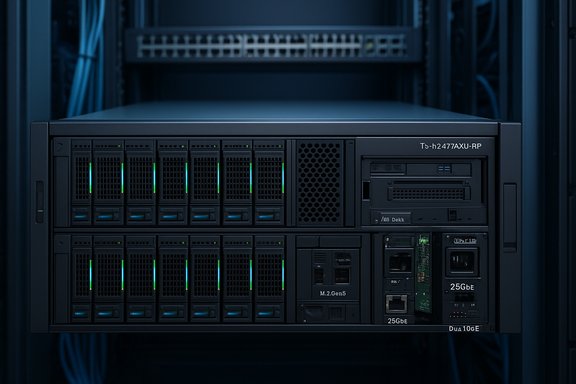
QNAP has expanded its TS-hx77 family with the TS-h2477AXU-RP, positioning the device as the 24-bay flagship for customers who want high density without stepping up to the larger 30-bay hybrid models. The appliance targets mid-size to large teams managing file servers, virtualization storage, archive pools and media production workloads. QNAP’s product literature highlights ZFS-backed QuTS hero as the platform for end-to-end data integrity, while channel listings and reseller pages confirm the device ships with dual redundant PSUs, multi‑Gigabit networking and three PCIe Gen4 expansion slots for optional 25GbE or GPU cards. In plain terms, the TS-h2477AXU-RP is an enterprise-minded NAS built to scale: 24 front bays in a 4U chassis, support for Gen5 NVMe M.2 SSDs (two internal slots), and the ability to expand to many petabytes through QNAP JBOD shelves. That combination aims to balance raw capacity, performance, and the data integrity advantages of ZFS.
From a service perspective the unit is friendly to technicians: hot-swap bays, front-accessible status LEDs, and modular PSUs reduce mean time to repair. QNAP’s guidance to use QNAP’s M.2 heatsinks for Gen5 modules is a practical note for buyers planning to populate the M.2 slots with high-performance NVMe SSDs.
Practical tip: For multi‑user editing, VDI, or heavy VM consolidation, plan for at least one 10GbE (or higher) uplink and consider dedicated networks for storage and management traffic to avoid contention.
(Technical specifications and retail pricing referenced from QNAP product documentation and current channel listings; independent lab performance and hands-on observations from recent reviews.
Source: IT Pro Qnap TS-h2477AXU-RP review: A big NAS appliance to satisfy storage-hungry businesses
 Background
QNAP has expanded its TS-hx77 family with the TS-h2477AXU-RP, positioning the device as the 24-bay flagship for customers who want high density without stepping up to the larger 30-bay hybrid models. The appliance targets mid-size to large teams managing file servers, virtualization storage, archive pools and media production workloads. QNAP’s product literature highlights ZFS-backed QuTS hero as the platform for end-to-end data integrity, while channel listings and reseller pages confirm the device ships with dual redundant PSUs, multi‑Gigabit networking and three PCIe Gen4 expansion slots for optional 25GbE or GPU cards. In plain terms, the TS-h2477AXU-RP is an enterprise-minded NAS built to scale: 24 front bays in a 4U chassis, support for Gen5 NVMe M.2 SSDs (two internal slots), and the ability to expand to many petabytes through QNAP JBOD shelves. That combination aims to balance raw capacity, performance, and the data integrity advantages of ZFS.Overview and what’s new
- Chassis: 4U rack with 24 hot-swap LFF/SFF drive bays.
- Processor: AMD Ryzen-class 8‑core CPU (Ryzen 7 series in current SKUs).
- Memory: 32GB DDR5 UDIMM installed, expandable up to 192GB (4 DIMM slots).
- NVMe: 2 × M.2 2280 PCIe Gen5 slots (for NVMe cache or pools).
- PCIe: 3 × PCIe Gen4 expansion slots for NICs, GPU, or storage adapters.
- Networking: Dual 2.5GbE and dual 10GbE RJ45 ports onboard (multi‑Gig supported); upgradeable to 25GbE via PCIe cards.
- Software: QuTS hero (ZFS) preferred; QTS installable as alternate OS.
- Power: Dual hot‑swap PSUs (800W models on some SKUs / vendors vary).
Design and deployment
Build and serviceability
The TS-h2477AXU-RP follows a traditional 4U enterprise design: a steel frame, metal drive carriers and a drive backplane feeding a bank of cold-swap fans. QNAP places the mainboard low in the chassis for airflow, with the Ryzen CPU under a large passive heatsink and the DIMM slots accessible for quick RAM upgrades. Dual hot‑plug PSUs are supplied in common SKUs to meet high-availability expectations.From a service perspective the unit is friendly to technicians: hot-swap bays, front-accessible status LEDs, and modular PSUs reduce mean time to repair. QNAP’s guidance to use QNAP’s M.2 heatsinks for Gen5 modules is a practical note for buyers planning to populate the M.2 slots with high-performance NVMe SSDs.
Installation workflow (typical)
- Rackmount the appliance and connect redundant power feeds.
- Install drives (HDDs for capacity pools, NVMe for cache or system pools).
- Boot and run the web-based installer to choose QuTS hero or QTS.
- Configure storage pools, set RAID levels, and create NAS shares / iSCSI LUNs.
- Configure networking (link aggregation / SMB Multichannel / MPIO), snapshots, and replication.
Hardware deep dive
CPU and memory
The reviewed configuration is built around an 8‑core Ryzen 7 CPU operating in the Ryzen‑7000 series class and supplied with 32GB DDR5 UDIMM. QNAP’s platform supports up to 192GB across four DIMM slots, allowing administrators to scale memory for heavier ZFS workloads (deduplication, compression, and multiple VMs). Official QNAP specs and reseller pages corroborate the 4× DIMM design and DDR5 expansion ceiling. Practical point: ZFS features such as inline deduplication and large ARC caches are memory-hungry. If you plan to use deduplication or host many containers/VMs, scale the RAM accordingly.Storage and expansion
- Front bays: 24 × SATA 3.5"/2.5" (hot-swap).
- Internal NVMe: 2 × M.2 2280 PCIe Gen5 slots (backwards compatible).
- External JBOD: Support for QNAP’s TL-R2400PES-RP 24‑bay expansion chassis; up to eight of those logically expand the system, delivering very large raw capacities.
- PCIe slots: 3 × PCIe Gen4 for NICs, GPUs or other I/O cards.
Drive flexibility
QNAP does not impose restrictive drive lists in the same way some vendors do; the unit has been tested with mainstream NAS HDDs and consumer NVMe SSDs, but for sustained enterprise use select NAS-rated HDDs and enterprise NVMe drives. The QuTS hero OS will report and manage SSD endurance and can throttle pools to avoid simultaneous SSD failures — an important capability when mixing different endurance classes.QuTS hero: ZFS-based protection and data services
QuTS hero is the selling point for businesses prioritizing data integrity. Its headline features include:- ZFS copy-on-write for near-infinite, fast snapshots.
- End-to-end checksums with self-healing on reads.
- WORM (Write Once Read Many) policies for immutable storage and ransomware protection.
- Triple parity and triple mirror RAID options for extreme redundancy.
- Inline deduplication and compression (deduplication requires additional memory).
- SnapSync and block-level replication for remote synchronization and disaster recovery.
Networking and real-world performance
Lab-tested numbers
In lab testing deployed by independent reviewers, the TS-h2477AXU-RP recorded strong 10GbE performance using embedded ports: sequential reads/writes around 9.2 Gbit/s on a single 10GbE path, and roughly 18.5 Gbit/s read and 17.4 Gbit/s write when using dual 10GbE MPIO aggregation. Random I/O results were nearly identical, indicating efficient ZFS ARC and ZIL behavior under the test conditions. Remarkably, CPU utilization remained low in those tests, which points to the platform’s ability to deliver high throughput without saturating the processor. These figures are consistent with both the IT Pro hands‑on tests and QNAP’s lab-published throughput guidance (which uses different test conditions and more aggressive NIC counts). When comparing numbers, remember vendor labs typically run specific configurations (enterprise SSDs, multiple 25GbE links) that are not directly comparable to single 10GbE client tests.Networking flexibility
The TS-h2477AXU-RP’s dual 10GbE and dual 2.5GbE ports provide flexible multi‑Gig connectivity out of the box. For heavier networking demands you can add certified QNAP 25GbE adapters in the PCIe slots. QNAP’s virtual switch and port trunking support SMB Multichannel and MPIO for aggregated throughput and redundancy.Practical tip: For multi‑user editing, VDI, or heavy VM consolidation, plan for at least one 10GbE (or higher) uplink and consider dedicated networks for storage and management traffic to avoid contention.
Price, SKUs and value
IT Pro’s hands‑on review cited a diskless, end‑user UK price of £6,635 (ex VAT) for the reviewed SKU; channel pricing elsewhere shows USD/EUR variances with typical street prices in the mid‑$6,000s to low‑$7,000s depending on region, RAM configuration and reseller margins. QNAPWorks and SHI list similar SKUs in the $6,099–$7,082 range, illustrating how local taxes, distribution and configuration options drive final costs. Put another way: expect a six‑figure-dollar‑cent price in enterprise currency for the base chassis before drives and optional NICs. Value analysis:- Cost per bay: With 24 bays, the chassis provides a relatively low cost-per-bay compared with some 16- and 30-bay alternatives — making it attractive to businesses prioritizing raw capacity.
- Total solution cost: Add enterprise HDDs, M.2 NVMe modules (Gen5), additional NICs, and extended warranty to arrive at the true deployed cost; these items can double the chassis price for large-capacity builds.
- Support: QNAP offers multi-year limited warranties and a channel-backed support ecosystem; verify local support SLAs for mission-critical deployments.
Strengths and where it shines
- Huge expansion potential: Connect multiple 24‑bay JBODs to reach PB-scale raw capacity.
- Strong base performance: 10GbE testing shows nearly line-rate single-link throughput and effective link aggregation scaling.
- ZFS-based QuTS hero: Robust data protection (checksums, snapshots, immutability) and enterprise RAID options.
- Flexible networking: Onboard multi‑Gig ports and multiple PCIe slots for 25GbE or GPU acceleration.
- RAM headroom: 192GB maximum supports memory-heavy ZFS features and multiple VMs/containers.
Potential risks and downsides
- Total deployed cost: Drives, enterprise NVMe SSDs, and high-speed NICs add materially to the bill; plan budgets accordingly.
- Complexity of memory sizing: Enabling inline deduplication or very aggressive snapshot strategies requires significant RAM — undersized systems will negate the advantages of these features.
- Operational overhead: QuTS hero’s power and features add management complexity versus simpler, lightweight NAS OSes; smaller teams must plan for the administration burden.
- Vendor pricing and SKU variance: PSU sizes, preinstalled CPU microcode variants and included accessories differ across SKUs and regions; confirm exact SKU details at purchase.
- Supply and lead times: Enterprise hardware often faces lead-time variability; if you’re timing large migrations, confirm delivery windows with resellers.
Practical deployment recommendations
- Right-size memory: Start with at least 64GB if you plan inline deduplication or heavy VM workloads; scale to 128–192GB for aggressive dedupe and many concurrent VMs.
- Use NAS-rated HDDs for capacity: Choose drives with proven sustained workload ratings and vendor-recommended models for RAID stability.
- Populate M.2 with high-endurance NVMe: Use enterprise-grade Gen5 (or compatible Gen4) SSDs for ZIL and ARC duties when workloads require low latency.
- Segment networks: Separate management, backup replication and client traffic on distinct VLANs or physical NICs to avoid noisy-neighbor issues.
- Plan for offsite replication: Configure SnapSync or Hybrid Backup Sync with an offsite target (or cloud) to satisfy 3‑2‑1 backup policies.
- Test HA and failover: If using High Availability clustering, validate failover scenarios and ensure management scripts and monitoring are functioning.
Who should buy this unit?
- Workgroups or mid‑size enterprises that require large on-prem bulk storage and want strong data integrity guarantees.
- Media production houses needing many terabytes of nearline storage with the option to add NVMe acceleration for active projects.
- Virtualization hosts and backup targets where ZFS snapshots and efficient replication are essential.
- IT teams that prefer on-prem control over cloud costs for cold or regulatory data.
Final verdict
The QNAP TS-h2477AXU-RP is a thoughtfully engineered, high-density rackmount NAS that delivers a compelling mix of capacity, performance and enterprise data services. Its combination of an 8‑core Ryzen-class CPU, DDR5 memory expansion, two Gen5 M.2 slots and QuTS hero’s ZFS protection make it a strong platform for businesses that need to keep large volumes of data under tight operational control. Independent lab testing confirms robust 10GbE performance and effective scalability with link aggregation, while channel pricing shows the chassis lands in a competitive range for its class — though the final deployed cost depends heavily on drives, SSDs and network upgrades. Buyers should weigh the advantages of QuTS hero’s advanced features against the additional memory and management costs they imply. When configured correctly and integrated into a well-architected backup/DR plan, the TS-h2477AXU-RP delivers a powerful, expandable foundation for enterprise storage.(Technical specifications and retail pricing referenced from QNAP product documentation and current channel listings; independent lab performance and hands-on observations from recent reviews.
Source: IT Pro Qnap TS-h2477AXU-RP review: A big NAS appliance to satisfy storage-hungry businesses
