

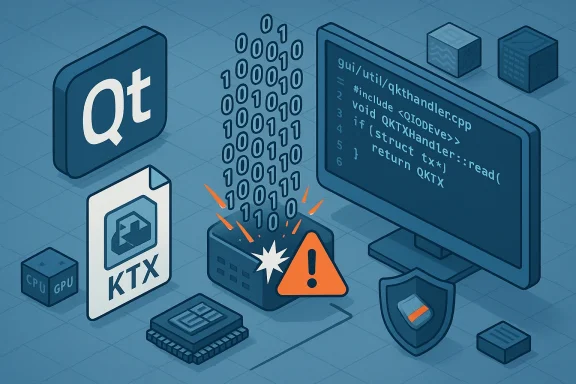
A subtle flaw in Qt’s KTX image handling — tracked as CVE-2024-25580 — can be triggered by a specially crafted KTX file to cause a buffer overflow and crash applications that use Qt’s image loader. The issue affects multiple maintained Qt branches and was fixed by the Qt project in targeted point releases; vendors and packagers issued advisories and security updates shortly after disclosure.
KTX (Khronos Texture) is a widely used container format for GPU-ready texture data. It is used in game engines, 3D tools, texture pipelines, and any application that needs to ship pre-compressed textures to graphics hardware. Because KTX files frequently contain binary headers and packed image levels, they require careful bounds checking during parsing to avoid integer and buffer overflows.
Qt provides support for many image formats through plugin handlers; qktxhandler.cpp is the Qt code component responsible for reading KTX images into Qt’s image subsystems. When a vulnerability affects a code path used for image decoding in a ubiquitous framework like Qt, it has an outsized impact: a single vulnerable library can expose many desktop applications, utilities and even server-side image-processing components to the same flaw. The advisory from The Qt Company states the vulnerability was assigned CVE-2024-25580 and lists the affected versions and fixed releases.
What public resources do tell us:
For defenders and developers, this advisory reinforces a few perennial best practices:
Source: MSRC Security Update Guide - Microsoft Security Response Center
 Background
KTX (Khronos Texture) is a widely used container format for GPU-ready texture data. It is used in game engines, 3D tools, texture pipelines, and any application that needs to ship pre-compressed textures to graphics hardware. Because KTX files frequently contain binary headers and packed image levels, they require careful bounds checking during parsing to avoid integer and buffer overflows.Qt provides support for many image formats through plugin handlers; qktxhandler.cpp is the Qt code component responsible for reading KTX images into Qt’s image subsystems. When a vulnerability affects a code path used for image decoding in a ubiquitous framework like Qt, it has an outsized impact: a single vulnerable library can expose many desktop applications, utilities and even server-side image-processing components to the same flaw. The advisory from The Qt Company states the vulnerability was assigned CVE-2024-25580 and lists the affected versions and fixed releases.
What CVE-2024-25580 is (concise summary)
- The vulnerability is a buffer overflow in the KTX image handler implementation at gui/util/qktxhandler.cpp in Qt.
- A crafted KTX image can trigger the overflow and crash the application that attempts to load it.
- The vulnerability affects multiple Qt branches and was addressed in Qt point releases: Qt 5.15.17, Qt 6.2.12, Qt 6.5.5, and Qt 6.6.2 (the advisory and vendor notices list these versions as the fixes).
Why this matters: exposure and real-world impact
The direct technical impact here is availability: a malformed KTX causes a buffer overflow that crashes the process performing the decode. Consequences vary by how the vulnerable Qt code is used:- Desktop applications that display or import textures (3D editors, viewers, games, modeling tools) can crash when a user opens or previews a crafted KTX file.
- Automated image-processing services, CI job runners, or conversion pipelines that accept untrusted image uploads can be forced offline or made to repeatedly crash, causing a denial‑of‑service condition.
- Applications that deserialize or accept KTX data over the network (for example, texture streaming services, remote asset stores, or in-app downloads) can be attacked remotely if they accept untrusted KTX payloads without sandboxing.
- On multi-tenant systems or devices with restricted resources, repeated crashes may cascade into system-level outages or degraded service.
Technical analysis: what we know (and what is still unverified)
Official advisories and CVE metadata state a buffer overflow exists in gui/util/qktxhandler.cpp and that a crafted KTX file can trigger it; the public Qt advisory and announcement point to patches to be applied or to upgrading to fixed Qt point releases. The vendor advisory does not publish a malicious sample or an exploit, and the publicly available CVE entries stop short of releasing a fully reproducible exploit.What public resources do tell us:
- The vulnerable code path is specifically the KTX image reader in Qt’s base image handling code.
- The fix was applied in several branches; the project provides patch diffs and Gerrit code-review references for the changes.
- There is no public, vetted proof-of-concept exploit demonstrating reliable remote code execution. The primary impact listed by multiple sources is crash / DoS rather than guaranteed code execution. If a buffer overflow is exploitable in-process, further conditions determine whether remote code execution (RCE) is realistic on a given target; those conditions include architecture, memory protections, build flags, presence of control-flow integrity mitigations, and the exact overflow characteristics. Because public advisories do not assert RCE confidently, treating the issue as primarily an availability risk — and as a potential path to more severe compromise only in particular contexts — is the prudent stance.
Corroborated timeline and vendor response
- The issue was publicly announced by The Qt Company with an advisory assigning CVE-2024-25580 and recommending updates or patches. That advisory enumerated the affected branches and the fixed point releases.
- Distribution and packaging vendors (Debian, Ubuntu, Oracle Linux and others) added the CVE to their security trackers and provided package updates in their channels. Those tracking pages reproduce the vulnerability description and list packaged fixes or the status of evaluation/patching.
- National vulnerability catalogs (NVD/MITRE) recorded the CVE and the description, providing a persistent reference for security tooling and compliance processes.
Severity, CVSS, and divergent scores — what to watch for
Different security databases and vendors sometimes produce different CVSS scores for the same CVE because they interpret exploitability and prerequisites differently. For CVE-2024-25580:- Several distribution advisories and scanners list the vector as largely local (AV:L) with availability impact and a CVSS in the medium range (CVSS 3.x ~6.2 is commonly seen among vendor entries).
- Some vulnerability aggregators provide slightly different assessments (varying numbers in the medium range). One commercial analysis rated the vulnerability with a particular technical vector string. Discrepancies reflect differing judgments about whether the vulnerability can be triggered remotely in typical deployments, how easy exploitation is, and whether confidentiality or integrity impacts exist.
Who is at risk? Threat model and exposure mapping
High-risk scenarios- Applications that preview or import user-submitted KTX textures from the web, user uploads, or untrusted external repositories.
- Servers and automated pipelines that decode or transcode KTX textures at scale as part of CI, asset pipelines, or CDN ingestion.
- Desktop tools used by artists and pipeline operators where a single malicious asset could cause repeated crashes across developer workstations or render nodes.
- Devices and embedded systems using Qt with KTX support exposed to external media (for instance, appliances or devices that accept texture packages or firmware bundles with KTX assets).
- Applications that do not use the Qt KTX handler at all (for example, Qt builds where the KTX plugin is not enabled).
- Application deployments that only load KTX from trusted internal sources and follow strict file integrity policies.
Detection: spotting exploitation or attempted misuse
Signs that a process may have been hit by CVE-2024-25580 include:- Reproducible crashes when loading KTX textures. Crash dumps or stack traces pointing into the Qt image loading paths (for example, symbols in qktxhandler or related Qt image-handling functions) should be investigated.
- Unexpected increases in restart/respawn events for image-processing workers or desktop tools.
- Fuzzer and QA failures around KTX samples; if a test harness suddenly starts failing on specific KTX inputs, that could indicate an attempted trigger or a malformed file found by fuzzers/attackers.
- File ingest logs showing malformed or malformed-looking KTX files from anonymous or untrusted sources.
- Collect crash dumps and check whether any frames reference Qt image handling or qktxhandler. If symbols are available, the stack trace will often show the exact code path.
- Search logs and telemetry for KTX file handling events that precede crashes — timestamps will reveal correlation with file ingest events.
- Run offline scanning of stored assets for suspicious or anomalous KTX headers (see mitigation section for more on header checks).
Immediate mitigation and remediation (what teams should do)
If you maintain applications, libraries, or systems that link against Qt or ship Qt-based binaries, follow these prioritized actions:- Patch or upgrade: The single best mitigation is to apply the official Qt updates that contain the fix. Upgrade to:
- Qt 5.15.17
- Qt 6.2.12
- Qt 6.5.5
- Qt 6.6.2
These releases include the patch referenced in the vendor advisory; apply them for the branch you run. - If you cannot immediately upgrade, apply vendor-supplied backported patch diffs where available. The Qt advisory published patch diffs and code-review references for porting the fix into affected branches; downstream packagers commonly included those fixes in distro packages. Reviewing and testing those backports is a pragmatic interim step.
- Reduce exposure:
- Treat any inbound KTX file or container from untrusted sources as untrusted data. Restrict KTX uploads to authenticated/trusted actors where possible.
- Configure services to process untrusted image assets in isolated sandboxes or containerized workers that can be restarted automatically without affecting core services.
- Apply memory-hardening and security compilers/flags (ASLR, stack canaries, DEP) for in-house builds to raise the bar for exploitation.
- Implement input validation and filtering:
- Reject KTX files whose declared size or metadata fields are inconsistent, out-of-bounds, or obviously malformed.
- Impose reasonable size limits and scan KTX headers before committing to full decode.
- When possible, perform a light-weight header-only validation step in a safe, sandboxed process before handing the asset to the main application.
- Monitor and respond:
- Update detection rules to catch crashes or exceptions tied to Qt’s KTX handler.
- Patch management teams should track vendor advisories and distro security bulletins for the latest packaging information.
Developer guidance: hardening the KTX path
If you are an application developer or integrate Qt into products, the following actions will reduce risk and improve resilience:- Link or ship updated Qt versions as soon as they are validated in your QA pipeline. Prioritize builds used in internet-facing or automated processing scenarios.
- If your application implements custom KTX handling or relies on Qt’s implementation in performance-sensitive code, review the patch diff to understand how Qt fixed the bug and whether additional checks are appropriate for your use case. The official patch references in the Qt advisory are the primary source to consult.
- Add unit tests that exercise malformed KTX headers and unexpected metadata values. Include fuzzing in CI pipelines focusing on KTX parsing routines.
- Consider abandoning or disabling less-common image plugins if your product never needs a format; minimize the attack surface by disabling unused decoders/plugins at build time.
- Where performance permits, parse image containers in a safe process and pass only validated pixel buffers or sanitized intermediate representations to the main application process.
Incident response playbook (concise steps)
- Identify all products and services that use Qt and that could process KTX files.
- Determine whether your builds include the KTX handler (not all builds enable every plugin).
- Deploy patched Qt releases or apply vendor-supplied backports to affected products.
- Isolate services that process untrusted images into sandboxed workers if not already done.
- If crashes are observed, collect crash dumps, correlate with incoming KTX files, and extract samples for further analysis in an isolated environment.
- For affected customer-facing services, apply compensating controls (temporary blocking of KTX uploads, stricter validation) until patches are deployed.
- After remediation, perform regression testing and, where feasible, run targeted fuzzing against qktxhandler or your KTX-handling code to confirm the issue is addressed.
Patching and lifecycle considerations for vendors and packagers
- Distributors should ensure the fixed Qt point releases are rolled into their package updates and that customers are notified of the urgency where the product is widely exposed.
- Long-term support (LTS) users on older branches should either upgrade to the fixed LTS point release or consume backported fixes from their vendor.
- For embedded devices and appliances where shipping a new Qt binary is non-trivial, consider deploying a targeted update mechanism for the image-handling component, or a micro-update to an isolated image-processing worker to reduce deployment friction.
Practical checklist for IT teams (quick reference)
- [ ] Inventory: List all deployed applications using Qt and identify which ones can load KTX files.
- [ ] Patch: Prioritize patching systems that process untrusted KTX inputs; upgrade to Qt 5.15.17 / 6.2.12 / 6.5.5 / 6.6.2 as applicable.
- [ ] Mitigate: If immediate patching isn’t possible, restrict KTX handling, disable the KTX plugin, or sandbox processing.
- [ ] Monitor: Add crash-detection rules that flag repeated Qt crashes and collect suspicious KTX samples.
- [ ] Test: Run regression tests and fuzzing for KTX parsing after applying fixes.
Strengths and weaknesses of the response ecosystem
Strengths- The vendor (Qt) disclosed the vulnerability publicly and provided targeted patches for multiple branches, allowing downstream consumers to apply fixes quickly. The advisory included direct patch diffs and code-review references for maintainers.
- Major distributors and security trackers captured the CVE and produced package updates, enabling enterprise patch pipelines to roll the fixes into managed estates.
- The public advisories do not always provide enough low-level detail for a full independent technical triage without reviewing the patch diffs, which can slow down risk scoring for some teams.
- Variations in CVSS scoring across sources may confuse prioritization for organizations that rely blindly on numeric thresholds rather than contextual threat modeling. Security teams should apply context-aware prioritization for image-handling services and internet-facing ingestion points.
Closing analysis and recommendations
CVE-2024-25580 is a classic example of how relatively compact, format-specific code paths in widely used libraries can produce systemic risk. The specific attack surface — KTX image parsing — is narrow, but the reach is broad because Qt is embedded in many desktop and server products. The vendor response was timely and provided concrete fixes; the recommended action for most teams is simple and urgent: upgrade to the fixed Qt point release for your supported branch, or apply vendor-supplied backports and disable KTX handling for untrusted inputs until you can.For defenders and developers, this advisory reinforces a few perennial best practices:
- Treat all binary media from untrusted sources as potentially hostile and process it in isolation.
- Keep frameworks and dependencies up to date and subscribe to vendor security advisories for the libraries you depend on.
- Incorporate fuzz testing and negative-path unit tests for all parsers that process binary formats.
Source: MSRC Security Update Guide - Microsoft Security Response Center
