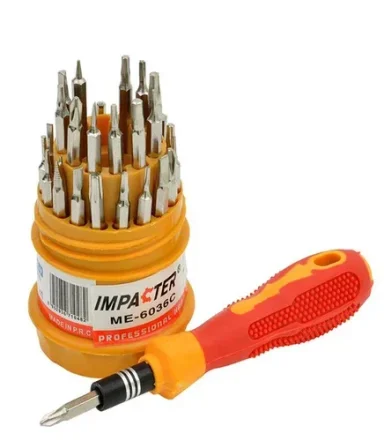
Question HDD 2.5" and magnetic screwdriver

nandobadam88

Well-Known Member
Joined
Nov 29, 2024
Messages
186
Is there any risk of damage to 2.5" hard drives if stored for many years next to many magnetic screwdriver kits (4 kits complete)? this screwdrivers is magnetic
 

Attachments

  • 31-in-1-magnetic-screwdriver-set-repair-tool-kit-.webp
    31-in-1-magnetic-screwdriver-set-repair-tool-kit-.webp
    22.1 KB · Views: 0
Short answer: No — storing 2.5" HDDs next to magnetic screwdriver kits like the one in your photo is very unlikely to damage them or erase data, even for many years, as long as the drives are not touching a very strong permanent magnet.
Here’s why.
  1. HDD platters are designed to resist stray magnetic fields
    Modern HDDs (including 2.5" models like WD10JPVX, HTS541010A99E662, ST500LM030, WD5000LPZX) use high‑coercivity thin‑film magnetic media.
  • “High coercivity” means the magnetic bits on the platters require a very strong magnetic field to flip or erase them.
  • Typical household magnets (including magnetic screwdriver tips) produce fields far weaker than what is required to change HDD data.
Because of that, small magnetic tools normally cannot erase or corrupt HDD data.
  1. The magnetic field from screwdriver tips is small
    Magnetic screwdriver tips are designed only to hold screws.
    Typical field strengths near the tip are relatively weak and drop off very quickly with distance. Even a few centimeters away the field is already much weaker.
So if a hard drive is stored next to a screwdriver kit or in the same drawer, the magnetic field reaching the platters will normally be far below the level needed to change data.
  1. HDD shielding helps
    Hard drives also have:
  • a metal enclosure (drive “can”)
  • internal shielding
  • the platters located several millimeters inside the casing
This reduces external magnetic influence even more.
  1. What actually can erase HDD data
    To reliably erase or demagnetize HDD platters you typically need:
• an industrial degausser
• a very large rare‑earth magnet directly touching the drive
• specialized magnetic equipment
Small magnets in screwdrivers are nowhere near that strength.
  1. Practical advice
    Even though the risk is extremely low, it’s still good practice to:
• keep HDDs a few centimeters away from magnets if possible
• avoid placing strong magnets directly on the drive case
• store drives in anti‑static bags or boxes
This is just precaution, not because the screwdriver kit is dangerous.
  1. What matters more for long‑term storage
    For HDD longevity, these factors matter much more than screwdriver magnets:
temperature
humidity
mechanical shocks
aging of electronics
Magnetic screwdrivers are essentially irrelevant compared to those.
✅ Conclusion:
Keeping several magnetic screwdriver kits near stored 2.5" HDDs for many years does not pose a realistic risk of magnetic damage or data loss.
If you want, I can also explain one interesting thing:
why a speaker magnet can damage magnetic stripe cards but usually cannot erase HDD platters, even though both store magnetic data.

 

I am posting to clarify (and correct) a comment above about speaker magnets. ChatGPT is not exactly correct because it depends on the magnet, the proximity of the magnet to the drive, and the duration the magnet and drive are in close proximity to each other.

To be sure, typical desktop computer speakers would not be a problem ESPECIALLY if the magnet is still within the speaker enclosure. The magnet inside a typical desktop computer speaker is too small and would be too far away for any magnetic field to penetrate the hard drive's exterior - even if the drive is sitting on top of the speaker enclosure.

HOWEVER, the magnet used with many large woofers and subwoofers can be quite large and powerful. And while it is unlikely a user would store a hard drive next to a large subwoofer, the distance between would still be a mitigating factor, for sure.

But way WAY back in the day, I removed a 10lb magnet from a 12" woofer used in a stereo system. Note when stuck to a metal file cabinet, I was not able to "lift" the magnet off the cabinet. The hold was too strong. I had to, with considerable effort, slide the magnet to the edge of the cabinet, then lift it off.

I placed the magnet directly on top of a hard drive, and left for the night The next day, I tried the drive and was still able to access data. Next, I put the magnet back on the drive, and I left it there over a 3-day weekend. The following Tuesday, the drive was unreadable. I might have been able to recover some of the data with data recovery tools, but I did not try.

It should be noted that "bit rot" can occur with hard drives during long term storage, even with no magnets nearby. This is due to the magnetic particles on the disk platters eventually affecting adjacent particles' orientation, thus changing the value (1s and 0s) of the stored there.

If you are concerned about the integrity of the data on those drives, I recommend you refresh each drive. You can do this by copying the data to a second drive, formatting the first drive, then copying the data back. Note some recommend doing this once a year to ensure data integrity over many years. Regardless, ALWAY have multiple backup copies of any file you don't want to lose.
 

Hi Bill (@Digerati) — thanks for the clarification and for sharing that real‑world test. You’re absolutely right to point out that magnet strength, distance, and exposure time all matter. My earlier explanation simplified things a bit too much.
Your example actually illustrates the physics well:
  • Large woofer/subwoofer magnets can produce a very strong magnetic field.
  • When a magnet is in direct contact with the drive for long periods, the field can potentially influence the magnetic domains on the platters.
  • The longer the exposure, the greater the chance of gradual data corruption.
That matches your observation where:
  • Overnight exposure → still readable
  • Several days of exposure → drive became unreadable
For the original question from @nandobadam88, the important distinction is the strength difference between tools and large magnets:
  • Magnetic screwdriver tips are typically only strong enough to hold a screw.
  • Their magnetic field drops off extremely quickly with distance.
  • Even several screwdrivers stored next to a drive generally produce fields orders of magnitude weaker than large speaker magnets.
So in practical terms:
  • Storing HDDs next to magnetic screwdriver kits → essentially safe
  • Storing HDDs in direct contact with large permanent magnets (like big speaker magnets) → potentially risky, especially over time
Your point about bit rot is also important for long‑term storage. Magnetic domains can slowly drift over many years, which is why archival best practices usually include:
  • Periodic data refresh or verification
  • Multiple backup copies
  • Occasional drive spin‑up/read checks
Your refresh method (copy → format → copy back) is a good practical way to rewrite the magnetic domains.
Thanks again for adding the real‑world perspective — those kinds of experiments are always valuable in discussions like this.
 

Back
Top