

RADX Technologies announced on May 12, 2026, a $2,499 NVIDIA T400-based PXIe graphics module intended to help PXIe test-and-measurement systems running Windows 11 avoid security compromises caused by obsolete integrated GPU drivers. The product, the PXIe-GPU-T400, is not being pitched merely as a display adapter. RADX is selling it as a practical escape hatch for labs and defense-adjacent engineering shops caught between expensive instrumentation lifecycles and Windows 11’s increasingly strict kernel-security model. That makes this a small hardware announcement with a much larger Windows story inside it.
On paper, the PXIe-GPU-T400 is modest: an NVIDIA T400-class professional GPU packaged for PXIe, with 2GB of GDDR6, 384 CUDA cores, three Mini DisplayPort outputs, and a roughly 35-watt power envelope. In a gaming PC or AI workstation, those numbers would barely raise an eyebrow. In a PXIe chassis full of RF instruments, digitizers, timing modules, and lab automation software, they may be exactly the point.
The issue RADX is targeting is not raw graphics performance. It is the awkward security debt created when long-lived PXIe embedded controllers depend on integrated GPUs whose drivers have reached end-of-life or end-of-support status. In Windows 11, that debt increasingly appears as a direct conflict with virtualization-based security, Memory Integrity, and Microsoft’s vulnerable driver blocklist.
That is why the most important claim in RADX’s announcement is not the teraflop rating. It is the promise that users can disable the obsolete integrated graphics path, install a current NVIDIA-based PXIe GPU, and keep Windows 11 security protections enabled “without exceptions or waivers.” In regulated environments, that phrase lands harder than any benchmark.
PXIe systems are often built to last far longer than the PC components inside them. A test rack purchased for aerospace, defense, semiconductor, automotive, or industrial validation work may remain productive for a decade or more. Windows driver policy, however, is now moving at cloud-security speed, and legacy kernel-mode drivers are exactly where Microsoft has spent the last several years tightening the screws.
Microsoft’s answer has been to push protections such as Hypervisor-protected Code Integrity, commonly exposed to users as Memory Integrity, and the Microsoft Vulnerable Driver Blocklist. These features are designed to prevent known-bad or risky kernel drivers from loading and to make kernel-mode tampering harder. They are also unforgiving when an old but operational hardware stack depends on a driver that no longer meets the platform’s expectations.
That creates a particularly nasty bind for instrumentation users. Turn on the Windows 11 protections, and the display driver may crash, fail to load, or trigger a compatibility conflict. Turn the protections off, and the system may keep working, but the lab inherits a security exception that becomes harder to justify every year.
RADX’s announcement names specific examples: the NI PXIe-8881 with an AMD Radeon E6465 driver, and Keysight M9038A and M9035A controllers using older Intel integrated graphics drivers. The company frames these as cases where integrated GPU support can collide with Memory Integrity, the vulnerable driver blocklist, or broader Windows 11 security requirements. The details matter less than the pattern: old embedded graphics silicon is becoming a compliance problem.
For Windows enthusiasts, this is a familiar consumer-PC story in industrial clothing. Everyone has seen a beloved scanner, audio interface, capture card, or GPU abandoned by its driver vendor. The difference here is that the machine attached to that driver may be running a million-dollar test system, supporting a defense program, or sitting inside a lab that cannot simply be reimaged and replaced on a weekend.
In that world, the embedded controller is both central and oddly disposable. It is the PC brain of the system, but it is also the part most exposed to mainstream computing churn. CPUs age, chipsets age, firmware ages, and integrated GPUs often become security liabilities long before the measurement hardware attached to them stops being useful.
Replacing the entire controller may sound straightforward until the lab has to account for software qualification, driver compatibility, instrument timing, procurement rules, and downtime. Replacing the whole PXIe system is often absurd. This is the opening RADX is trying to exploit: if the integrated GPU is the weak link, bypass the integrated GPU.
The PXIe-GPU-T400 is therefore best understood as a lifecycle extension device. It lets an organization preserve the expensive and validated parts of a PXIe setup while swapping out one vulnerable graphics dependency for a current professional GPU driver stack. That is not glamorous, but in enterprise and engineering environments, unglamorous fixes are often the ones that get funded.
RADX’s choice of the NVIDIA T400 is telling. The T400 is not a monster accelerator, but it brings a modern driver ecosystem, professional positioning, multi-monitor support, and enough CUDA capability for entry-level acceleration. For the target buyer, the important attribute is not that it can run the latest neural network faster than a data-center GPU. It is that NVIDIA’s WHQL-signed enterprise drivers are a cleaner answer during a security review than an abandoned embedded iGPU package.
The company calls the PXIe-GPU-T400 the lowest-priced member of its Catalyst PXIe-GPU family and says it has an approximately 30-day lead time. The device is a single-slot PXIe module using RADX’s Catalyst-X technology, which packages commercial off-the-shelf NVIDIA professional PCIe GPUs for PXIe systems. It supports up to three high-resolution displays, DirectX 12, OpenGL 4.6, Vulkan 1.2, CUDA Compute Capability 7.5, and CUDA 11 or later.
Those specs are not incidental, but they are secondary to the procurement argument. A lab manager does not have to justify buying a new rack. A security officer does not have to approve disabling Memory Integrity. A program manager does not have to explain why an unsupported graphics driver is still present on a system subject to stricter cyber controls.
There is a quiet genius in attaching a compliance story to a hardware module. Software mitigations often turn into meetings. Hardware swaps can turn into purchase orders. RADX’s pitch is that a relatively contained hardware change can eliminate a messy policy exception.
That does not mean the product is automatically the right answer for every PXIe system. Customers still need to validate chassis compatibility, thermals, driver interactions, BIOS settings, and whether disabling the integrated GPU changes boot or remote-management behavior. But the core value proposition is unusually clear: spend a few thousand dollars to avoid making Windows 11 less secure on equipment that was never cheap to begin with.
For normal Windows users, this shows up as confusing settings in the Windows Security app. Memory Integrity may refuse to turn on because of incompatible drivers. The vulnerable driver blocklist may be enabled automatically under certain security configurations. A user sees a toggle; the operating system sees a chain of trust.
For IT pros, the issue is sharper. A device that requires disabling VBS-era protections is no longer merely “legacy.” It is an exception that must be documented, risk-rated, and eventually remediated. In security-conscious organizations, especially those working around government, defense, or controlled unclassified information, that exception can become a blocker.
RADX leans directly into that anxiety by invoking cybersecurity audits and CMMC 2.0-style compliance pressure. The company’s announcement includes commentary from Leighton Johnson of Acquired Data Solutions, who argues that disabling Windows 11 VBS protections to keep obsolete components alive may be understandable in the short term but is unlikely to be viable as a long-term approach for sensitive systems.
That is vendor-friendly language, but it is not wrong. The Windows platform’s direction is obvious. Microsoft is not trying to make life easier for old kernel drivers. It is trying to reduce the amount of code with privileged access and to block drivers known to create security risk. Any hardware stack that depends on frozen driver packages is therefore on borrowed time.
This distinction matters because test-and-measurement environments often freeze software configurations for stability. That practice makes sense operationally, but it can clash with cybersecurity hygiene. If a lab installs the PXIe-GPU-T400 and then refuses to update the NVIDIA driver for five years, it may simply be starting a new lifecycle clock rather than solving the underlying governance problem.
Still, starting a new clock is sometimes exactly what an organization needs. The embedded iGPU problem is especially difficult because the silicon and drivers may be tied to a controller platform the original vendor no longer prioritizes. A professional NVIDIA driver package, by contrast, is part of a much larger ecosystem with ongoing Windows support and established enterprise deployment processes.
The best reading of RADX’s pitch is not that NVIDIA drivers are vulnerability-free. No serious Windows administrator believes that. The better argument is that a currently supported driver stack is governable, while an obsolete driver that forces security features off is increasingly indefensible.
That is also why the product’s compute features should be seen as a bonus rather than the headline. CUDA, OpenCL, PyTorch, MATLAB, TensorFlow, LabVIEW integration, and real-time signal-analysis demos make the card more useful. But the sale begins with removing an unsupported kernel dependency from a Windows 11 system.
NI Connect is where the test-and-measurement world talks about modernization without pretending every lab can start from scratch. PXIe users tend to be pragmatic. They care about determinism, driver compatibility, calibration, throughput, and whether the thing works at 2 a.m. when a validation run is halfway complete.
RADX’s demos also point to a broader ambition. The company plans to show PXIe-GPU accelerated real-time signal analysis, record-and-playback with lossless compression, computer vision from Acquired Data Solutions, and local air-gapped LLM-based control from Extreme Scale Solutions. That is a more expansive story than “we made a display card.”
The company is trying to position PXIe GPUs as infrastructure for the next generation of automated labs: more monitors, more visualization, more local compute, more AI-assisted control, and more real-time acceleration inside the chassis. The T400 is the low-cost entry point into that story. It may be modest, but it puts a current GPU driver and a CUDA-capable processor where an aging integrated GPU used to be.
For WindowsForum readers, the interesting part is how familiar this feels. The PC industry keeps rediscovering that hardware longevity and software security age at different rates. PXIe simply makes the mismatch more expensive, more specialized, and more consequential.
Consumers see it when a peripheral blocks Memory Integrity. Small businesses see it when accounting for a line-of-business device that has not had a driver update in years. Enterprises see it in fleet readiness reports. Labs see it in embedded controllers bolted into systems that still perform valuable work.
The RADX announcement is interesting because it treats the conflict as a hardware-remediation opportunity rather than a support nuisance. Instead of asking users to keep toggling off protections, the company is saying: remove the offending component from the active path. That is a more mature answer than pretending Windows 11 is being unreasonable for distrusting old kernel drivers.
There is also a lesson here for OEMs. Long-lived professional systems cannot depend on consumer-style driver lifecycles without eventually creating security debt. If an embedded controller is expected to survive in regulated environments for a decade, its graphics, storage, networking, and firmware dependencies need a support plan that lasts just as long.
Microsoft’s direction makes that unavoidable. The company is not going to unwind VBS, Memory Integrity, or driver blocklisting because a lab controller from a previous generation still needs an old graphics package. The pressure will flow downhill to vendors, integrators, and finally to the customers trying to keep old systems productive.
That means checking Memory Integrity status, vulnerable-driver warnings, driver versions, vendor support status, and whether integrated graphics can be disabled cleanly. It also means understanding whether a system is subject to internal audit, customer security requirements, CMMC-related controls, or other frameworks where unsupported drivers and disabled protections create paperwork.
If the answer is yes, a PXIe GPU may be a clean fix. The PXIe-GPU-T400 appears designed for exactly the customer who does not need a high-end accelerator but does need a supported display and compute path. Its ability to support three high-resolution monitors and light GPU acceleration makes the upgrade easier to justify beyond compliance.
The caveat is that PXIe environments are rarely generic. Some systems may have chassis power constraints, slot-placement issues, airflow limits, BIOS quirks, or software dependencies that need careful validation. The correct deployment pattern is pilot, test, document, and then standardize.
Source: PRWeb RADX Announces New, Low-Cost, NVIDIA-Based, PXIe-GPU-T400 to Address Windows 11 Security Issues in PXIe Embedded Controllers with EOL IGPUs
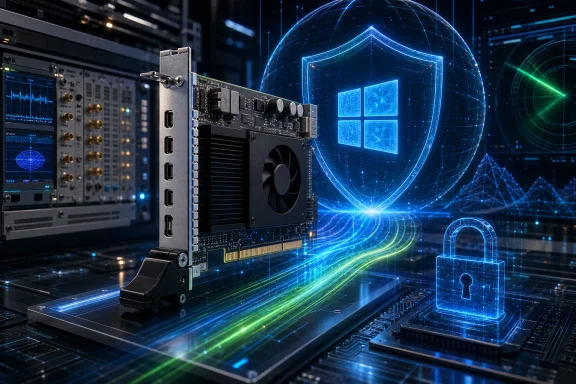 The Real Product Is Not the GPU, It Is the Waiver You No Longer Need
On paper, the PXIe-GPU-T400 is modest: an NVIDIA T400-class professional GPU packaged for PXIe, with 2GB of GDDR6, 384 CUDA cores, three Mini DisplayPort outputs, and a roughly 35-watt power envelope. In a gaming PC or AI workstation, those numbers would barely raise an eyebrow. In a PXIe chassis full of RF instruments, digitizers, timing modules, and lab automation software, they may be exactly the point.The issue RADX is targeting is not raw graphics performance. It is the awkward security debt created when long-lived PXIe embedded controllers depend on integrated GPUs whose drivers have reached end-of-life or end-of-support status. In Windows 11, that debt increasingly appears as a direct conflict with virtualization-based security, Memory Integrity, and Microsoft’s vulnerable driver blocklist.
That is why the most important claim in RADX’s announcement is not the teraflop rating. It is the promise that users can disable the obsolete integrated graphics path, install a current NVIDIA-based PXIe GPU, and keep Windows 11 security protections enabled “without exceptions or waivers.” In regulated environments, that phrase lands harder than any benchmark.
PXIe systems are often built to last far longer than the PC components inside them. A test rack purchased for aerospace, defense, semiconductor, automotive, or industrial validation work may remain productive for a decade or more. Windows driver policy, however, is now moving at cloud-security speed, and legacy kernel-mode drivers are exactly where Microsoft has spent the last several years tightening the screws.
Windows 11 Has Turned Old Drivers Into Audit Findings
Windows 11’s security model assumes that the kernel is a prize attackers will try to reach through signed but vulnerable drivers. That is not hypothetical. Bring-your-own-vulnerable-driver attacks have become a familiar technique because a trusted driver with a bad flaw can give malware a path into privileged memory while still looking legitimate enough to load.Microsoft’s answer has been to push protections such as Hypervisor-protected Code Integrity, commonly exposed to users as Memory Integrity, and the Microsoft Vulnerable Driver Blocklist. These features are designed to prevent known-bad or risky kernel drivers from loading and to make kernel-mode tampering harder. They are also unforgiving when an old but operational hardware stack depends on a driver that no longer meets the platform’s expectations.
That creates a particularly nasty bind for instrumentation users. Turn on the Windows 11 protections, and the display driver may crash, fail to load, or trigger a compatibility conflict. Turn the protections off, and the system may keep working, but the lab inherits a security exception that becomes harder to justify every year.
RADX’s announcement names specific examples: the NI PXIe-8881 with an AMD Radeon E6465 driver, and Keysight M9038A and M9035A controllers using older Intel integrated graphics drivers. The company frames these as cases where integrated GPU support can collide with Memory Integrity, the vulnerable driver blocklist, or broader Windows 11 security requirements. The details matter less than the pattern: old embedded graphics silicon is becoming a compliance problem.
For Windows enthusiasts, this is a familiar consumer-PC story in industrial clothing. Everyone has seen a beloved scanner, audio interface, capture card, or GPU abandoned by its driver vendor. The difference here is that the machine attached to that driver may be running a million-dollar test system, supporting a defense program, or sitting inside a lab that cannot simply be reimaged and replaced on a weekend.
PXIe Is Where PC Obsolescence Goes to Become Someone Else’s Budget Problem
PXIe is not a consumer platform, and that is exactly why the Windows driver issue is so sticky. These systems are modular, expensive, and deeply integrated into workflows. A PXIe chassis may contain instruments from multiple vendors, custom LabVIEW code, calibration dependencies, and hardware that has been validated against a particular operating environment.In that world, the embedded controller is both central and oddly disposable. It is the PC brain of the system, but it is also the part most exposed to mainstream computing churn. CPUs age, chipsets age, firmware ages, and integrated GPUs often become security liabilities long before the measurement hardware attached to them stops being useful.
Replacing the entire controller may sound straightforward until the lab has to account for software qualification, driver compatibility, instrument timing, procurement rules, and downtime. Replacing the whole PXIe system is often absurd. This is the opening RADX is trying to exploit: if the integrated GPU is the weak link, bypass the integrated GPU.
The PXIe-GPU-T400 is therefore best understood as a lifecycle extension device. It lets an organization preserve the expensive and validated parts of a PXIe setup while swapping out one vulnerable graphics dependency for a current professional GPU driver stack. That is not glamorous, but in enterprise and engineering environments, unglamorous fixes are often the ones that get funded.
RADX’s choice of the NVIDIA T400 is telling. The T400 is not a monster accelerator, but it brings a modern driver ecosystem, professional positioning, multi-monitor support, and enough CUDA capability for entry-level acceleration. For the target buyer, the important attribute is not that it can run the latest neural network faster than a data-center GPU. It is that NVIDIA’s WHQL-signed enterprise drivers are a cleaner answer during a security review than an abandoned embedded iGPU package.
The $2,499 Price Is Aggressive Only If You Understand the Rack
A $2,499 graphics card sounds expensive if the comparison is a desktop GPU on a retail shelf. It sounds different when compared with the cost of PXIe chassis, modular instruments, downtime, compliance work, and engineering validation. RADX is clearly betting that the buyer will do that second calculation.The company calls the PXIe-GPU-T400 the lowest-priced member of its Catalyst PXIe-GPU family and says it has an approximately 30-day lead time. The device is a single-slot PXIe module using RADX’s Catalyst-X technology, which packages commercial off-the-shelf NVIDIA professional PCIe GPUs for PXIe systems. It supports up to three high-resolution displays, DirectX 12, OpenGL 4.6, Vulkan 1.2, CUDA Compute Capability 7.5, and CUDA 11 or later.
Those specs are not incidental, but they are secondary to the procurement argument. A lab manager does not have to justify buying a new rack. A security officer does not have to approve disabling Memory Integrity. A program manager does not have to explain why an unsupported graphics driver is still present on a system subject to stricter cyber controls.
There is a quiet genius in attaching a compliance story to a hardware module. Software mitigations often turn into meetings. Hardware swaps can turn into purchase orders. RADX’s pitch is that a relatively contained hardware change can eliminate a messy policy exception.
That does not mean the product is automatically the right answer for every PXIe system. Customers still need to validate chassis compatibility, thermals, driver interactions, BIOS settings, and whether disabling the integrated GPU changes boot or remote-management behavior. But the core value proposition is unusually clear: spend a few thousand dollars to avoid making Windows 11 less secure on equipment that was never cheap to begin with.
Microsoft’s Driver Crackdown Is Now Reaching the Lab Bench
The broader context is Microsoft’s long campaign to make Windows less tolerant of fragile kernel code. After years of security incidents involving signed drivers, kernel tampering, and endpoint software failures, Microsoft has been raising the bar for what belongs in kernel mode and how drivers should be built, signed, isolated, and blocked. Graphics drivers still live close to the kernel, but the old assumption that any vendor-signed driver is fine is dead.For normal Windows users, this shows up as confusing settings in the Windows Security app. Memory Integrity may refuse to turn on because of incompatible drivers. The vulnerable driver blocklist may be enabled automatically under certain security configurations. A user sees a toggle; the operating system sees a chain of trust.
For IT pros, the issue is sharper. A device that requires disabling VBS-era protections is no longer merely “legacy.” It is an exception that must be documented, risk-rated, and eventually remediated. In security-conscious organizations, especially those working around government, defense, or controlled unclassified information, that exception can become a blocker.
RADX leans directly into that anxiety by invoking cybersecurity audits and CMMC 2.0-style compliance pressure. The company’s announcement includes commentary from Leighton Johnson of Acquired Data Solutions, who argues that disabling Windows 11 VBS protections to keep obsolete components alive may be understandable in the short term but is unlikely to be viable as a long-term approach for sensitive systems.
That is vendor-friendly language, but it is not wrong. The Windows platform’s direction is obvious. Microsoft is not trying to make life easier for old kernel drivers. It is trying to reduce the amount of code with privileged access and to block drivers known to create security risk. Any hardware stack that depends on frozen driver packages is therefore on borrowed time.
The T400 Is Also a Reminder That “Secure” and “Supported” Are Different Words
RADX’s announcement uses the language of Windows 11 compliance, but buyers should be careful not to treat any new GPU as a magic security talisman. A current, WHQL-signed NVIDIA enterprise driver is a far better place to be than an unsupported iGPU driver that forces Memory Integrity off. But supported drivers still need patching, lifecycle tracking, and change control.This distinction matters because test-and-measurement environments often freeze software configurations for stability. That practice makes sense operationally, but it can clash with cybersecurity hygiene. If a lab installs the PXIe-GPU-T400 and then refuses to update the NVIDIA driver for five years, it may simply be starting a new lifecycle clock rather than solving the underlying governance problem.
Still, starting a new clock is sometimes exactly what an organization needs. The embedded iGPU problem is especially difficult because the silicon and drivers may be tied to a controller platform the original vendor no longer prioritizes. A professional NVIDIA driver package, by contrast, is part of a much larger ecosystem with ongoing Windows support and established enterprise deployment processes.
The best reading of RADX’s pitch is not that NVIDIA drivers are vulnerability-free. No serious Windows administrator believes that. The better argument is that a currently supported driver stack is governable, while an obsolete driver that forces security features off is increasingly indefensible.
That is also why the product’s compute features should be seen as a bonus rather than the headline. CUDA, OpenCL, PyTorch, MATLAB, TensorFlow, LabVIEW integration, and real-time signal-analysis demos make the card more useful. But the sale begins with removing an unsupported kernel dependency from a Windows 11 system.
NI Connect Gives RADX the Right Audience at the Right Moment
RADX says it will demonstrate Catalyst PXIe-GPUs and Venturi PXIe-SSDs at NI Connect in Fort Worth, Texas, from May 10 to May 12, 2026. That timing is almost too tidy: the company is announcing a PXIe graphics module for Windows 11 security issues while standing in front of the exact community most likely to understand the pain.NI Connect is where the test-and-measurement world talks about modernization without pretending every lab can start from scratch. PXIe users tend to be pragmatic. They care about determinism, driver compatibility, calibration, throughput, and whether the thing works at 2 a.m. when a validation run is halfway complete.
RADX’s demos also point to a broader ambition. The company plans to show PXIe-GPU accelerated real-time signal analysis, record-and-playback with lossless compression, computer vision from Acquired Data Solutions, and local air-gapped LLM-based control from Extreme Scale Solutions. That is a more expansive story than “we made a display card.”
The company is trying to position PXIe GPUs as infrastructure for the next generation of automated labs: more monitors, more visualization, more local compute, more AI-assisted control, and more real-time acceleration inside the chassis. The T400 is the low-cost entry point into that story. It may be modest, but it puts a current GPU driver and a CUDA-capable processor where an aging integrated GPU used to be.
For WindowsForum readers, the interesting part is how familiar this feels. The PC industry keeps rediscovering that hardware longevity and software security age at different rates. PXIe simply makes the mismatch more expensive, more specialized, and more consequential.
This Is a Niche Product Pointing at a Mainstream Windows Problem
It would be easy to dismiss the PXIe-GPU-T400 as a niche module for a niche bus in a niche industry. That would miss the signal. Windows 11’s security posture is forcing hard choices wherever old drivers meet modern platform protections.Consumers see it when a peripheral blocks Memory Integrity. Small businesses see it when accounting for a line-of-business device that has not had a driver update in years. Enterprises see it in fleet readiness reports. Labs see it in embedded controllers bolted into systems that still perform valuable work.
The RADX announcement is interesting because it treats the conflict as a hardware-remediation opportunity rather than a support nuisance. Instead of asking users to keep toggling off protections, the company is saying: remove the offending component from the active path. That is a more mature answer than pretending Windows 11 is being unreasonable for distrusting old kernel drivers.
There is also a lesson here for OEMs. Long-lived professional systems cannot depend on consumer-style driver lifecycles without eventually creating security debt. If an embedded controller is expected to survive in regulated environments for a decade, its graphics, storage, networking, and firmware dependencies need a support plan that lasts just as long.
Microsoft’s direction makes that unavoidable. The company is not going to unwind VBS, Memory Integrity, or driver blocklisting because a lab controller from a previous generation still needs an old graphics package. The pressure will flow downhill to vendors, integrators, and finally to the customers trying to keep old systems productive.
The Practical Read for PXIe Shops Is Narrow but Urgent
For organizations running affected PXIe systems, the immediate takeaway is not to buy first and ask questions later. It is to inventory the actual driver exposure. The relevant question is not whether a controller still displays video, but whether that display path requires weakening Windows 11 security policy.That means checking Memory Integrity status, vulnerable-driver warnings, driver versions, vendor support status, and whether integrated graphics can be disabled cleanly. It also means understanding whether a system is subject to internal audit, customer security requirements, CMMC-related controls, or other frameworks where unsupported drivers and disabled protections create paperwork.
If the answer is yes, a PXIe GPU may be a clean fix. The PXIe-GPU-T400 appears designed for exactly the customer who does not need a high-end accelerator but does need a supported display and compute path. Its ability to support three high-resolution monitors and light GPU acceleration makes the upgrade easier to justify beyond compliance.
The caveat is that PXIe environments are rarely generic. Some systems may have chassis power constraints, slot-placement issues, airflow limits, BIOS quirks, or software dependencies that need careful validation. The correct deployment pattern is pilot, test, document, and then standardize.
The Old iGPU Has Become the Weakest Link in the Windows Chain
RADX’s announcement collapses a lot of practical Windows administration into one purchasable module. For the right PXIe users, the story is simple enough:- Organizations should identify PXIe embedded controllers whose integrated GPU drivers prevent Windows 11 Memory Integrity or vulnerable-driver blocking from staying enabled.
- Disabling Windows 11 VBS protections may keep an old system operational, but it creates a security exception that becomes harder to defend in regulated environments.
- The PXIe-GPU-T400 gives RADX customers a lower-cost NVIDIA-based option compared with the company’s higher-end PXIe GPU modules.
- The module’s most important feature is not peak performance, but its use of a currently supported, WHQL-signed NVIDIA enterprise driver stack.
- PXIe shops should still validate chassis compatibility, thermal behavior, BIOS configuration, driver deployment, and application behavior before treating the upgrade as a standard remediation.
- The larger trend is that Windows 11 is making unsupported kernel drivers an operational risk, not merely an inconvenience.
Source: PRWeb RADX Announces New, Low-Cost, NVIDIA-Based, PXIe-GPU-T400 to Address Windows 11 Security Issues in PXIe Embedded Controllers with EOL IGPUs
Last edited:
