

RAH Infotech announced on June 4, 2026, in India that it has appointed Sanjit Talapatra as Vice President – Cloud & Digital Transformation, giving him responsibility for cloud partnerships and enterprise modernisation work across AWS, Microsoft Azure, and Google Cloud. The hire is not just another executive shuffle in India’s crowded technology channel market. It is a signal that the once-clean boundary between distributor, reseller, systems integrator, and cloud adviser is being redrawn by the economics of hybrid cloud, AI infrastructure, and enterprise platform sprawl.
The easy phase of enterprise cloud adoption is over. Most serious organizations already have something running in the cloud, often more than they planned, sometimes less coherently than they admit, and rarely in a way that maps neatly to the original business case. That is the market RAH Infotech is addressing with Talapatra’s appointment.
The company’s language around the move is revealing. This is not framed as a pure sales appointment or as a hyperscaler alliance role. Talapatra’s mandate spans enterprise architecture, platform engineering, data modernisation, and engagement with AWS, Azure, and Google Cloud. In other words, RAH is positioning the role around execution rather than evangelism.
That matters because the cloud market has changed from a land-grab into an optimization problem. Enterprises are no longer asking whether they should adopt cloud services; they are asking how to make cloud, on-premises systems, data platforms, security controls, and AI tooling behave like a deliberate architecture instead of a procurement accident.
For WindowsForum readers, the Microsoft Azure angle is especially important, but it is only one part of the story. The appointment points to a broader enterprise reality: Windows Server estates, Active Directory dependencies, Microsoft 365 identity layers, VMware migrations, container platforms, data lakes, and AI workloads increasingly sit inside the same modernization conversation. The partner that can stitch those pieces together becomes more valuable than the partner that merely introduces another SKU.
The classic value-added distributor model was built around vendor relationships, partner enablement, logistics, technical support, and market development. Cloud has complicated that model. A customer buying a firewall, endpoint platform, or storage appliance could once draw a reasonably clear line between product selection and deployment. A customer moving workloads across Azure, AWS, and Google Cloud faces a more fluid set of decisions involving identity, networking, compliance, observability, cost governance, data gravity, and application modernization.
That is why the appointment of a cloud transformation executive is more strategically interesting than the title might suggest. RAH is effectively saying that the value in the channel is moving upward, from fulfillment and product mapping into architecture and execution. If that shift works, the company becomes stickier with both enterprise customers and partners because it participates earlier in the decision cycle.
There is a risk here, too. Advisory-led transformation is harder to scale than product-led distribution. It requires credible architects, repeatable delivery frameworks, cloud cost discipline, and a clear line between vendor-neutral guidance and vendor-driven incentives. The companies that get this right can become trusted operating partners; the companies that do not risk becoming expensive brochures for hyperscaler programs.
That background is relevant because the hard part of cloud modernization is rarely the console demo. It is the organizational and architectural translation layer: turning executive ambition into migration waves, landing zones, governance rules, operating models, application refactoring plans, and measurable outcomes. Large consultancies and global integrators tend to train people in that machinery because they operate where architecture, procurement, risk, and delivery meet.
The language from RAH CEO Anurag Singh emphasizes this translation function. He described Talapatra as someone who can turn complex technology decisions into executable plans. That may sound like standard appointment-day praise, but it identifies the precise gap many enterprises face: they can buy cloud capacity, subscribe to AI services, and attend vendor workshops, yet still struggle to convert those ingredients into reliable operating platforms.
Talapatra’s own statement pushes the same theme further, arguing that organizations are moving beyond “cloud-first” into what he calls intelligence-led enterprises. The phrase has the polished feel of modern transformation marketing, but the underlying claim is sound. Cloud strategy is increasingly inseparable from data strategy and AI strategy. Infrastructure is not just where workloads run; it is where data pipelines, inference workloads, automation systems, and security telemetry converge.
The problem is that moving first to cloud does not guarantee moving well. A lift-and-shift migration can reduce data center pressure while preserving brittle application patterns. A multicloud strategy can improve negotiating leverage while multiplying governance headaches. A platform engineering initiative can accelerate developers while creating a new internal monopoly if it is badly designed. Every modernization move has a shadow.
That is where RAH’s appointment becomes a useful marker of the market. The next phase is less about convincing enterprises to use hyperscale platforms and more about making those platforms legible, governed, and financially defensible. This is where FinOps, security architecture, data modernization, and automation move from specialist concerns into board-level technology management.
For Windows-heavy enterprises, the shift is particularly visible. Azure is often the natural extension of Microsoft identity, endpoint, collaboration, and server environments. But Azure rarely exists alone. AWS may host cloud-native products, Google Cloud may sit under analytics or AI initiatives, and private infrastructure may remain essential for latency, regulation, licensing, or operational control. The result is not a clean cloud destination; it is a portfolio that needs design.
That is the difficult space for a company like RAH Infotech. To be valuable, it must maintain strong hyperscaler relationships while preserving enough architectural independence to be trusted by customers. If every problem ends in the same cloud recommendation, the advisory claim collapses. If the advice is genuinely workload-led, the partner becomes more important.
Talapatra’s cross-hyperscaler remit suggests RAH understands this. A single-cloud practice can be commercially attractive, especially when tied to incentives and certifications, but enterprise reality is stubbornly mixed. Multi-cloud is not always a strategy; sometimes it is simply the accumulated result of mergers, departmental autonomy, developer preference, regulatory constraints, or historical procurement. Either way, customers need help managing it.
The phrase “commercially sound” in RAH’s announcement deserves attention. Cloud transformation has too often been sold as an engineering inevitability rather than a financial discipline. In 2026, that pitch is less persuasive. CFOs have seen unpredictable consumption bills, CIOs have seen migration programs stall, and CISOs have seen identity and configuration mistakes turn cloud speed into cloud exposure. A credible cloud partner now has to speak architecture and economics in the same sentence.
Talapatra’s statement about infrastructure, data, and AI operating as a connected system is the most interesting part of the announcement because it frames modernization as a dependency chain. AI pilots can be launched quickly, but durable AI programs need clean data access, secure integration, scalable compute, and policy controls. Those requirements pull old infrastructure decisions back into the foreground.
This is where a company rooted in security and infrastructure may have an advantage over a pure cloud consultancy. AI workloads do not remove the need for network segmentation, privileged access management, backup, compliance, endpoint controls, or application security. They increase the cost of getting those basics wrong. As enterprises connect more data to more automated systems, the blast radius of poor architecture expands.
For Microsoft-centric shops, the same dynamic applies across Azure AI services, Microsoft Fabric, Power Platform, Microsoft 365 Copilot, Entra ID, and the broader security stack. The promise is integration; the danger is assuming integration equals governance. A partner that understands both the Microsoft ecosystem and the competing hyperscaler landscape can help customers avoid building a shiny AI layer over a fragile estate.
RAH’s announcement explicitly names sectors such as BFSI, healthcare, retail, manufacturing, government, telecom, IT, and ITeS. These are not casual verticals. They are sectors where downtime, compliance failure, data exposure, and poor integration can produce real commercial and reputational damage. Cloud modernization in those environments is not a weekend migration story.
The Indian channel ecosystem also has its own complexity. Enterprises often rely on layered partner networks, regional delivery capabilities, OEM relationships, and specialized service providers. A company like RAH must therefore serve two audiences at once: end customers that want strategic clarity, and channel partners that need enablement, architecture support, and differentiated offerings.
That dual role can be powerful if handled carefully. RAH can use Talapatra’s practice to create repeatable cloud and transformation frameworks that partners can take to market. But if the company moves too far into direct services without clear partner alignment, it risks channel tension. The best version of this strategy strengthens the ecosystem rather than bypassing it.
That means defining outcomes before architectures harden. A cloud modernization program should be able to say what will improve: release frequency, recovery time, cost allocation, security posture, application performance, developer productivity, analytics latency, infrastructure utilization, or regulatory reporting. Without that discipline, cloud programs become expensive motion.
It also means acknowledging that not every workload belongs in a hyperscale cloud, at least not immediately. Some applications are constrained by latency, licensing, data residency, operational risk, or simply weak business justification. Good modernization is not migration maximalism. It is portfolio management with engineering consequences.
This is where Talapatra’s enterprise architecture background could matter most. Enterprise architecture has sometimes earned a reputation as a governance bottleneck, but in messy hybrid environments it can be the difference between a coherent platform and a series of disconnected initiatives. The modern version of the discipline must be faster, more pragmatic, and closer to delivery than the old review-board model. If RAH can make that practical for customers, the appointment will have more than symbolic value.
But the more interesting Microsoft story is competitive coexistence. Few large enterprises are purely Microsoft, purely AWS, or purely Google Cloud. Even Microsoft-first organizations may use AWS for product engineering or Google Cloud for data and AI workloads. That means Azure strategy increasingly needs to be designed in relation to other platforms, not in isolation.
This is why hybrid and multicloud experience matters in a cloud transformation leader. The questions customers ask are rarely vendor-neutral in theory, but they are vendor-mixed in practice. How should Entra ID interact with non-Microsoft cloud resources? Where should sensitive data live? How should security telemetry be consolidated? Which workloads should remain on-premises? How should Kubernetes, backup, policy, and observability be standardized across environments?
A strong Azure practice that ignores AWS and Google Cloud is incomplete. A multicloud practice that treats Azure as just another cloud misses the gravitational pull of Microsoft identity, productivity, management, and security tooling. RAH’s task is to operate in that tension without turning it into a sales slogan.
RAH will need to show that Talapatra’s appointment leads to concrete offerings rather than just broader positioning. That could mean packaged assessment services, cloud readiness frameworks, migration factories, FinOps programs, platform engineering blueprints, data modernization accelerators, or industry-specific architectures. The exact form matters less than whether customers and partners can understand what RAH now does differently.
The company will also need to avoid the trap of imitating the global systems integrators from which many cloud leaders are recruited. RAH’s advantage is likely to come from proximity to the channel, vendor ecosystem, and Indian enterprise buying patterns. If it becomes merely a smaller version of a global consultancy, it loses the sharper role it can play as a specialist intermediary.
Talapatra’s career across NTT Data, KPMG India, Capgemini, Atos, and Infosys gives him a credible base. But the differentiator will be how he adapts that experience to RAH’s model. Enterprise transformation at a distributor-led solutions company is not the same as enterprise transformation inside a global consulting machine. The operating model must fit the business.
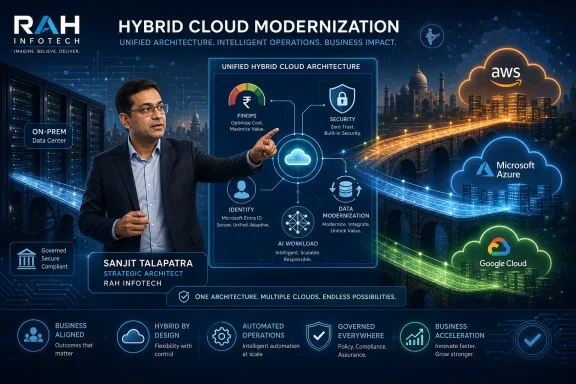 RAH Infotech Is Hiring for the Messy Middle of Cloud
The easy phase of enterprise cloud adoption is over. Most serious organizations already have something running in the cloud, often more than they planned, sometimes less coherently than they admit, and rarely in a way that maps neatly to the original business case. That is the market RAH Infotech is addressing with Talapatra’s appointment.The company’s language around the move is revealing. This is not framed as a pure sales appointment or as a hyperscaler alliance role. Talapatra’s mandate spans enterprise architecture, platform engineering, data modernisation, and engagement with AWS, Azure, and Google Cloud. In other words, RAH is positioning the role around execution rather than evangelism.
That matters because the cloud market has changed from a land-grab into an optimization problem. Enterprises are no longer asking whether they should adopt cloud services; they are asking how to make cloud, on-premises systems, data platforms, security controls, and AI tooling behave like a deliberate architecture instead of a procurement accident.
For WindowsForum readers, the Microsoft Azure angle is especially important, but it is only one part of the story. The appointment points to a broader enterprise reality: Windows Server estates, Active Directory dependencies, Microsoft 365 identity layers, VMware migrations, container platforms, data lakes, and AI workloads increasingly sit inside the same modernization conversation. The partner that can stitch those pieces together becomes more valuable than the partner that merely introduces another SKU.
The Channel Is Becoming an Architecture Business
RAH Infotech was founded in 2005 and has long been associated with cybersecurity, networking, application security, infrastructure, and channel-led enterprise technology delivery. That history matters because the company is not trying to enter cloud from a blank slate. It is trying to extend a channel and solutions business into a market where customers increasingly expect advisory depth before they sign a deployment order.The classic value-added distributor model was built around vendor relationships, partner enablement, logistics, technical support, and market development. Cloud has complicated that model. A customer buying a firewall, endpoint platform, or storage appliance could once draw a reasonably clear line between product selection and deployment. A customer moving workloads across Azure, AWS, and Google Cloud faces a more fluid set of decisions involving identity, networking, compliance, observability, cost governance, data gravity, and application modernization.
That is why the appointment of a cloud transformation executive is more strategically interesting than the title might suggest. RAH is effectively saying that the value in the channel is moving upward, from fulfillment and product mapping into architecture and execution. If that shift works, the company becomes stickier with both enterprise customers and partners because it participates earlier in the decision cycle.
There is a risk here, too. Advisory-led transformation is harder to scale than product-led distribution. It requires credible architects, repeatable delivery frameworks, cloud cost discipline, and a clear line between vendor-neutral guidance and vendor-driven incentives. The companies that get this right can become trusted operating partners; the companies that do not risk becoming expensive brochures for hyperscaler programs.
Sanjit Talapatra’s Résumé Fits the Moment
Talapatra arrives with 17 years of experience across cloud transformation, enterprise architecture, infrastructure modernisation, and technology consulting. RAH says he joins from NTT Data, where he served as Associate Director – Technical Architects and worked on cloud-led transformation programs for Fortune 500 clients across hybrid architectures involving AWS, Azure, and Google Cloud. His earlier roles included KPMG India, Capgemini, Atos, and Infosys.That background is relevant because the hard part of cloud modernization is rarely the console demo. It is the organizational and architectural translation layer: turning executive ambition into migration waves, landing zones, governance rules, operating models, application refactoring plans, and measurable outcomes. Large consultancies and global integrators tend to train people in that machinery because they operate where architecture, procurement, risk, and delivery meet.
The language from RAH CEO Anurag Singh emphasizes this translation function. He described Talapatra as someone who can turn complex technology decisions into executable plans. That may sound like standard appointment-day praise, but it identifies the precise gap many enterprises face: they can buy cloud capacity, subscribe to AI services, and attend vendor workshops, yet still struggle to convert those ingredients into reliable operating platforms.
Talapatra’s own statement pushes the same theme further, arguing that organizations are moving beyond “cloud-first” into what he calls intelligence-led enterprises. The phrase has the polished feel of modern transformation marketing, but the underlying claim is sound. Cloud strategy is increasingly inseparable from data strategy and AI strategy. Infrastructure is not just where workloads run; it is where data pipelines, inference workloads, automation systems, and security telemetry converge.
“Cloud-First” Has Become Too Small an Ambition
For much of the past decade, cloud-first was a useful slogan. It forced conservative IT organizations to stop treating cloud as an exception and start evaluating it as a default option. But slogans have a shelf life, and cloud-first now often describes a procurement posture rather than an operating model.The problem is that moving first to cloud does not guarantee moving well. A lift-and-shift migration can reduce data center pressure while preserving brittle application patterns. A multicloud strategy can improve negotiating leverage while multiplying governance headaches. A platform engineering initiative can accelerate developers while creating a new internal monopoly if it is badly designed. Every modernization move has a shadow.
That is where RAH’s appointment becomes a useful marker of the market. The next phase is less about convincing enterprises to use hyperscale platforms and more about making those platforms legible, governed, and financially defensible. This is where FinOps, security architecture, data modernization, and automation move from specialist concerns into board-level technology management.
For Windows-heavy enterprises, the shift is particularly visible. Azure is often the natural extension of Microsoft identity, endpoint, collaboration, and server environments. But Azure rarely exists alone. AWS may host cloud-native products, Google Cloud may sit under analytics or AI initiatives, and private infrastructure may remain essential for latency, regulation, licensing, or operational control. The result is not a clean cloud destination; it is a portfolio that needs design.
Hyperscalers Need Partners That Can Say “Not Yet”
AWS, Microsoft Azure, and Google Cloud all want more enterprise workloads, more AI consumption, and deeper platform dependency. Their incentives are clear. But customers increasingly need intermediaries that can translate hyperscaler roadmaps into practical choices, and sometimes that means telling a customer that a migration is premature, a data estate is not ready, or a cloud-native rewrite will not pay back quickly enough.That is the difficult space for a company like RAH Infotech. To be valuable, it must maintain strong hyperscaler relationships while preserving enough architectural independence to be trusted by customers. If every problem ends in the same cloud recommendation, the advisory claim collapses. If the advice is genuinely workload-led, the partner becomes more important.
Talapatra’s cross-hyperscaler remit suggests RAH understands this. A single-cloud practice can be commercially attractive, especially when tied to incentives and certifications, but enterprise reality is stubbornly mixed. Multi-cloud is not always a strategy; sometimes it is simply the accumulated result of mergers, departmental autonomy, developer preference, regulatory constraints, or historical procurement. Either way, customers need help managing it.
The phrase “commercially sound” in RAH’s announcement deserves attention. Cloud transformation has too often been sold as an engineering inevitability rather than a financial discipline. In 2026, that pitch is less persuasive. CFOs have seen unpredictable consumption bills, CIOs have seen migration programs stall, and CISOs have seen identity and configuration mistakes turn cloud speed into cloud exposure. A credible cloud partner now has to speak architecture and economics in the same sentence.
AI Turns Infrastructure Modernisation Into a Boardroom Issue
The appointment also lands at a moment when AI has changed the temperature of infrastructure debates. Enterprises that treated cloud modernization as a long-running IT roadmap now face pressure to support AI-assisted operations, analytics, automation, and customer-facing intelligence. That pressure exposes weaknesses in data platforms, identity design, network architecture, observability, and governance.Talapatra’s statement about infrastructure, data, and AI operating as a connected system is the most interesting part of the announcement because it frames modernization as a dependency chain. AI pilots can be launched quickly, but durable AI programs need clean data access, secure integration, scalable compute, and policy controls. Those requirements pull old infrastructure decisions back into the foreground.
This is where a company rooted in security and infrastructure may have an advantage over a pure cloud consultancy. AI workloads do not remove the need for network segmentation, privileged access management, backup, compliance, endpoint controls, or application security. They increase the cost of getting those basics wrong. As enterprises connect more data to more automated systems, the blast radius of poor architecture expands.
For Microsoft-centric shops, the same dynamic applies across Azure AI services, Microsoft Fabric, Power Platform, Microsoft 365 Copilot, Entra ID, and the broader security stack. The promise is integration; the danger is assuming integration equals governance. A partner that understands both the Microsoft ecosystem and the competing hyperscaler landscape can help customers avoid building a shiny AI layer over a fragile estate.
India’s Enterprise Market Rewards the Integrator Who Can De-Risk Change
India is a particularly demanding market for this kind of role. Large enterprises across banking, healthcare, telecom, manufacturing, retail, IT services, and government are modernising under cost pressure, regulatory scrutiny, talent constraints, and intense competitive timelines. They want speed, but not at the expense of resilience. They want cloud flexibility, but not uncontrolled spending. They want AI, but not another disconnected proof of concept.RAH’s announcement explicitly names sectors such as BFSI, healthcare, retail, manufacturing, government, telecom, IT, and ITeS. These are not casual verticals. They are sectors where downtime, compliance failure, data exposure, and poor integration can produce real commercial and reputational damage. Cloud modernization in those environments is not a weekend migration story.
The Indian channel ecosystem also has its own complexity. Enterprises often rely on layered partner networks, regional delivery capabilities, OEM relationships, and specialized service providers. A company like RAH must therefore serve two audiences at once: end customers that want strategic clarity, and channel partners that need enablement, architecture support, and differentiated offerings.
That dual role can be powerful if handled carefully. RAH can use Talapatra’s practice to create repeatable cloud and transformation frameworks that partners can take to market. But if the company moves too far into direct services without clear partner alignment, it risks channel tension. The best version of this strategy strengthens the ecosystem rather than bypassing it.
The Real Test Is Whether Modernisation Becomes Measurable
The most overused word in enterprise technology is not “cloud” or “AI.” It is “transformation.” The word has been stretched to cover everything from a genuine operating model redesign to a software renewal with a new dashboard. RAH’s challenge will be to make its transformation practice measurable enough that customers can separate substance from theater.That means defining outcomes before architectures harden. A cloud modernization program should be able to say what will improve: release frequency, recovery time, cost allocation, security posture, application performance, developer productivity, analytics latency, infrastructure utilization, or regulatory reporting. Without that discipline, cloud programs become expensive motion.
It also means acknowledging that not every workload belongs in a hyperscale cloud, at least not immediately. Some applications are constrained by latency, licensing, data residency, operational risk, or simply weak business justification. Good modernization is not migration maximalism. It is portfolio management with engineering consequences.
This is where Talapatra’s enterprise architecture background could matter most. Enterprise architecture has sometimes earned a reputation as a governance bottleneck, but in messy hybrid environments it can be the difference between a coherent platform and a series of disconnected initiatives. The modern version of the discipline must be faster, more pragmatic, and closer to delivery than the old review-board model. If RAH can make that practical for customers, the appointment will have more than symbolic value.
The Microsoft Angle Is Bigger Than Azure Consumption
WindowsForum readers will naturally look for the Azure implications, and there are several. RAH’s cloud practice will almost certainly touch Microsoft workloads through identity modernization, Windows Server migration, SQL Server decisions, endpoint and security integration, and hybrid management. Azure is not just a destination for virtual machines; it is part of the control plane for many Microsoft-dependent organizations.But the more interesting Microsoft story is competitive coexistence. Few large enterprises are purely Microsoft, purely AWS, or purely Google Cloud. Even Microsoft-first organizations may use AWS for product engineering or Google Cloud for data and AI workloads. That means Azure strategy increasingly needs to be designed in relation to other platforms, not in isolation.
This is why hybrid and multicloud experience matters in a cloud transformation leader. The questions customers ask are rarely vendor-neutral in theory, but they are vendor-mixed in practice. How should Entra ID interact with non-Microsoft cloud resources? Where should sensitive data live? How should security telemetry be consolidated? Which workloads should remain on-premises? How should Kubernetes, backup, policy, and observability be standardized across environments?
A strong Azure practice that ignores AWS and Google Cloud is incomplete. A multicloud practice that treats Azure as just another cloud misses the gravitational pull of Microsoft identity, productivity, management, and security tooling. RAH’s task is to operate in that tension without turning it into a sales slogan.
A Leadership Hire Does Not Build a Practice by Itself
Executive appointments are easy to overread. A new vice president can set direction, win internal attention, and reassure customers, but a transformation practice is built through hiring, methodology, delivery discipline, partner trust, and reference wins. The hard work begins after the announcement.RAH will need to show that Talapatra’s appointment leads to concrete offerings rather than just broader positioning. That could mean packaged assessment services, cloud readiness frameworks, migration factories, FinOps programs, platform engineering blueprints, data modernization accelerators, or industry-specific architectures. The exact form matters less than whether customers and partners can understand what RAH now does differently.
The company will also need to avoid the trap of imitating the global systems integrators from which many cloud leaders are recruited. RAH’s advantage is likely to come from proximity to the channel, vendor ecosystem, and Indian enterprise buying patterns. If it becomes merely a smaller version of a global consultancy, it loses the sharper role it can play as a specialist intermediary.
Talapatra’s career across NTT Data, KPMG India, Capgemini, Atos, and Infosys gives him a credible base. But the differentiator will be how he adapts that experience to RAH’s model. Enterprise transformation at a distributor-led solutions company is not the same as enterprise transformation inside a global consulting machine. The operating model must fit the business.
RAH’s Cloud Bet Comes With a Clearer Scorecard
The importance of this appointment is not that one executive has changed jobs. It is that RAH Infotech is placing cloud and digital transformation closer to the center of its enterprise story at a time when customers are demanding more accountable technology outcomes. The appointment gives the company a public thesis; the market will now test whether it can execute.- Sanjit Talapatra has been appointed Vice President – Cloud & Digital Transformation at RAH Infotech, with responsibility across AWS, Microsoft Azure, Google Cloud, enterprise architecture, platform engineering, and data modernisation.
- RAH is using the hire to move further up the value chain from technology distribution and solution delivery into advisory-led cloud execution.
- The appointment reflects a broader market shift away from simple cloud-first messaging and toward governed, financially accountable hybrid and multicloud modernization.
- Talapatra’s background at NTT Data, KPMG India, Capgemini, Atos, and Infosys gives RAH experience from large-scale consulting and enterprise architecture environments.
- The practical test will be whether RAH can turn the appointment into repeatable offerings that help customers control cost, reduce complexity, improve resilience, and prepare data platforms for AI-driven workloads.
References
- Primary source: Passionate In Marketing
Published: 2026-06-04T10:30:14.606683
Loading…
www.passionateinmarketing.com - Related coverage: thecompanycheck.com

Rah Infotech Private Limited - 2026 Insights
Explore Rah Infotech Private Limited, a information technology private limited company in New Delhi, Delhi, India. Est. 2005. FY 2026 financials, directors,... www.thecompanycheck.com
- Related coverage: rittech.com
Loading…
www.rittech.com - Related coverage: crunchbase.com
Loading…
www.crunchbase.com - Related coverage: techachievemedia.com

Vikas Dhall Appointed Vice President – Sales (Services) at RAH Infotech
At RAH Infotech, Vikas Dhall will be responsible for leading the Services business, expanding customer reach, and accelerating growth techachievemedia.com
- Related coverage: in.linkedin.com
Loading…
in.linkedin.com