

Monash University is piloting a graph-database and generative-AI platform — Research and Publications Pattern Analysis (RAPPA) — that links researchers, publications, equipment and funding into a single, queryable knowledge graph to improve discoverability and measure return on research investment.
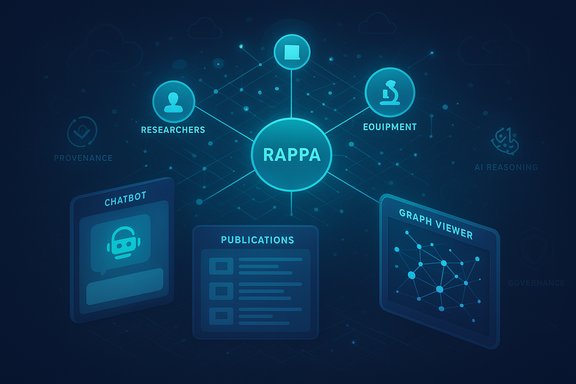
Universities have long struggled with fragmented research records: publication lists, grant receipts, equipment inventories and expertise directories typically live in separate systems and formats. RAPPA addresses that fragmentation by ingesting institutional publication metadata and Monash’s Capability Finder equipment registry, then storing entities and their relationships in a graph database so users can explore connections interactively — via a chatbot, a publications browser and a graph visualiser.
The Monash team presented RAPPA at an AWS Public Sector Symposium, positioning the platform as a way to make the implicit links between research income, outputs and the facilities that produced them explicit. The pilot reportedly ingested roughly 14,000 public research records and the Capability Finder, and aims to serve research performance staff, students/researchers, and senior leadership with tailored natural-language workflows.
Amazon Neptune supports both Gremlin and OpenCypher access patterns, allowing institutions to pick the query language that suits their analytics and tooling. Linkurious’s Neptune connector (and its OpenCypher support) makes it easier to surface Neptune graphs to non‑technical users.
Anthropic and Bedrock provide strong capability, including long-context and structured output modes, but model outputs remain probabilistic; operational guardrails are non-negotiable.
For similar institutions evaluating knowledge-graph pilots, the RAPPA prototype offers a concrete pattern: start small with public corpora, design clear human-in-the-loop validation paths for AI inferences, and instrument costs and privacy controls from day one. Done well, a knowledge-graph plus generative-AI approach can transform how academic organisations find expertise, allocate resources and demonstrate research impact — but the transformation must be built on strong data, governance and operational foundations.
Conclusion: RAPPA demonstrates a practical, enterprise-aligned pattern for turning scattered research records into an actionable knowledge graph powered by multimodal generative AI. The technical choices are supportable by existing cloud services and vendor integrations, but the initiative’s long-term success will depend on disciplined data engineering, explicit governance and human-centred validation workflows.
Source: iTnews Monash University pilots graph database tech to map research ecosystem
 Background / Overview
Universities have long struggled with fragmented research records: publication lists, grant receipts, equipment inventories and expertise directories typically live in separate systems and formats. RAPPA addresses that fragmentation by ingesting institutional publication metadata and Monash’s Capability Finder equipment registry, then storing entities and their relationships in a graph database so users can explore connections interactively — via a chatbot, a publications browser and a graph visualiser.The Monash team presented RAPPA at an AWS Public Sector Symposium, positioning the platform as a way to make the implicit links between research income, outputs and the facilities that produced them explicit. The pilot reportedly ingested roughly 14,000 public research records and the Capability Finder, and aims to serve research performance staff, students/researchers, and senior leadership with tailored natural-language workflows.
RAPPA architecture: how the pieces fit
Cloud-native stack and components
RAPPA is built on AWS and combines a graph database with generative-AI services and standard cloud glue components. Key elements described in the pilot include:- Amazon Neptune as the graph database to store nodes/relationships (researchers, papers, equipment, awards). Neptune is AWS’s managed graph service and supports property graphs (Gremlin and OpenCypher) and RDF/SPARQL, with VPC isolation, encryption at rest and managed backups.
- Amazon Bedrock for managed access to third‑party foundation models; RAPPA reportedly uses Anthropic models via Bedrock to produce summaries and extract equipment usage from text and images. Amazon’s Bedrock pages confirm Anthropic Claude family models are available through the service.
- AWS Lambda and API Gateway as the routing layer that receives user queries, calls Bedrock for reasoning and Neptune for graph queries, then returns summaries or graph visualisations. The architecture pattern of Lambdas + API Gateway feeding model endpoints is a widely used serverless integration approach.
- Amazon S3 for static content and file storage, which is the standard repository for blobs and archival artifacts in AWS-native architectures.
- Frontend apps: a Streamlit container for the natural-language chatbot; a custom publications browser built with AWS’s Cloudscape design components; and a Linkurious-powered graph viewer for interactive network visualisation. Streamlit is commonly used for containerised conversational frontends and lightweight web apps, while Linkurious is an off-the-shelf visual analytics tool that integrates with Neptune.
Why a graph database?
Graph databases model relationships as first-class citizens. For a research ecosystem where the value is in connections — which equipment was used in which study, who collaborated with whom, how grants flowed into outputs — a property graph or RDF model directly represents these links and enables fast traversals and pattern queries that are awkward in relational schemas.Amazon Neptune supports both Gremlin and OpenCypher access patterns, allowing institutions to pick the query language that suits their analytics and tooling. Linkurious’s Neptune connector (and its OpenCypher support) makes it easier to surface Neptune graphs to non‑technical users.
Three core user personas and workflows
RAPPA was explicitly shaped around three personas the Monash team identified:- Research performance staff — who need to validate which facilities and equipment were used in published work for reporting and cost allocation. RAPPA generates plain‑language summaries of papers and uses multimodal AI to infer equipment usage from text, figures and images; staff still manually validate inferred links before they feed reporting.
- Students and researchers — who benefit from improved discoverability of experts, method papers, and available services. Natural-language search and the graph viewer help candidates find collaborators, locate instruments or find precedent methods.
- Senior leadership / governance — who require consolidated views of research outputs, equipment utilisation and industry collaboration to inform strategy and investment decisions. The graph enables aggregated reporting and tracing of income-to-output pathways.
Technical validation and cross-checks
To assess the RAPPA design, it’s necessary to verify the capabilities of the underlying components and confirm they align with the use cases Monash describes.Amazon Neptune: fit for purpose?
Amazon Neptune is a managed graph database that supports property-graph query languages (Gremlin and OpenCypher) and RDF/SPARQL, with typical cloud-native security and management features. Neptune is suitable for relationship-centric queries and visualisation workflows; the choice matches RAPPA’s need to store rich entity relationships and traverse them interactively. Documentation confirms these capabilities and production‑grade features such as encryption, snapshot backups and VPC isolation. Independent tooling support is also present: Linkurious offers an official Neptune connector and documents configuration options for retrieving metadata and connecting to Neptune instances, which supports the integration choice reported by Monash. The Linkurious admin manual also lists Neptune among supported vendors and provides deployment guidance for VPC access patterns.Amazon Bedrock + Anthropic models: multimodal reasoning and long context
Amazon Bedrock provides managed access to Anthropic Claude models; Anthropic’s Claude Opus/Sonnet families support large context windows and are positioned for reasoning and structured outputs. The AWS Bedrock pages list Claude variants and describe extended context windows (e.g., 200K tokens baseline and previews to 1M tokens), which is valuable when summarising long academic papers or reasoning across many documents. That capability aligns with RAPPA’s multimodal summarisation and inference needs. Cross-check: Anthropic’s model listings and Bedrock model mapping show Claude Opus/Sonnet models are available on Bedrock — corroborating the claim that RAPPA can call Anthropic models via Bedrock rather than hosting models directly. Organizations using Bedrock can therefore rely on standardized APIs and AWS governance hooks for model calls.Frontend choices: Streamlit, Cloudscape and Linkurious
- Streamlit is a practical choice for rapid app iteration and lightweight conversational interfaces. Community and vendor examples demonstrate containerised Streamlit chatbots that call LLMs and vector stores; Streamlit’s chat components and container deployment patterns are well established. This makes it a pragmatic way to prototype an NLP-enabled chatbot for campus users.
- Cloudscape Design System is AWS’s design system used across console experiences; using Cloudscape for an internal publications browser helps achieve a consistent enterprise UI in AWS-hosted apps. AWS service updates and documentation references Cloudscape components in recent UI refreshes, supporting the implementation choice.
- Linkurious provides enterprise graph visualisation and investigative tools; product pages and blog posts describe Neptune connectors and OpenCypher support, validating that Linkurious can serve as the graph viewer for RAPPA.
Strengths: what RAPPA gets right
- Relationship-first modelling: Graphs map naturally to the research domain where entities are heavily interconnected. The move to a graph store reduces the friction of cross-referencing equipment, people and publications.
- Faster insight cycles: Using a managed graph service and managed generative models can dramatically reduce time-to-insight for reporting and discovery compared with manual reconciliation workflows. Monash’s pilot suggests “many times faster and more accurate” reporting is possible when relationships are explicit.
- Multimodal extraction adds value: Extracting text, figures and charts to infer equipment usage and summarise methods, then surfacing those in plain language, is a high-value operational feature for research-performance teams that must audit facility usage. Anthropic-class models with long context windows can help parse and synthesise long academic articles.
- User-centred design: Building three persona-specific interfaces (chatbot, publications browser, graph viewer) is a practical UX approach that balances discoverability with investigative depth.
Risks and limitations — technical, operational and ethical
Data quality and metadata hygiene
Graphs are powerful only when nodes and relationships are accurate. University data sources often contain duplicates, inconsistent author name forms, missing equipment identifiers and sparse metadata for legacy publications. The usefulness of RAPPA’s inferences will be bounded by input quality and the effort required to reconcile identities and normalize equipment names.- If Neptunian nodes contain ambiguous researcher identifiers, traversals will return misleading links.
- Automated linking of equipment to publications based on text/image inference must be verified; the pilot’s human validation step is essential to avoid generating false positives.
Model hallucination and provenance
Generative models — even those optimised for safety and reasoning — can hallucinate or misattribute usage. When the system “infers” that a paper used a specific instrument based on a chart or methodology paragraph, that is an inference rather than incontrovertible fact. Institutional workflows must retain provenance metadata (which model, model version, extraction confidence, source snippet) and require human sign-off before records feed governance or financial reporting.Anthropic and Bedrock provide strong capability, including long-context and structured output modes, but model outputs remain probabilistic; operational guardrails are non-negotiable.
Privacy, IP and contractual exposure
Research outputs and laboratory records can contain sensitive data or contractual obligations (industry partners, embargoes). Calling external model endpoints—whether Bedrock-hosted Anthropic models or third-party services—introduces contractual and residency considerations. Although Bedrock is an AWS-managed interface, organisations must validate data residency requirements, contractual guarantees about data reuse, and logging/retention controls before routing sensitive inputs. These are practical legal and procurement issues that university IT and legal teams must resolve.Scalability and operational cost
Graph traversal workloads can be query-intensive; large cross-cutting reporting queries that traverse many hops or combine heavy property payloads can expose latency and cost trade-offs. Neptune is designed for production graph workloads, but institutional pilots must characterise query patterns, caching strategies, and cost for embedding inference (model token costs), API gateway/Lambda runtime costs, and S3 storage. Capacity planning and cost governance are essential.Practical recommendations for Monash and other universities
- Standardise identifiers first: invest in persistent researcher and instrument identifiers (ORCID, local equipment IDs) and a canonical metadata schema before large-scale ingestion. Clean input data reduces downstream manual validation work dramatically.
- Treat model outputs as candidates: require human validation for any assertion that feeds reporting, procurement decisions or funding attribution. Record provenance (prompt, model, confidence score, source snippet).
- Adopt a staged rollout: keep sensitive corpus and embargoed materials offline from external model calls until contractual protections or private-hosting options are in place. Pilot with public publications and non-sensitive metadata initially.
- Instrument and monitor costs: deploy telemetry that tracks Bedrock model calls, token usage, Lambda execution time and Neptune query patterns to avoid surprise bills. Set alert thresholds and periodic audits.
- Provide researcher opt-out / review: allow researchers to correct or annotate linked records — a human-in-the-loop correction mechanism will improve graph quality and adoption.
- Document governance and procurement clauses: mandate explicit vendor clauses about prompt/data reuse, deletion and audit rights in any commercial model agreement. Bedrock simplifies access but does not remove contractual steps required for sensitive data.
Where RAPPA could be headed and collaboration opportunities
Monash has signalled openness to working with other universities to take RAPPA to production. A federated approach — where multiple institutions exchange schema templates and anonymised mappings — could accelerate cross-campus collaboration and interoperability. However, scaling to an enterprise-grade production product will require:- Robust ETL pipelines and identity resolution services.
- Strong governance around model usage, data residency, and IP.
- Operational readiness: SRE practices, performance testing for high-cardinality graph traversals, and user support for research offices.
Final assessment: promise and prudence
RAPPA is a pragmatic and well-targeted pilot that aligns modern graph technology with generative AI to solve a perennial university problem: how to see and measure the scholarly return on institutional investment. Using Amazon Neptune for relationship modelling and Bedrock for multimodal summarisation is a sensible, commercially supported stack that benefits from managed services and vendor integrations (for example, Linkurious’ Neptune connectors). The platform’s strengths include improved discoverability, accelerated reporting workflows, and potential new insights into equipment utilisation and collaboration networks. Those gains, however, hinge on disciplined data hygiene, conservative trust models for AI-generated assertions, and careful legal/procurement work on model use and data residency.For similar institutions evaluating knowledge-graph pilots, the RAPPA prototype offers a concrete pattern: start small with public corpora, design clear human-in-the-loop validation paths for AI inferences, and instrument costs and privacy controls from day one. Done well, a knowledge-graph plus generative-AI approach can transform how academic organisations find expertise, allocate resources and demonstrate research impact — but the transformation must be built on strong data, governance and operational foundations.
Appendix: verification highlights (technical claims checked)
- Amazon Neptune supports property graph and RDF models, Gremlin and OpenCypher, plus managed security features (VPC, encryption).
- Linkurious has an official connector and documentation for Amazon Neptune and added OpenCypher support in late 2024, validating the graph-visualisation choice.
- Amazon Bedrock exposes Anthropic Claude models (Opus/Sonnet variants) with long-context modes; Bedrock and Anthropic docs show model availability and large-context previews useful for lengthy academic documents.
- Containerised Streamlit chatbots and production deployment patterns are established in cloud-first deployments and community examples; Streamlit chat components support chat UX used in RAPPA’s chatbot.
Conclusion: RAPPA demonstrates a practical, enterprise-aligned pattern for turning scattered research records into an actionable knowledge graph powered by multimodal generative AI. The technical choices are supportable by existing cloud services and vendor integrations, but the initiative’s long-term success will depend on disciplined data engineering, explicit governance and human-centred validation workflows.
Source: iTnews Monash University pilots graph database tech to map research ecosystem
