

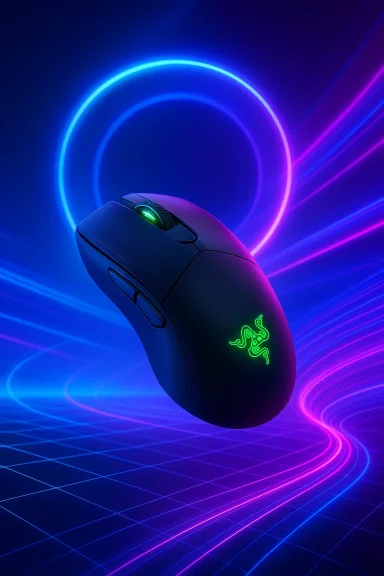
The Razer Viper V4 Pro arrives at a moment when competitive mice have become less about flashy gimmicks and more about shaving tiny amounts of friction off every motion, click, and recharge cycle. Windows Central’s review makes clear that this isn’t a broad-market gaming mouse dressed up in esports clothing; it is a purpose-built performance tool that refines an already dominant formula with a lighter chassis, improved wireless hardware, and far better endurance. At $159.99, though, it also underscores a familiar truth in high-end peripherals: the best tools are often the hardest to justify unless you are using them at the level they were designed for. The result is a mouse that feels almost overqualified for everyone except the players chasing marginal gains.
Razer has spent years turning the Viper line into one of the defining shapes in competitive gaming, and the V4 Pro is best understood as an evolution of that esports-first strategy rather than a reinvention. That matters because the category itself has changed. A few years ago, “pro mouse” usually meant the lightest shell, the safest shape, and a decent sensor; now it means all that plus wireless stability, battery optimization, and software tuning that can hold up under tournament scrutiny.
The review context also tells us something important about the market. Razer’s Viper V3 Pro had already established itself as a favorite among professional players, and Razer publicly leaned into that position by calling it the #1 mouse used by esports pros in its own messaging around the product line. That created a clear benchmark for the V4 Pro to beat, not just match. If the V3 Pro was the consensus choice, the V4 Pro needed to prove that incremental hardware changes could still feel meaningful in real play.
What makes the V4 Pro notable is not that it adds one headline feature, but that it tightens nearly every part of the experience. The sensor is faster, the shell is lighter, the battery lasts much longer, and the wireless dongle becomes an actual status tool rather than a passive accessory. In a category where buyers are already paying a premium, polish is not decorative — it is the product.
At the same time, the mouse illustrates the split between consumer and competitive expectations. For most users, a strong wireless mouse is one that feels comfortable, tracks reliably, and lasts long enough between charges. For esports players, that is just the entry fee. They want confidence under pressure, and the Viper V4 Pro is designed to make that confidence feel like a hardware feature.
The Viper V3 Pro strengthened that legacy by aligning the product more directly with pro-player preferences. Razer said its shape, button placement, and feel were refined with feedback from esports athletes, and the company highlighted the mouse’s rise to the top of pro usage charts in its own marketing. In other words, the Viper V3 Pro did not merely succeed as a retail product — it became part of the public language of competitive performance.
Razer’s wider 2025-2026 product direction reinforces that point. The company has continued to push premium peripherals with ultra-low latency, high polling rates, and esports-specific engineering, as seen in its DeathAdder V4 Pro launch, which emphasized HyperSpeed Wireless Gen-2, 8,000Hz support, and optical scroll hardware. That broader pattern shows that the Viper V4 Pro is part of a company-wide push toward more specialized, more technical flagship peripherals.
The significance for Windows users is straightforward. Windows remains the natural home for top-tier PC gaming hardware, and competitive mice like the Viper V4 Pro tend to influence the accessory market far beyond their niche. Features that start as “pro-only” often become table stakes in the next wave of mainstream gear.
That shift is visible in the Viper V4 Pro’s design choices. Instead of adding RGB spectacle or superfluous extras, Razer focused on a light shell, durable switches, and a more informative dongle. The message is subtle but clear: if you want an elite gaming mouse, you should be buying the invisible improvements as much as the visible ones.
The key thing is that Razer did not seem to get there by making the shell feel disposable. The reinforced plastic construction suggests an attempt to preserve structural confidence even while trimming mass. That balance is difficult, and it is often where lightweight mice fail: they feel fast, but also hollow.
The reviewer’s response points toward a successful compromise. The Viper V4 Pro feels featherlight, but not cheap, and that distinction is crucial in a premium product.
That said, the shape is clearly optimized for competitive control rather than comfort-first ergonomics. This is the sort of mouse that rewards fingertip and claw users most, especially those who prize quick transitions over palm-heavy support. For long casual sessions, that might not matter much; for ranked FPS play, it can be decisive.
The optical scroll wheel is another subtle win. Scroll wheels are easy to overlook until one feels sticky or mushy, and then they become a daily annoyance. Here, the wheel is described as smooth and effective, which suggests Razer treated a mundane part with the same seriousness as the sensor.
The reviewer also ties the sensor to the mouse’s smooth and responsive feeling. That is the real test. High-end sensors do not just need to be accurate; they need to disappear. When the hand and cursor feel fused, the hardware has done its job.
The practical caveat is obvious: max polling comes with battery tradeoffs. Razer says battery life drops sharply from the advertised 180 hours at 1,000Hz to roughly 45 hours at 8,000Hz, and the review found that estimate broadly accurate. That makes polling rate a power-management choice as much as a performance one.
The big caveat remains polling rate. At 8,000Hz, the battery story becomes much less generous, and that is the tradeoff users need to understand. This is not a flaw so much as a reality of the feature set: extreme responsiveness costs power.
This is more meaningful than it first appears. Competitive users care about certainty, and visualizing connection quality removes one more layer of ambiguity from the setup. You do not have to guess whether your link is healthy; the mouse tells you.
Synapse also handles calibration and sensitivity adjustment, which is where the mouse becomes more than a static object. Fine-tuning matters because the “perfect” mouse is often the one that matches a user’s grip, desk, and game-specific habits rather than a universal standard.
That kind of flexibility is especially relevant in the Windows ecosystem. High-end peripherals often expect buyers to accept a layer of vendor software, but when that software becomes easier to access, it lowers the barrier to using the hardware properly.
The Viper V4 Pro is clearly trying to preserve that momentum. It does not try to attract the broadest possible audience. Instead, it aims to be the kind of mouse that a serious player can adopt with minimal adjustment and maximum trust.
That is why the reviewer’s hesitation to buy it personally makes sense. The mouse may be elite, but elite does not equal universal. In fact, the very traits that make it compelling to pros may make it excessive for ordinary users.
For everyone else, the calculation is murkier. A mouse does not need to be expensive to be excellent, and many users will never exploit the Viper V4 Pro’s full ceiling. In that sense, its value is highly dependent on intention.
The reviewer’s conclusion captures this tension well: the Viper V4 Pro is top-class, but not the sort of thing most people should buy by default. That is not a criticism of the product so much as a recognition of what kind of product it is.
The other question is whether the market will continue to reward ultra-premium mice in an era when excellent midrange options keep getting better. For esports players, the answer is probably yes, because trust is worth paying for. For everyone else, the answer may remain “probably not,” and that is fine; products like this do not need to be universal to matter.
Source: Windows Central Review: Razer's Viper V4 Pro mouse makes me feel like the pro gamer I'm not
 Overview
Razer has spent years turning the Viper line into one of the defining shapes in competitive gaming, and the V4 Pro is best understood as an evolution of that esports-first strategy rather than a reinvention. That matters because the category itself has changed. A few years ago, “pro mouse” usually meant the lightest shell, the safest shape, and a decent sensor; now it means all that plus wireless stability, battery optimization, and software tuning that can hold up under tournament scrutiny.The review context also tells us something important about the market. Razer’s Viper V3 Pro had already established itself as a favorite among professional players, and Razer publicly leaned into that position by calling it the #1 mouse used by esports pros in its own messaging around the product line. That created a clear benchmark for the V4 Pro to beat, not just match. If the V3 Pro was the consensus choice, the V4 Pro needed to prove that incremental hardware changes could still feel meaningful in real play.
What makes the V4 Pro notable is not that it adds one headline feature, but that it tightens nearly every part of the experience. The sensor is faster, the shell is lighter, the battery lasts much longer, and the wireless dongle becomes an actual status tool rather than a passive accessory. In a category where buyers are already paying a premium, polish is not decorative — it is the product.
At the same time, the mouse illustrates the split between consumer and competitive expectations. For most users, a strong wireless mouse is one that feels comfortable, tracks reliably, and lasts long enough between charges. For esports players, that is just the entry fee. They want confidence under pressure, and the Viper V4 Pro is designed to make that confidence feel like a hardware feature.
Background
Razer’s Viper family has long occupied a special place in the gaming peripheral hierarchy. It is one of those product lines that becomes bigger than the sum of its specifications because it represents a design philosophy: keep the mouse simple, keep it fast, and remove anything that could interrupt a clean aim or a fast flick. That’s why the Viper shape has become so influential in competitive circles.The Viper V3 Pro strengthened that legacy by aligning the product more directly with pro-player preferences. Razer said its shape, button placement, and feel were refined with feedback from esports athletes, and the company highlighted the mouse’s rise to the top of pro usage charts in its own marketing. In other words, the Viper V3 Pro did not merely succeed as a retail product — it became part of the public language of competitive performance.
Why this generation matters
The Viper V4 Pro is the next step in that trajectory, and the timing matters. Competitive gaming hardware has matured to the point where a new sensor or a slightly better switch no longer feels revolutionary on paper. Instead, manufacturers compete by reducing the number of reasons a player might doubt the tool in hand. That includes battery life, wireless stability, grip comfort, and software calibration.Razer’s wider 2025-2026 product direction reinforces that point. The company has continued to push premium peripherals with ultra-low latency, high polling rates, and esports-specific engineering, as seen in its DeathAdder V4 Pro launch, which emphasized HyperSpeed Wireless Gen-2, 8,000Hz support, and optical scroll hardware. That broader pattern shows that the Viper V4 Pro is part of a company-wide push toward more specialized, more technical flagship peripherals.
The significance for Windows users is straightforward. Windows remains the natural home for top-tier PC gaming hardware, and competitive mice like the Viper V4 Pro tend to influence the accessory market far beyond their niche. Features that start as “pro-only” often become table stakes in the next wave of mainstream gear.
The premium mouse category has narrowed
What used to separate expensive gaming mice from cheaper ones has narrowed considerably. Better sensors, low-latency wireless, and long battery life are no longer rare. That has forced brands like Razer to compete on refinement rather than raw capability.That shift is visible in the Viper V4 Pro’s design choices. Instead of adding RGB spectacle or superfluous extras, Razer focused on a light shell, durable switches, and a more informative dongle. The message is subtle but clear: if you want an elite gaming mouse, you should be buying the invisible improvements as much as the visible ones.
- Competitive mice now win on consistency, not just peak specs.
- Battery life is becoming a real selling point, not an afterthought.
- Wireless dongles are turning into diagnostic tools.
- Lightweight construction is expected, but not at the expense of durability.
- Software and calibration matter more than marketing flourishes.
Design and Build
The Viper V4 Pro’s biggest immediate impression is how little visual clutter it carries. This is a minimalist mouse in the best sense: restrained, symmetrical, and stripped of the RGB theater that still defines much of the gaming market. That choice gives it a serious, almost clinical feel, which is exactly what a competitive accessory should project.Lightweight without feeling fragile
At 49 grams for the black model and 50 grams for the white one, the mouse sits comfortably in the ultra-lightweight category. That matters because every gram saved can make rapid repositioning feel less effortful, especially in FPS titles where micro-adjustments and repeated flicks dominate the hand motion profile.The key thing is that Razer did not seem to get there by making the shell feel disposable. The reinforced plastic construction suggests an attempt to preserve structural confidence even while trimming mass. That balance is difficult, and it is often where lightweight mice fail: they feel fast, but also hollow.
The reviewer’s response points toward a successful compromise. The Viper V4 Pro feels featherlight, but not cheap, and that distinction is crucial in a premium product.
Shape and ergonomics
Razer’s symmetrical shape remains familiar, but the mouse is not truly ambidextrous in the strictest sense. The left-side buttons make it more naturally suited to right-handed use, which is standard in this class, but still worth noting for buyers who expect full dual-hand flexibility.That said, the shape is clearly optimized for competitive control rather than comfort-first ergonomics. This is the sort of mouse that rewards fingertip and claw users most, especially those who prize quick transitions over palm-heavy support. For long casual sessions, that might not matter much; for ranked FPS play, it can be decisive.
Surface, grip, and click feel
The review emphasizes that the optical Gen-4 switches are clicky and a bit loud, though that is not necessarily a flaw in a headset-heavy gaming setup. In esports hardware, tactile certainty often matters more than acoustic refinement. A firm click can be reassuring if it translates into a clean and predictable actuation point.The optical scroll wheel is another subtle win. Scroll wheels are easy to overlook until one feels sticky or mushy, and then they become a daily annoyance. Here, the wheel is described as smooth and effective, which suggests Razer treated a mundane part with the same seriousness as the sensor.
- 49g/50g is light enough to matter in high-speed aim games.
- The reinforced chassis aims to preserve durability.
- The symmetrical shell favors competitive right-handed use.
- Optical switches bring a more deliberate, precise click feel.
- The scroll wheel avoids the sluggishness common in lesser mice.
Sensor and Performance
Performance is where the Viper V4 Pro earns its price tag most convincingly. The review’s strongest praise centers on how precise and responsive the mouse feels in fast, high-stakes shooters such as Marathon, Battlefield 6, and Helldivers 2. That kind of judgment is what buyers in this segment care about most, because the difference between “good” and “elite” often shows up only when movement becomes frantic.Focus Pro 50K and the shape of precision
The mouse uses Razer’s Focus Pro 50K Optical sensor Gen-3, which gives it a massive nominal DPI ceiling of 50,000. On paper, that number is more useful as a marketing and tuning range statement than as a practical target for normal play, but it still matters. A broader ceiling can give users more room to find the exact sensitivity curve they want without feeling boxed in.The reviewer also ties the sensor to the mouse’s smooth and responsive feeling. That is the real test. High-end sensors do not just need to be accurate; they need to disappear. When the hand and cursor feel fused, the hardware has done its job.
Polling rate and latency
Razer’s support for up to 8,000Hz polling is another major pillar of the Viper V4 Pro’s identity. Competitive players often obsess over latency because, at the highest levels, even small reductions can change the feel of a flick, a spray correction, or a tracking adjustment.The practical caveat is obvious: max polling comes with battery tradeoffs. Razer says battery life drops sharply from the advertised 180 hours at 1,000Hz to roughly 45 hours at 8,000Hz, and the review found that estimate broadly accurate. That makes polling rate a power-management choice as much as a performance one.
What players will actually notice
Most players will not consciously identify a sensor delta between a very good mouse and an excellent one in casual use. What they will notice is confidence: fewer doubts about cursor drift, fewer moments where the hardware feels like the limiting factor, and less hesitation during rapid movement. The Viper V4 Pro seems built to reduce that psychological noise as much as physical input lag.- 8,000Hz is aimed squarely at the competitive fringe.
- The sensor’s strength is in consistency as much as speed.
- High DPI is about tuning flexibility, not everyday necessity.
- Low-latency movement matters most in FPS and arena shooters.
- The mouse’s performance aims to feel invisible, not flashy.
Battery Life and Wireless Hardware
Battery life is one of the most impressive areas of improvement here, especially because it solves a pain point that is often tolerated rather than fixed in gaming mice. A wireless mouse is only truly premium if it can stay out of the way for days or weeks at a time, and the Viper V4 Pro’s claimed 180-hour rating at 1,000Hz is a serious leap.Endurance as a feature, not a compromise
The jump from the Viper V3 Pro’s peak battery figure to the V4 Pro’s rating changes the ownership experience in a very practical way. Instead of thinking about charging as a frequent chore, the user can treat it as a routine maintenance task. That matters more than it sounds, because even a tiny amount of battery anxiety can interfere with the mental rhythm of competitive play.The big caveat remains polling rate. At 8,000Hz, the battery story becomes much less generous, and that is the tradeoff users need to understand. This is not a flaw so much as a reality of the feature set: extreme responsiveness costs power.
HyperSpeed Wireless Gen-2 and the dongle
The wireless side is where Razer’s design cleverness becomes obvious. The dongle is not just a standard receiver; it is a half-spherical puck with three LED indicators showing connection quality, battery level, and polling preset. That turns a utilitarian component into a status dashboard, which is exactly the kind of thing a serious player can use without thinking about it too much.This is more meaningful than it first appears. Competitive users care about certainty, and visualizing connection quality removes one more layer of ambiguity from the setup. You do not have to guess whether your link is healthy; the mouse tells you.
Wired charging still matters
Even in a flagship wireless mouse, wired charging remains part of the ecosystem. The USB-A to USB-C cable is unsurprising, but that simplicity is useful. Players who prefer predictable desk setups or who want to top off between sessions need a charging path that doesn’t complicate their workflow.- 180 hours is a major quality-of-life upgrade at standard polling rates.
- 45 hours at 8,000Hz is the price of maximum responsiveness.
- The dongle doubles as a diagnostic display.
- Wireless stability is presented as seamless rather than novel.
- Charging remains straightforward and unobtrusive.
Software and Customization
Razer Synapse remains a central part of the experience, and that comes with the usual caveat: the software is powerful, but it is still software. In the best case, it lets players fine-tune the mouse to the point where the hardware feels personally calibrated. In the worst case, it adds one more app to manage.Synapse and on-the-fly tuning
The Viper V4 Pro includes two customizable side buttons, which can be remapped for macros and other actions. That keeps the mouse useful not just for pure aim, but for games and workflows where quick auxiliary inputs matter. For many competitive players, the side buttons are not decorative extras; they are integral to movement and ability usage.Synapse also handles calibration and sensitivity adjustment, which is where the mouse becomes more than a static object. Fine-tuning matters because the “perfect” mouse is often the one that matches a user’s grip, desk, and game-specific habits rather than a universal standard.
Web-based convenience versus app overhead
The review notes that customization can be done through the app or web-based version, which is an understated but valuable improvement. Browser-based control reduces the friction of setup, especially for people who reinstall Windows often, move between systems, or simply do not want another persistent app in their tray.That kind of flexibility is especially relevant in the Windows ecosystem. High-end peripherals often expect buyers to accept a layer of vendor software, but when that software becomes easier to access, it lowers the barrier to using the hardware properly.
What customization means in practice
For casual users, customization can seem like overkill. For competitive players, it is the difference between a mouse that merely works and one that feels tuned for a specific role. The Viper V4 Pro appears to respect that distinction, offering a deep enough toolset without forcing the user into obvious complexity.- Two remappable side buttons increase gameplay utility.
- Synapse supports calibration and performance tuning.
- Browser access makes setup less painful.
- Sensitivity controls help tailor the mouse to different games.
- The software complements the hardware instead of redefining it.
Competitive Context
This is where the Viper V4 Pro becomes more interesting than a simple product review. It is not just a mouse; it is Razer’s statement about where competitive gaming hardware is headed. In a market where pro adoption and retail sales influence each other, a mouse like this can shape expectations for an entire category.Why pro players matter so much
Razer has openly tied the Viper family to esports credibility, pointing to Prosettings data and feedback from dozens of players in the Viper V3 Pro cycle. That matters because competitive gear sells partly through social proof. When top players use a product, it becomes easier for aspiring players to see it as the default choice.The Viper V4 Pro is clearly trying to preserve that momentum. It does not try to attract the broadest possible audience. Instead, it aims to be the kind of mouse that a serious player can adopt with minimal adjustment and maximum trust.
The cost of specialization
The downside of this strategy is obvious: the more specialized a mouse becomes, the harder it is to recommend to everyone else. A $160 accessory is a rational purchase if your performance depends on it, but it is a luxury if you mostly play single-player games, strategy titles, or do general productivity work.That is why the reviewer’s hesitation to buy it personally makes sense. The mouse may be elite, but elite does not equal universal. In fact, the very traits that make it compelling to pros may make it excessive for ordinary users.
Competitive advantages in practical terms
What does the Viper V4 Pro give players that cheaper mice do not? Not magic. It offers refinement, confidence, and a better chance that hardware disappears behind skill. In competitive gaming, that is often the highest compliment you can pay.- Pro adoption creates a credibility flywheel.
- Specialization strengthens performance but narrows the audience.
- The mouse’s advantage is about removing uncertainty.
- Competitive players will value consistency more than feature count.
- The product reinforces Razer’s esports identity.
Consumer Value and Pricing
At $159.99, the Viper V4 Pro sits squarely in premium territory, and that price is the biggest barrier to mainstream appeal. A consumer buyer can get a very good gaming mouse for much less, and in many games or use cases, the practical difference will be small.Why the price feels justified — and why it doesn’t
If you are a competitive FPS player, the mouse’s light weight, sensor accuracy, long battery life, and wireless confidence provide a coherent value story. Everything about it supports fast, repeatable performance. In that context, the price becomes a matter of how much you are willing to pay to reduce friction.For everyone else, the calculation is murkier. A mouse does not need to be expensive to be excellent, and many users will never exploit the Viper V4 Pro’s full ceiling. In that sense, its value is highly dependent on intention.
Consumer versus enthusiast realities
This split is common in PC hardware, but it is especially sharp in peripherals. A laptop buyer can often justify premium spending with broader productivity gains; a gaming mouse mainly pays off in the specific way it feels to use. That means the return on investment is tied directly to play style and habits.The reviewer’s conclusion captures this tension well: the Viper V4 Pro is top-class, but not the sort of thing most people should buy by default. That is not a criticism of the product so much as a recognition of what kind of product it is.
A premium accessory in a value-conscious market
The broader mouse market has become more crowded with capable wireless options, including less expensive alternatives that cover 90 percent of what most users need. That puts premium devices under pressure to justify themselves with excellence rather than novelty. Razer appears to understand that, which is why the Viper V4 Pro leans so hard into polished execution.- $159.99 positions the mouse as a premium purchase.
- Value depends heavily on competitive intent.
- Cheaper mice now cover most everyday needs well.
- This product is about marginal gains, not broad accessibility.
- The premium is easier to justify for esports than for casual play.
Strengths and Opportunities
The Viper V4 Pro’s strengths are easy to summarize, but the larger opportunity is strategic: it shows how a mature category can still improve meaningfully when the design brief is precise. Razer is not chasing trends here; it is shaving down the rough edges that matter to the people most likely to notice them.- Excellent sensor performance that feels precise and smooth in real use.
- Very low weight without an obviously fragile build.
- Strong battery life at standard polling rates.
- A useful wireless dongle that adds real visibility into connection status.
- Competitive-grade switches with long rated durability.
- Clean, minimalist design that avoids unnecessary visual clutter.
- Deep customization through Synapse and web-based controls.
- Clear esports identity that reinforces Razer’s premium positioning.
Risks and Concerns
The Viper V4 Pro is not without drawbacks, and most of them come from the same place: specialization. The more a product optimizes for competitive performance, the less forgiving it becomes for anyone outside that lane.- High price limits appeal outside the competitive audience.
- 8,000Hz polling meaningfully reduces battery life.
- Loud clicks may be annoying in quiet environments.
- Right-hand bias limits flexibility despite the symmetrical shape.
- Synapse dependence may frustrate users who prefer simpler setups.
- Marginal gains can be hard to justify for casual players.
- No RGB appeal may make it feel too austere for some buyers.
Looking Ahead
The Viper V4 Pro suggests that the next phase of gaming mouse design will focus less on dramatic reinvention and more on invisible optimization. Battery efficiency, dongle intelligence, switch consistency, and low-latency tuning are becoming the real battlegrounds. If Razer can maintain this level of polish, it will keep its place near the top of the competitive peripheral conversation.The other question is whether the market will continue to reward ultra-premium mice in an era when excellent midrange options keep getting better. For esports players, the answer is probably yes, because trust is worth paying for. For everyone else, the answer may remain “probably not,” and that is fine; products like this do not need to be universal to matter.
- Watch whether more pros adopt the Viper V4 Pro in tournament play.
- Watch for firmware or software updates that improve battery efficiency.
- Watch how rivals respond to the dongle’s status indicators.
- Watch whether the price settles over time.
- Watch whether Razer extends these design ideas to more affordable models.
Source: Windows Central Review: Razer's Viper V4 Pro mouse makes me feel like the pro gamer I'm not
Last edited:
