

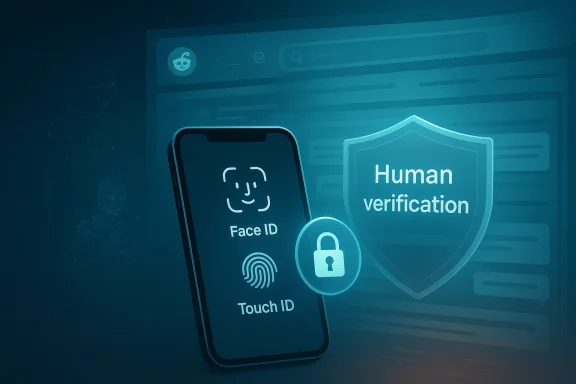
Reddit’s latest anti-bot thinking points to a much bigger shift than a simple product tweak: the company may be moving toward a world where proving you are human matters as much as posting well. In remarks attributed to CEO Steve Huffman on the TBPN podcast, Reddit is reportedly exploring lightweight verification methods such as Face ID, Touch ID, and other passkey-style checks to curb the flood of bots and AI-generated posts. If that experiment turns into a real policy, it could reshape one of the internet’s most important anonymous discussion platforms, with major consequences for privacy, moderation, and the future of online identity.
Reddit has spent years trying to balance two things that are often in tension: anonymity and trust. The platform’s culture depends on users feeling free to speak without tying every comment to a real-world identity, but that same openness has made it attractive to spammers, astroturfers, bot operators, and increasingly sophisticated AI accounts. The result is a platform that is still hugely influential, but also one where authenticity is under constant pressure.
That pressure is no longer hypothetical. Public discussion around synthetic content has accelerated as large language models made it cheap and easy to generate convincing posts, comments, and vote manipulation at scale. Reddit has also had to contend with a broader internet trend in which platforms are forced to choose between convenience and verification. The more frictionless a service is, the easier it becomes for automated systems to imitate real people.
The University of Zurich controversy in 2025 made that danger hard to ignore. Researchers secretly used AI-generated comments in r/changemyview, triggering a backlash that highlighted just how vulnerable Reddit can be when bad actors imitate human voices well enough to blend in. Engadget reported on the experiment and Reddit’s response, underscoring how quickly trust can evaporate when users realize they may be talking to software rather than people.
At the same time, the broader industry has been drifting toward stronger verification systems. Discord, for example, has rolled out age-assurance flows that can include face scans or ID checks in some regions, while trying to emphasize that data is not permanently tied to an account. Discord’s documentation makes clear that it is not requiring every user to complete face scans, but it is still normalizing a world in which biometric verification is becoming part of routine platform access.
Reddit’s own product direction also suggests a company that is increasingly willing to intervene in the mechanics of identity and content integrity. Its transparency reporting shows continued reliance on automated flags and enforcement to manage abuse, and its developer ecosystem now includes bot-detection tools and behavioral verification challenges. That matters because the platform is not starting from zero; it is already experimenting with the machinery needed to distinguish a person from a script.
Steve Huffman’s reported framing is revealing because it suggests Reddit does not necessarily want users’ real names, home addresses, or government identities. Instead, the company appears to be exploring a narrower question: can a third party certify that a device or account holder is a person without Reddit itself becoming a repository of personal identity data? That is a very different proposition from full real-name verification.
This is why verification is no longer just about safety or spam. It is about preserving the core promise of the platform. If users believe that most conversations are contaminated, then Reddit becomes less a forum and more a feed of contested signals.
But the promise is only as strong as the implementation. If users suspect that “lightweight” verification is just a stepping stone toward broader ID collection, the backlash could be immediate and intense. Reddit has to convince people that it is trying to protect anonymity, not quietly dismantle it.
Still, the optics are delicate. Many users will hear “Face ID” and immediately think “face scanning,” even if the technical reality is more privacy-preserving. The platform will need to explain, repeatedly and carefully, what exactly is being verified, where the data lives, and who can access it.
That makes the approach pragmatic, but also incomplete. A determined attacker can still use real devices, coordinated human operators, or compromised accounts. Verification raises the bar; it does not eliminate the threat.
That means Reddit may need tiered trust levels rather than a universal gate. Some users might be able to browse freely, while posting, commenting, or joining high-abuse communities could require stronger verification. That kind of selective friction is more realistic than an all-or-nothing policy.
The company will likely argue that the goal is not to unmask users but to confirm that accounts are operated by real humans. That is a reasonable distinction, and in a perfect world it would satisfy most privacy concerns. In practice, though, people rarely trust promises that sound like infrastructure changes to them.
That is why privacy objections are not just emotional reactions. They are rational responses to the possibility of scope creep.
That distinction may be the single most important public-relations challenge Reddit faces. Even if the underlying data never leaves the handset, many users will still experience the policy as a form of identity escalation. Perception, in this case, may matter almost as much as architecture.
The University of Zurich episode showed how powerful this can be in a debate context. The bots did not merely flood a thread; they adopted personas and moral framing designed to influence the conversation. That kind of manipulation is precisely what makes synthetic content so destabilizing in communities built on argument and trust.
This is a huge problem for Reddit because the site’s most valuable surfaces depend on ranking systems, votes, comments, and social validation. If those signals can be gamed by bots, then the entire discovery layer becomes more vulnerable.
That is the logic behind verification. It is not that moderation failed completely. It is that moderation now faces a volume and realism problem it was never built to solve on its own.
The competitive implication is that Reddit could either look ahead of the curve or dangerously out of step, depending on execution. If it succeeds, it may set a precedent for anonymous but verified participation. If it fails, it could become a case study in how to alienate users while trying to save a community from automation.
If users lose faith in Reddit’s human signal, they may not just scroll less. They may stop treating it as a place worth asking serious questions.
It would also be commercially attractive. Advertisers, moderators, and community managers all benefit from cleaner signals. The challenge is making that value proposition clear without sounding like the company is turning Reddit into a gated identity system.
For enterprise users, moderators, developers, and brands, the picture is more mixed. Cleaner identity signals could improve subreddit quality, reduce spam in customer-support communities, and make analytics more trustworthy. That is especially relevant for brands using Reddit as a place to monitor sentiment and community feedback.
The design question is therefore not “can Reddit verify humans?” It is “can Reddit make verification feel like a protective layer rather than a surveillance layer?”
But even enterprise value collapses if the user base feels coerced. A cleaner forum with fewer real participants is not a success story. It is a hollow one.
A staged rollout would also create room for different verification tiers. A user who only reads content might never be asked to prove anything, while a user who posts repeatedly in controversial or spam-heavy subreddits might encounter stronger checks. That kind of model aligns with how large platforms usually manage risk.
It will also need exception handling for users with accessibility needs, older devices, shared devices, and countries with different privacy expectations. The more edge cases the system ignores, the faster it will become a source of support pain rather than protection.
At the same time, Discord’s example also shows the cost of doing this poorly. Once a platform introduces verification, users start asking why, where the data goes, how long it is kept, and whether it can be used for something else later. Those questions do not disappear just because the feature is technically justified.
That means Reddit will need a strong public explanation, not just a product change. It will need to explain the threat, the mechanism, the safeguards, and the exit ramps.
So while Discord may provide a technical template, Reddit has a much tougher cultural problem to solve. The same tool can mean very different things depending on the community that receives it.
The broader internet trend is clear: platforms are getting less tolerant of anonymous abuse and more willing to trade some convenience for trust. That does not mean users will accept every new gate, but it does mean the conversation is now moving from “should platforms verify humans?” to “how much verification can they introduce without destroying what made them valuable?”
Source: PCMag Australia Reddit Could Soon Require Face ID to Prove You're Not a Bot
 Background
Reddit has spent years trying to balance two things that are often in tension: anonymity and trust. The platform’s culture depends on users feeling free to speak without tying every comment to a real-world identity, but that same openness has made it attractive to spammers, astroturfers, bot operators, and increasingly sophisticated AI accounts. The result is a platform that is still hugely influential, but also one where authenticity is under constant pressure.That pressure is no longer hypothetical. Public discussion around synthetic content has accelerated as large language models made it cheap and easy to generate convincing posts, comments, and vote manipulation at scale. Reddit has also had to contend with a broader internet trend in which platforms are forced to choose between convenience and verification. The more frictionless a service is, the easier it becomes for automated systems to imitate real people.
The University of Zurich controversy in 2025 made that danger hard to ignore. Researchers secretly used AI-generated comments in r/changemyview, triggering a backlash that highlighted just how vulnerable Reddit can be when bad actors imitate human voices well enough to blend in. Engadget reported on the experiment and Reddit’s response, underscoring how quickly trust can evaporate when users realize they may be talking to software rather than people.
At the same time, the broader industry has been drifting toward stronger verification systems. Discord, for example, has rolled out age-assurance flows that can include face scans or ID checks in some regions, while trying to emphasize that data is not permanently tied to an account. Discord’s documentation makes clear that it is not requiring every user to complete face scans, but it is still normalizing a world in which biometric verification is becoming part of routine platform access.
Reddit’s own product direction also suggests a company that is increasingly willing to intervene in the mechanics of identity and content integrity. Its transparency reporting shows continued reliance on automated flags and enforcement to manage abuse, and its developer ecosystem now includes bot-detection tools and behavioral verification challenges. That matters because the platform is not starting from zero; it is already experimenting with the machinery needed to distinguish a person from a script.
Why Reddit Is Talking About Verification Now
The timing is no accident. Reddit is facing a more hostile authenticity environment than it did even two years ago, and AI has changed the scale of the problem. What once looked like the occasional spam campaign now looks like an industrialized content problem, with synthetic accounts capable of writing, voting, and replying in ways that feel annoyingly human. That shift forces Reddit to ask whether old moderation assumptions still work.Steve Huffman’s reported framing is revealing because it suggests Reddit does not necessarily want users’ real names, home addresses, or government identities. Instead, the company appears to be exploring a narrower question: can a third party certify that a device or account holder is a person without Reddit itself becoming a repository of personal identity data? That is a very different proposition from full real-name verification.
The Human Problem Has Become a Product Problem
For years, the platform could treat bots as a moderation issue. Now they are becoming a core product issue. If users stop believing the comments they read are mostly from actual people, the value of Reddit’s discussion model starts to erode.This is why verification is no longer just about safety or spam. It is about preserving the core promise of the platform. If users believe that most conversations are contaminated, then Reddit becomes less a forum and more a feed of contested signals.
- Trust is now a product feature, not just a moderation outcome
- Bot detection must scale faster than bot generation
- Synthetic content undermines subreddit norms
- A human signal is becoming economically valuable
A Subtle but Important Framing Shift
The language around “prove you’re human” is also different from “prove your identity.” That distinction matters because it lets Reddit aim for fewer false humans without necessarily forcing more real-world disclosure. In theory, a passkey or device-level verification could confirm personhood while preserving pseudonymity.But the promise is only as strong as the implementation. If users suspect that “lightweight” verification is just a stepping stone toward broader ID collection, the backlash could be immediate and intense. Reddit has to convince people that it is trying to protect anonymity, not quietly dismantle it.
What Biometric Verification Could Mean
If Reddit leans on Face ID, Touch ID, or similar device-native checks, it may not be asking users to upload their face to Reddit at all. That is an important nuance. In Apple-style workflows, biometric matching often happens on-device, with the app receiving only a confirmation token rather than the biometric template itself. That could make the approach more palatable than a centralized face-scan database.Still, the optics are delicate. Many users will hear “Face ID” and immediately think “face scanning,” even if the technical reality is more privacy-preserving. The platform will need to explain, repeatedly and carefully, what exactly is being verified, where the data lives, and who can access it.
Device Trust Versus Identity Trust
The appeal of biometric or passkey-based verification is that it can reduce friction while still raising the cost of mass abuse. A bot network can rent infrastructure, rotate IPs, and generate text endlessly. It cannot as easily fake a device-level trust signal tied to a real human interaction.That makes the approach pragmatic, but also incomplete. A determined attacker can still use real devices, coordinated human operators, or compromised accounts. Verification raises the bar; it does not eliminate the threat.
- Passkeys are strong against credential theft
- Biometrics are convenient but politically sensitive
- Device-based proof can be more private than ID upload
- No verification method is bot-proof
Where the Technical Challenge Gets Hard
The hardest part is not the cryptography. It is deciding what count as acceptable evidence of humanness without turning the user experience into a maze of exceptions. Reddit serves casual lurkers, moderators, journalists, researchers, niche hobbyists, and people using throwaway accounts for sensitive conversations. A single verification model will not fit all of them.That means Reddit may need tiered trust levels rather than a universal gate. Some users might be able to browse freely, while posting, commenting, or joining high-abuse communities could require stronger verification. That kind of selective friction is more realistic than an all-or-nothing policy.
The Privacy Trade-Off
This is where the debate gets much bigger than spam. Reddit’s identity as a semi-anonymous platform is one of its biggest strengths, and also one of its most fragile assets. Users come to Reddit to ask embarrassing questions, discuss mental health, trade niche expertise, or debate politics without tying every word to their real name. Any move toward verification will be judged against that expectation.The company will likely argue that the goal is not to unmask users but to confirm that accounts are operated by real humans. That is a reasonable distinction, and in a perfect world it would satisfy most privacy concerns. In practice, though, people rarely trust promises that sound like infrastructure changes to them.
What Users Will Worry About
Many Redditors will worry less about what Reddit says it will do today and more about what the infrastructure could enable tomorrow. Once a platform has a verification pipeline, it can be repurposed. Today it might be used only to block bots. Tomorrow it could be tied to reputation systems, access controls, or regulatory compliance workflows.That is why privacy objections are not just emotional reactions. They are rational responses to the possibility of scope creep.
- Verification can drift into surveillance
- Temporary assurances can become permanent systems
- Data minimization only works if it stays minimal
- Anonymity is easy to promise and hard to preserve
The Psychology of “Face ID”
There is also an emotional layer here that matters. Face ID is familiar on phones, but it is deeply unfamiliar as a gateway to a discussion forum. A biometric check on your personal device feels normal; a biometric check by a social network feels like a category change.That distinction may be the single most important public-relations challenge Reddit faces. Even if the underlying data never leaves the handset, many users will still experience the policy as a form of identity escalation. Perception, in this case, may matter almost as much as architecture.
What the AI Threat Actually Looks Like
The most dangerous bots are no longer the obvious ones posting nonsense links or repetitive spam. The real problem is the emergence of systems that can mimic tone, sentiment, and even social positioning with enough accuracy to be persuasive. That makes moderation much harder, because the content itself may look organic even when the intent is manipulative.The University of Zurich episode showed how powerful this can be in a debate context. The bots did not merely flood a thread; they adopted personas and moral framing designed to influence the conversation. That kind of manipulation is precisely what makes synthetic content so destabilizing in communities built on argument and trust.
Engagement Is Not Proof of Authenticity
One of the more unsettling findings in recent research is that machine-generated text can earn engagement that is comparable to human-authored content, and sometimes even higher. That means popularity alone is no longer a reliable signal of authenticity. A post can feel native to the platform and still be synthetic.This is a huge problem for Reddit because the site’s most valuable surfaces depend on ranking systems, votes, comments, and social validation. If those signals can be gamed by bots, then the entire discovery layer becomes more vulnerable.
- High engagement does not guarantee human origin
- Synthetic posts can imitate subreddit culture
- Personas can be tailored to specific communities
- Manipulation is more dangerous than spam
Why Moderation Alone Isn’t Enough
Reddit can remove obvious abuse, but moderation is inherently reactive. By the time a bot farm is detected, it may already have influenced conversations, shaped votes, and seeded misleading narratives. The platform needs a stronger front door, not just better cleanup after the fact.That is the logic behind verification. It is not that moderation failed completely. It is that moderation now faces a volume and realism problem it was never built to solve on its own.
Competitive and Industry Implications
If Reddit moves forward, it will not be doing so in a vacuum. Other platforms are wrestling with the same tensions between openness, abuse, and verification. Discord’s age-assurance rollout is a reminder that user trust systems are becoming more common across digital communities, even when they are framed as safety features rather than anti-bot tools.The competitive implication is that Reddit could either look ahead of the curve or dangerously out of step, depending on execution. If it succeeds, it may set a precedent for anonymous but verified participation. If it fails, it could become a case study in how to alienate users while trying to save a community from automation.
A Different Battle Than X or Facebook
Reddit is not just another social feed. Its forums are topical, community-driven, and often deeply specialized. That means authenticity is more valuable here than on a broad entertainment timeline because the site is used for advice, troubleshooting, and real debate.If users lose faith in Reddit’s human signal, they may not just scroll less. They may stop treating it as a place worth asking serious questions.
The Future of “Verified Anonymity”
A more interesting possibility is that Reddit becomes a pioneer in verified anonymity—a model where the platform knows you are human, but not who you are. That could become a useful middle ground for the internet at large.It would also be commercially attractive. Advertisers, moderators, and community managers all benefit from cleaner signals. The challenge is making that value proposition clear without sounding like the company is turning Reddit into a gated identity system.
- Cleaner communities could improve advertiser confidence
- Moderators may welcome stronger anti-bot tooling
- Anonymous verification could become a platform differentiator
- Bad execution could trigger migration to alternatives
Consumer Impact Versus Enterprise Impact
For regular users, the impact of any Face ID or passkey-based verification will be felt first as friction. If verification becomes mandatory for posting, voting, or joining certain communities, casual users may simply disengage. The more sensitive or privacy-conscious users become, the more likely they are to treat such prompts as a red flag.For enterprise users, moderators, developers, and brands, the picture is more mixed. Cleaner identity signals could improve subreddit quality, reduce spam in customer-support communities, and make analytics more trustworthy. That is especially relevant for brands using Reddit as a place to monitor sentiment and community feedback.
The Consumer Experience Will Decide Everything
The consumer side is where the fight will be won or lost. If the process feels invasive, users will resist. If it feels optional, many will ignore it. If it feels necessary but discreet, adoption is more plausible.The design question is therefore not “can Reddit verify humans?” It is “can Reddit make verification feel like a protective layer rather than a surveillance layer?”
Enterprise Gains, But Only If Trust Survives
Enterprise stakeholders may actually prefer a more verified Reddit because it reduces noise and improves signal quality. Marketers, researchers, and community operators want fewer fake interactions and more stable identities. That could make the platform more useful as a business intelligence layer.But even enterprise value collapses if the user base feels coerced. A cleaner forum with fewer real participants is not a success story. It is a hollow one.
- Users want low-friction access
- Communities want fewer fake accounts
- Brands want trustworthy engagement
- Moderators want fewer abuse waves
How Reddit Could Roll This Out
The smartest rollout would likely be incremental, not universal. Reddit could start with high-risk communities, posting thresholds, or suspicious behavioral patterns rather than forcing every account through verification at once. That would let the company test user reaction while minimizing the chance of a platform-wide revolt.A staged rollout would also create room for different verification tiers. A user who only reads content might never be asked to prove anything, while a user who posts repeatedly in controversial or spam-heavy subreddits might encounter stronger checks. That kind of model aligns with how large platforms usually manage risk.
A Possible Sequence
If Reddit is serious about this direction, a realistic implementation path might look something like this:- Start with opt-in or limited pilot programs in bot-heavy communities.
- Use device-native checks for low-friction verification where available.
- Add third-party human-verification tokens for users who cannot or will not use biometrics.
- Reserve heavier identity checks for edge cases, abuse appeals, or high-risk actions.
- Measure user churn, bot reduction, and moderator satisfaction before expanding.
Why This Matters Operationally
A rushed rollout would be disastrous because verification systems are easy to misunderstand and hard to unwind. Once people believe a platform is collecting biometric or identity data, trust drops fast and rarely recovers quickly. Reddit needs the rollout to feel deliberate, transparent, and narrow in scope.It will also need exception handling for users with accessibility needs, older devices, shared devices, and countries with different privacy expectations. The more edge cases the system ignores, the faster it will become a source of support pain rather than protection.
- Pilot first, then expand
- Keep the verification promise narrow
- Provide non-biometric alternatives
- Build accessibility into the flow
What Reddit Can Learn From Discord
Discord’s recent age-assurance work is instructive because it shows how quickly a platform can normalize sensitive verification while still insisting it is not trying to profile everyone. Its support pages emphasize that most users will not be required to submit face scans or ID and that identity is not simply welded to the account. That is a model Reddit may want to study closely.At the same time, Discord’s example also shows the cost of doing this poorly. Once a platform introduces verification, users start asking why, where the data goes, how long it is kept, and whether it can be used for something else later. Those questions do not disappear just because the feature is technically justified.
The Trust Lesson
The key lesson is that verification has to be framed as narrow, temporary, and private. If users believe the company is building a permanent identity moat, they will push back. If they believe it is a carefully bounded anti-abuse measure, they are more likely to tolerate it.That means Reddit will need a strong public explanation, not just a product change. It will need to explain the threat, the mechanism, the safeguards, and the exit ramps.
Why Reddit Is Harder Than Discord
Reddit is more culturally sensitive than Discord because its identity is so entwined with pseudonymity and disclosure by strangers. People go there to say things they would not say on their real profiles. That makes any verification feature feel more politically loaded, even if the engineering is similar.So while Discord may provide a technical template, Reddit has a much tougher cultural problem to solve. The same tool can mean very different things depending on the community that receives it.
Strengths and Opportunities
Reddit’s proposed shift has real strategic upside if the company can preserve its core values while reducing abuse. The best-case outcome is a platform that remains pseudonymous but becomes much harder to game.- Higher trust in discussions and comments
- Reduced influence from spam and AI bot networks
- Better moderation efficiency for volunteer moderators
- Cleaner signals for advertisers and researchers
- A possible blueprint for verified anonymity
- Improved community health in high-abuse subreddits
- Stronger defense against coordinated manipulation
Risks and Concerns
The risks are just as significant, and in some cases more immediate. If Reddit miscommunicates the policy or overreaches technically, it could trigger a backlash that hurts engagement more than bots ever did.- User backlash over perceived surveillance
- Erosion of Reddit’s anonymous culture
- False positives that lock out legitimate users
- Accessibility and device-compatibility problems
- Scope creep from human verification to identity tracking
- Cross-border regulatory complications
- Verification theater that fails to stop sophisticated attackers
Looking Ahead
The next phase will likely be defined by specificity. Reddit needs to clarify whether it is talking about on-device verification, third-party human tokens, passkeys, or something heavier, because those are not interchangeable in the public mind. It also needs to show that its solution is aimed at bots, not at forcing real identities into a platform built on pseudonyms.The broader internet trend is clear: platforms are getting less tolerant of anonymous abuse and more willing to trade some convenience for trust. That does not mean users will accept every new gate, but it does mean the conversation is now moving from “should platforms verify humans?” to “how much verification can they introduce without destroying what made them valuable?”
- Watch whether Reddit starts with pilots or a full rollout
- Watch whether verification is optional, conditional, or mandatory
- Watch for user reaction in privacy-focused communities
- Watch whether Reddit offers non-biometric alternatives
- Watch whether moderators receive new anti-bot tools
- Watch how Reddit defines data retention and third-party involvement
Source: PCMag Australia Reddit Could Soon Require Face ID to Prove You're Not a Bot
