

Xiaomi’s Redmi brand has just put a big question mark over the mid-range market with an official teaser confirming the REDMI Turbo 5 Series will launch this month and — for the first time in the Turbo line — introduce a REDMI Turbo 5 Max that promises “Max-level performance, battery life, and flagship experience” in the CNY 2,500 price segment.
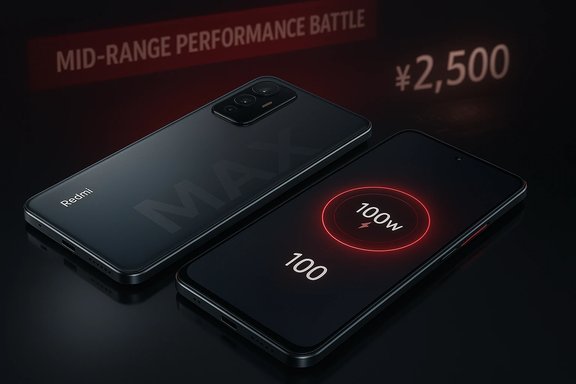
The Turbo line has evolved from budget-focused value propositions into Redmi’s performance-focused mid-range family, and the Turbo 5 generation appears aimed at seizing the 2,500-yuan (roughly $350–$380) sweet spot for buyers who want flagship-like speed without flagship prices. Official teasers describe the launch as “The 2026 mid-range performance battle,” and promotional imagery for the Max variant uses confident language — the “Max” mark visually reflects the word “WIN” in the poster, underlining Redmi’s competitive positioning. Early coverage and multiple leak-oriented outlets report the REDMI Turbo 5 lineup will include at least three variants — a base Turbo 5, a Turbo 5 Pro (or similar), and the new Turbo 5 Max — with the Max being billed as the segment’s performance and endurance champion. Pricing for the Max is placed around CNY 2,500, a positioning that explicitly targets the crowded mid-range performance tier for 2026.
Key phrases emphasized in this coverage for discoverability: REDMI Turbo 5 Max, mid-range performance, Dimensity 9500s / 9500e, CNY 2,500, POCO X8 rebrand, ultrasonic fingerprint, 100W charging, and flagship experience.
Source: GIZGUIDE REDMI Turbo 5 Max with "flagship experience" teased, to launch this January
 Background / Overview
The Turbo line has evolved from budget-focused value propositions into Redmi’s performance-focused mid-range family, and the Turbo 5 generation appears aimed at seizing the 2,500-yuan (roughly $350–$380) sweet spot for buyers who want flagship-like speed without flagship prices. Official teasers describe the launch as “The 2026 mid-range performance battle,” and promotional imagery for the Max variant uses confident language — the “Max” mark visually reflects the word “WIN” in the poster, underlining Redmi’s competitive positioning. Early coverage and multiple leak-oriented outlets report the REDMI Turbo 5 lineup will include at least three variants — a base Turbo 5, a Turbo 5 Pro (or similar), and the new Turbo 5 Max — with the Max being billed as the segment’s performance and endurance champion. Pricing for the Max is placed around CNY 2,500, a positioning that explicitly targets the crowded mid-range performance tier for 2026. What the teasers actually tell us
- Official confirmation: Redmi publicly announced that the Turbo 5 Series will be unveiled this month, and teased the Turbo 5 Max as a new model in the line.
- Messaging: the marketing tagline frames the launch as the beginning of a 2026 “mid-range performance battle,” and the poster copy stresses “Max-level performance, battery life, and flagship experience.”
- Price band: the company and early reports place the Max in the 2,500-yuan price bracket — a very competitive mid-range sweet spot globally.
Leaks, rumors, and early spec signals
Several reputable rumor sites and tipsters have filled the specification gaps with recurring claims. These are still leaks and should be treated cautiously, but the consensus points to the following likely hardware directions:Chipset and performance
- Likely chipset family: next-generation MediaTek Dimensity silicon is the expected backbone of the Turbo 5 family. Some tipsters name the Dimensity 9500s / 9500e for the Max variant, while lower Turbo models could use Dimensity 8500 or similar chips. If true, the Dimensity 9500s/e would bring a higher-end GPU and larger cache configurations into the mid-range price band.
Build and design cues
- Construction: multiple leaks point to a metal frame and a flat display with rounder corners, suggesting a premium in-hand feel rather than the softer plastic packages typical of cheaper mid-rangers.
- Biometric input: some reports say Xiaomi is testing or planning an ultrasonic in-display fingerprint on higher Turbo variants — a feature usually reserved for pricier models.
Battery and charging
- Battery: leaks suggest a very large battery compared with typical mid-range pack sizes; the Turbo 4 Pro predecessor had an oversized cell, and the Turbo 5 Max is being characterized as another endurance-first device.
- Charging: rumors point at 100W wired charging and class-leading reverse charging in some Max leaks, though exact numbers haven’t been confirmed. If accurate, that would make the Turbo 5 Max competitive on charging speeds relative to pricier phones.
Cameras and extras
- Camera module: leak chatter promises a “fully equipped” camera system on the Max, which likely means a higher-quality main sensor and flexible secondary modules (wide, ultrawide, macro/tele). Specifics — sensor names, focal lengths, or stabilization technology — are not yet verified.
International branding and market strategy
Redmi’s global strategy often involves rebranding China-market devices for other regions under the POCO label or as global Redmi models. Early reports suggest the REDMI Turbo 5 Max (and related Turbo 5 variants) could be rebadged for international markets as part of the POCO X8 family — a move consistent with Redmi’s previous cross-brand crossovers. This would let Xiaomi preserve price positioning and distribution while adapting marketing and software packages to different regions. From a channel perspective, rebranding helps Xiaomi place the same hardware into multiple retail channels without undercutting local brand strategies. It also smooths the adoption path for markets where POCO has stronger mid-range performance credentials.Critical analysis: what Redmi is promising versus what it must deliver
The teaser language is bold: “Max-level performance, battery life, and flagship experience.” To turn that into reality at the CNY 2,500 price point, Redmi will need to make tough engineering choices and likely accept trade-offs. Here’s a breakdown of strengths, necessary trade-offs, and potential risks.Strengths and plausible wins
- Competitive SoC selection could push class-leading CPU and GPU performance into a mid-range price slot. MediaTek’s Dimensity 9500-series silicon (if used) has the theoretical throughput to outmatch common mid-range chips, making Redmi’s performance claims credible on paper.
- Large battery plus fast charging is already a Redmi hallmark in Turbo/K-series devices; combining an oversized cell with 100W-class charging could deliver exceptional day-to-day usability and fast top-ups compared with rivals.
- Metal frame and premium fit-and-finish would give the Turbo 5 Max real flagship feel at mid-range pricing, raising perceived value and retail appeal.
Trade-offs Redmi will likely accept
- Display tech: offering a flat panel with rounder corners may signal cost-conscious choices for the screen (e.g., a high-quality LCD or mid-grade OLED rather than an expensive, ultra-high-refresh, peak-brightness flagship panel). Optimizing for battery life could prioritize panel efficiency over raw peak brightness.
- Thermal management: high-performance SoCs in mid-range chassis require careful thermal design. Sustained performance will depend on Redmi’s ability to manage heat without increasing weight, thickness, or fan noise — real-world sustained benchmarks will matter more than short burst scores.
- Camera tuning: a “fully equipped” camera stack is not the same as flagship-level image processing. Sensor quality, optics, ISP tuning, and computational photography software will determine whether the Max’s camera ambitions are realized. Leaks promise capability but not proven results.
Potential risks and open questions
- Chip naming ambiguity: rumors have alternately referenced Dimensity 9500s, 9500e, and other derivatives. These are different SKUs with different performance and efficiency characteristics; until Xiaomi confirms the exact SoC, performance claims remain uncertain. Treat the chipset leaks as probable but unconfirmed.
- Price vs. specs: delivering a metal frame, a large battery, a high-end chipset, ultrasonic fingerprint, and 100W charging in a 2,500-yuan package is ambitious. Xiaomi may need to trim corners in areas like display peak brightness, camera hardware, or software polish to hit that price point.
- Regional differences: Redmi often ships different SKUs and software configurations by market. The Chinese Turbo 5 Max may differ materially from any POCO-branded international variant in SoC, RAM/storage options, or LTE/5G band support. Buyers outside China should expect SKU divergence until official global SKUs are announced.
What to watch for at launch — a practical checklist
When Redmi unveils the Turbo 5 Series later this month, these are the concrete numbers and items that will determine whether the Max delivers on its promise:- Official SoC name and bench-verified performance (Dimensity 9500s / 9500e / other).
- Exact battery capacity (mAh) and official charging specs (peak wattage and supported charging protocols).
- Display type and key metrics: panel type (OLED/LCD), resolution, refresh rate, peak brightness (nits), and HDR certification.
- Build materials confirmed (metal frame? glass back? and measured weight/thickness.
- Camera sensor specifications (main sensor, OIS presence, optical zoom, ultrawide specs) and sample images from official hands-on units.
- Presence and type of in-display fingerprint sensor (ultrasonic vs optical) and biometric performance in testing.
- Regional SKU mapping and whether a POCO X8 rebrand will bring identical hardware or localized changes.
- Software baseline and update policy for flagship-like features and long-term OS/security support.
Competitive context: who the Turbo 5 Max will be up against
If Redmi lands the Turbo 5 Max at the advertised price with a high-end Dimensity chip and large battery, the phone will challenge several established mid-range and “near-flagship” devices in 2026:- Competitors using Snapdragon 7-series or re-badged 8-series silicon in the same price band.
- Value-flagship offerings from Realme, iQOO, and Honor that prioritize battery + performance.
- The POCO brand’s own mid-range portfolio, which may cannibalize or complement the Turbo line depending on global SKU choices.
The software question: will experience match hardware?
Hardware remains necessary but not sufficient. For the Turbo 5 Max to feel flagship, Redmi must deliver competent software optimization:- Thermal and power profiles tuned to extract sustained performance from the SoC without thermally throttling too quickly.
- Camera processing that leverages sensor hardware and NPU capabilities for strong computational photography outcomes.
- System stability and update cadence — buyers in this price band increasingly care about multi-year software support and timely security patches.
Conclusion — realistic expectations and purchase guidance
The REDMI Turbo 5 Max teaser marks a clear strategic push: Xiaomi wants a mid-range phone that’s perceived as a “performance champion” in the 2,500-yuan bracket. The combination of an ambitious chipset choice, large battery claims, and premium materials would, if realized, make the Turbo 5 Max a compelling option for buyers who prioritize long battery life and near-flagship performance without paying flagship prices. However, the current public information is a mix of official positioning and leak-based speculation. Key details — the exact MediaTek SKU (9500s vs 9500e), verified battery capacity, display grade, and camera hardware — remain unconfirmed and will determine whether Redmi’s “Max-level” claims are substantive or primarily marketing. Treat early chipset and charging numbers as plausible but unverified until the launch event provides full specs and independent reviews supply real-world benchmarks. Buyers should watch the official Redmi launch and third-party reviews closely. If Redmi nails the hardware-software balance and keeps pricing near CNY 2,500, the Turbo 5 Max could reshape what the mid-range performance segment looks like in 2026. Until then, the teaser is a strong signal of intent — and a promise that will need independent verification.Key phrases emphasized in this coverage for discoverability: REDMI Turbo 5 Max, mid-range performance, Dimensity 9500s / 9500e, CNY 2,500, POCO X8 rebrand, ultrasonic fingerprint, 100W charging, and flagship experience.
Source: GIZGUIDE REDMI Turbo 5 Max with "flagship experience" teased, to launch this January
