

Microsoft says Regis Aged Care has used RegiCare Assist since September 2025 across 72 Australian care facilities, where about 150 staff use the Copilot Studio and Microsoft Foundry-based assistant to summarize clinical progress reports and surface potential resident-care issues. The important part is not that Microsoft has found another place to say “agent.” It is that one of the least glamorous workflows in healthcare—reading long, repetitive, high-stakes notes—is exactly where enterprise AI may prove useful first. RegiCare Assist is a reminder that the future of AI in care is less likely to look like a robot nurse and more likely to look like a better morning handover.
The technology industry has spent the past two years trying to make “autonomous agents” sound inevitable. Much of that rhetoric has been abstract: agents that manage projects, negotiate with other agents, rewrite business processes, and relieve humans of the indignity of clicking through software. In aged care, the pitch becomes harder to inflate, because the cost of a mistake is immediately human.
That is why RegiCare Assist is interesting. Microsoft’s example is not an AI diagnosing a resident, prescribing a medication, or deciding whether a fall requires escalation. It is an assistant that reads a pile of progress notes and condenses the material into something a clinical manager can review faster.
That may sound modest, but aged care is full of modest tasks that become dangerous when volume overwhelms attention. A resident refuses medication, another reports pain, a night-shift note mentions confusion, a wound dressing is delayed, and somewhere inside dozens of pages is the pattern that matters. The clinical risk is often not that nobody documented the event. It is that the event was documented into invisibility.
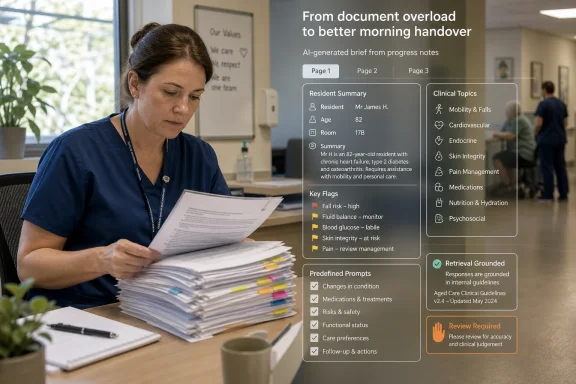
RegiCare Assist is built around that problem. According to Microsoft, the system can take large daily reports, summarize them, flag abnormalities, and organize findings by clinical topic. In one example, a 68-page 24-hour report was reduced to a three-page summary within minutes. That is not a miracle; it is compression. But compression, in the right workflow, is operationally important.
The best use of a large language model in that setting is not free-form creativity. It is constrained reading. The system is not being asked to invent a care plan from first principles; it is being asked to extract, summarize, and classify information that already exists in the organization’s own records.
That distinction matters. Generative AI is weakest when treated as an oracle and strongest when used as a language interface over bounded material. In this case, the model’s job is closer to triage than judgment: help the human find what requires attention, then get out of the way.
This is also where the “AI replaces workers” argument becomes too blunt to be useful. If a clinical manager spends less time hunting through pages and more time reviewing the right details, the labor has not vanished. It has moved from document excavation to clinical assessment. In a stretched care environment, that shift can matter even if it never appears in a flashy productivity chart.
That combination is exactly where Microsoft wants corporate AI to land. The company does not merely want employees chatting with a general-purpose assistant. It wants organizations building governed, task-specific agents connected to business data, business workflows, and business rules.
In a care setting, that governance story is not decorative. A chatbot that answers vaguely, improvises policy, or reacts differently depending on how a tired manager phrases a question is not a productivity tool. It is a liability with a friendly interface.
RegiCare Assist appears designed to narrow that surface area. Microsoft says the system uses predefined prompts and a click-based interface rather than relying entirely on open-ended user queries. That is a subtle but important design choice. It acknowledges that prompt freedom is not always empowerment; sometimes it is another way to introduce inconsistency.
RAG does not eliminate hallucination. It does not guarantee that every relevant detail is retrieved, interpreted correctly, or expressed with the right urgency. But it can reduce the risk of the model wandering into unsupported advice, and it creates a more auditable relationship between source material and output.
The crucial word is reduce. Too much AI marketing treats grounding as a magic solvent for uncertainty. It is not. It is one control among many, and in sensitive environments the stack of controls matters more than any single feature.
That is why the click-based interface is as important as the model choice. If staff are selecting from approved prompts, the organization can test those prompts, refine them, and compare outputs against expected results. The system becomes less like an open conversation and more like a governed workflow with language generation inside it.
AI systems often fail at the seam between natural language and operational reality. A person thinks they asked the obvious question. The system interprets it narrowly, or retrieves a partial set of records, or organizes the answer in a way that hides an exception. In a demo, the answer looks polished. In production, the omitted item is the thing that matters.
This is why prompt libraries, workflow templates, and controlled interactions are not bureaucratic overkill. They are part of the safety case. The more predictable the input, the more testable the output.
For IT teams, the lesson is blunt: if a system’s reliability depends on every user becoming an expert prompt writer, the system is not ready for high-stakes work. RegiCare Assist appears to recognize that problem by narrowing the user experience. That does not make it foolproof, but it moves responsibility back where it belongs: into design, testing, governance, and training.
The distinction is especially important in aged care, where context is everything. A fall note is not just a fall note. Its significance depends on the resident’s baseline mobility, medication changes, infection risk, cognition, recent incidents, family concerns, staffing notes, and clinical history.
A summary can help a manager reach the relevant facts faster. It can also flatten nuance if users become too trusting. The compressed version of a record is useful only if staff remember that it is a map, not the territory.
That is where training and culture become as important as architecture. If staff treat RegiCare Assist as a starting point, it may reduce friction. If they treat it as the record itself, it could create a new kind of blind spot. The risk in healthcare AI is rarely that the software suddenly becomes autonomous; it is that humans quietly begin deferring to it because it is faster, cleaner, and more confident than the messy source material.
Still, RegiCare Assist targets a plausible source of time recovery. Reading dozens of pages of progress notes is cognitively expensive work. It requires sustained attention, pattern recognition, and the discipline to notice a small but clinically meaningful sentence buried among routine observations.
If AI can reliably bring the highest-priority items to the top, the productivity gain is not merely minutes saved. It is attention preserved. That is a more valuable resource than time in a care environment, because tired professionals do not simply work slower; they miss things.
But this is also where evidence matters. Microsoft reports positive user feedback, and the operational story is sensible. What remains less clear is whether the system has measurably improved clinical governance, reduced missed escalations, improved follow-up speed, or changed resident outcomes. In healthcare and aged care, “users like it” is useful but not sufficient.
Care documentation is not a clean corpus. It is written by busy humans, often across shifts, under pressure, and inside systems that were not designed for literary precision. Notes may be terse, repetitive, inconsistent, or full of local shorthand. An AI system that works on pristine examples may struggle when the real data gets messy.
That does not mean the technology should be dismissed. It means evaluation has to be continuous and clinical, not just technical. The right measures are not only latency, token cost, and user adoption. They include false negatives, false positives, escalation accuracy, time-to-review, staff trust calibration, and whether managers still inspect source records when the summary looks complete.
For sysadmins and IT leaders, this is where vendor excitement collides with governance. Deploying an AI assistant is not the end of the project. It is the beginning of monitoring, feedback loops, incident review, permission audits, and revision control for prompts and knowledge sources.
That is why RegiCare Assist matters beyond Regis. Microsoft needs examples showing that Copilot-era AI can be embedded into real workflows without asking organizations to throw away their governance model. Aged care gives the company a strong narrative: understaffed environments, heavy documentation, high administrative burden, and a clear human-in-the-loop boundary.
The harder part is proving that the governance layer is not merely present but effective. AI agents introduce new questions about data access, prompt control, connector permissions, output logging, and who is allowed to build or publish what. The more Microsoft pushes low-code agent creation, the more enterprises must prevent low-code sprawl from becoming low-code risk.
In that sense, RegiCare Assist is not just a care-sector story. It is a test of Microsoft’s central claim that enterprise AI can be democratized without becoming chaotic. The claim may be true, but only if organizations treat agent governance as core infrastructure rather than an afterthought.
That creates a familiar IT pattern. A department finds a repetitive process. A vendor or systems integrator builds a workflow. The tool works well enough to spread. Then IT inherits responsibility for identity, access, data boundaries, audit trails, lifecycle management, and the inevitable “why did the AI say this?” ticket.
Copilot Studio lowers the barrier to building agents, which is both the appeal and the danger. The easier it becomes to create a workflow over sensitive data, the more important it becomes to classify which workflows deserve strict review. A care-report assistant is not the same risk category as a lunch-menu bot.
Administrators should pay attention to the design choices here: predefined prompts, grounded retrieval, limited interaction patterns, and explicit human responsibility. Those are not healthcare-specific niceties. They are the template for any department asking to put AI near regulated, confidential, or operationally critical data.
The elderly residents in a facility are not abstractions in a workflow diagram. They are people with changing conditions, communication barriers, medication profiles, and risks that may evolve overnight. The value of RegiCare Assist depends on whether it helps staff notice those changes sooner, not whether it produces elegant prose.
This is why “AI tidies up care reports” is a better description than “AI transforms care.” Tidying sounds small, but in documentation-heavy environments it may be exactly the right ambition. It also keeps the technology in its place. The assistant organizes the desk; the clinician decides what the mess means.
The industry would benefit from more of that modesty. The most dangerous AI deployments are often the ones that confuse administrative fluency with operational competence. A clean summary can feel authoritative even when it is incomplete. The countermeasure is not cynicism; it is disciplined verification.
This is where enterprise AI often becomes less magical and more like every other enterprise technology wave. The tool is only part of the system. The surrounding work—process mapping, change management, user training, testing, and support—determines whether it survives contact with daily operations.
The “missing word” prompt detail again matters here. It suggests the project involved iterative tuning rather than simple deployment. In a sensitive environment, that tuning cannot be left to vibes. It needs documented acceptance criteria and a way to detect when changes to prompts, source systems, or model behavior alter outputs.
Integrators may find a large market in exactly this kind of work. Not building grand autonomous systems, but turning narrow, high-friction business processes into governed AI-assisted workflows. It is less glamorous than the agentic future, but more likely to be paid for.
In fairness, proving care-quality improvement is difficult. Outcomes in aged care are influenced by staffing, resident acuity, facility processes, documentation quality, and many factors unrelated to software. A tool can be useful without producing an immediately clean causal metric.
Still, serious deployments should try. Did morning reviews get faster? Were more incidents escalated within target timeframes? Did managers identify patterns earlier? Did staff spend less time in the record system without sacrificing review quality? Did the assistant produce false reassurance in any cases? These are not hostile questions. They are the questions that turn a promising pilot into responsible infrastructure.
AI vendors often prefer adoption metrics because they are easier to celebrate. Healthcare organizations should insist on operational and clinical measures because they are harder to fake. The next phase of this story should be less about whether staff like the assistant and more about what changed after it became routine.
The practical lessons are concrete:
 Microsoft Finds a More Believable AI Story in the Nursing Notes
The technology industry has spent the past two years trying to make “autonomous agents” sound inevitable. Much of that rhetoric has been abstract: agents that manage projects, negotiate with other agents, rewrite business processes, and relieve humans of the indignity of clicking through software. In aged care, the pitch becomes harder to inflate, because the cost of a mistake is immediately human.That is why RegiCare Assist is interesting. Microsoft’s example is not an AI diagnosing a resident, prescribing a medication, or deciding whether a fall requires escalation. It is an assistant that reads a pile of progress notes and condenses the material into something a clinical manager can review faster.
That may sound modest, but aged care is full of modest tasks that become dangerous when volume overwhelms attention. A resident refuses medication, another reports pain, a night-shift note mentions confusion, a wound dressing is delayed, and somewhere inside dozens of pages is the pattern that matters. The clinical risk is often not that nobody documented the event. It is that the event was documented into invisibility.
RegiCare Assist is built around that problem. According to Microsoft, the system can take large daily reports, summarize them, flag abnormalities, and organize findings by clinical topic. In one example, a 68-page 24-hour report was reduced to a three-page summary within minutes. That is not a miracle; it is compression. But compression, in the right workflow, is operationally important.
The Best Enterprise AI Use Cases Are Boring on Purpose
There is a reason this case feels more credible than many AI demos. It begins with a real bottleneck, not a speculative future. Clinical nursing managers already have to review large volumes of written material, and they already have to do so under time pressure.The best use of a large language model in that setting is not free-form creativity. It is constrained reading. The system is not being asked to invent a care plan from first principles; it is being asked to extract, summarize, and classify information that already exists in the organization’s own records.
That distinction matters. Generative AI is weakest when treated as an oracle and strongest when used as a language interface over bounded material. In this case, the model’s job is closer to triage than judgment: help the human find what requires attention, then get out of the way.
This is also where the “AI replaces workers” argument becomes too blunt to be useful. If a clinical manager spends less time hunting through pages and more time reviewing the right details, the labor has not vanished. It has moved from document excavation to clinical assessment. In a stretched care environment, that shift can matter even if it never appears in a flashy productivity chart.
RegiCare Assist Shows Microsoft’s Agent Strategy at Its Most Practical
Microsoft’s technical framing puts RegiCare Assist squarely inside its broader enterprise AI strategy. Regis developed the solution with Cognizant using Microsoft Copilot Studio and Microsoft Foundry. Copilot Studio supplies the low-code agent and workflow layer; Foundry supplies the model-development and evaluation environment behind the scenes.That combination is exactly where Microsoft wants corporate AI to land. The company does not merely want employees chatting with a general-purpose assistant. It wants organizations building governed, task-specific agents connected to business data, business workflows, and business rules.
In a care setting, that governance story is not decorative. A chatbot that answers vaguely, improvises policy, or reacts differently depending on how a tired manager phrases a question is not a productivity tool. It is a liability with a friendly interface.
RegiCare Assist appears designed to narrow that surface area. Microsoft says the system uses predefined prompts and a click-based interface rather than relying entirely on open-ended user queries. That is a subtle but important design choice. It acknowledges that prompt freedom is not always empowerment; sometimes it is another way to introduce inconsistency.
Retrieval-Augmented Generation Is the Seatbelt, Not the Engine
Microsoft says the solution uses retrieval augmented generation, or RAG, grounded in Regis’ internal clinical guidelines and procedures. That phrase has become a fixture of enterprise AI marketing, but in this case it carries real weight. If a system is going to summarize care notes and highlight issues, it needs to anchor its responses in the organization’s own rules rather than a model’s statistical memory.RAG does not eliminate hallucination. It does not guarantee that every relevant detail is retrieved, interpreted correctly, or expressed with the right urgency. But it can reduce the risk of the model wandering into unsupported advice, and it creates a more auditable relationship between source material and output.
The crucial word is reduce. Too much AI marketing treats grounding as a magic solvent for uncertainty. It is not. It is one control among many, and in sensitive environments the stack of controls matters more than any single feature.
That is why the click-based interface is as important as the model choice. If staff are selecting from approved prompts, the organization can test those prompts, refine them, and compare outputs against expected results. The system becomes less like an open conversation and more like a governed workflow with language generation inside it.
The Missing Word Problem Is the Whole Problem
One of the most revealing details in Microsoft’s account is Regis’ acknowledgement that prompt engineering mattered enough that even a missing word could cause not all relevant residents to appear in an answer. That is the sort of detail that should make every administrator sit up straighter. It is also the sort of detail that makes the case study more believable.AI systems often fail at the seam between natural language and operational reality. A person thinks they asked the obvious question. The system interprets it narrowly, or retrieves a partial set of records, or organizes the answer in a way that hides an exception. In a demo, the answer looks polished. In production, the omitted item is the thing that matters.
This is why prompt libraries, workflow templates, and controlled interactions are not bureaucratic overkill. They are part of the safety case. The more predictable the input, the more testable the output.
For IT teams, the lesson is blunt: if a system’s reliability depends on every user becoming an expert prompt writer, the system is not ready for high-stakes work. RegiCare Assist appears to recognize that problem by narrowing the user experience. That does not make it foolproof, but it moves responsibility back where it belongs: into design, testing, governance, and training.
This Is Not Clinical Decision Support, and That Boundary Matters
Regis and Microsoft are careful to say the system does not replace clinical decision-making. That caveat is not a legal footnote. It is the entire operating model. The assistant may surface events, cluster them, summarize them, and make the morning review faster, but the accountable judgment remains human.The distinction is especially important in aged care, where context is everything. A fall note is not just a fall note. Its significance depends on the resident’s baseline mobility, medication changes, infection risk, cognition, recent incidents, family concerns, staffing notes, and clinical history.
A summary can help a manager reach the relevant facts faster. It can also flatten nuance if users become too trusting. The compressed version of a record is useful only if staff remember that it is a map, not the territory.
That is where training and culture become as important as architecture. If staff treat RegiCare Assist as a starting point, it may reduce friction. If they treat it as the record itself, it could create a new kind of blind spot. The risk in healthcare AI is rarely that the software suddenly becomes autonomous; it is that humans quietly begin deferring to it because it is faster, cleaner, and more confident than the messy source material.
The Real Productivity Gain Is Attention, Not Time
Microsoft’s framing emphasizes reduced time at the computer and more time with residents. That is a familiar healthcare technology promise, and it deserves some skepticism. Many digital systems have arrived promising to reduce administrative work, only to create new administrative rituals around the tool itself.Still, RegiCare Assist targets a plausible source of time recovery. Reading dozens of pages of progress notes is cognitively expensive work. It requires sustained attention, pattern recognition, and the discipline to notice a small but clinically meaningful sentence buried among routine observations.
If AI can reliably bring the highest-priority items to the top, the productivity gain is not merely minutes saved. It is attention preserved. That is a more valuable resource than time in a care environment, because tired professionals do not simply work slower; they miss things.
But this is also where evidence matters. Microsoft reports positive user feedback, and the operational story is sensible. What remains less clear is whether the system has measurably improved clinical governance, reduced missed escalations, improved follow-up speed, or changed resident outcomes. In healthcare and aged care, “users like it” is useful but not sufficient.
Care Providers Need Evidence Beyond the Happy Case Study
The next question for RegiCare Assist is not whether it can produce an impressive summary. It is whether it performs reliably across the ugly cases: ambiguous notes, incomplete documentation, contradictory entries, uncommon symptoms, temporary staff language, spelling errors, and residents with complex histories.Care documentation is not a clean corpus. It is written by busy humans, often across shifts, under pressure, and inside systems that were not designed for literary precision. Notes may be terse, repetitive, inconsistent, or full of local shorthand. An AI system that works on pristine examples may struggle when the real data gets messy.
That does not mean the technology should be dismissed. It means evaluation has to be continuous and clinical, not just technical. The right measures are not only latency, token cost, and user adoption. They include false negatives, false positives, escalation accuracy, time-to-review, staff trust calibration, and whether managers still inspect source records when the summary looks complete.
For sysadmins and IT leaders, this is where vendor excitement collides with governance. Deploying an AI assistant is not the end of the project. It is the beginning of monitoring, feedback loops, incident review, permission audits, and revision control for prompts and knowledge sources.
Microsoft’s Healthcare AI Pitch Is Really a Governance Pitch
Microsoft has an advantage in this market because many healthcare and care organizations already live inside its identity, productivity, security, and compliance ecosystem. Copilot Studio is not being sold as a standalone toy. It is part of a stack that includes Entra identity, Power Platform governance, Microsoft 365 controls, auditability, and the broader enterprise trust story.That is why RegiCare Assist matters beyond Regis. Microsoft needs examples showing that Copilot-era AI can be embedded into real workflows without asking organizations to throw away their governance model. Aged care gives the company a strong narrative: understaffed environments, heavy documentation, high administrative burden, and a clear human-in-the-loop boundary.
The harder part is proving that the governance layer is not merely present but effective. AI agents introduce new questions about data access, prompt control, connector permissions, output logging, and who is allowed to build or publish what. The more Microsoft pushes low-code agent creation, the more enterprises must prevent low-code sprawl from becoming low-code risk.
In that sense, RegiCare Assist is not just a care-sector story. It is a test of Microsoft’s central claim that enterprise AI can be democratized without becoming chaotic. The claim may be true, but only if organizations treat agent governance as core infrastructure rather than an afterthought.
The Windows Angle Is the Admin Angle
For WindowsForum readers, the practical significance is not that a care provider in Australia built a summarization agent. It is that this is the shape enterprise AI deployments are likely to take across Windows-heavy organizations. The first wave of serious adoption will not be one giant general assistant replacing a department. It will be dozens or hundreds of narrow agents inserted into existing workflows.That creates a familiar IT pattern. A department finds a repetitive process. A vendor or systems integrator builds a workflow. The tool works well enough to spread. Then IT inherits responsibility for identity, access, data boundaries, audit trails, lifecycle management, and the inevitable “why did the AI say this?” ticket.
Copilot Studio lowers the barrier to building agents, which is both the appeal and the danger. The easier it becomes to create a workflow over sensitive data, the more important it becomes to classify which workflows deserve strict review. A care-report assistant is not the same risk category as a lunch-menu bot.
Administrators should pay attention to the design choices here: predefined prompts, grounded retrieval, limited interaction patterns, and explicit human responsibility. Those are not healthcare-specific niceties. They are the template for any department asking to put AI near regulated, confidential, or operationally critical data.
Aged Care Is a Hard Place to Hide AI Weaknesses
Aged care also exposes a tension that consumer AI products can often evade. In a casual setting, an AI summary that misses a nuance is annoying. In a care setting, missed nuance can become a clinical governance problem. That changes the acceptable error rate.The elderly residents in a facility are not abstractions in a workflow diagram. They are people with changing conditions, communication barriers, medication profiles, and risks that may evolve overnight. The value of RegiCare Assist depends on whether it helps staff notice those changes sooner, not whether it produces elegant prose.
This is why “AI tidies up care reports” is a better description than “AI transforms care.” Tidying sounds small, but in documentation-heavy environments it may be exactly the right ambition. It also keeps the technology in its place. The assistant organizes the desk; the clinician decides what the mess means.
The industry would benefit from more of that modesty. The most dangerous AI deployments are often the ones that confuse administrative fluency with operational competence. A clean summary can feel authoritative even when it is incomplete. The countermeasure is not cynicism; it is disciplined verification.
The Integrator Still Matters in the Age of Agents
Cognizant’s role in the project is another useful reminder. Low-code AI platforms may reduce the amount of traditional software engineering required, but they do not erase implementation work. Someone still has to understand the workflow, the data sources, the permission model, the care policies, the user interface, and the failure modes.This is where enterprise AI often becomes less magical and more like every other enterprise technology wave. The tool is only part of the system. The surrounding work—process mapping, change management, user training, testing, and support—determines whether it survives contact with daily operations.
The “missing word” prompt detail again matters here. It suggests the project involved iterative tuning rather than simple deployment. In a sensitive environment, that tuning cannot be left to vibes. It needs documented acceptance criteria and a way to detect when changes to prompts, source systems, or model behavior alter outputs.
Integrators may find a large market in exactly this kind of work. Not building grand autonomous systems, but turning narrow, high-friction business processes into governed AI-assisted workflows. It is less glamorous than the agentic future, but more likely to be paid for.
The Unanswered Question Is Outcomes
The biggest limitation in the RegiCare Assist story is the lack of hard outcome data. Microsoft says the system is used daily by about 150 staff and points to positive feedback. That supports adoption. It does not yet prove improved care.In fairness, proving care-quality improvement is difficult. Outcomes in aged care are influenced by staffing, resident acuity, facility processes, documentation quality, and many factors unrelated to software. A tool can be useful without producing an immediately clean causal metric.
Still, serious deployments should try. Did morning reviews get faster? Were more incidents escalated within target timeframes? Did managers identify patterns earlier? Did staff spend less time in the record system without sacrificing review quality? Did the assistant produce false reassurance in any cases? These are not hostile questions. They are the questions that turn a promising pilot into responsible infrastructure.
AI vendors often prefer adoption metrics because they are easier to celebrate. Healthcare organizations should insist on operational and clinical measures because they are harder to fake. The next phase of this story should be less about whether staff like the assistant and more about what changed after it became routine.
The Lesson From Regis Is Smaller, Sharper, and More Useful Than the Hype
RegiCare Assist is not a general AI breakthrough, and that is precisely why it deserves attention. It takes a narrow workflow, applies language-model summarization to a real document burden, and wraps the system in enough structure that humans remain responsible for decisions. That is a more credible model for enterprise AI than most of the autonomous-agent theater.The practical lessons are concrete:
- The most useful AI deployments may begin with document-heavy workflows where important signals are already present but difficult to find quickly.
- A constrained interface with approved prompts can be safer than an open-ended chatbot when users are working with sensitive or regulated information.
- Retrieval-augmented generation helps ground outputs, but it should be treated as one control in a broader governance system rather than a guarantee of correctness.
- Human responsibility has to be designed into the workflow, not added later as a disclaimer.
- Adoption metrics and positive feedback are encouraging, but care-sector AI ultimately needs evidence about quality, escalation, and risk.
- IT teams should expect successful departmental agents to become governance projects the moment they touch sensitive operational data.
References
- Primary source: igor´sLAB
Published: 2026-05-20T04:50:08.192060
RegiCare Assist: Microsoft AI tidies up care reports, but does not re…
Microsoft reports on the use of RegiCare Assist at the Australian care provider Regis Aged Care.www.igorslab.de - Official source: learn.microsoft.com
Implement a zoned governance strategy - Microsoft Copilot Studio | Microsoft Learn
Establish a secure Copilot Studio environment strategy with tenant isolation, ALM processes, and advanced security features like Azure Private Link and MFA.learn.microsoft.com - Official source: adoption.microsoft.com
Microsoft Copilot Studio – Microsoft Adoption
Deliver value and employee satisfaction with our tools for Microsoft 365 Copilot Chat, Microsoft 365 Copilot, and agent deployment and adoption.www.adoption.microsoft.com - Official source: developer.microsoft.com
Microsoft 365 Copilot | Extend and Customize Copilot
Extend, enrich, and customize Microsoft Microsoft 365 Copilot. Explore Copilot extensibility options such as agents, API plugins, and Copilot connectors to expand AI-powered productivity, skills, and creativity.developer.microsoft.com - Official source: microsoft.com
Microsoft Copilot Studio | Create AI Agents
Build AI agents with Microsoft Copilot Studio. Enhance your workflows with powerful AI bots and seamless Microsoft 365 Copilot integrations.www.microsoft.com
- Official source: info.microsoft.com
Secure, Govern, and Manage Agents | Microsoft Copilot Studio
Watch this webinar to learn how to adopt AI agents while maintaining security and governance with Microsoft Copilot Studio.info.microsoft.com
- Official source: techcommunity.microsoft.com
Computer-using agents in Microsoft Copilot Studio are now generally available | Microsoft Community Hub
The next chapter of enterprise AI isn't about chatting with assistants—it's about agents that actually do the work. techcommunity.microsoft.com
- Official source: news.microsoft.com
- Related coverage: techradar.com
Experts warn Microsoft Copilot Studio agents are being hijacked to steal OAuth tokens | TechRadar
Microsoft acknowledges the risk, so users should be cautiouswww.techradar.com - Related coverage: windowscentral.com
Microsoft Copilot Wave 3 adds AI agents and E7 Frontier Suite | Windows Central
Microsoft Copilot is rolling out more agentic AI control and model support in a new subscription tier for Microsoft 365.www.windowscentral.com - Official source: cdn-dynmedia-1.microsoft.com
- Official source: microsoft.github.io
