

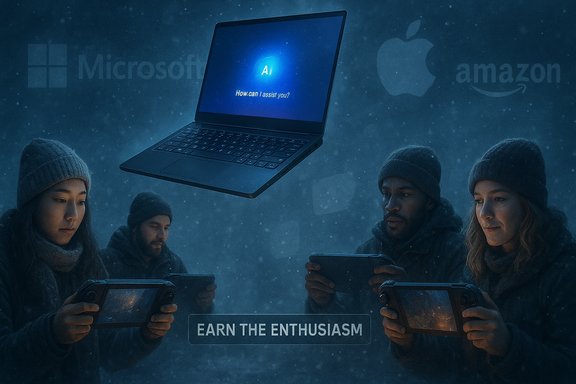
The tech industry’s holiday glow is fading into a quiet, exhausted winter: the big consumer names—Microsoft, Google, Apple, and Amazon—still ship remarkable products, but the spark of fandom that once turned early adopters into evangelists has dimmed. What remains is a mixture of fatigue, distrust, and transactional relationships: customers who buy, not ambassadors who champion. That shift matters because enthusiasm is the oxygen of ecosystem growth. In 2026 the question is no longer whether companies can build technically impressive devices, but whether they can earn genuine excitement again.
The late 2010s and early 2020s were an era when product launches created tribal followings. Enthusiasts rallied around platform narratives—mobile ecosystems, console wars, and the rise of premium ultraportables—and often acted as unpaid marketing engines. Over the last two years, however, two forces have reshaped that dynamic: an industry-wide pivot to AI-driven services and a stretch of consolidation, cost-cutting, and subscription-driven monetization. Those forces have produced technically ambitious outcomes—AI assistants baked into OSes, powerful ARM laptop silicon, new form factors—but also a cultural recoil that looks like apathy, skepticism, and, for many, weariness. This piece maps that change, explains why it matters, and identifies the companies and product categories still capable of arresting the drift.
Microsoft’s hardware remains strong: the recent Surface Pro 11 and Surface Laptop 7 show meaningful refinement in design, performance-per-watt (thanks to ARM/Qualcomm variants), and battery life, earning positive reviews. But enthusiasm has a costless currency: narrative. That narrative has frayed amid aggressive monetization and product displacements.
Restoring enthusiasm will require more than better marketing. It demands a recalibration of value: clear product benefits, honest pricing, meaningful privacy guarantees, and visible investments in creative content. Fans return when the product becomes theirs again—not merely another subscription on a credit card.
If 2026 is to feel different, the industry must stop expecting goodwill as a baseline and start earning it again, one well-built product and one protected creative ecosystem at a time.
Source: Windows Central Heading into 2026, Microsoft, Google, Apple, and Amazon feel… tired
 Background
The late 2010s and early 2020s were an era when product launches created tribal followings. Enthusiasts rallied around platform narratives—mobile ecosystems, console wars, and the rise of premium ultraportables—and often acted as unpaid marketing engines. Over the last two years, however, two forces have reshaped that dynamic: an industry-wide pivot to AI-driven services and a stretch of consolidation, cost-cutting, and subscription-driven monetization. Those forces have produced technically ambitious outcomes—AI assistants baked into OSes, powerful ARM laptop silicon, new form factors—but also a cultural recoil that looks like apathy, skepticism, and, for many, weariness. This piece maps that change, explains why it matters, and identifies the companies and product categories still capable of arresting the drift.What’s changed since the era of fans
From evangelists to subscribers
Where once fans defended product decisions and evangelized features, modern relationships have been reduced to subscriptions, renewals, and churn. The shift is subtle but consequential: an enthusiast will champion a product to friends and remain loyal through bumps; a subscriber will cut a plan when value dips. That change reflects product strategy (bundling, subscriptions, and services), economic stress on consumers, and a cultural reaction to surveillance- and ad-driven monetization models.The AI pressure test
AI has been shoved into every product announcement. The payoff is inconsistent: in some cases meaningful efficiency gains, in other cases superficial features that feel like marketing. The rush to monetize generative AI has prompted price reconfigurations across consumer services and pushed companies to reallocate capital—sometimes at the expense of creative, long-term product development.Microsoft: great devices, fraying patience
How Microsoft lost the fan narrative
Microsoft still controls a dominant platform, ships the Surface line, and runs Azure and Office—products that matter every day to hundreds of millions. Yet the company’s public persona has shifted from scrappy innovator to profit-driven aggregator. High‑profile strategic moves (big AI investments, large cloud capex, and costly acquisitions) produce tension with everyday users who increasingly see bundling, rolling subscription fees, and privacy tradeoffs rather than delight.Microsoft’s hardware remains strong: the recent Surface Pro 11 and Surface Laptop 7 show meaningful refinement in design, performance-per-watt (thanks to ARM/Qualcomm variants), and battery life, earning positive reviews. But enthusiasm has a costless currency: narrative. That narrative has frayed amid aggressive monetization and product displacements.
Copilot, privacy, and the Copilot+ PC story
Microsoft’s Copilot rollout reframed Windows as an “agent” platform. Copilot+ PCs promised on-device acceleration for generative tasks and features like “Recall.” The problem: rollout has exposed tradeoffs—privacy concerns about persistent context capture, early bugs, and feature creep that made the experience feel intrusive rather than empowering. These missteps created noise that eroded the goodwill Microsoft once enjoyed from communities like the Windows Insider program. Internal and forum analyses have pointed to the tension between novelty and governance in agent-driven desktops.Gaming: Game Pass, studio cuts, and a base of despondent fans
The Xbox story crystallizes the broader problem: service-first strategy plus cost pressure equals disappointed fans. Game Pass has been repositioned multiple times and recently re-priced in major markets, provoking subscriber backlash and cancellations. Microsoft’s restructurings and ongoing studio consolidations have led to cancellations and significant layoffs; several high-profile first-party projects and studios were paused or shut during 2025. The combined effect is an erosion of faith among core Xbox players, who now face higher subscription costs and fewer blockbuster exclusives.The other incumbents: Google, Apple, Amazon
Google: utility without glamour, and publishers squeezed
Google’s consumer products remain ubiquitous—Search, Maps, Android—but cool is a much harder claim to make. Google’s strength is technical breadth; its weakness is an optics and business-model problem. Changes in Search (AI Overviews and generative features) shifted traffic patterns and accelerated a “zero-click” dynamic that shrank referral volumes to publishers. Numerous publishers and industry groups reported steep organic declines, and legal and public pushback followed. The upshot: Google still powers much of the web’s discovery, but its platform changes have depressed the incentives for independent publishing—and that hurts the entire content ecosystem. At the same time, Google’s own consumer hardware lacks the same cachet it once sought. Android remains a dominant OS, but Android as “cool” suffers from fragmentation and OEM variability; Samsung’s foldables are among the few mobile products that can still generate sustained excitement. OEM differentiation, rather than Google’s core consumer efforts, is carrying the hardware narrative.Apple: premium polish, but limited fandom bounce-backs
Apple’s problems are subtler. Its hardware is still widely admired for fit and finish, but the company’s big spatial computing bet, the Vision Pro, landed as a demonstration of potential rather than a mass-market hit. Early production and adoption metrics put Vision Pro in the hundreds of thousands of units—impressive for a first-generation premium product, but far from mainstream adoption. Apple’s product cadence—and the slow, careful rollouts—mean the company will likely recover excitement with iterative refinements (and a rumored foldable in 2026), but the instant fandom of the iPhone era is harder to reproduce.Amazon: functionality without fandom
Amazon remains the reflexive shopping destination. Its consumer hardware lines—Echo, Fire, Kindle and others—are useful but rarely aspirational. New products sometimes ship with inventory and logistics hiccups; recent high-profile hardware launches experienced delayed fulfilment and spotty availability during high-sales periods. That pattern reinforces the perception of Amazon as utility-first rather than cult-forming. Community enthusiasm rarely coalesces into active fandom for Amazon hardware. Reddit and community reports around recent Kindle launches show shipping variability and mixed early impressions. Because those reports come from many users and not a single official source, they should be treated as observational rather than definitive.Bright spots: innovation that still excites
Even as fandom cools, there are areas generating clear excitement and meaningful product momentum.- Qualcomm and Windows on ARM: ARM-based Windows laptops have emerged as credible, efficient alternatives, with Qualcomm’s Snapdragon X series delivering strong battery life and platform-level NPUs for on-device AI. OEMs have committed multiple designs across price tiers, and reviews have begun to show competitive performance-per-watt advantages on everyday workloads. That momentum is a major hardware narrative for 2025–2026 and one of the clearest examples of product-level excitement translating into market activity.
- OEM creativity (Dell, HP, Lenovo): Partner engineering has produced interesting form factors and purpose-built devices. Lenovo’s new Legion Go 2 handheld and similar Windows-based gaming handhelds show how OEMs can innovate without relying solely on platform-level hype. These devices are resonating with enthusiasts who want new form factors and a fresh use model.
- Handheld gaming PCs: The handheld market—originally ignited by devices like Steam Deck—has matured. New entrants and second-generation devices (Lenovo Legion Go 2, ROG Ally iterations, and others) are creating a genuine sub-ecosystem where Windows-based handhelds are now viable gaming devices. These products are exciting because they represent concrete, tangible improvements in portability and performance.
Why the gap between technical excellence and fandom?
Several structural dynamics explain the paradox: the industry still produces innovation, but it no longer automatically generates evangelism.- Monetization fatigue: Consumers are sensitive to subscription creep—new recurring charges and sudden tier changes reduce the emotional ROI of adopting a platform. When services that were once “free” or low-cost get re-priced or gated, enthusiasm falls. The Game Pass restructuring and price increases provide a recent, salient example.
- Platform dependence and platform power: As platforms (Google Search, Apple App Store, Microsoft Store) exert more control over discovery and monetization, independent creators and small companies feel squeezed. The result is a thinned sense of community ownership and fewer grassroots ambassadors.
- Privacy and trust erosion: Novel features that aggregate more personal data—whether labeled “Recall,” “Personalized AI,” or “Contextual Agents”—create unease. Fans historically defended companies when benefits felt clear and privacy tradeoffs reasonable; now, fuzzy promises and opaque data practices breed suspicion.
- Consolidation and layoffs: Studio closures, staff reductions, and canceled projects do real reputational damage. They also reduce the visible creative output that fuels fandom; fewer bold, original titles and hardware experiments mean fewer reasons for communities to rally. Microsoft’s studio purges and cancellations generated a sustained, negative emotional reaction among gamers.
The risks of the “we’re just consumers now” era
- Innovation stasis: When companies prioritize predictable revenue over category-defining bets, the pace of authentically new experiences slows. Incrementalism wins short-term profitability but starves the market of “wow” moments.
- Ecosystem fragility: Publisher revenue declines caused by AI-overviews and discovery changes could hollow out independent journalism and specialized content production. That harms product ecosystems that rely on discovery-driven interest spikes.
- Regulatory and legal blowback: As platforms favor their own properties (e.g., video results or owned services), antitrust and platform-competition risk increases. Companies that rely on preferential placement may face more intense scrutiny and legal challenges.
- Talent and creativity drain: Continued layoffs and cancellations in creative divisions (games, hardware R&D, content teams) reduce long-term capability and morale, making it harder to produce the next wave of beloved products.
What companies must do to rebuild enthusiasm
- Make meaningful tradeoffs—return to product-first thinking
Prioritize user-facing experiences that feel transformational, not incremental. Product craftsmanship still matters: better battery life, clever hinge engineering, and genuinely useful AI features will produce advocates when they solve real problems. - Respect the listener—explain and protect data
Where features require personal data, clarity and user control are essential. Privacy-first implementations that are obviously in the user’s interest win trust. - Fix monetization optics
Transparent, stable pricing—paired with genuine value—lowers churn and rebuilds goodwill. Sudden tier restructuring without clear user benefit is corrosive. - Protect independent creators
Platforms should create clear revenue pathways and predictable discovery mechanics for publishers and developers. If the web’s content economy withers, every platform loses an upstream source of culture and interest. - Balance cost cuts with creative investment
Cutting studios or R&D to fund short-term priorities achieves immediate financial objectives but thins future franchise pipelines. Companies must sustain creative bets even when near-term accounting looks unattractive.
What to watch in 2026
- Will Microsoft stabilize Game Pass pricing and restore some trust through clearer value delivery and user protections? Early 2025–late 2025 changes show the company will keep experimenting with tiers and pricing—how this is communicated will determine customer sentiment.
- Can Qualcomm and OEMs translate Windows-on-ARM momentum into mainstream adoption beyond ultraportables? If ARM laptops deliver consistent real-world advantages (battery life, always-on AI), the industry could see a durable platform shake-up.
- Will publishers secure redress or new monetization arrangements in response to AI Overviews and “zero-click” search? Legal and industry responses in 2025 suggest continued friction; outcomes will shape the next decade of online publishing.
- Can Apple convert Vision Pro’s promise into a broader product line without repeating high initial price points? Iteration, content partnerships, and lower-cost form factors will be decisive.
Conclusion
The headline is uncomfortable but true: the era when major tech companies could rely on adoring fans to amplify every launch has been interrupted by business model shifts, AI-driven intermediations, and a cultural backlash against data-hungry platforms. Yet the underlying capability for engineering magic remains intact—Qualcomm and OEMs are proving it, new hardware like modern handhelds delivers genuine utility and novelty, and many companies still produce best-in-class products.Restoring enthusiasm will require more than better marketing. It demands a recalibration of value: clear product benefits, honest pricing, meaningful privacy guarantees, and visible investments in creative content. Fans return when the product becomes theirs again—not merely another subscription on a credit card.
If 2026 is to feel different, the industry must stop expecting goodwill as a baseline and start earning it again, one well-built product and one protected creative ecosystem at a time.
Source: Windows Central Heading into 2026, Microsoft, Google, Apple, and Amazon feel… tired
