

Rainbow Six Siege remains one of the most instructive examples of how a live-service shooter can survive hardware change, platform drift, and years of content churn. When Ubisoft first published the game’s PC specs in 2015, the requirements looked modest even by then-current standards, and that legacy still shapes how the title is discussed today. But the version of Siege players are talking about now is not the same game it was at launch: Ubisoft has evolved the platform, updated the launcher and storefront presentation, and recently reworked the PC-facing requirements around Windows 10/11 and DirectX 12 in its current store listings.
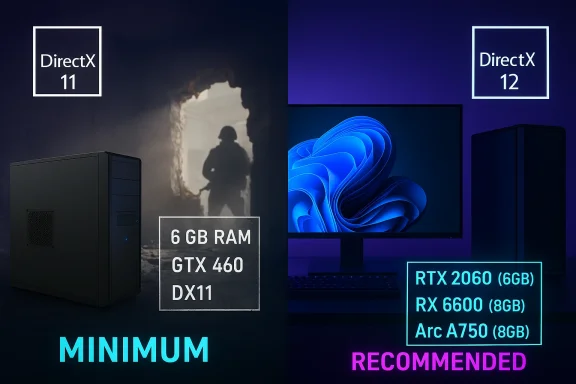
That matters because a lot of older articles still circulate with the original 2015 minimum and recommended figures, including the familiar 6 GB RAM minimum, 8 GB recommended, and 30 GB/47 GB storage targets from Ubisoft’s launch-era PC spec sheet. Today, however, Ubisoft’s store pages for Siege X list a newer baseline centered on Windows 10/11, DirectX 12, and entry-level GPUs such as the RTX 2060 6 GB, Radeon RX 6600 8 GB, or Intel Arc A750 8 GB, which is a very different message for PC buyers than the one published a decade ago.
The Dafunda write-up that has circulated online captures that tension well: it blends the legacy minimum spec with a much more contemporary operating-system framing, then adds a claim about the game’s renewed Steam momentum, saying Siege has crossed the 200,000-player mark on Steam for the first time. The hard part is that the hardware section is straightforward to verify, while the player-count claim is harder to pin down from public sources without a live concurrency tracker or a Ubisoft announcement that explicitly matchestinction is important, because old-spec articles are often technically accurate and still semantically outdated at the same time.
At a broader level, Siege is still important because it sits at the intersection of competitive esports, tactical FPS design, and long-tail monetization. Ubisoft has continued to treat the franchise as a durable service game rather than a one-and-done release, and that has kept the PC version relevant well beyond the initial 2015 launch window. In practice, that means system requirements are not just a shopping list for new players; they are also a signal about the studio’s expectations for the game’s visual baseline, anti-cheat environment, and rendering pipeline.
Rainbow Six Siege launched in 2015 as a competitive tactical shooter built around close-quarters combat, destructible environments, and asymmetric attack-defense rounds. Ubisoft’s original PC specification reflected that era’s PC hardware reality: the game was designed to be playable on relatively modest machines, with a minimum processor tier like the Intel Core i3 560 or AMD Phenom II X4 945, 6 GB of RAM, and DirectX 11-era graphics cards such as the GTX 460 or Radeon HD 5870. For its time, that was an accessible floor, and it helped Siege reach a broad audience quickly.
The appeal of the game was never about spectacle alone. Siege asked players to think in terms of information, map control, sound cues, sight lines, and utility management, and that made the technical baseline more important than in many mainstream shooters. A system that could keep frame times stable and input latency low was often more valuable than one that simply posted a high average frame rate on paper. That is why PC spec discussions around Siege tend to focus not only on “can it run?” but on “can it run cleanly enough for competitive play?”
Over time, Ubisoft has kept the game alive through seasonal updates, balance passes, map changes, modernized editions, and platform refreshes. The result is a moving target: the original 2015 spec sheet remains a historical reference, but current storefront listings now reflect a more contemporary software stack, including Windows 10/11 and DirectX 12. That transition is typical of aging live-service games, which rarely receive a single dramatic sequel-style reset; instead, they slowly accrete new assumptions about drivers, APIs, and compatible hardware.
There is also a commercial layer to this story. Ubisoft has publicly emphasized Rainbow Six Siege’s long-running player base, with past milestone posts celebrating 20 million, 25 million, and 30 million registered players over the years. Those figures are not the same as Steam concurrency, but they underline how strategically valuable the game remains to Ubisoft’s portfolio. When a publisher continues investing in a ten-year-old multiplayer game, the system requirements become part of a larger trust relationship: players want to know whether a modern PC can still join the ecosystem without a costly upgrade.
For Windows users, that matters in practical ways. A machine that barely cleared the original minimums in 2015 may still launch the game now, but it might not provide the smooth experience modern competitive players expect. Updated launcher requirements, newer drivers, and stronger GPU baselines all nudge players toward more recent hardware. The gap between “runs” and “runs well” is often where confusion begins. That distinction is easy to miss and expensive to ignore.
That baseline made sense in 2015, when the tactical shooter market still had room for a game that looked restrained but played with high fidelity in a competitive context. Ubisoft’s messaging focused on playable performance and supported GPUs, not on ultra settings or cinematic rendering. The core objective was simple: enough hardware to maintain responsiveness during rapid indoor engagements and destruction-heavy firefights.
That approach helped the game’s ecosystem thrive. Competitive multiplayer titles tend to benefit from a wide hardware footprint because more players can participate in ranked, casual, and esports-adjacent modes without needing a new PC first. For Ubisoft, this was a sensible strategic choice, especially for a franchise that depends on matchmaking population and long-term engagement.
The original storage number also deserves attention. Thirty to forty-seven gigabytes seemed respectable in 2015, but a decade of patches, new operators, new maps, and backend changes has made growth inevitable. Live-service shooters are almost never static, and Siege is no exception. Once a game starts absorbing years of content, “lightweight” becomes a historical adjective rather than a technical one.
This does not automatically mean the game has become “hard to run.” It means Ubisoft now expects a more recent PC software stack and a GPU family that reflects the modern driver ecosystem. For consumers, that translates to an easier question: not “can my old DirectX 11 card limp through Siege?” but “does my system fit the current release model?” That is a cleaner and more realistic framing for 2026.
For enterprise IT, the takeaway is different but still relevant. Organizations that standardize PC fleets for labs, events, or esports venues cannot rely on decade-old spec sheets indefinitely. If the game’s current store page is the operative reference, administrators need to check modern GPU and OS compatibility before they assign the title to any shared machine image. Old compatibility assumptions age quickly in a fast-moving multiplayer title. ([store.ubisoft.com](null noting that Ubisoft’s current store pages exist alongside legacy press materials. That creates a split reality where one source reflects the historical launch target and another reflects the present-day product. Readers should treat the current store listing as the practical reference point and the 2015 press release as the archival baseline.
This distinction matters because Steam performance figures can refer to different things: peak concurrent players, 24-hour peak, rolling averages, or all-platform user counts inferred from marketing messaging. A statement like “more than 200,000 players on Steam” may sound precise, but it can hide a lot of ambiguity if it is not tied to a timestamped measurement. For that reason, it is safer to treat the Dafunda figure as a report rather than a hard fact unless paired with a live tracker or a Ubisoft statement.
That friction is not necessarily a bad sign. In competitive PC gaming, a healthier requirement floor can improve the experience by making matchmaking and frame pacing more consistent across the player base. The trade-off is that low-end users may feel excluded when a long-standing game shifts forward technologically. Ubisoft has to balance both outcomes carefully.
A strong player count also affects the modifiable parts of the game ecosystem: queue times, anti-cheat scrutiny, content cadence, and monetization pressure. In mature shooters, success can be a double-edged sword because popular live-service games often need more aggressive backend maintenance and more frequent compatibility updates. That can raise the cost of staying current, even when the game itself remains free or broadly accessible.
That said, Siege remains far from a brute-force hardware monster compared with some modern AAA releases. The current visible requirement snippet still points to midrange graphics cards rather than top-tier flagships, which tells us Ubisoft is not trying to make the game exclusive to elite rigs. Instead, the company appears to be nudging players into a newer baseline that should preserve competitive fidelity and technical consistency.
That is especially true now that Ubisoft is clearly positioning Siege as an evolving platform rather than a frozen legacy title. If you manage a shared Windows image, you cannot treat the old Windows 7-era messaging as operational guidance. A modern image needs current drivers, supported DirectX capabilities, and compatibility validation for whatever version of Siege X is actually being distributed today.
For tournament organizers, this also means building around a more conservative compatibility standard is no longer enough. The game’s current platform expectations likely assume more recent Windows versions and newer GPU drivers, which can affect event setup and troubleshooting workflows. In practice, the cost of neglecting these details is downtime, not just performance complaints.
The upside is that a modernized baseline can reduce weird edge cases. Older hardware often creates driver-specific bugs, audio oddities, or network issues that are disproportionate in impact during ranked play. A cleaner platform target is usually better for large communities, even if some older PCs are left behind.
The interesting competitive implication is that Siege remains a “performance-first” game even as its requirements age upward. The current baseline does not indicate a bloated or overreaching engine so much as a mature service that is progressively pruning older compatibility layers. That is a common pattern for multiplayer games that want to stay relevant without building a sequel from scratch.
There is also a brand lesson here. Siege has survived because it became a platform with a recognizable identity, not because it stayed visually static. The more a game can adapt its technical foundations without breaking its community, the more likely it is to remain culturally relevant for years. That is a rare achievement in live-service gaming. (news.ubisoft.com)
For PC enthusiasts, this makes Siege a useful case study in how system requirements age. A game that once looked remarkably forgiving can slowly transform into a title that expects current-gen software assumptions while still feeling reasonable to run. That middle path is exactly where many successful competitivews.ubisoft.com]
The opportunities are real too. A refreshed baseline can make the game easier to support, easier to market, and easier to position for returning players who want a current Windows experience without buying a flagship GPU. If Ubisoft continues to manage the transition carefully, the game can keep broad appeal while reducing compatibility noise.
There is also the risk that a stronger technical baseline will quietly exclude people running older but still functional PCs. Even if the game remains relatively modest by modern shooter standards, the move away from legacy platforms can still feel abrupt to budget-conscious players. Ubisoft will need to manage that carefully if it wants to preserve goodwill.
What to watch next is less about a dramatic hardware leap and more about how Ubisoft communicates the transition. Clear spec pages, updated launcher messaging, and transparent performance guidance will matter more than flashy marketing language. Players do not just want to know that Siege is alive; they want to know that the version they install will behave predictably on their machine.
Source: Dafunda.com https://dafunda.com/en/games/rainbow-six-siege-system-requirements-pc/
That matters because a lot of older articles still circulate with the original 2015 minimum and recommended figures, including the familiar 6 GB RAM minimum, 8 GB recommended, and 30 GB/47 GB storage targets from Ubisoft’s launch-era PC spec sheet. Today, however, Ubisoft’s store pages for Siege X list a newer baseline centered on Windows 10/11, DirectX 12, and entry-level GPUs such as the RTX 2060 6 GB, Radeon RX 6600 8 GB, or Intel Arc A750 8 GB, which is a very different message for PC buyers than the one published a decade ago.
The Dafunda write-up that has circulated online captures that tension well: it blends the legacy minimum spec with a much more contemporary operating-system framing, then adds a claim about the game’s renewed Steam momentum, saying Siege has crossed the 200,000-player mark on Steam for the first time. The hard part is that the hardware section is straightforward to verify, while the player-count claim is harder to pin down from public sources without a live concurrency tracker or a Ubisoft announcement that explicitly matchestinction is important, because old-spec articles are often technically accurate and still semantically outdated at the same time.
At a broader level, Siege is still important because it sits at the intersection of competitive esports, tactical FPS design, and long-tail monetization. Ubisoft has continued to treat the franchise as a durable service game rather than a one-and-done release, and that has kept the PC version relevant well beyond the initial 2015 launch window. In practice, that means system requirements are not just a shopping list for new players; they are also a signal about the studio’s expectations for the game’s visual baseline, anti-cheat environment, and rendering pipeline.
 Overview
Rainbow Six Siege launched in 2015 as a competitive tactical shooter built around close-quarters combat, destructible environments, and asymmetric attack-defense rounds. Ubisoft’s original PC specification reflected that era’s PC hardware reality: the game was designed to be playable on relatively modest machines, with a minimum processor tier like the Intel Core i3 560 or AMD Phenom II X4 945, 6 GB of RAM, and DirectX 11-era graphics cards such as the GTX 460 or Radeon HD 5870. For its time, that was an accessible floor, and it helped Siege reach a broad audience quickly.The appeal of the game was never about spectacle alone. Siege asked players to think in terms of information, map control, sound cues, sight lines, and utility management, and that made the technical baseline more important than in many mainstream shooters. A system that could keep frame times stable and input latency low was often more valuable than one that simply posted a high average frame rate on paper. That is why PC spec discussions around Siege tend to focus not only on “can it run?” but on “can it run cleanly enough for competitive play?”
Over time, Ubisoft has kept the game alive through seasonal updates, balance passes, map changes, modernized editions, and platform refreshes. The result is a moving target: the original 2015 spec sheet remains a historical reference, but current storefront listings now reflect a more contemporary software stack, including Windows 10/11 and DirectX 12. That transition is typical of aging live-service games, which rarely receive a single dramatic sequel-style reset; instead, they slowly accrete new assumptions about drivers, APIs, and compatible hardware.
There is also a commercial layer to this story. Ubisoft has publicly emphasized Rainbow Six Siege’s long-running player base, with past milestone posts celebrating 20 million, 25 million, and 30 million registered players over the years. Those figures are not the same as Steam concurrency, but they underline how strategically valuable the game remains to Ubisoft’s portfolio. When a publisher continues investing in a ten-year-old multiplayer game, the system requirements become part of a larger trust relationship: players want to know whether a modern PC can still join the ecosystem without a costly upgrade.
Why old specs still matter
Legacy requirements still shape search traffic because many players first encounter Siege through older guides and forum posts. Those articles often remain indexed and highly visible, even when the store page has moved on. That creates a subtle but real problem: a user may think they are reading current advice when they are actually reading launch-era data.For Windows users, that matters in practical ways. A machine that barely cleared the original minimums in 2015 may still launch the game now, but it might not provide the smooth experience modern competitive players expect. Updated launcher requirements, newer drivers, and stronger GPU baselines all nudge players toward more recent hardware. The gap between “runs” and “runs well” is often where confusion begins. That distinction is easy to miss and expensive to ignore.
The Original PC Baseline
Ubisoft’s launch-era PC spec sheet for Rainbow Six Siege was deliberately approachable. The minimum CPU recommendation of an Intel Core i3 560 or AMD Phenom II X4 945, paired with 6 GB RAM and a GTX 460 or Radeon HD 5870, signaled that this was meant to be a broadly accessible shooter rather than an ultra-high-end showcase. Storage was also modest by modern standards: 30 GB minimum and 47 GB recommended.That baseline made sense in 2015, when the tactical shooter market still had room for a game that looked restrained but played with high fidelity in a competitive context. Ubisoft’s messaging focused on playable performance and supported GPUs, not on ultra settings or cinematic rendering. The core objective was simple: enough hardware to maintain responsiveness during rapid indoor engagements and destruction-heavy firefights.
What the launch specs told players
The early spec table implied a game optimized for stability rather than extravagance. A 6 GB memory floor and DirectX 11 support were ordinary enough to reassure mainstream PC buyers, while the recommended CPU and GPU values suggested the game would benefit from a more serious gaming rig. In other words, Siege was positioned as friendly to midrange machines but still willing to reward better hardware.That approach helped the game’s ecosystem thrive. Competitive multiplayer titles tend to benefit from a wide hardware footprint because more players can participate in ranked, casual, and esports-adjacent modes without needing a new PC first. For Ubisoft, this was a sensible strategic choice, especially for a franchise that depends on matchmaking population and long-term engagement.
The original storage number also deserves attention. Thirty to forty-seven gigabytes seemed respectable in 2015, but a decade of patches, new operators, new maps, and backend changes has made growth inevitable. Live-service shooters are almost never static, and Siege is no exception. Once a game starts absorbing years of content, “lightweight” becomes a historical adjective rather than a technical one.
What the Current Store Pages Say
Ubisoft’s current store listings for Rainbow Six Siege X tell a more modern story. Instead of the old Windows 7/8.1/10 framing, the store now emphasizes Windows 10/11 and DirectX 12, and it names entry-level contemporary cards such as the RTX 2060 6 GB, RX 6600 8 GB, and Intel Arc A750 8 GB in the visible requirement snippet. That is a meaningful shift in tone, even if the exact full table is presented in storefront formatting rather than a classic spec article.This does not automatically mean the game has become “hard to run.” It means Ubisoft now expects a more recent PC software stack and a GPU family that reflects the modern driver ecosystem. For consumers, that translates to an easier question: not “can my old DirectX 11 card limp through Siege?” but “does my system fit the current release model?” That is a cleaner and more realistic framing for 2026.
Why the API shift matters
The move to DirectX 12 is more than a line item. DX12 tends to imply a newer rendering architecture, modern GPU driver support, and different optimization priorities than a legacy DX11 title. In a live-service shooter, that can affect CPU scheduling, frametime consistency, and how the game scales across devices with very different core counts. (store.ubisoft.com)For enterprise IT, the takeaway is different but still relevant. Organizations that standardize PC fleets for labs, events, or esports venues cannot rely on decade-old spec sheets indefinitely. If the game’s current store page is the operative reference, administrators need to check modern GPU and OS compatibility before they assign the title to any shared machine image. Old compatibility assumptions age quickly in a fast-moving multiplayer title. ([store.ubisoft.com](null noting that Ubisoft’s current store pages exist alongside legacy press materials. That creates a split reality where one source reflects the historical launch target and another reflects the present-day product. Readers should treat the current store listing as the practical reference point and the 2015 press release as the archival baseline.
The Steam Popularity Story
The Dafunda summary says Rainbow Six Siege has recently crossed 200,000 Steam players and entered a top-10 most-played range on the platform. That claim is plausible in spirit, given Siege’s long-running popularity and Ubisoft’s continued investment, but it is not something that can be cleanly confirmed from the sources available here. What can be confirmed is that Ubisoft continues to promote the franchise heavily and has recently published a fresh live-service cadence for Siege on its official site.This distinction matters because Steam performance figures can refer to different things: peak concurrent players, 24-hour peak, rolling averages, or all-platform user counts inferred from marketing messaging. A statement like “more than 200,000 players on Steam” may sound precise, but it can hide a lot of ambiguity if it is not tied to a timestamped measurement. For that reason, it is safer to treat the Dafunda figure as a report rather than a hard fact unless paired with a live tracker or a Ubisoft statement.
Why player growth changes the hardware conversation
When a live-service game gets a surge in visibility, hardware demand becomes a broader issue than individual launch-day buyers. Returning players may be running older PCs, and new players arriving through social momentum may not realize the current build expects a newer operating system and a more recent GPU baseline. A popular game can therefore create hardware friction at exactly the moment it becomes easiest to recommend socially.That friction is not necessarily a bad sign. In competitive PC gaming, a healthier requirement floor can improve the experience by making matchmaking and frame pacing more consistent across the player base. The trade-off is that low-end users may feel excluded when a long-standing game shifts forward technologically. Ubisoft has to balance both outcomes carefully.
A strong player count also affects the modifiable parts of the game ecosystem: queue times, anti-cheat scrutiny, content cadence, and monetization pressure. In mature shooters, success can be a double-edged sword because popular live-service games often need more aggressive backend maintenance and more frequent compatibility updates. That can raise the cost of staying current, even when the game itself remains free or broadly accessible.
Consumer Impact: Can Your PC Still Run It?
For consumers, the first question is whether an older gaming PC can still handle Siege comfortably. If a machine was built around the original 2015 minimum spec, the honest answer is usually maybe, but not at the standard a modern competitive player would want. The current store-facing requirement language suggests Ubisoft now expects a more recent CPU, OS, and GPU combination than the original spec sheet did.That said, Siege remains far from a brute-force hardware monster compared with some modern AAA releases. The current visible requirement snippet still points to midrange graphics cards rather than top-tier flagships, which tells us Ubisoft is not trying to make the game exclusive to elite rigs. Instead, the company appears to be nudging players into a newer baseline that should preserve competitive fidelity and technical consistency.
Practical upgrade advice
If you are checking a current Windows PC, the most important questions are straightforward. Do you have Windows 10 or 11? Do you have a GPU that fits the modern release baseline? Do you have enough free space for the installation and future patches? Those practical checks matter more than the nostalgia of the original 2015 minimums.- Confirm your OS is current enough for the store listing.
- Check whether your GPU is on the modern baseline rather than the old launch-era one.
- Make sure you have enough free SSD space for the current install and updates.
- Update drivers before expecting stable matchmaking or competitive performance.
- Test frame pacing, not just average FPS, because Siege rewards consistency.
Enterprise and Community Implications
Although Rainbow Six Siege is mainly a consumer game, its longevity gives it unusual relevance to enterprise environments as well. Internet cafés, esports venues, LAN centers, and managed gaming labs need spec clarity more than casual buyers do, because they often maintain standardized hardware images. The shift from a 2015 spec sheet to a 2026 storefront baseline means those environments should revisit their fleet assumptions.That is especially true now that Ubisoft is clearly positioning Siege as an evolving platform rather than a frozen legacy title. If you manage a shared Windows image, you cannot treat the old Windows 7-era messaging as operational guidance. A modern image needs current drivers, supported DirectX capabilities, and compatibility validation for whatever version of Siege X is actually being distributed today.
Competitive infrastructure matters
Competitive communities are sensitive to any hardware change because the smallest difference can affect perceived fairness. If one group of players runs the game on old-spec hardware and another runs on updated midrange cards, the experience gap can turn into a gameplay gap. That is why system requirements are more than consumer advice; they are part of the game’s competitive design.For tournament organizers, this also means building around a more conservative compatibility standard is no longer enough. The game’s current platform expectations likely assume more recent Windows versions and newer GPU drivers, which can affect event setup and troubleshooting workflows. In practice, the cost of neglecting these details is downtime, not just performance complaints.
The upside is that a modernized baseline can reduce weird edge cases. Older hardware often creates driver-specific bugs, audio oddities, or network issues that are disproportionate in impact during ranked play. A cleaner platform target is usually better for large communities, even if some older PCs are left behind.
How Siege Compares with Modern PC Shooters
Rainbow Six Siege occupies a different lane from the latest photorealistic shooters that chase ray tracing and giant install sizes. Its endurance comes from systems depth, not sheer audiovisual excess. That is why it can keep a relatively moderate system footprint while still demanding a modern OS and a reliable graphics stack.The interesting competitive implication is that Siege remains a “performance-first” game even as its requirements age upward. The current baseline does not indicate a bloated or overreaching engine so much as a mature service that is progressively pruning older compatibility layers. That is a common pattern for multiplayer games that want to stay relevant without building a sequel from scratch.
What rivals should notice
Other shooters should notice how Ubisoft handles this transition. Rather than make a hard public break from old hardware all at once, Ubisoft appears to be allowing the game’s public-facing identity to evolve through store pages, edition naming, and platform messaging. That lowers the friction of modernization and keeps the player conversation focused on playability rather than abandonment.There is also a brand lesson here. Siege has survived because it became a platform with a recognizable identity, not because it stayed visually static. The more a game can adapt its technical foundations without breaking its community, the more likely it is to remain culturally relevant for years. That is a rare achievement in live-service gaming. (news.ubisoft.com)
For PC enthusiasts, this makes Siege a useful case study in how system requirements age. A game that once looked remarkably forgiving can slowly transform into a title that expects current-gen software assumptions while still feeling reasonable to run. That middle path is exactly where many successful competitivews.ubisoft.com]
Strengths and Opportunities
The biggest strength of Rainbow Six Siege is that it has remained relevant long after most competitive shooters would have faded. Ubisoft has kept the franchise alive through persistent updates, and the current store pages show that the company is still aligning the product with modern PC expectations. That gives Siege a rare combination of heritage and technical momentum.The opportunities are real too. A refreshed baseline can make the game easier to support, easier to market, and easier to position for returning players who want a current Windows experience without buying a flagship GPU. If Ubisoft continues to manage the transition carefully, the game can keep broad appeal while reducing compatibility noise.
- Modern OS support improves compatibility with current Windows builds.
- Midrange GPU targets keep the game accessible to a large audience.
- Long-term live-service support helps the franchise stay vi
- Competitive depth continues to differentiate Siege from flashy rivals.
- Platform modernization should reduce old-driver and legacy-OS issues.
- Cross-generation relevance keeps the community large enough for healthy matchmaking.
Risks and Concerns
The main risk is confusion. Readers who land on older articles may assume the 2015 requirements are still sufficient, while current store pages now point to a newer baseline. That mismatch can lead to bad purchasing decisions, frustrated upgrades, or a false sense of compatibility.There is also the risk that a stronger technical baseline will quietly exclude people running older but still functional PCs. Even if the game remains relatively modest by modern shooter standards, the move away from legacy platforms can still feel abrupt to budget-conscious players. Ubisoft will need to manage that carefully if it wants to preserve goodwill.
- Outdated guides may mislead players about current requirements.
- Legacy hardware may no longer meet the practical baseline for a smooth experience.
- Launch-era storage figures can understate how much space the modern build needs.
- Player-count claims can be overstated without clear measurement definitions.
- Platform fragmentation may complicate support for organizers and community hosts.
- Performance expectations can diverge sharply between minimum and practical competitive settings.
Looking Ahead
Rainbow Six Siege looks set to remain a significant part of Ubisoft’s catalog, not because it is the newest shooter on the market but because it has become one of the company’s most durable competitive services. The current requirement language suggests a game that is still accessible, still evolving, and still being tuned for a modern Windows ecosystem. That is a good sign for continuity, even if it raises the floor for some older PCs.What to watch next is less about a dramatic hardware leap and more about how Ubisoft communicates the transition. Clear spec pages, updated launcher messaging, and transparent performance guidance will matter more than flashy marketing language. Players do not just want to know that Siege is alive; they want to know that the version they install will behave predictably on their machine.
- Updated store specs may continue to replace older references across regional storefronts.
- Steam concurrency trends will be worth tracking alongside Ubisoft’s own messaging.
- Driver and OS guidance may become more central as the game’s baseline modernizes.
- Community reception will show whether players accept the higher compatibility floor.
Source: Dafunda.com https://dafunda.com/en/games/rainbow-six-siege-system-requirements-pc/
