

Relativity’s investment in generative AI for legal data intelligence is a study in disciplined product engineering: the company built Relativity aiR on a Microsoft Azure foundation to accelerate e‑discovery and investigations while prioritizing defensibility, auditability, and enterprise trust. The result is a platform that couples modern generative models with document‑centric evidence plumbing—citation‑level grounding, human‑in‑the‑loop validation, and tenant‑bound security controls—so law firms, corporations, and public agencies can scale review without trading away compliance or provenance. This article explains how Relativity engineered that balance on Azure, verifies core technical claims, evaluates business impact, and highlights the operational tradeoffs enterprises must manage when adopting AI for legal data intelligence.
Relativity built its cloud offering, RelativityOne, on Microsoft Azure and increasingly integrates Azure OpenAI and other Azure cognitive services to power generative features under the Relativity aiR brand. The partnership with Microsoft is explicit: Relativity leverages Azure OpenAI for language modeling, Azure cognitive features (such as translation and PII detection) for document enrichment, and the broader Azure compliance and regional presence to meet legal and regulatory requirements. Microsoft’s customer narrative and Relativity’s product materials both emphasize that the platform is designed to produce reviewable, evidence‑backed outputs rather than opaque model responses—an essential distinction in legal contexts. Relativity’s public statements and press releases quantify adoption and impact: since aiR’s introduction, customers have used the suite to process tens of millions of documents in thousands of matters, and early case examples report large reductions in review time and cost. Those figures are vendor‑reported and should be validated in pilots, but they are consistent with independent industry reporting that shows Azure‑hosted document understanding tooling can materially cut manual extraction time when paired with rigorous review processes.
Defensibility: When every model decision links to a specific document citation or excerpt, attorneys can reproduce the analysis and defend it under discovery obligations.
Scalability: Azure’s global footprint and managed model hosting provide the throughput and regional controls law firms and corporations require when handling cross‑border matters.
Security posture: Combining Azure’s compliance posture with Relativity’s security controls forms a layered defense that aligns with legal and government customer expectations.
Adopting AI for legal data intelligence is not a binary choice between speed and defensibility; it is an operational discipline. When implemented with a governance‑first posture, a defensible AI system like Relativity aiR can materially accelerate discovery, reduce repetitive labor, and surface insights that would otherwise be buried in millions of documents—so long as organizations plan for the people, processes, and contractual guardrails required to sustain trustworthy outcomes.
Key takeaways
Source: Microsoft https://www.microsoft.com/en/customers/story/25991-relativity-azure-openai-in-foundry-models]
 Background
Relativity built its cloud offering, RelativityOne, on Microsoft Azure and increasingly integrates Azure OpenAI and other Azure cognitive services to power generative features under the Relativity aiR brand. The partnership with Microsoft is explicit: Relativity leverages Azure OpenAI for language modeling, Azure cognitive features (such as translation and PII detection) for document enrichment, and the broader Azure compliance and regional presence to meet legal and regulatory requirements. Microsoft’s customer narrative and Relativity’s product materials both emphasize that the platform is designed to produce reviewable, evidence‑backed outputs rather than opaque model responses—an essential distinction in legal contexts. Relativity’s public statements and press releases quantify adoption and impact: since aiR’s introduction, customers have used the suite to process tens of millions of documents in thousands of matters, and early case examples report large reductions in review time and cost. Those figures are vendor‑reported and should be validated in pilots, but they are consistent with independent industry reporting that shows Azure‑hosted document understanding tooling can materially cut manual extraction time when paired with rigorous review processes. How Relativity framed the problem: legal data intelligence at scale
Legal teams face a unique set of constraints that shape any AI solution:- Extremely large volumes of unstructured documents spanning email, PDFs, images, chats, and native files.
- High stakes for accuracy and provenance: every extracted fact may be inspected in discovery or at trial.
- Strict privacy, confidentiality, and regulatory boundaries requiring tenant separation, auditable controls, and in‑region processing options.
- A workflow model that requires human judgment—AI must assist attorneys, not replace them.
Architectural foundations on Azure
Relativity’s technical choices reflect common enterprise patterns for trustworthy AI: a governed data plane, model hosting in a controlled cloud tenancy, evidence‑preserving extraction, and identity‑centric access control. The core Azure components and architectural patterns used include:- Azure OpenAI Service: Host language models and provide inference for generative features (Relativity reports GPT‑4 was the foundation for early language model work). Model inference is orchestrated so that tenant data and prompts remain within RelativityOne and Azure control planes.
- Azure Cognitive Services: Used for document processing utilities such as translation, PII detection, and image OCR to create structured inputs for downstream workflows.
- Secure cloud tenancy on Microsoft Azure: Regionally distributed Azure data centers and Microsoft’s compliance certifications are part of Relativity’s trust narrative; Relativity combines that with its own security operations to monitor and protect customer environments.
- Retrieval‑Augmented Generation (RAG) patterns: Document indexing and vectorization feed model prompts with curated, high‑quality context to minimize hallucinations and ground model outputs in evidence.
- Human‑in‑the‑loop validation and auditing: All model outputs include citations or bounding boxes pointing to source documents so reviewers can verify and correct results.
- Tenant isolation and access control: Identity and access management are bound to organizational policies so AI operations respect client‑level separation and legal hold constraints.
Why these choices matter for legal workflows
Grounding: Feeding the model with curated evidence sets reduces hallucination and increases the chance that a natural‑language rationale can be traced back to a document snippet.Defensibility: When every model decision links to a specific document citation or excerpt, attorneys can reproduce the analysis and defend it under discovery obligations.
Scalability: Azure’s global footprint and managed model hosting provide the throughput and regional controls law firms and corporations require when handling cross‑border matters.
Security posture: Combining Azure’s compliance posture with Relativity’s security controls forms a layered defense that aligns with legal and government customer expectations.
Relativity aiR: product design and defensibility-first features
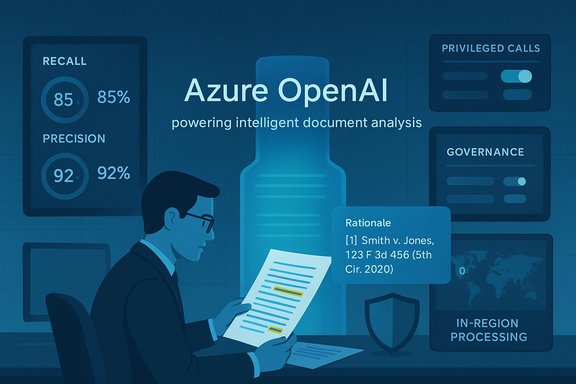
Relativity engineered aiR to be fit‑for‑purpose in legal review with several core product design principles:- Evidence‑first explanations: aiR annotates each prediction with document‑level citations and natural‑language rationales so reviewers can confirm why the model made a call. This explicit provenance is central to making AI outputs auditable and defensible in court or compliance settings.
- Human‑in‑the‑loop controls: Attorneys set parameters, validate sample outputs, and remain the final arbiter for privilege calls and critical legal determinations—aiR is positioned as an assistive tool rather than an autonomous decision‑maker.
- Measurement and continuous validation: Relativity’s applied science teams test models on matter‑specific data and provide tooling to measure recall, precision, and elusion—metrics common in e‑discovery quality assurance. These KPIs feed ongoing model refinements and deployment gating.
- Integration with Relativity workflows: aiR’s outputs (predictions, rationales, and citations) are embedded directly into RelativityOne review workflows, enabling reviewers to act on insights without leaving the platform. This reduces friction and preserves audit trails.
Verifying technical claims and adoption metrics
Key vendor claims require verification from independent or cross‑referenced sources. The most load‑bearing claims and how they are corroborated:- Claim: aiR uses Azure OpenAI (GPT‑4 foundation) for language understanding. Verified by Microsoft’s customer story and Relativity product pages, both of which explicitly state that Relativity leverages Azure OpenAI for aiR features. These are two independent corporate sources—Relativity (product pages/press) and Microsoft (customer case story)—that describe the same integration.
- Claim: Significant reductions in review time and cost (e.g., vendor statements of 20–40% average savings, and customer examples like 85% reduction). These figures appear in Relativity’s marketing materials and press releases; PRNewswire and Relativity customer quotes provide concrete examples (Purpose Legal, Troutman Pepper, etc.. These are vendor‑sourced case outcomes; independent verification would require client‑side audits or third‑party case studies, so treat headline percentages as indicative but vendor‑reported until validated externally.
- Claim: Evidence‑linked, auditable rationales reduce hallucination risk. Relativity documents the feature design and Microsoft’s customer narrative highlights defensibility; independent analyst commentary on Azure Document Intelligence and RAG patterns supports the premise that provenance and grounding materially reduce hallucination risk when implemented correctly. This is a technology‑level claim supported by vendor design and broader platform analyses, but the effectiveness depends heavily on dataset curation and review processes.
Operationalizing aiR in practice: workflow and controls
Deploying generative AI into legal review requires operational discipline. Relativity’s documented approach maps to a typical governance‑first rollout:- Data triage and curation: Identify the matter’s canonical dataset and remove extraneous or sensitive records that are out of scope for model consumption.
- Sample validation: Run aiR on a representative sample and measure recall/precision; surface disagreements for manual review and annotate corrections.
- Human review gating: Put thresholds and human verification steps in place—e.g., require human approval for privilege calls or high‑risk categories.
- Logging and retention: Ensure all AI prompts, model outputs, and reviewer decisions are logged and retained according to legal hold and evidentiary standards.
- Periodic red‑teaming: Simulate adversarial prompts and injection attacks to validate model robustness and data exfiltration protections.
Business impact: what legal teams gain (and the limits)
Relativity and partner case studies report several measurable business benefits:- Faster first‑pass review: aiR automates prioritization and early relevance calls, shortening the time to first meaningful insights.
- Cost reduction in reviewer hours: Vendors report large reductions in manual review effort for routine categories and privilege screening.
- Increased throughput: Some deployments report multi‑million document processing capabilities with high daily throughput.
- Improved small‑team capability: Small review teams can handle larger matters when AI surfaces likely positives and reduces repetitive triage.
- Model accuracy varies by corpus: Domain‑specific language, obscure formats, and scanned images with poor OCR quality reduce effectiveness.
- Human validation remains essential: Privilege and strategic case decisions still require legal judgment, and courts will expect defensible review practices.
- Cost and licensing: High model inference volumes create meaningful Azure consumption and licensing considerations that must be budgeted and monitored.
Risks, mitigations, and governance — critical analysis
Relativity’s approach addresses many risk vectors by design, but risks remain and deserve scrutiny:- Hallucination and over‑trust: Even with grounding, models can infer or over‑generalize. Mitigation: require document citations, present confidence scores, and enforce reviewer gates for risky outputs. Relativity surfaces natural‑language rationales with explicit citations to reduce this risk.
- Data residency and regulatory risk: Cross‑border matters raise data sovereignty concerns. Mitigation: choose RelativityOne instances in appropriate regions, use Azure’s regional controls, and validate data‑flow diagrams in contracts. Relativity and Microsoft both highlight regional availability and Azure compliance baselines as part of their trust messaging.
- Vendor concentration and lock‑in: Relying on Azure OpenAI and a single cloud tenancy has procurement and exit implications. Mitigation: insist on clear portability options for exports, retain canonical evidence sets outside model hosting surfaces, and negotiate SLAs and data export commitments in contracts.
- Cost predictability: High inference and vector search volumes can escalate cloud bills. Mitigation: run consumption modeling, use quotas and throttles, and adopt reserved capacities where available.
- Model lifecycle and drift: Legal language and document types evolve; models can drift. Mitigation: implement continuous monitoring, periodic retraining or revalidation on fresh matter types, and version controls tied to audit records.
Practical checklist for legal teams evaluating Relativity aiR on Azure
- Define the scope: Which matter types and document classes will be in scope? What are the evidentiary and regulatory requirements?
- Insist on provenance: Require that the system provides document‑level citations, and test that reviewers can jump from prediction to source with minimal friction.
- Pilot with metrics: Run a controlled pilot measuring recall, precision, reviewer time saved, and disagreement rates. Validate vendor claims against matter‑specific baselines.
- Validate security and residency: Confirm the RelativityOne instance location, encryption-at-rest/transit, and logging/retention policies match compliance needs.
- Contractual SLAs: Negotiate data portability, retention of logs for legal hold, and clauses addressing model updates and performance regressions.
- Cost modeling: Include inference, storage, vector indexing, and human validation labor in total cost‑of‑ownership calculations.
- Establish governance: Designate a legal‑tech owner, define human review thresholds, and schedule periodic red‑team tests and audits.
Where Relativity’s approach stands in the legal tech landscape
Relativity’s combination of enterprise‑grade cloud hygiene, evidence‑centric model outputs, and integrated review workflows places it among the leading vendors trying to move generative AI from experiment to production in legal environments. The company’s strategy—embed Azure OpenAI for language capabilities, add Azure cognitive preprocessing, and layer defensibility controls—tracks closely with best‑practice architectures described by cloud providers and enterprise partners. Independent press coverage and Relativity’s own press releases show accelerating adoption, regional rollouts, and commitments to make aiR capabilities standard in RelativityOne offerings—moves that signal both product confidence and a bet on rapid market demand.Conclusion: measured acceleration, not a free pass
Relativity’s engineering of aiR on Azure demonstrates a pragmatic and governance‑oriented path for bringing generative AI into legal workflows. By anchoring model outputs to document evidence, insisting on human oversight, and leveraging Azure’s compliance and regional capabilities, Relativity has built a solution that addresses the core enterprise concerns of trust, traceability, and scale. Vendor claims around time and cost savings are promising and consistent with customer anecdotes, but they remain vendor‑reported metrics that every purchaser should validate with matter‑specific pilots and contractual protections.Adopting AI for legal data intelligence is not a binary choice between speed and defensibility; it is an operational discipline. When implemented with a governance‑first posture, a defensible AI system like Relativity aiR can materially accelerate discovery, reduce repetitive labor, and surface insights that would otherwise be buried in millions of documents—so long as organizations plan for the people, processes, and contractual guardrails required to sustain trustworthy outcomes.
Key takeaways
- Relativity aiR pairs Azure OpenAI and Azure cognitive services with evidence‑oriented workflows to deliver generative AI designed for legal defensibility.
- Core strengths: document‑level provenance, integrated review workflows, regional hosting options, and a governance focus that suits regulated legal environments.
- Primary risks: vendor‑reported performance claims need independent validation, model drift and hallucination still require human oversight, and cloud consumption must be budgeted and controlled.
- Recommended approach: run scoped pilots, insist on provenance and logging, codify human review thresholds, and negotiate data portability and SLA terms into contracts.
Source: Microsoft https://www.microsoft.com/en/customers/story/25991-relativity-azure-openai-in-foundry-models]
