

Reltio’s announcement that it has earned the Microsoft Azure Certified Software designation marks a practical milestone in the vendor’s long-running Azure strategy and signals a new convenience vector for enterprises that want governed, real-time data to feed analytics and AI agents running on Azure. tps://www.ad-hoc-news.de/news/marktberichte/reltio-achieves-microsoft-azure-certification-accelerating-trusted-data/68604192)
Reltio, a cloud-native vendor best known for its Reltio Data Cloud and master-data / context-intelligence capabilities, has been available on the Microsoft Azure Marketplace for several years. The company’s recent certification announcement reiterates that availability while adding a formal Microsoft-backed validation of technical interoperability, security posture, and marketplace readiness. Reltio positions the certification as an endorsement for customers seeking to unify data estates and supply AI agents with trusted, near-real-time context—claims the company has been building toward through its Microsoft Fabric and Purview integrations.
Microsoft’s certified-software designations are not decorative badges; they are the result of a structured audit and marketplace review process that evaluates technical interoperability, customer success metrics, and marketplace readiness. The program is explicitly intended to increase discoverability on Microsoft Marketplace, enable closer collaboration with Microsoft sellers, and unlock commercial pathways such as co-sell and Azure-native procurement benefits.
Operational checklist for procurement teams:
That said, certification is not a substitute for customer-specific validation. Security controls, data residency rules, governance SLAs, and large-scale performance need to be tested in your environment. Procurement teams should also validate MACC eligibility for the exact Marketplace offer and follow Microsoft’s purchase guidance to ensure accounting benefits are realized.
If your organization is building AI agents, analytics products, or governance-first master-data programs on Azure, Reltio’s certified presence on Marketplace and its directly supported Fabric integration are worthy of evaluation—starting with a scoped pilot that follows the checklist above. The certification smooths many paths, but it does not eliminate the need for the standard enterprise due diligence that every cloud procurement and integration project requires.
Source: HPCwire Reltio Achieves Microsoft Azure Certification - BigDATAwire
 Background
Reltio, a cloud-native vendor best known for its Reltio Data Cloud and master-data / context-intelligence capabilities, has been available on the Microsoft Azure Marketplace for several years. The company’s recent certification announcement reiterates that availability while adding a formal Microsoft-backed validation of technical interoperability, security posture, and marketplace readiness. Reltio positions the certification as an endorsement for customers seeking to unify data estates and supply AI agents with trusted, near-real-time context—claims the company has been building toward through its Microsoft Fabric and Purview integrations.Microsoft’s certified-software designations are not decorative badges; they are the result of a structured audit and marketplace review process that evaluates technical interoperability, customer success metrics, and marketplace readiness. The program is explicitly intended to increase discoverability on Microsoft Marketplace, enable closer collaboration with Microsoft sellers, and unlock commercial pathways such as co-sell and Azure-native procurement benefits.
Why this certification matters — the practical angle for IT buyers
This certification matters for three operational reasons:- Procurement simplicity: Certified Marketplace offers are easier to buy through the Azure portal and, when eligible, can be counted toward a customer’s Microsoft Azure Consumption Commitment (MACC). That can materially affect budgeting and procurement windows for large enterprises.
- Seller and marketplace visibility: Microsoft’s certified-software pathway is explicitly designed to increase a vendor’s visibility to Microsoft field sellers and to facilitate co-sell engagement and go-to-market support. That often shortens procurement cycles and can bring additional pre-sales resources.
- Technical validation: The certification means Reltio passed a technical review that touches on reliability, security, and interoperability with Azure services—important signals for enterprises that require platform alignment as part of their compliance or architecture guardrails.
What Reltio Data Cloud brings to Azure customers
Reltio Data Cloud is built to provide unified, governed, context-rich data across domains (customers, products, suppliers, interactions) with an emphasis on real-time availability and AI-readiness. Key product attributes Reltio highlights include:- Real-time data unification and entity resolution for master data.
- AI-native pipelines that create context-rich, flattened schemas for analytics and agents.
- Governance and lineage features that integrate with enterprise data governance tooling.
- Enterprise-grade security controls and multi-tenant SaaS operational practices.
Zero-copy integration: what it is, and why it matters
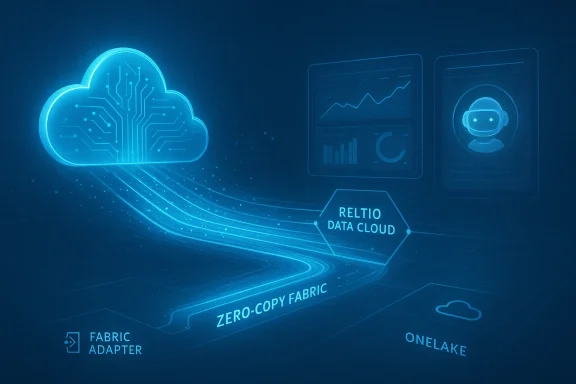
The “zero-copy” model Reltio advertises uses Fabric External Data Share / OneLake patterns to make Reltio-managed datasets available in Fabric without physically duplicating or shuttling them into a separate warehouse. For analytics and AI teams, the advantages are:- Reduced data duplication and storage costs.
- Up-to-date, governance-aware datasets downstream for analytics and Copilot/agent workloads.
- Lower ETL maintenance and fewer synchronization errors to troubleshoot.
The Microsoft side: what “Certified Software for Azure” actually validates
Microsoft’s certified-software pathway examines three broad areas:- Technical interoperability and architecture: Is the solution compatible with Azure services and reference architectures?
- Marketplace readiness and commercial evidence: Is the offer transactable in Microsoft Marketplace and does it show customer success or marketplace traction?
- Customer success and operational reliability: Are there references, case studies, and measurable outcomes showing the solution runs at scale and delivers value?
Procurement and accounting: MACC, Marketplace, and what enterprises should check
Reltio’s announcement explicitly calls out the Azure Marketplace and MACC as buyer advantages: when customers buy Reltio through the Marketplace and meet the eligibility criteria, the purchase can decrement their Microsoft Azure Consumption Commitment (MACC), easing budget alignment and shortening procurement friction. This is a genuine operational benefit for enterprises with committed Azure spend.Operational checklist for procurement teams:
- Confirm the specific Reltio Marketplace offer is labeled Azure benefit eligible for MACC contribution.
- Purchase through the Azure portal or follow the Microsoft guidance that ensures the transaction decrements MACC (purchases via direct credit-card checkout may not).
- Verify deployment footprints and licensing model (SaaS subscription, private offer, BYOL options) and whether the Marketplace purchase covers ents.
- Coordinate with your Microsoft account team to confirm any co-sell or Marketplace incentives that might be available to the buyer or the vendor.
Enterprise use cases — where Reltio + Azure certification is most immediately useful
Reltio’s strengths align with several high-value enterprise patterns that Azure customers commonly pursue:- AI agents and Copilot scenarios: When agents require a trusted, real-time context (customer lifetime profile, product master, supplier status), Reltio’s unified data and zero-copy Fabric feed can reduce stale or conflicting inputs to generative systems. This lowers hallucination risk and improves decision relevance.
- Regulated industries (life sciences, financial services): Reltio’s emphasis on governance, lineage, and Purview integration can help organizations demonstrate who accessed which datasets and why—a major compliance need in healthcare and financial workflows. However, certification does not replace legal or industry-specific compliance validation.
- Customer 360 and omnichannel personalization: Real-time entity resolution plus low-latency access in Fabric enables analytics teams to build dashboards and models without contending with multi-hour ETL windows.
- Supplier and product data management for manufacturing and retail: Unified master data prevents costly procurement and supply-chain errors and enables faster analytics-driven inventory decisions.
Critical analysis — strengths, but also important caveats
Notable strengths
- Practical platform alignment: Certification plus native Fabric integration materially reduces the friction of putting governed master data in front of analytics and Copilot-like agents. Reltio’s zero-copy approach is a pragmatic answer to the age-old sync problem between operational master-data systems and analytics lakes.
- Procurement upside for Azure-first shops: Marketplace availability and MACC eligibility remove some legal and invoice complexity while improving visibility to Microsoft sellers—useful for large enterprise deals.
- Governance-aware design: Integration with Microsoft Purview (or similar governance tooling) helps organizations centralize lineage and policy enforcement—especially important for regulated industries.
Important risks and limitations
- Certification is not a silver bullet for compliance: The Microsoft certified-software designation validates architecture and marketplace readiness; it does not certify a product for every industry regulation or a customer’s unique data residency requirements. Customers in tightly regulated sectors must still perform their due diligence (SaaS data residency, encryption-at-rest/transport specifics, and auditability).
- Potential for increased Azure dependency: Zero-copy on Fabric and deep Purview integration improves convenience but deepens operational dependency on Microsoft’s analytics stack. Organizations should weigh the technical benefits against any strategic desire to remain cloud-agnostic.
- MACC complexity and accounting traps: Counting a purchase against MACC requires specific purchase flows and eligibility. Misunderstanding these rules can lead to unmet commitments and shortfall liabilities. Procurement teams must verify the exact offer terms; assumptions that “all Marketplace buys count” are dangerous.
- Operational visibility required for cross-tenant sharing: Zero-copy sharing uses mechanisms that create cross-service dependencies. Organizations must ensure proper identity federation, least-privilege access, and monitoring across tenants/workspaces to avoid unintended data exposure.
- Performance and scale testing still required: Certification audits technical architecture but enterprise-scale SLAs and end-to-end performance for specific workloads still require customer validation—especially in global, multi-region deployments.
How IT teams should evaluate Reltio post-certification
If your organization is considering Reltio Data Cloud now that it is Azure-certified, use this recommended evaluation checklist:- Confirm Marketplace Offer Details
- Ensure the specific Reltio offer is Azure benefit eligible if you intend to count the purchase toward MACC.
- Map Data Residency and Compliance Requirements
- Validate where Reltio will store PII or regulated data and whether that meets your legal/regulatory needs. Certification does not automatically solve data sovereignty constraints.
- Architect for Identity and Least Privilege
- Design Entra ID (Azure AD) integration, managed identities, and RBAC rules that limit dateltio and Fabric contexts.
- Run Performance and Scale Tests
- Execute realistic simulations of entity resolution, high-throughput event streams, and zero-copy consumers (analytics jobs, agents) to test latency and throughput.
- Trial Governance Flows
- Validate Purview lineage propagation and how governance metadata accompanies data into Fabric workspaces. Ensure data access reviews and DSAR processes run end-to-end.
- Align Commercial Terms
- Reconcile SaaS entitlements, private-offer customizations, and MACC accounting with procurement and finance teams. Double-check whether credits/promotions affect MACC eligibility.
Implementation patterns and a short deployment roadmap
The following numbered roadmap is a practical template for teams that want to pilot Reltio in an Azure environment while taking advantage of the Marketplace and Fabric integration.- Provision a non-prod tenant and subscribe to the Reltio Marketplace offer via the Azure portal, confirming Azure benefit eligibility for MACC if required.
- Connect Reltio to your Azure Entra ID for SSO, and implement conditional access and MFA for administrative roles.
- Configure a zero-copy Fabric share to a test OneLake workspace and deploy a small analytic pipeline to consume delta tables. Validate schema, latency, and governance tags.
- Integrate Reltio metadata lineage with Microsoft Purview; run governance reports to confirm end-to-end lineage visibility.
- Conduct user acceptance and security testing, including simulated DSAR and role-based access requests.
- Review commercial and billing flows with procurement, enabling the production subscription only after these checks are complete.
Where this fits into the broader Azure ecosystem strategy
Microsoft has been actively encouraging ISVs to certify their solutions and publish transactable offers in Marketplace to increase the proportion of partner-led commerce happening inside Azure. Certified software designations provide an amplification effect—improved discoverability, marketplace exposure, and possible co-sell enablement—that can materially accelerate adoption for well-architected SaaS vendors. Reltio’s certification, combined with its Fabric zero-copy integration, places it squarely in the path of organizations that want tightly integrated data foundations for Copilot-style agents, analytics, and real-time operational apps.Final assessment: what to expect and how to proceed
Reltio’s Azure Certified Software designation is a meaningful, verifiable signal that the vendor has met Microsoft’s technical and marketplace readiness gates. For Azure-centric enterprises, the practical benefits—simpler procurement, potential MACC credit, and smoother technical integration with Fabric and Purview—are real and potentially valuable.That said, certification is not a substitute for customer-specific validation. Security controls, data residency rules, governance SLAs, and large-scale performance need to be tested in your environment. Procurement teams should also validate MACC eligibility for the exact Marketplace offer and follow Microsoft’s purchase guidance to ensure accounting benefits are realized.
If your organization is building AI agents, analytics products, or governance-first master-data programs on Azure, Reltio’s certified presence on Marketplace and its directly supported Fabric integration are worthy of evaluation—starting with a scoped pilot that follows the checklist above. The certification smooths many paths, but it does not eliminate the need for the standard enterprise due diligence that every cloud procurement and integration project requires.
Source: HPCwire Reltio Achieves Microsoft Azure Certification - BigDATAwire
