

Microsoft’s decision to end free support for Windows 10 on October 14, 2025 created an immediate policy and practical crisis — and community repair groups stepped into the breach, turning International Repair Day into a national and global campaign to keep functioning machines in use rather than in landfill. The U.S. Public Interest Research Group (PIRG) ran a series of “Fix‑a‑thon” events that recruited volunteers, refurbished hardware, and reimaged machines with alternative, actively maintained operating systems; those events alone rescued more than a hundred laptops and provided a replicable model for communities, school districts, and civic organizations scrambling to avoid unnecessary e‑waste and security risk.
Microsoft’s official lifecycle pages state plainly that Windows 10 reached end of support on October 14, 2025, after which Home and Pro consumers no longer receive routine security or feature updates unless they enroll in the company’s consumer Extended Security Updates (ESU) pathway. The company frames ESU as a temporary, security‑only bridge intended to give households and small organizations time to migrate to Windows 11 or replace devices. The platform shift matters because Windows 11 enforces hardware gates — notably TPM 2.0, UEFI Secure Boot and a list of supported CPU generations — that exclude a significant portion of still‑serviceable Windows 10 machines from an in‑place upgrade. That technical reality, combined with Microsoft’s time‑boxed ESU option, created a narrow window of choices for users: pay or enroll for temporary ESU coverage, accept a cloud‑tethered route, buy new hardware, or look for alternatives that preserve a device’s usefulness. At scale this decision risks environmental and equity harms. The Open Repair Alliance tracked Repair Day activity and reported thousands of community events in 2025, underlining a global surge of local responses to software‑driven obsolescence. That spike is not just symbolic: it shows communities mobilizing to keep devices in service while the policy debate continues.
Advocates are asking for:
But repair events are an emergency kit, not a long‑term policy fix. The bigger problem remains structural: software lifecycles that outpace hardware lifetimes, gated upgrades that exclude large installed bases, and vendor‑driven migration economics that shift cost to users. Durable solutions require vendor commitments to longer servicing windows, regulatory frameworks that treat software servicing as part of product durability, and clearer point‑of‑sale disclosures. Community repair and policy change must proceed in parallel.
Source: PIRG As Windows 10 tech support ends, PIRG organizers rescue laptops across the country
 Background
Microsoft’s official lifecycle pages state plainly that Windows 10 reached end of support on October 14, 2025, after which Home and Pro consumers no longer receive routine security or feature updates unless they enroll in the company’s consumer Extended Security Updates (ESU) pathway. The company frames ESU as a temporary, security‑only bridge intended to give households and small organizations time to migrate to Windows 11 or replace devices. The platform shift matters because Windows 11 enforces hardware gates — notably TPM 2.0, UEFI Secure Boot and a list of supported CPU generations — that exclude a significant portion of still‑serviceable Windows 10 machines from an in‑place upgrade. That technical reality, combined with Microsoft’s time‑boxed ESU option, created a narrow window of choices for users: pay or enroll for temporary ESU coverage, accept a cloud‑tethered route, buy new hardware, or look for alternatives that preserve a device’s usefulness. At scale this decision risks environmental and equity harms. The Open Repair Alliance tracked Repair Day activity and reported thousands of community events in 2025, underlining a global surge of local responses to software‑driven obsolescence. That spike is not just symbolic: it shows communities mobilizing to keep devices in service while the policy debate continues. What PIRG’s Fix‑a‑thons did — a factual summary
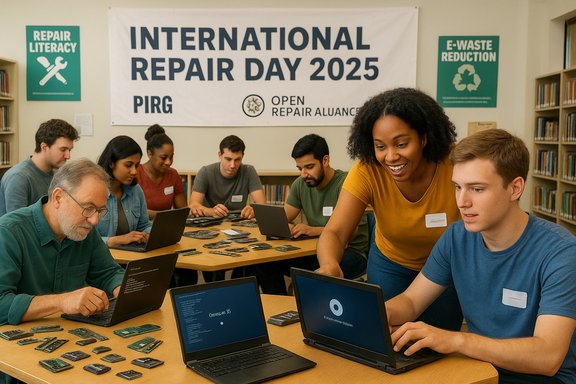
PIRG’s Right to Repair team organized Fix‑a‑thon events on and around International Repair Day (October 18, 2025) to salvage Windows 10 computers that would otherwise be left unsupported. Their public report and event materials show:- 64 volunteers across six U.S. cities (New York; Boston; Cambridge, MA; Worcester, MA; Madison, WI; and Chicago).
- 103 computers rescued through diagnostics, light hardware repair (battery swaps, SSD/RAM upgrades), and OS reimages to actively maintained alternatives (ChromeOS Flex, mainstream Linux distributions such as Ubuntu and Linux Mint).
- Most refurbished machines slated for donation to youth organizations, libraries and community nonprofits.
Why these Fix‑a‑thons mattered — security, equity, and environmental arguments
Security: immediate mitigation of a patching cliff
An unsupported operating system becomes an increasingly attractive target for attackers as new vulnerabilities are discovered and not patched. Microsoft’s ESU provides a one‑year security‑only path through October 13, 2026 for eligible devices, but that path requires enrollment and — for local accounts or some configurations — account linkage or payment mechanics that create friction. Reimaging to a maintained OS (ChromeOS Flex or supported Linux distributions) reintroduces ongoing vendor/security updates without the ESU constraints. For many users and institutions, that is the safest long‑term option.Equity: protecting low‑income households and public access
Libraries, community centers, after‑school programs and small nonprofits often run on tight budgets and donated hardware. For these organizations, paying for ESU or buying new Windows 11‑capable devices is not trivial. Community refurb events preserve the value of donated hardware and route working computers to organizations that serve digitally marginalized populations. PIRG’s donations to youth and nonprofit partners are a direct application of this principle.Environment: practical e‑waste avoidance
Manufacturing and disposing of new devices carries significant carbon and toxic‑waste costs. Repair and reuse delay the embodied emissions of a device and keep hazardous materials out of informal recycling streams. Estimates of the potential e‑waste created by wholesale device turnover vary widely and rely on modeling assumptions, so such numbers should be treated as directional rather than precise — but they clearly point to a large environmental footprint if replacement were the default outcome. Community refurb events directly reduce that near‑term replacement pressure.The technical toolkit: realistic OS and hardware choices for rescued machines
Community technicians at PIRG and partner events used a small set of proven strategies to bring Windows 10 machines back into secure, usable service. Each choice has trade‑offs in compatibility, maintenance burden, and user experience.- ChromeOS Flex — the low‑maintenance, cloud‑centric option: Google’s ChromeOS Flex can convert many x86 PCs and Macs into ChromeOS‑style endpoints, supporting automatic updates, fast boot and simple provisioning. Google publishes a certified‑models list and per‑model end‑of‑support timelines; non‑certified machines may run but risk reduced functionality. ChromeOS Flex is particularly attractive for shared/public devices and basic productivity use.
- Linux distributions (Ubuntu, Linux Mint, Xubuntu/Lubuntu) — flexible and long‑lived: Mainstream distributions such as Ubuntu LTS releases and Linux Mint offer long security update windows, a familiar desktop experience, and an extensive driver ecosystem. Lightweight spins (Xubuntu, Lubuntu) make older hardware feel responsive. Linux allows offline package management, local user accounts and granular control, but may require occasional community troubleshooting for proprietary drivers.
- Retaining Windows with ESU — a stopgap: ESU keeps machines on a security‑patching path for up to one year (consumer ESU availability through October 13, 2026), but the enrollment paths and account linkage requirements make it more of a temporary bridge than a long‑term default. ESU does not include feature updates or full technical support.
- Swap a slow HDD for a small SSD and upgrade to 8 GB RAM when possible — these two changes often make older devices feel significantly faster and more serviceable for web‑centric workflows.
How PIRG ran Fix‑a‑thons — a replicable operational checklist
PIRG’s events followed a repeatable flow that any community group or civic IT team can replicate. The steps below are distilled from PIRG event notes and common repair‑clinic best practices.- Triage and intake: basic health checks (battery, storage SMART, memory), document device model and owner consent.
- Data hygiene: perform secure data backups and verified data erasure for donated devices; capture donor consent and chain‑of‑custody logs.
- Live trial: boot candidate OSes from USB (ChromeOS Flex trial mode, Linux live USB) to confirm hardware compatibility before committing to installs.
- Repair and upgrades: replace failed components, install SSDs and additional RAM where benefit/cost justify; clean and de‑dust thermal channels.
- OS install and testing: deploy the chosen OS image, install updates and drivers, run a short acceptance test including Wi‑Fi, audio, webcam and peripherals.
- Recipient orientation and follow‑up: include simple orientation materials, recovery media, and a 30–90 day local support window to handle initial issues.
- Diagnostics/repair technicians (component swaps), reimaging operators (media preparation and deployments), user coaches (setup, account orientation), and logistics/data‑security managers (consent forms and wipe verification). These tasks map well to volunteers with basic IT literacy.
Strengths and immediate impact of PIRG’s approach
- Rapid local action: Fix‑a‑thons convert at‑risk hardware into useful devices within hours or days, providing an immediate counter to a policy‑driven replacement cycle. PIRG’s reported 103 rescued units are a concrete example of that rapid benefit.
- Community capacity building: Events teach volunteers and recipients repair literacy and simple device maintenance, building local resilience and reducing future support load.
- Targeted equity outcomes: By channeling refurbished machines to youth groups and nonprofits, the events prioritize those most harmed by the end‑of‑support decision.
- Environmental gains: Immediate reuse delays manufacturing emissions and keeps devices out of informal disposal streams — a practical, low‑cost climate and pollution mitigation.
Limits, risks, and the things Fix‑a‑thons cannot fix
While effective, community refurbishment is a mitigation — not a systemic cure.- Scale mismatch: Fix‑a‑thons operate on human time and spare parts; they can save hundreds or thousands locally but cannot match the global scale of installed Windows 10 devices at risk. Systemic vendor policy changes or regulation are still required for a durable outcome.
- Security trade‑offs: Alternative OS installs bring ongoing updates but may require occasional manual driver fixes and local maintenance. Recipients and hosting organizations must plan for patch management and support.
- Application compatibility: Industry‑specific Windows‑only software (legacy lab tools, specialized education software) may not run on Linux or ChromeOS Flex. Dual‑boot preserves functionality but leaves an unsupported Windows partition in place and therefore retains risk.
- Data and liability: Improper data erasure, poor documentation or inadequate consent protocols can expose events to privacy and legal risk. Events must adopt repeatable IT asset disposition standards and verification.
- Unverifiable environmental projections: Large e‑waste figures quoted during advocacy are often model‑based and sensitive to replacement and recycling assumptions. Use such numbers to understand scale and urgency, not as precise accounting.
Policy implications and the case for structural change
PIRG’s Fix‑a‑thons and the global Repair Day surge make two interrelated points clear: repair capacity matters right now, and software lifecycle policy belongs squarely on the public‑policy agenda.Advocates are asking for:
- Longer minimum software support windows aligned with typical hardware lifetimes, disclosed at point of sale. Consumers deserve clear, comparable information about how long a device will remain supported.
- Better firmware/driver pathways that allow legitimate upgrades (for example, enabling TPM/firmware updates where hardware physically supports it) rather than gating upgrades behind new silicon alone.
- Regulatory fixes that fold software servicing into ecodesign and repairability standards so that vendors account for the lifetime security of devices, not just initial hardware reliability.
How communities and institutions should plan now — an actionable playbook
- Inventory and prioritize: capture model, RAM, storage, firmware/TPM status and Windows build (22H2 required for ESU eligibility).
- Triage candidates for reimage vs. replacement: prefer SSD‑equipped or upgradable machines for refurbishment.
- Run live trials: always test ChromeOS Flex or a Linux live USB before installing.
- Stock a parts pool: SSDs, 8 GB RAM modules and common connector cables are the highest leverage parts.
- Standardize data wiping and consent: adopt an ITAD checklist and provide receipts to donors and recipients.
- Build follow‑up support windows: offer a 30–90 day local support helpline for recipients to reduce returns and increase success.
Final assessment — what worked, what still needs to change
PIRG’s Fix‑a‑thons are a strong, community‑level example of turning advocacy into action: volunteers, simple parts, and modern alternative OSes can convert vulnerable Windows 10 machines into safe, useful computers for schools and nonprofits. The events reduced immediate security risk, delivered tangible donations, and taught repair literacy to volunteers and recipients.But repair events are an emergency kit, not a long‑term policy fix. The bigger problem remains structural: software lifecycles that outpace hardware lifetimes, gated upgrades that exclude large installed bases, and vendor‑driven migration economics that shift cost to users. Durable solutions require vendor commitments to longer servicing windows, regulatory frameworks that treat software servicing as part of product durability, and clearer point‑of‑sale disclosures. Community repair and policy change must proceed in parallel.
Conclusion
The October 14, 2025 end of free Windows 10 support was a predictable milestone that nonetheless produced a sharp, immediate pain point for millions of users. PIRG’s Fix‑a‑thons transformed that pain into practical action — rescuing machines, routing them to community partners, and building repair capacity. Those events demonstrate the power and limits of grassroots repair: they serve as a practical stopgap that protects security, inclusion and the environment, while also underscoring that systemic policy changes are necessary to prevent the next mass‑obsolescence moment. The work that began on Repair Day shows how much can be done with volunteers and a modest parts pool — and it also clarifies what regulators and platform owners must still fix to make repair the rule, not the exception.Source: PIRG As Windows 10 tech support ends, PIRG organizers rescue laptops across the country
