

Replit’s December updates strip another layer of friction from turning ideas into live software: a free Starter Plan with daily Agent credits, a deep ChatGPT integration that lets you build apps inside conversations, and a set of Agent improvements—most notably Agent 3 and a new Fast mode—that push Replit from assisted editing toward genuinely autonomous app creation. These changes are not marketing vapor: Replit’s product blog and documentation lay out the mechanics, and independent coverage and user reporting confirm both the promise and the trade-offs that Windows developers and IT teams need to weigh.
Replit’s platform has been evolving rapidly from a cloud-based code editor into a full AI-first development environment. Over 2025 the company moved aggressively into agentic development—AI systems that can plan, build, test, and iterate—culminating in three related advances late in the year:
However, the new world of agentic development shifts risk from “writing code” to “validating agent outputs.” The most likely practical workflow for Windows teams in the near term is hybrid: use ChatGPT + Replit to iterate prototypes quickly, then bring the results into standard engineering pipelines for security, testing, and production hardening. Guardrails—billing alerts, secret management, and code review—are not optional when agents are allowed to make multi-file edits and to create or wire up third‑party connectors.
For hands-on testing, start with the free Starter Plan, try the @replit flow in a controlled ChatGPT thread, and evaluate Fast Mode for UI/UX tweaks. Keep rigorous review practices and independent testing in place before any public or production deployment. The future Replit is selling—software creation at the speed of conversation—is arriving fast; the sensible play is to embrace the productivity gains while formalizing the controls that make agentic workflows safe for teams and enterprise use.
Conclusion
Replit’s December product set stitches together a credible road toward agent-driven app creation: an accessible Starter Plan for experimentation, a ChatGPT integration that collapses ideation and build cycles, and agent upgrades that materially increase autonomy and speed. These are significant technical and UX advances that will accelerate prototyping and democratize app building—but the technology is not magic. Successful adoption on Windows and in enterprise environments will require disciplined governance, careful billing controls, and robust human-in-the-loop validation to convert those fast experiments into reliable, secure production systems.
Source: QUASA Connect Replit's AI Revolution: Free Starter Plan, ChatGPT App Building, and Agent Upgrades Make Coding Effortless
 Background / Overview
Replit’s platform has been evolving rapidly from a cloud-based code editor into a full AI-first development environment. Over 2025 the company moved aggressively into agentic development—AI systems that can plan, build, test, and iterate—culminating in three related advances late in the year:- A free Starter Plan that gives newcomers daily AI Agent credits and one free published app, lowering the entry barrier for AI-assisted building.
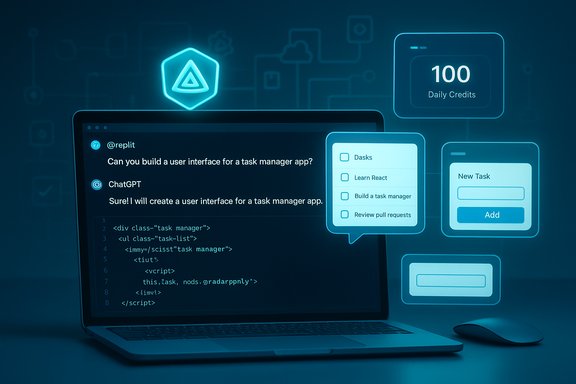
- A Replit integration with ChatGPT that lets you tag @replit inside a ChatGPT conversation to create, preview, and update a Replit app without leaving the chat.
- Platform-level Agent upgrades—including Agent 3 with extended autonomous runtime and a new Fast mode for rapid, scoped edits—designed to make prototyping and automation dramatically faster.
What’s in the Starter Plan (and what it actually lets you build)
The headline features
Replit’s Starter Plan is explicitly positioned as an onramp for learners and experimenters. Key bullet points in the official docs include:- Daily Agent credits that reset every day (with a monthly cap on credit usage). These credits are intended to let you try Replit Agent features without immediate payment.
- One free published app (public) available from Starter plan accounts; published deployments may be subject to refresh/expiration rules noted in deployment docs.
- Access to a basic Build/Design mode and the ability to create public Repls (projects), plus community support and the Design/Build flow that powers fast prototyping.
What to expect in practice (compute, limits, and ambiguities)
The documentation and product pages are consistent about daily credits and the single free published app, but some non-official summaries and comparison pages show slight variations in compute allowances (for example, Starter cited as offering 0.5 vCPU or similar small shared compute). Those data points are common in third‑party pricing comparisons, but the authoritative source remains Replit’s own pricing and docs pages—always check the platform UI for the live numbers attached to your account. If your app needs predictable, private compute you’ll likely outgrow Starter and want Core or Teams.- Practical impact: Starter is excellent for tutorials, classroom projects, prototypes, and MVPs intended for public testing. It is not a guaranteed production environment for sustained traffic or private apps.
ChatGPT + Replit: building apps inside a conversation
How the integration works
Replit’s new ChatGPT App integration is designed to make ChatGPT a true build surface. The flow is simple:- Connect Replit in ChatGPT’s Apps & Connectors settings (OAuth).
- In any ChatGPT conversation where the Replit app is enabled, start a message with @replit and describe the app you want.
- Replit Agent will bootstrap a working app in that conversation: you get a live preview, can ask for tweaks, and eventually open the app in Replit to continue developing or publish it.
Why this matters for Windows devs and teams
- Less context switching: design, prompts, code, preview, and initial deployment all happen in the same conversation thread. That streamlines ideation-to-prototype cycles.
- Collaboration-ready outputs: the app created in ChatGPT lives in your Replit account; the same workspace can later be opened, edited, and extended by collaborators.
- Governance & billing: because the work consumes Replit Agent credits, teams must tie ChatGPT-built work to Replit accounts governed by their billing and policy rules. Admins need to validate connector policies before enabling the integration broadly.
Practical limits and gotchas
- The ChatGPT integration creates or modifies the app associated with that conversation—if you want multiple independent apps you must use separate chat threads or manage apps from Replit directly.
- Some advanced Replit features (private databases, certain connectors, always‑on deployments) require paid plans—Starter’s free credits cover experimentation, not scale.
Agent 3: the autonomous backbone (what Replit claims, and what independent coverage says)
The claim set
Replit’s Agent 3—launched in September and refined since—is framed as a large step up in autonomy and self-validation. Notable product claims include:- Longer autonomous runtime: Agent 3 can run autonomously for up to 200 minutes (over three hours) in extended modes, allowing longer unattended builds and test cycles.
- Self-testing loop: Agent 3 runs tests in a browser, detects issues, and iteratively fixes them using an internal verification loop Replit describes as materially faster and cheaper than previous approaches. Replit’s engineering blog explains a REPL-based verification system and claims testing that is up to 3x faster and more cost-effective than some alternative models.
- Agent Generation: Agent 3 can create other agents and automations (Slack bots, Telegram bots, scheduled automations), enabling higher‑level workflow automation beyond single-app builds.
Independent confirmation
- Reuters reported Replit’s funding round and noted Agent 3 as part of the product updates tied to the company’s growth narrative; that provides an external, high‑trust confirmation that Agent 3 is a real, broadly promoted product milestone.
- Multiple Replit-hosted pages, the Agent 3 landing page, and engineering posts document the runtime, testing loop, and agent generation features—these are the primary sources where the technical claims originate.
Caveat and verification status
Replit’s performance and cost-efficiency claims for Agent 3’s testing and autonomy are plausible and are described in engineering detail on Replit’s blog, but third‑party benchmarking data is limited. Independent reporters cite the feature set and company claims, and community feedback (see “risks” below) indicates real users are exercising Agent 3 at scale. Treat performance numbers (e.g., “3x faster”, “10x more autonomous than V2”) as vendor-stated metrics that are corroborated by press coverage but not yet validated by widely published independent benchmarks.Fast Mode: speed vs. precision
What Fast Mode does
Fast Mode is a scoped, speed-first Agent profile that Replit introduced to enable quick edits and tight iteration loops. It’s optimized to:- Make targeted changes in 10–60 seconds instead of multi-minute builds.
- Prioritize minimal, accurate edits rather than broad architectural changes.
- Be cheaper per prompt than full autonomous builds; it’s intended as a pair‑programming partner for focused tasks.
Trade-offs
- Speed over depth: Fast Mode intentionally disables some full‑autonomy features (comprehensive testing, extended planning) to keep turnaround time low. That makes it ideal for UI tweaks and small feature changes—but not for large refactors or new integrations.
- Enabled by default for rapid prototyping: Replit positions Fast Mode as the default to encourage iteration velocity, but you can toggle to full autonomy when precision and validation matter.
Who benefits and who should be cautious
Winners
- Hobbyists, students, and educators will appreciate the no‑cost Starter path and the ChatGPT in-chat build experience for quick learning projects and class assignments.
- Product designers and MVP builders benefit from Fast Mode and the ChatGPT flow for rapid prototyping—design decisions can be tried and seen in minutes rather than hours.
- Small teams experimenting with automation can use Agent Generation to scaffold bots and scheduled workflows quickly—then graduate to more rigorous builds as needs grow.
Red flags and risks
- Billing surprises: Agent work consumes Replit credits. Extended autonomous sessions (Agent 3 in Max Autonomy) and complex builds use more credits; teams must configure spending alerts and governance to avoid unexpected charges. Replit’s docs show credit packs and billing controls but responsible accounting is the developer’s job.
- Quality & brittleness: community reporting includes mixed feedback—some users praise Agent 3’s ability to self-test and fix, while others report hangs or disruptive, incorrect edits that break apps. These real-world accounts underscore that agentic tooling is powerful but brittle in edge cases; human oversight remains essential. Treat agent edits like committing code from an unfamiliar contributor: always review and test.
- Security and connectors: agents that create or modify apps and connect third‑party services must be carefully controlled, especially in business contexts. Admin enablement, secret management, and connector policies are critical governance elements. Replit highlights connectors and secret management in its docs, but enterprise admins must map integration behavior to corporate compliance.
A practical checklist for Windows developers evaluating Replit now
- Create a free Starter account and confirm your daily Agent credits and published app allowance before you build anything substantial; use the credits to test the ChatGPT integration workflow.
- If you plan to use ChatGPT + Replit in a team, lock down OAuth/connectors via your ChatGPT workspace admin and ensure Replit billing is tied to an organizational account with spending controls.
- For production launches, prefer Replit Core or Teams—they include private apps, more compute, monthly credits, and governance features not available on Starter. Confirm resource allocations (vCPU, RAM, storage) in the UI as Replit’s public pages have evolved quickly in 2025.
- Use Fast Mode for scoped UI and UX iterations; toggle to full Agent autonomy when you need automated testing and multi‑file fixes. Always review agent-generated code and keep checkpoints/rollback points in Replit.
- Instrument CI/CD and automated tests outside the Agent’s sandbox for any mission‑critical app; Agent testing is useful, but independent verification decreases production risk.
Strategic implications for the Windows ecosystem
Replit’s moves accelerate a broader industry transition to agent-enabled development platforms. For Windows-focused teams and enterprise IT:- Tooling convergence: AI, IDE, hosting, and deployment are unified inside Replit—this reduces friction but increases the importance of platform governance. That’s relevant for Windows developers who typically mix local Visual Studio tooling with cloud-hosted CI/CD; Replit’s web-first model coexists with those workflows but may reshape early-stage prototyping.
- Copilot/ChatGPT parity: Replit’s ChatGPT App integration makes third‑party toolkits (like Replit) first‑class citizens inside ChatGPT flows. That mirrors other vendor strategies of embedding LLM-powered capabilities directly in collaboration tools and could shift where initial specs and prototypes are created.
- Skillset changes: Developers will spend less time on boilerplate and more on validation, architecture, and integration. The human role shifts toward supervising agents, writing robust tests, and hardening deployments—skills Windows teams must formalize.
Verification summary: what’s confirmed and what remains vendor‑stated
Confirmed across Replit's official posts, product docs, and independent reporting:- Replit launched a ChatGPT integration that allows building apps directly in ChatGPT via @replit.
- Replit introduced a free Starter Plan with daily Agent credits and one free published app (public).
- Fast Mode and Agent 3 are real features: Fast Mode for fast, scoped edits; Agent 3 for extended autonomous runtime and agent generation.
- Replit public statements on Agent 3’s testing performance and runtime are supported by detailed engineering posts and a company product site; Reuters and other outlets independently reported Agent 3 in the context of Replit’s funding and growth.
- Quantitative performance comparisons (e.g., “3x faster” testing, “10x cheaper” relative to specific models) are Replit’s own engineering metrics; they are plausible and described in detail by the company but not yet validated by neutral third‑party benchmarks available in public press. Independent validation is emerging but is not comprehensive. Treat these numbers as vendor-provided engineering claims until external benchmarks appear.
Final analysis: the upside and the responsibilities
Replit’s December updates materially lower the cognitive and logistical cost of going from idea to app. The combination of a free Starter Plan with daily agent credits, a ChatGPT integration that allows in-conversation app creation, and more autonomous Agent capabilities represents a powerful onramp for newcomers and a fast prototyping loop for experienced teams.However, the new world of agentic development shifts risk from “writing code” to “validating agent outputs.” The most likely practical workflow for Windows teams in the near term is hybrid: use ChatGPT + Replit to iterate prototypes quickly, then bring the results into standard engineering pipelines for security, testing, and production hardening. Guardrails—billing alerts, secret management, and code review—are not optional when agents are allowed to make multi-file edits and to create or wire up third‑party connectors.
For hands-on testing, start with the free Starter Plan, try the @replit flow in a controlled ChatGPT thread, and evaluate Fast Mode for UI/UX tweaks. Keep rigorous review practices and independent testing in place before any public or production deployment. The future Replit is selling—software creation at the speed of conversation—is arriving fast; the sensible play is to embrace the productivity gains while formalizing the controls that make agentic workflows safe for teams and enterprise use.
Conclusion
Replit’s December product set stitches together a credible road toward agent-driven app creation: an accessible Starter Plan for experimentation, a ChatGPT integration that collapses ideation and build cycles, and agent upgrades that materially increase autonomy and speed. These are significant technical and UX advances that will accelerate prototyping and democratize app building—but the technology is not magic. Successful adoption on Windows and in enterprise environments will require disciplined governance, careful billing controls, and robust human-in-the-loop validation to convert those fast experiments into reliable, secure production systems.
Source: QUASA Connect Replit's AI Revolution: Free Starter Plan, ChatGPT App Building, and Agent Upgrades Make Coding Effortless
