Reply Retains Azure Expert MSP Status for Sixth Consecutive Year

  • Thread Author
Reply’s latest renewal as a Microsoft Azure Expert Managed Services Provider (MSP) — reportedly the sixth consecutive year the group has held the badge — is both a résumé-building milestone for the Reply network and a practical procurement signal for enterprises that rely on Azure for mission‑critical workloads. The recognition, announced in a Business Wire release and echoed across Reply’s regional newsroom, attributes the renewal to the combined contributions of Cluster Reply, Solidsoft Reply and Valorem Reply and cites audited compliance across Microsoft’s Solutions Partner designations (Data & AI, Digital & App Innovation and Infrastructure).

A glowing blue Azure Expert MSP shield is projected in a modern conference room.Background / Overview​

Microsoft’s Azure Expert MSP program is a gated partner track created to identify and validate partners capable of delivering end‑to‑end, repeatable managed services at enterprise scale on Azure. The program requires partners to meet Solutions Partner prerequisites, demonstrate measurable customer success and complete an independent audit that examines people, processes and tooling. Renewal is an annual process, triggered around the partner’s anniversary date and including both pre‑audit and on‑site assessments. The Partner Center guidance and Microsoft Learn pages describe a structured enrollment, audit and renewal workflow that partners must navigate to receive and retain AEMSP status. Reply’s announcement frames the December renewal as another validation of group‑level capabilities, calling out three specialist companies that drive verticalized delivery: Solidsoft Reply (healthcare and regulated traceability platforms), Cluster Reply (industrial Generative AI platforms such as the “GenAI Hub” for Danieli) and Valorem Reply (integration modernization for the University of Portsmouth). Those case examples — and the claim of a sixth straight year of recognition — are present in the corporate release and in subsidiary case pages.

What the Azure Expert MSP badge actually certifies​

The audit, the gates, and the operational baseline​

Earning the Azure Expert MSP designation is not a one‑off marketing award. Microsoft requires partners to:
  • Hold aligned Solutions Partner designations in key Azure areas (for Reply, those include Data & AI, Digital & App Innovation and Infrastructure).
  • Meet performance and skilling thresholds.
  • Provide documented customer success evidence and references.
  • Complete a mandatory, independent audit that inspects runbooks, operational tooling, security and service management processes.
Microsoft and partner documentation make the audit mechanics clear: there is a pre‑audit assessment and an intensive on‑site audit (often described as a two‑day engagement) that tests the partner against a checklist of controls and operational artifacts. Renewal windows open 45 days before the anniversary date; partners must satisfy the published requirements and complete an audit within a defined renewal period. Independent partner announcements and audit narratives commonly report that auditors validate dozens of discrete controls spanning cloud operations, security, governance, FinOps, runbooks and documented customer outcomes. Large, repeatable Azure operations with 24×7 monitoring, automated change control, incident management and documented continuous improvement are the running themes auditors look for. Examples from other Azure Expert MSP announcements underscore the same checklist: evidence of applied Cloud Adoption Framework practices, SLAs and demonstrable automation.

What it doesn’t automatically guarantee​

While the badge signals maturity, it is not an ironclad guarantee of flawless delivery. The audit validates processes and evidence at the time of review; operational quality over the life of a multi‑year engagement still depends on program governance, named delivery teams, contractual SLAs and continuous oversight from the customer. Buyers should therefore treat the badge as a strong shortlisting signal that must be followed by standard procurement due diligence.

Reply’s delivery model: specialist companies under a single umbrella​

Reply’s group structure is a network of specialized firms, each positioned to own vertical or technical depth while leveraging shared platform capabilities and a centralized go‑to‑market.
  • Solidsoft Reply — positions itself as the regulated‑environment Azure specialist (traceability platforms across pharma/healthcare, managed services spanning multiple countries). Solidsoft explicitly publicized a re‑achievement of Azure Expert MSP status and highlights regulated traceability as a recurring vertical offering.
  • Cluster Reply — develops industry AI platforms; it published a detailed case study describing the GenAI Hub for Danieli, built on Azure and designed to centralize AI use‑case governance, observability and auditing.
  • Valorem Reply — focuses on integration modernization and cloud‑first operational transformations; the University of Portsmouth case documents a “Microsoft‑first” integration transformation that reduced integration development timelines, uplifted governance and emphasized knowledge transfer.
This decentralized-but-networked delivery model can be a practical commercial advantage: it lets Reply present verticalized IP while consolidating partner‑program credibility under a single corporate umbrella. When multiple legal entities contribute to a programmatic claim, procurement teams should demand clear operational accountability and an explicit prime‑contracting vehicle to avoid handoff ambiguity.

Case studies that illustrate the claim (what the public evidence shows)​

Solidsoft Reply — regulated traceability and multi‑country managed services​

Solidsoft’s announcement of a re‑achieved Azure Expert MSP specialization reiterates the subsidiary’s focus on global traceability and highly regulated workloads. The subsidiary’s public materials stress strict compliance, auditability and a global managed‑service footprint, which are precisely the types of scenarios where audited service processes and Azure governance frameworks matter most. Those public materials align directly with the examples called out in Reply’s corporate release.

Cluster Reply and Danieli — GenAI Hub for industrial AI governance​

Cluster Reply’s Danieli case study describes a GenAI Hub platform built on Azure. The technical description is focused: microservices architecture, modules to expose LLMs, AI guardrails to filter harmful outputs, centralized model control, observability and an auditing trail of prompts and responses. From an enterprise risk perspective, those are the right architectural ingredients for a production‑grade Generative AI deployment on Azure: centralized control, observability and auditable inputs. The case demonstrates how an Azure‑native platform can be used to scale GenAI while adding compliance and monitoring layers.

Valorem Reply and the University of Portsmouth — integration modernization​

Valorem Reply’s case with the University of Portsmouth documents a practical migration off costly legacy middleware to Azure Integration Services and API Management — a classic modernization play for higher education. The story emphasizes measurable outcomes: reduced time to deploy integrations, improved governance and an explicit people‑first approach (training, CI/CD, and automated testing). That combination of technology and capability uplift is consistent with what Microsoft and large procurers expect from partners holding the AEMSP designation.

What this means for Windows‑centric enterprise IT teams​

For organizations that plan, procure and operate Windows and Azure stacks, Reply’s renewed AEMSP recognition is a meaningful, practical signal — but it should be applied within a disciplined evaluation process.
  • Shortlisting value: The AEMSP badge shortens the vendor rubric. Procurement and sourcing teams increasingly use partner‑program badges to narrow vendor lists on RFPs and capability screens.
  • Operational expectations: Expect audited runbooks, named SLAs, incident/playbook evidence, and a named cloud operations handover plan if the partner is awarded the contract.
  • Commercial levers: Use structured pilots and FinOps gating to validate ongoing cost control and cloud consumption behaviour rather than buying on badge alone.
Practical verification steps recommended for buyers:
  • Request Partner Center exports or screenshots that confirm the partner’s current AEMSP status and the effective/renewal dates. Microsoft’s partner listings are the canonical record for program badges.
  • Ask for the audit summary or SOC‑style attestations that were produced for the independent audit. These do not disclose sensitive detail but should indicate control coverage and remediation status.
  • Require named references for production‑grade work that match the scale, geography and regulatory context of your planned program. Where multiple legal entities contribute, require a single accountable prime.
  • Run a metered pilot (time‑boxed, cost‑capped) that validates observability, security guardrails and FinOps outputs before committing to a long‑term managed‑services contract.

Strengths: why this recognition matters​

  • Independent verification: The independent audit and the annual renewal cycle make AEMSP a proof point for operational discipline — not merely marketing copy. Buyers can reasonably expect mature service management, automation and governance processes.
  • Vertical depth through specialised subsidiaries: Reply’s network model allows the group to present domain‑specific IP alongside cloud engineering competence — a useful combination when regulated verticals (healthcare, pharma, industrial) are involved.
  • Microsoft alignment: Solutions Partner designations in Data & AI, Digital & App Innovation and Infrastructure align with the most common enterprise Azure modernisation patterns — data pipelines, app modernization and infrastructure operations. This puts Reply in a position to propose cross‑stack solutions where customers prefer a single partner to coordinate Azure‑native work.

Risks and caveats: what procurement and technology teams should watch for​

  • Badge ≠ guaranteed outcomes: Audit snapshots are helpful, but they are still a point‑in‑time verification. Long‑running operational success requires continuous governance, named SLAs and independent performance measures.
  • Vendor concentration and lock‑in: Deep, Azure‑native platforms reduce migration friction but increase portability risk. Contracts should include escape clauses, data export guarantees and portability commitments for critical artifacts and AI models.
  • Commercial complexity: Large Azure engagements often surface unexpected cost drivers (eg. model inference egress, storage, region‑specific capacity premiums). FinOps and cost acceptance criteria should be explicitly embedded in SOWs and acceptance tests.
  • Multi‑entity delivery complexity: When several Reply companies contribute (Cluster, Solidsoft, Valorem), clarify contractual accountability, escalation pathways and a single integrative governance plan to prevent service fragmentation.
  • Regulatory and data residency concerns: For regulated industries (healthcare, pharma), request concrete proof of compliance architectures, data flow diagrams and a mapped set of controls (encryption at rest/in transit, key management, DLP, logging and retention). The badge helps, but regulatory compliance is more than a partner program.

A pragmatic checklist for buyers evaluating Reply (or any Azure Expert MSP)​

  • Proof of current AEMSP status in Partner Center, with effective dates.
  • Audit summary or attestation that lists audited domains and any remediation items.
  • Named customer references for projects comparable in scale and regulatory profile.
  • Documented SRE/managed‑services runbooks and service levels that will govern your estate.
  • A FinOps plan with clear budget controls, tagging standards and cloud‑cost KPIs.
  • A portability / exit plan for critical workloads and AI artifacts.
Use the checklist to convert the AEMSP recognition into contractual comfort rather than taking it at face value.

Why this matters now: market context​

As enterprises accelerate migration and production adoption of AI on Azure, partners that combine operational managed‑services maturity with domain IP are increasingly valuable. Microsoft’s partner architecture — Solutions Partner designations layered with specializations and gated programs such as AEMSP — is explicitly structured to help enterprise customers find partners who can deliver at scale. That said, the hyperscale cloud era also raises new questions about economics, supplier concentration and model governance. The badge makes Reply a credible, discoverable candidate for large Azure programs; the rest is standard procurement engineering.

Final assessment​

Reply’s renewal of Azure Expert MSP status for what the company and its press materials describe as the sixth successive year is a concrete operational achievement that should materially shorten early vendor selection cycles for Azure‑native engagements. The recognition is supported by subsidiary case work — Solidsoft’s regulated traceability services, Cluster’s GenAI Hub for Danieli, and Valorem’s integration modernization for the University of Portsmouth — all of which are publicly documented and align with Azure‑native modernization patterns. However, the recognition should be treated as a door opener, not as a procurement endpoint. The independent audit and Solutions Partner alignments materially raise the bar for any provider, but enterprises still have to validate delivery readiness through Partner Center proof, audit summaries, named references, measurable pilots and contractual protections for cost, portability and governance. When those guardrails are in place, the combination of Reply’s audited managed‑service discipline and its verticalized platform IP can deliver substantial value to Windows‑centric organizations moving to Azure and seeking to operationalize AI at scale.

This renewed recognition is a useful signal for enterprises shortlisting partners for Azure migrations, managed operations and AI production. It confirms that Reply’s group — through Cluster Reply, Solidsoft Reply and Valorem Reply — remains an active, audited participant in Microsoft’s highest partner tier, while also underlining the practical steps buyers must take to convert partner program signals into durable, contractually enforceable outcomes.
Source: 01net Reply Recognized as a Microsoft Azure Expert Managed Services Provider for the Sixth Consecutive Year
 

Reply’s renewed recognition as a Microsoft Azure Expert Managed Services Provider (Azure Expert MSP) for the sixth consecutive year cements the company’s position among a narrow tier of cloud partners that Microsoft entrusts to run, secure and scale complex Azure estates for large enterprises. The announcement, published by Reply and syndicated through Business Wire on December 18, 2025, explicitly cites the contribution of Reply’s specialist businesses — Cluster Reply, Solidsoft Reply, and Valorem Reply — and highlights healthcare, manufacturing and higher‑education case studies as evidence of the group’s platform depth and industry reach.

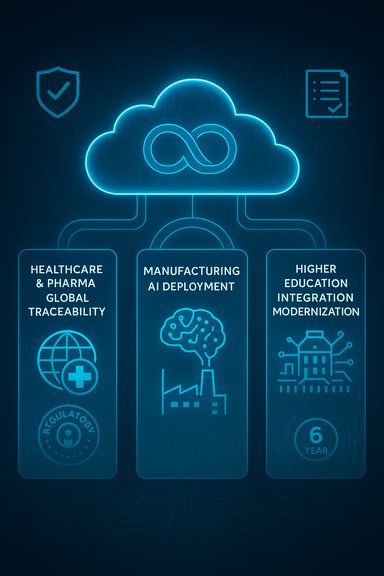
Neon cloud AI diagram linking healthcare traceability, manufacturing AI deployment, and higher education modernization.Background​

Microsoft’s Azure Expert MSP program is purpose‑built to identify and validate partners with proven, repeatable capability to deliver end‑to‑end Azure solutions at scale. Unlike ordinary partner badges, Azure Expert MSP is audit‑driven: applicants must meet a set of prerequisites, pass both pre‑audit and on‑site third‑party assessments, and keep meeting ongoing requirements to retain the status. The program includes prerequisites around Solutions Partner designations (notably Data & AI, Digital & App Innovation, and Infrastructure), documented customer success, and operational maturity. Microsoft’s own partner documentation and Partner Center guidance describe the program steps and the intensive audit process that underpins it. Reply’s announcement says the sixth consecutive renewal was secured by passing Microsoft’s rigorous review and by leveraging certified Azure specialists across its network. Reply calls out specific wins and programmes where its specialist companies have delivered Azure‑first outcomes: Solidsoft Reply’s Azure platforms for pharmaceuticals and global traceability in regulated contexts; Cluster Reply’s Generative AI adoption model built for metallurgy group Danieli; and Valorem Reply’s Microsoft‑first integration modernization with the University of Portsmouth. These examples are used to illustrate the breadth of Reply’s Azure work and to show the cross‑company model Reply uses to package cloud, governance and vertical expertise.

Why the Azure Expert MSP badge matters​

The Azure Expert MSP designation plays several roles for enterprise buyers and for the vendor ecosystem:
  • Signal of operational rigor. The program’s independent audit covers processes, security and service operations; passing it provides tangible evidence that an MSP has disciplined runbooks, monitoring, incident response and lifecycle operations. Microsoft requires a pre‑audit review and a two‑day on‑site audit for applicants.
  • Procurement differentiation. Large public and regulated sector contracts increasingly filter vendors using partner badges and documented attestations. An Expert MSP badge shortens the procurement trust path — provided buyers verify the underlying artifacts.
  • Co‑sell and engineering alignment. Microsoft prioritises Azure Expert MSPs for deeper GTM plays, joint engineering sessions and co‑sell engagements with field teams. This makes the badge commercially valuable beyond marketing copy.
  • Ongoing assurance model. The certification is not a one‑time stamp; partners are re‑evaluated on renewal windows (which include audits tied to anniversary dates), so maintaining the badge requires sustained investment.
Independent MSPs and customers often frame the program as exclusive and tightly governed: public statements from other Azure Expert MSPs describe the audit as covering dozens of control areas and requiring evidence across technology, process and people — a reality that both raises the bar and creates a defensible set of expectations for customers.

Verified claims in Reply’s announcement​

The most load‑bearing claims in Reply’s press release are verifiable against public sources:
  • The renewal as Azure Expert MSP for the sixth consecutive year is directly stated in Reply’s newsroom and in the Business Wire release dated December 18, 2025. Those releases are the primary public record for the announcement.
  • The program’s audit‑based nature and prerequisites (including Solutions Partner designations) match Microsoft’s published process for Azure Expert MSP candidacy and renewals. Microsoft documentation requires completing a formal application, scheduling a third‑party audit and meeting ongoing renewal windows.
  • Several case examples named by Reply — Solidsoft Reply’s global traceability and Pharma work, Cluster Reply’s engagement with Danieli, and Valorem Reply’s University of Portsmouth project — are also reflected in regionally syndicated releases and on the Reply group sites. These read as named, public case studies rather than anonymous claims.
Where claims are less concrete — such as the total number of countries served for a specific product line or an implied market ranking — readers should treat those as company‑reported metrics that require further validation through references, Partner Center exports, or contract‑level artifacts. Internal metrics and “market position” descriptions are standard PR language; procurement teams should request documentary proof.

What this recognition tells IT decision‑makers​

For Windows‑centric IT teams, the recognition signals a few practical takeaways:
  • If your estate is Azure‑heavy and Microsoft‑centric, an Azure Expert MSP can shorten time‑to‑value. Partners with the badge typically bring automated CMPs (Cloud Management Platforms), runbooks and monitoring templates that reduce lift on repetitive operations. Reply’s materials specifically highlight its CMP and operational tooling as auditor‑facing artifacts.
  • Expect disciplined governance and controls as part of the offering. The audit looks at governance, security controls and evidence of customer success. For regulated workloads (healthcare, pharma, manufacturing), those elements are indispensable — and Reply points to regulated‑environment projects in its announcement.
  • Credential badges matter — but so does verification. Microsoft partner badges are useful screening tools, not substitutes for technical diligence. Buyers should request Partner Center exports, the audit executive summary, named references and runbooks to convert the badge into contractual assurance. Procurement checklists and independent verification steps are already common practice in large‑scale procurements.

Strengths implied by Reply’s renewal​

Reply’s sixth consecutive renewal points to several tangible strengths:
  • Sustained operational maturity. Retaining an audit‑grade badge over multiple cycles requires ongoing investment in people, automation and compliance. That suggests Reply maintains an operations‑centred delivery model rather than ad‑hoc project engineering.
  • Cross‑company capability model. Reply’s structure — a network of specialist companies that include Cluster Reply, Solidsoft Reply and Valorem Reply — lets the group combine industry vertical expertise (e.g., pharma traceability) with technical specialisms (e.g., Copilot/Generative AI adoption, integration modernisation). That provides a plug‑and‑play pattern for enterprises seeking vendor consolidation on Azure.
  • Microsoft alignment and joint motion potential. An Expert MSP designation usually increases a partner’s access to Microsoft engineering, co‑sell opportunities and early access to platform roadmaps — practical advantages when enterprises rely on Microsoft‑first roadmaps such as Copilot, Foundry or Azure AI infrastructure.

Risks, gaps and areas that require buyer scrutiny​

Even for a certified partner, several practical risks and caveats remain for enterprise buyers:
  • Badge != turnkey guarantee. The Expert MSP audit attests to processes and evidence across selected customer engagements, but it does not guarantee flawless delivery on every contract. Buyers should require named references and comparable project artifacts for contracts of similar scale or regulatory sensitivity.
  • Cost predictability for modern AI workloads. While partners can deliver governance and tooling, the economics of AI model usage — token meters, GPU capacity, persistent model hosting — remain variable. Cost models for large fleets of Copilot agents or generative workloads are still maturing and should be validated in a metered pilot.
  • Vendor concentration and lock‑in. Deeper integration with Microsoft services and managed offerings increases efficiency but can raise migration friction if multi‑cloud strategies become necessary. Tender specifications should include exit gates, clean‑handovers of IP and artifacts, and defined formats for infrastructure as code to avoid operational lock‑in.
  • Audit scope and exceptions. The Azure Expert MSP audit has breadth but also a scoped set of controls. Buyers should ask for the audit executive summary or redacted auditor report to understand caveats, exceptions, or mitigation plans that may affect their weighted procurement scoring. Not every audit covers every industry nuance.
  • Regulatory and residency complexity. For regulated data and geofenced workloads, confirm how the partner manages model provenance, data residency, and third‑party model providers. Microsoft’s increasing support for multi‑model hosting introduces governance complexity that needs explicit contractual control.

Practical due‑diligence checklist for enterprises evaluating Reply (or any Azure Expert MSP)​

  • Request a Partner Center export and a current list of Solutions Partner designations and their effective dates.
  • Obtain the audit executive summary or a redacted auditor letter for the latest Azure Expert MSP renewal.
  • Ask for 2–3 named, industry‑relevant references (architect or IT director level) and agreed contact details.
  • Review the partner’s Cloud Management Platform (CMP) documentation and request a short technical demo showing monitoring, automation and billing‑level observability.
  • Run a funded pilot with measurable gates for cost, performance, governance and rollback within a realistic 30–60 day window.
  • Contractually require runbooks, SLA definitions, incident response playbooks and exit/knowledge‑transfer deliverables to be part of the SOW.
  • Confirm security and compliance attestations: ISO 27001, ISO 20000, SOC2, and any industry‑specific certifications or red‑team results relevant to the work.
This checklist synthesises published procurement guidance and practical recommendations used by customers shortlisting Azure partners. Requiring these artifacts converts a marketing badge into verifiable, auditable contract deliverables.

Market context: why partners race for Expert MSP and Solutions Partner badges​

The Azure Expert MSP program is a high‑signal, resource‑intensive recognition. For partners, it unlocks co‑sell motions, improves discoverability in Microsoft‑led deals, and aligns their GTM with Microsoft’s product and field organization. For customers, the badge simplifies vendor pre‑qualification when evaluating complex cloud engagements.
However, as many systems integrators and MSPs pursue the same badges — particularly the Solutions Partner designations that feed into Expert MSP preconditions — buyers must increasingly rely on proof beyond badges. The badge is an effective filter but not a final selection criterion: the rise of similar announcements across the vendor landscape has shifted procurement focus to audit summaries, telemetry, named references and demonstrable automation.

The strategic value of Reply’s vertical examples​

Reply’s press release calls out three concrete vertical engagements that reveal how the group translates platform competence into sector outcomes:
  • Healthcare & Pharma (Solidsoft Reply): Global traceability platforms and managed services across 30+ countries — the combination of regulatory controls, end‑to‑end traceability and Azure governance is a natural fit for regulated estates where auditability and continuity matter. This is consistent with Solidsoft’s public statements about re‑achieving the Expert MSP specialisation and its focus on GS1 traceability systems.
  • Manufacturing / Generative AI (Cluster Reply & Danieli): Building a structured adoption model for Generative AI on Azure for an industrial client highlights two strengths: the ability to design a secure, scalable model deployment pattern and the capacity to combine OT/IT domain knowledge with cloud governance. For industrial IoT and metalurgy firms, integrating AI pilots within secure Azure tenancy constructs is the differentiator.
  • Higher Education (Valorem Reply & University of Portsmouth): Modernising integration infrastructure with a Microsoft‑first strategy typically focuses on agility, API management and cloud governance. For universities with federated systems and constrained budgets, this kind of modernization can reduce technical debt while improving cloud governance and developer velocity.
These examples show the commercial pattern Reply emphasises: combine a platform credential (Expert MSP) with vertical case studies to de‑risk procurement conversations and accelerate field alignment.

Conclusion​

Reply’s renewal as a Microsoft Azure Expert MSP for the sixth consecutive year is a defensible commercial milestone. The recognition is backed by an audit‑driven program that Microsoft operates to ensure partners can manage enterprise‑grade Azure estates. Public releases from Reply and syndication by Business Wire and regional outlets confirm the renewal and outline concrete case studies across regulated industries, manufacturing and higher education — all domains where operational discipline and governance matter most. For enterprise IT buyers, the badge should be treated as a strong starting signal: it reduces discovery friction but does not replace normal procurement diligence. The most prudent approach is to convert the badge into verifiable artifacts — Partner Center exports, named references, audit summaries and measurable pilot outcomes — before awarding large, regulated or mission‑critical contracts. Doing so preserves the commercial advantages the badge intends to provide while protecting the buyer from execution, cost and compliance risks that remain in any complex cloud transformation.
Reply’s sixth renewal underscores a broader market truth: Microsoft’s emphasis on verified partner capabilities has created clearer procurement signposts, but the real determiners of long‑term success are repeatable operations, transparent economics for AI workloads, and airtight governance — areas where buyers should demand evidence as rigorously as partners demand the badge.

Source: afp.com Reply Recognized as a Microsoft Azure Expert Managed Services Provider for the Sixth Consecutive Year | AFP.com
 

Back
Top