

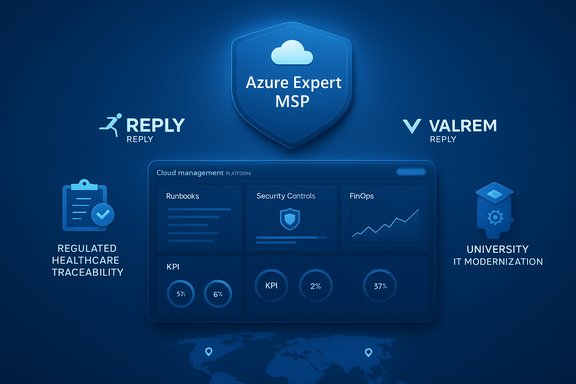
Reply has been recognized once again as a Microsoft Azure Expert Managed Services Provider (Azure Expert MSP) — the sixth consecutive annual renewal for the group — a milestone that underlines Reply’s continuing alignment with Microsoft’s most demanding partner criteria and puts its specialist companies (Cluster Reply, Solidsoft Reply and Valorem Reply) back into the enterprise shortlist for large, regulated Azure programs.
Microsoft’s Azure Expert MSP program is a gated, audit-driven partner track designed to identify managed-service providers capable of operating Azure estates at enterprise scale. To obtain and retain the badge partners must meet predefined Solutions Partner prerequisites, supply named customer evidence, and successfully complete a multi-stage third‑party audit that includes both pre‑audit validation and an intensive on‑site assessment. The Partner Center guidance and public Microsoft documentation describe the process as resource-intensive — often requiring hundreds of hours across an organisation to prepare and pass. Reply’s group-level announcement — issued via Business Wire and mirrored across Reply’s regional newsrooms — states the renewal was achieved by combining the capabilities of its specialist subsidiaries (Cluster Reply, Solidsoft Reply and Valorem Reply) and by passing Microsoft’s audit process. The corporate communiqué cites vertical case examples — regulated traceability and pharma workloads, a Generative AI adoption model for Danieli in heavy industry, and an integration modernization project for the University of Portsmouth — as evidence that operational discipline and vertical IP underpin the renewal.
However, buyers should be mindful of three structural limitations:
That said, the Azure Expert MSP badge should be the start of a measured procurement process — not the endpoint. Convert the badge into verifiable artifacts: audit summaries, named references, CMP access, FinOps commitments and contractual portability. When those guardrails are in place, an Azure Expert MSP with Reply’s vertical experience can substantially reduce operational risk and accelerate time‑to‑value for Azure workstreams.
Source: Bakersfield.com Reply reconnu comme fournisseur expert de services gérés Microsoft Azure pour la sixième année consécutive
 Background / Overview
Microsoft’s Azure Expert MSP program is a gated, audit-driven partner track designed to identify managed-service providers capable of operating Azure estates at enterprise scale. To obtain and retain the badge partners must meet predefined Solutions Partner prerequisites, supply named customer evidence, and successfully complete a multi-stage third‑party audit that includes both pre‑audit validation and an intensive on‑site assessment. The Partner Center guidance and public Microsoft documentation describe the process as resource-intensive — often requiring hundreds of hours across an organisation to prepare and pass. Reply’s group-level announcement — issued via Business Wire and mirrored across Reply’s regional newsrooms — states the renewal was achieved by combining the capabilities of its specialist subsidiaries (Cluster Reply, Solidsoft Reply and Valorem Reply) and by passing Microsoft’s audit process. The corporate communiqué cites vertical case examples — regulated traceability and pharma workloads, a Generative AI adoption model for Danieli in heavy industry, and an integration modernization project for the University of Portsmouth — as evidence that operational discipline and vertical IP underpin the renewal. What the Azure Expert MSP badge actually certifies
The audit and prerequisites
The Azure Expert MSP badge is more than marketing: it is built around a formal audit checklist administered by an independent assessor. Applicants must:- Hold aligned Solutions Partner designations (commonly Data & AI, Digital & App Innovation and Infrastructure).
- Provide documented customer evidence and references that meet the Partner Center templates.
- Demonstrate operational maturity in service management, monitoring, security and FinOps.
- Operate an automated Cloud Management Platform (CMP) and show a minimum number of active CMP customers as part of the audit.
- Pass a pre‑audit and a concentrated, on‑site two‑day assessment to verify controls, processes and artifacts.
What a successful audit demonstrates
Passing the audit demonstrates repeatable, auditable capability across:- Cloud operations and incident response runbooks
- Continuous monitoring, automation and SRE-style practices
- Security and governance, including identity, encryption and logging
- FinOps processes (cost monitoring, tagging and governance)
- Documented customer success with comparable references and published case studies.
What Reply’s sixth consecutive renewal means in practice
Sustained operational maturity
Retaining the badge for six consecutive years implies Reply has institutionalised many of the operational practices Microsoft audits for: cross‑company runbooks, an automated CMP, continuous skilling and demonstrable customer outcomes. Multi‑year renewals are non‑trivial because the program requires a re‑evaluation cycle and adherence to ongoing program requirements. This continuity reduces execution risk for buyers seeking a partner to run production Azure workloads.Verticalised delivery via specialist companies
Reply’s announcement explicitly credits three specialist businesses:- Solidsoft Reply — positioned around regulated healthcare and pharmaceutical traceability platforms, claiming managed services across many countries.
- Cluster Reply — showcased for industrial Generative AI adoption models (for example, an engagement with metallurgy group Danieli).
- Valorem Reply — presented for Microsoft‑first integration modernization (for example, for the University of Portsmouth).
Market signal and commercial advantage
An Azure Expert MSP badge can yield practical benefits beyond credibility:- Higher Microsoft engagement: expert MSPs often receive deeper field alignment and joint GTM opportunities.
- Procurement differentiation: public-sector and regulated tenders increasingly rely on partner badges and audited attestations as gating criteria.
- Operational accelerators: audited CMPs, runbooks and reusable accelerators compressed into managed‑service offers can materially reduce time‑to‑value.
Verifying the load-bearing claims — what’s confirmed, what’s not
- Claim: Reply renewed Azure Expert MSP for the sixth consecutive year. — Confirmed by Reply’s corporate announcement and Business Wire distribution. The press material explicitly states “sixth consecutive year.”
- Claim: Cluster Reply, Solidsoft Reply and Valorem Reply contributed to the renewal. — Confirmed in Reply’s press release and Solidsoft’s subsidiary news pages. The press inventory names these entities as the specialist companies underpinning Reply’s managed‑service capability.
- Claim: The Azure Expert MSP program requires a third‑party audit, Solutions Partner alignment and ongoing re‑evaluation. — Confirmed by Microsoft’s partner program documentation which outlines the pre‑audit and on‑site audit process, prerequisites and annual re‑assessment.
- Claim: Specific case examples (e.g., Danieli, University of Portsmouth, Solidsoft traceability in “30+ countries”). — The Business Wire release and Reply subsidiary pages cite these engagements as named case examples. These are company‑reported references and are appropriate evidence for procurement screening, but buyers should verify comparable references and engage named contacts to confirm architecture, SLAs and outcomes. Where numeric counts (like “30+ countries”) are used, treat those as company assertions that need direct verification.
- Claim: There are fewer than 150 Azure Expert MSP partners globally. — This figure appears in some company releases and subsidiary pages; however, Microsoft does not publish a definitive, continuously updated public count in a single authoritative list. Treat headline partner‑count claims as approximate unless confirmed directly by Microsoft Partner Center exports or an official Microsoft statement. Flag such numeric claims as approximations until verified.
Strengths and practical advantages for Windows-centric enterprise buyers
- Operational assurance: The audit focuses on runbooks, SRE-style monitoring and service management — all elements that cut operational risk for Windows servers, Azure AD integrations, and Azure-hosted workloads.
- Vertical IP plus cloud discipline: Reply’s model pairs domain accelerators with audited operational practice, which is useful where industry-specific controls (HIPAA, GxP, ISO standards) intersect with Azure.
- Microsoft alignment: An Azure Expert MSP frequently gets prioritized access to Microsoft engineering help and co‑sell corridors, which can accelerate problem resolution and feature roadmap alignment during large migrations.
- Reusable engineering artifacts: A certified CMP and documented accelerators compress repetitive engineering work — beneficial for organizations standardizing on Azure for Windows application modernization.
Risks, caveats and procurement guardrails
Badge is a door opener — not an execution guarantee
An audit validates a partner’s processes and a sample of deliveries at a point in time. It does not guarantee flawless delivery on every engagement. Buyers must insist on:- Named references for comparable projects with contactable references.
- An executive summary of the auditor’s findings where possible.
- Detailed SOW-level runbooks, SLAs and acceptance criteria.
Cost predictability and FinOps for AI-enabled workloads
Managed services that support AI production workloads on Azure introduce new cost drivers: inference egress, GPU/accelerator provisioning and storage. Ensure the partner provides:- A clear FinOps plan with tagging, budgets, and cost-optimization playbooks.
- Acceptance tests that include cost thresholds and workload scaling profiles.
Vendor concentration and portability
Deep Microsoft alignment accelerates adoption but may constrain portability. Contracts should include:- Data export and portability guarantees.
- Clear IP ownership terms for model artifacts and custom code.
- Exit and transition plans that map to runbook handover and operating procedures.
Multi-entity delivery complexity
When delivery uses multiple subsidiaries (as Reply’s model does), ensure a single accountable legal entity, a unified governance plan and a consolidated escalation path are contractually defined. Distribute risk and accountability to avoid fragmentation.Practical procurement checklist: converting the badge into contractual certainty
- Confirm the partner’s Apparent Status in Microsoft Partner Center (certificate dates and effective window).
- Request the audit executive summary or an attestation that lists audited domains and any remediation items.
- Ask for 3–5 customer references with environments comparable in scale and regulatory exposure.
- Validate operational artifacts: incident response, change management, performance tuning, CMP screenshots or access, and cost management dashboards.
- Confirm staff skilling and rotation: number of Azure‑certified engineers assigned, bench management and knowledge-transfer plans.
- Negotiate FinOps, portability, and exit provisions as contracted milestones and acceptance criteria.
- Map legal accountability when multiple subsidiaries are involved; ensure consolidated liability and single-point billing if needed.
Deep dive: the case studies Reply cites (what they imply)
Solidsoft Reply — regulated traceability and pharma
Solidsoft’s materials emphasise GS1 traceability systems and managed services across numerous countries in regulated contexts. For buyers in healthcare and life sciences, the crucial tests are whether the partner can demonstrate encryption, key management, cross-border data handling, validation artifacts and audit trails that match regulatory regimes. Company claims about the number of countries served are verifiable through named customer references and contract exhibits, and should be validated during procurement.Cluster Reply — industrial Generative AI adoption (Danieli)
Industrial AI deployments combine OT constraints, secure model hosting and inference scalability. The Danieli example suggests Reply can design secure model deployment patterns on Azure and bridge OT/IT boundaries. For manufacturers, the important verification points are secure model lifecycle management, inference latency profiles, data governance across plant networks and secure edge‑to‑cloud architectures. Ask for architecture diagrams, model governance artifacts and proof of secure inference benchmarking.Valorem Reply — university integration modernization
Higher education modernization is often about consolidating federated systems, improving developer velocity, and reducing technical debt. The University of Portsmouth example signals capability in integration modernization and API governance on Azure. Verify whether the engagement included clear SLAs, API management artifacts, and migration cutover playbooks aligned with Azure services such as API Management, Logic Apps and Azure AD B2C/Entra integrations.Critical analysis: strengths — and where to push for more proof
Reply’s multi-year renewal signals several strengths: consolidated operational tooling, repeatable delivery models and Microsoft alignment that can translate to faster time-to-production. The company’s vertical case examples indicate practical domain knowledge rather than generic cloud projects. These are positive signals for Windows‑centric IT teams standardising on Azure.However, buyers should be mindful of three structural limitations:
- The certification is a snapshot, not continuous proof. Operational drift between audits is possible.
- Corporate PR often includes numeric and exclusivity claims that are approximate; verify partner counts and market‑share assertions directly with Microsoft or via Partner Center.
- Multi‑entity delivery models require clear contractual accountability to avoid service fragmentation across subsidiaries.
Recommendations for WindowsForum readers and enterprise IT leaders
- Treat the Azure Expert MSP badge as a high‑quality shortlist filter. Use it to remove unqualified vendors early, but convert it into named evidence before awarding large contracts.
- Request the partner’s audit executive summary or an attestation describing the audited control domains and remediation items.
- Use a short, representative pilot to validate: operational runbooks, CMP integration, cost profile under load, and secure model hosting (for AI workloads).
- Demand commercial protections for FinOps, model portability and data exportability to avoid surprise costs and lock‑in.
- When multiple legal entities contribute to delivery, require a single contracting entity and a consolidated governance plan.
Conclusion
Reply’s announcement that it has been recognised as a Microsoft Azure Expert Managed Services Provider for the sixth consecutive year is a meaningful market signal: it demonstrates sustained investment in operational discipline, automation and Microsoft alignment. For Windows‑centric enterprises planning large Azure migrations, complex managed services, or production AI deployments, the designation shortens the discovery phase and puts Reply on a short list worth vetting.That said, the Azure Expert MSP badge should be the start of a measured procurement process — not the endpoint. Convert the badge into verifiable artifacts: audit summaries, named references, CMP access, FinOps commitments and contractual portability. When those guardrails are in place, an Azure Expert MSP with Reply’s vertical experience can substantially reduce operational risk and accelerate time‑to‑value for Azure workstreams.
Source: Bakersfield.com Reply reconnu comme fournisseur expert de services gérés Microsoft Azure pour la sixième année consécutive
