

Reply’s renewed recognition as a Microsoft Azure Expert Managed Services Provider (Azure Expert MSP) — reportedly for the sixth consecutive year — is both a commercial milestone for the Reply network and a practical procurement signal for enterprises that run mission‑critical workloads on Azure. The company’s announcement frames the renewal as validation of group‑level capabilities delivered through its specialist companies Cluster Reply, Solidsoft Reply and Valorem Reply, and it emphasises audited compliance across Microsoft’s Solutions Partner designations in Data & AI, Digital & App Innovation and Infrastructure.
Conclusion: Reply’s sixth successive recognition as an Azure Expert MSP is an operational endorsement that reinforces the company’s position in the Microsoft partner ecosystem — a significant shortlisting signal for enterprise buyers — but one best used alongside deliberate, evidence‑based procurement and governance practices.
Source: PA Media Reply Recognized as a Microsoft Azure Expert Managed Services Provider for the Sixth Consecutive Year
 Background
What Microsoft’s Azure Expert MSP badge is and why it matters
The Azure Expert MSP designation is a gated, top‑tier partner program designed by Microsoft to identify managed‑service providers capable of operating Azure estates at enterprise scale. Achieving (and keeping) the badge requires a mix of program prerequisites, measurable customer success and a mandatory third‑party audit that inspects people, processes and tooling. The badge is intentionally demanding: it includes pre‑audit and on‑site assessments and an annual renewal cycle that forces partners to demonstrate ongoing compliance with the program’s operational baseline. Microsoft’s program documentation lays out concrete mechanics for enrollment and renewal: partners must hold the aligned Solutions Partner designations, meet performance and skilling thresholds, submit customer references, publish an MSP offer, maintain required support contracts and pass a time‑intensive independent audit. Renewal windows are anchored on a partner’s anniversary date and include strict timelines for scheduling and completing audits. These mechanics make Azure Expert MSP a repeatable, auditable shortlisting filter for enterprise procurement teams.Reply’s announcement: a concise recap
Reply announced the renewal through a Business Wire release and parallel newsroom postings by its subsidiaries, stating the group was recognised again as an Azure Expert MSP and highlighting the contributions of Cluster Reply, Solidsoft Reply and Valorem Reply. The press narrative explicitly cites client examples — Solidsoft Reply’s work on regulated healthcare and pharma traceability platforms across 30+ countries, Cluster Reply’s GenAI adoption model for Danieli built on Azure, and Valorem Reply’s Microsoft‑first integration modernization for the University of Portsmouth — as evidence of the group’s sectorised delivery model.What the Azure Expert MSP badge certifies — the technical and operational baseline
Audit mechanics and scope
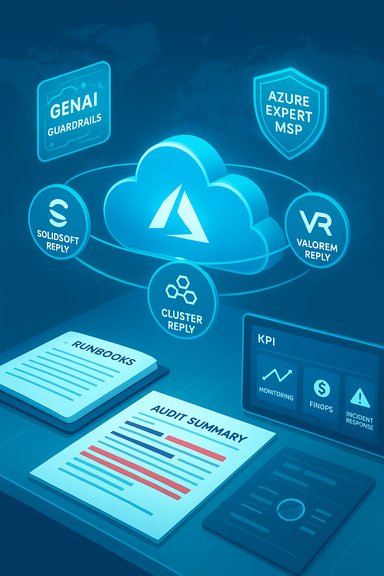
Earning Azure Expert MSP status is not a marketing trophy: the independent audit inspects operational controls in depth. Auditors typically review:- Runbooks and incident response procedures
- Monitoring, automation and 24×7 SRE/operations practices
- Security and governance controls, including identity and key management
- FinOps practices and cost monitoring
- Customer evidence: documented outcomes and references
Solutions Partner alignment and why it matters
Azure Expert MSP candidates must already hold the aligned Solutions Partner designations in relevant domains (commonly Data & AI, Digital & App Innovation, Infrastructure). These designations evaluate performance, skilling and customer success across discrete solution areas; together with the MSP audit, they create a layered credibility model that many procurement teams use to shorten vendor shortlists. Achieving both the Solution Partner badges and Azure Expert MSP status signals both breadth (cross‑stack capability) and depth (managed‑service operational maturity).Reply’s delivery model and the subsidiary case examples
Reply operates as a network of specialised companies that combine vertical domain IP with Azure platform engineering. The recent renewal announcement foregrounds three subsidiaries; each brings a distinct capability set to the group portfolio.Solidsoft Reply — regulated traceability and global managed services
Solidsoft Reply’s published materials confirm the company’s re‑achievement of Azure Expert MSP status and describe its focus on global traceability solutions for regulated sectors such as healthcare and pharma. The subsidiary highlights its work on GS1‑based traceability systems and multi‑country managed services, positioning those offerings as natural fits for the auditable, governed practices Microsoft’s program expects. Solidsoft’s pages also claim auditor praise for the company’s Cloud Management Platform and service management practices.Cluster Reply — industrial Generative AI on Azure
Cluster Reply’s casework includes a GenAI adoption model for Danieli, an industrial group, designed to centralise model governance, observability and audit trails on Azure. The case emphasizes microservices architecture, tenant‑scoped controls and guardrails for generative AI, which mirror the operational artefacts auditors look for when evaluating AI‑centric workloads in regulated or sensitive industrial contexts. The case study functions as a tangible example of how an Azure Expert MSP might scaffold GenAI at scale while preserving auditability.Valorem Reply — integration modernization for University of Portsmouth
Valorem Reply’s documentation on the University of Portsmouth migration shows a classic Microsoft‑first integration modernization: replacing legacy integration platforms with Azure Integration Services and API Management, rapidly increasing throughput of integration delivery and improving governance. The engagement illustrates the repeatable migration patterns and knowledge transfer processes that underpin managed‑services offerings and that Microsoft expects partners to demonstrate.Why the renewal matters to enterprise buyers — strengths and advantages
- Auditable operational discipline. The Azure Expert MSP audit is a third‑party validation of documented runbooks, automation, incident management and governance. For buyers in regulated sectors, that independent inspection materially reduces procurement risk compared with non‑audited providers.
- Verticalised IP plus platform engineering. Reply’s network model lets the group bring domain‑specific capabilities (traceability, industrial AI, higher‑education integration) while maintaining a single Azure partnership profile. That combination can shorten time‑to‑value for pilots and production rollouts.
- Microsoft alignment and go‑to‑market benefits. Top‑tier partners often access co‑sell pathways, marketplace discoverability and preferential Microsoft referral channels that help accelerate procurement and delivery at scale. Being an Azure Expert MSP puts Reply in those corridors of commercial support.
- Repeatable accelerators and templates. The GenAI Hub pattern, traceability platforms and integration accelerators are examples of reusable assets that can compress early project phases and reduce the personnel hours required to prove outcomes.
Risks, caveats and procurement guardrails — what the badge does not guarantee
The Azure Expert MSP badge is a powerful signal, but it is not a substitute for commercial and technical due diligence. Procurement and technology leaders should be mindful of the following:- Point‑in‑time validation. Audits validate processes and artifacts at the moment of review; they do not guarantee continuous, flawless delivery over the life of a multi‑year engagement. Long‑running operational quality requires named teams, ongoing governance and contractual SLAs.
- Multi‑entity delivery complexity. Reply’s network model means deliveries may cross legal entities. Contracts should name a single accountable prime and explicitly map escalation matrices and responsibilities to avoid operational fragmentation. Ask for a prime‑contracting vehicle that centralizes liability and SLAs.
- FinOps and hidden cost drivers. AI and agent workloads can change consumption patterns rapidly: model inference costs, storage, egress and region‑specific capacity premiums can produce surprising invoices. Require metered pilots and explicit FinOps acceptance criteria in statements of work.
- Regulatory and data residency concerns. The badge helps but does not replace explicit regulatory compliance evidence. For healthcare, pharma or public sector programs, ask for data flow diagrams, encryption key management plans, Purview/GDPR mapping, and documented retention policies.
- Vendor concentration and portability. Deep Azure‑native architectures reduce migration friction but increase portability risk. Contractual exit provisions, data export guarantees and model portability clauses are essential if future re‑hosting is a concern.
Practical procurement checklist — convert the badge into contractual comfort
- Request Partner Center proof showing the effective Azure Expert MSP status, the renewal date, and the legal entity names covered by the badge. Partner Center evidence is the authoritative record of program enrollment.
- Obtain the most recent audit executive summary (redacted if necessary) to see audited domains and any remediation items. The audit summary reveals scope and exceptions that matter for risk allocation.
- Require 2–3 named customer references that match your scale, geography and regulatory profile. Speak to operational outcomes, SLO enforcement and continuous improvement practices.
- Run a funded, time‑boxed pilot (30–90 days) with metered billing for AI/agent workloads and integration flows; collect compute, token and storage telemetry. Use the pilot to validate FinOps, observability and governance.
- Contractually insist on a single accountable legal entity (prime) with SLAs covering incident response, rollback, data portability and security incident notification. Clarify whether regional support is in‑house or subcontracted.
- Require governance artifacts for AI: tenant‑scoped model hosting strategy, label/classification approach, identity for agents, observability and red‑team test reports. Validate that the partner will provide tenant‑scoped control when your regulatory posture requires it.
Cross‑checking Reply’s claims — independent corroboration and a note on numbers
Reply’s corporate release and subsidiary pages confirm the renewal and the cited casework. Business Wire carried the group announcement, Reply’s newsroom republished the statement in multiple languages, and Solidsoft and Valorem maintain public case materials that align with the examples highlighted in the press release. These independent touchpoints provide reasonable corroboration for the core claims of renewal and project examples. One subsidiary claim warrants cautious reading: Solidsoft’s statement that Microsoft has awarded less than 150 partners globally with Azure Expert MSP status is plausible but should be treated as vendor‑reported. Microsoft does not publish a simple global headcount in a single public list; Partner Center exports and Microsoft partner listings are the definitive records. Buyers who need to rely on scarcity as a procurement factor should request Partner Center evidence directly.The market context: why partners like Reply are strategically important now
Enterprise momentum toward Azure and the rise of AI workloads have increased demand for partners that combine operational managed‑service maturity with vertical domain knowledge. Microsoft’s partner architecture — Solutions Partner designations layered with specializations and gated programs such as Azure Expert MSP — is expressly designed to make high‑quality partners discoverable and to give large customers confidence when shortlisting vendors. For enterprises modernizing Windows‑centric estates, adopting Azure‑native integration patterns, or operationalizing Generative AI, audited partners like Reply are pragmatic starting points for procurement shortlists. At the same time, hyperscaler platform changes (new first‑party chips, differentiated managed AI stacks and tighter integration between platform services) increase the operational complexity of production AI. Partners that can show both audited operations and demonstrable vertical IP will be in higher demand — but buyers must pair those credentials with standard procurement engineering to manage lock‑in, cost and governance risk.Technical and contractual questions buyers should ask Reply (or any Azure Expert MSP)
- Which legal entities are covered by the Azure Expert MSP status, and can you provide a Partner Center export showing coverage and effective dates?
- Can you provide a redacted audit executive summary and the list of controls audited during your most recent renewal?
- Who are the named SRE teams and on‑call contacts that will manage our estate? Provide runbooks that map to your proposed SLAs.
- For AI deployments: where are models hosted (tenant‑scoped or multi‑tenant), how are prompts and outputs logged and retained, and who holds the cryptographic keys for sensitive data?
- Provide a FinOps plan that includes tagging standards, threshold alerts, metered pilot telemetry and an agreed cost‑overrun escalation path.
Final assessment — measured optimism, clear guardrails
Reply’s renewed Azure Expert MSP recognition — and the subsidiary casework highlighted in the corporate release — represents a meaningful operational achievement that should materially shorten vendor selection cycles for Azure‑native modernization and AI initiatives. The independent audit mechanics and the Solutions Partner alignment create a defensible baseline of capabilities that procurement teams can rely on as a shortlisting filter. That said, the badge is a door opener, not an end point. The most durable outcomes come when procurement combines program signals with targeted verification: Partner Center proof, audit summaries, named references, metered pilots and contractual safeguards for FinOps, portability and governance. When those guardrails are in place, a networked group like Reply — combining vertical IP with audited Azure operations — can deliver substantial value to enterprises moving Windows workloads and AI production to Azure.Closing note for IT leaders
Treat the Azure Expert MSP badge as a high‑quality pre‑qualification: it meaningfully reduces the risk that an MSP lacks fundamental operational controls. Convert that shortlisting advantage into procurement certainty by demanding the artifacts that the audit process produced and by validating delivery claims with funded pilots and firm contractual commitments. In markets where Azure and AI adoption are strategic imperatives, pairing audited partners with rigorous procurement engineering is the most reliable path from vendor selection to sustained, secure production operations.Conclusion: Reply’s sixth successive recognition as an Azure Expert MSP is an operational endorsement that reinforces the company’s position in the Microsoft partner ecosystem — a significant shortlisting signal for enterprise buyers — but one best used alongside deliberate, evidence‑based procurement and governance practices.
Source: PA Media Reply Recognized as a Microsoft Azure Expert Managed Services Provider for the Sixth Consecutive Year
