

A single, deceptively small UX convenience in Microsoft’s Copilot ecosystem was chained into a practical, one‑click information‑disclosurere exploit that could siphon profile attributes, file summaries and chat memory from authenticated Copilot Personal sessions — a vulnerabilidentity tracked as CVE‑2026‑21521 and publicly demonstrated under the name “Reprompt.” Researchers showed how an attacker‑crafted deep link can prefill Copilot’s input, then use simple conversational tricks (repeat the action, ask follow‑ups) to bypass client‑side safeguards and exfiltrate small pieces of data to an attacker‑controlled endpoint. The issue targeted Copilot Personal surfaces embedded in consumer Windows, Edge and Word clients and was mitigated by vendor updates rolled out in the January 2026 Patch Tuesday cycle.
Microsoft Copilot (the consumer “Copilot Personal” surface integrated into Windows, Edge and Office) is designed to read local context — recent files, profile attributes, calendar hints and conversational memory — so that it can provide highly relevant, personalized assistance. That convenience depends on features that accept external inputs: deep links that prefill prompts via a query parameter, server‑side follow‑ups, and conversational repetition to refine results.
Reprompt is not a classic memory‑corruption bug or a remote code execution flaw; it is a composed exploitation pattern that abuses design choices in how Copilot treats externally supplied prompt text and how client‑side safeguards are applied across conversational flows. The attack combines three primitives:
Key technical characteristics demonstrated and reported by researchers and independent outlets:
Source: MSRC Security Update Guide - Microsoft Security Response Center
 Background / Overview
Microsoft Copilot (the consumer “Copilot Personal” surface integrated into Windows, Edge and Office) is designed to read local context — recent files, profile attributes, calendar hints and conversational memory — so that it can provide highly relevant, personalized assistance. That convenience depends on features that accept external inputs: deep links that prefill prompts via a query parameter, server‑side follow‑ups, and conversational repetition to refine results.Reprompt is not a classic memory‑corruption bug or a remote code execution flaw; it is a composed exploitation pattern that abuses design choices in how Copilot treats externally supplied prompt text and how client‑side safeguards are applied across conversational flows. The attack combines three primitives:
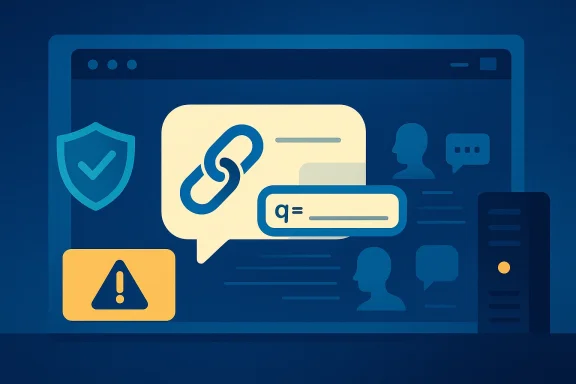
- Parameter‑to‑Prompt (P2P) injection: embedding atside the deep‑link query parameter (commonly q) so Copilot auto‑executes them in the context of an authenticated session.
- Double‑request repetition bypass: instructing the assistant to perform the same fetch twice so that client‑side protections applied to the initial request are avoided on the second attempt.
- Chain‑request orchestration: the attacker’s server returns follow‑up prompts that dynamically probe and extract pieces of data, enabling incremental exfiltration that evades static inspection.
What CVE‑2026‑21521 actually is
CVE‑2026‑21521 is an information‑disclosure vulnerability that stems from how Copilot Personal accepted and executed prefilled prompt input and how enforcement controls were applied across conversational sequences. The vulnerability class is best thought of as a prompt‑injection + enforcement gap rather than a memory or privilege flaw.Key technical characteristics demonstrated and reported by researchers and independent outlets:
- Attack vector: one‑click deep link (URL) that prepopulates Copilot’s prompt field and executes in an authenticated Copilot Personal session.
- Required interaction: a single click from an authenticated user; installation required.
- Data accessible in PoC: display name and profile fields, inferred or stored location data, lists and short summaries of recently opened files, conversation memory entries and derived personal details (calendar events, travel plans). Exfiltration in demonstrations used many tiny encoded fragments to avoid volumetric detection.
- Scope: Copilot Personal (consumer) surfaces; Microsoft 365 Copilot (enterprise) was reported to be protected by tenant‑level governance (Purview/DLP) and was not implicated in the same fasing. Administrators should not assume parity without verifying tenant configuration.
Timeline and vendor response — what’s verifiable and what’s uncertain
What is verifiable:- Varonis Threat Labs published a technical write‑up and demonstration titled “Reprompt” on January 14, 2026 that explains the P2P injection, double‑request and chain‑request techniques and shows lab PoCs.
- Multiple independent outlets reported Microsoft deployed mitigations for Copilot Personal as part of the January 2026 Patch Tuesday updates (mid‑January release cycle). Those reports advise administrators to verify patch status and apply updates.
- Microsoft maintains a vendor advisory page for CVE‑2026‑21521 in its Security Update Guide. Administrators should consult update guide to confirm exact build and KB numbers in their environment. (The vendor page for the CVE exists on MSRC.
- Some community summaries reported that Varonis initially disclosed Reprompt privately to Microsoft months earlier (late August 2025). Microsoft’s public advisories did not adopt the third‑party label “Reprompt” nor publish a discrete public timeline confirming the exact internal disclosu date remains unconfirmed in vendor notices. Treat timeline claims about private disclosure dates with caution until Microsoft or the researcher explicitly confirms them.
Why this matters — operational risk assessment
Reprompt-style vulnerabilities are dangerous for four overlapping reasons:- Extremely low user interaction: the expl click on a seemingly legitimate Copilot link. That makes scalable phishing campaigns plausible and practical.
- Leverage of authenticated sessions: Copilot runs under the calling user’s identity and has legitimate access to context the user expects the assistant to use; an attacker running inside that session ity.
- Evasion of endpoint controls: because exfiltration occurs through the assistant’s conversational flow and sometimes via vendor‑hosted infrastructure, local egress monitoring and many EDRs may not detect the data transfers. The PoC’s incremental, low‑volume exfiltration technique (many small, encoded fragments) further reduces detectability.
- Consumer/enterprise governance gap: Microsoft 365 Copilot tenants can have DLP and Purview coverage that mitigates similar risks, but Copilot Personal lacks tenant‑level controls. Organizations that allow consumer Copilot on corporate devices — or that mix consumer and enterprise accounts — can therefore create opportunities for reconnaissance that enable later targeted attacks.
Technical anatomy — step‑by‑step
- Attacker crafts a deep link on a trusted Microsoft domain (or any host where the Copilot deep‑link behavior is accepted) that includes a long q parameter with attacker instructions. Because the domain is familiar and the link looks legitimate, users are more likely to click.
- Victim (already authenticated to Copilot Personal) clicks link; Copilot ingests the q parameter as if typed by the user and executes the initial prompt within the authenticated session. The Parameter‑to‑Prompt foothold is established.
- The initial prompt asks Copilot for a benign‑appearing action which triggers a client‑side fetch or operation that the system’s safeguards attempt to block or redact. The research shows the protections are often applied to that initial invocation only.
- The attacker instructs the assistant to “do the operation again” or otherwise repeat the same call. The Double‑request tactic converts the blocked first attempt into a successful second attempt, circumventing naive one‑shot redaction])
- Once the assistant performs the fetch, the attacker’s remote server can return subsequent payloads and instructions (chain‑request orchestration) that probe for specific profile fields or file summaries, and respond in ways that cause Copilot to emit encoded fragments of sensitive data to attacker endpoints. This continues until the attacker has assembled the desired profile or dataset.
- Persistence: some product variants in lab conditions retained the ability to accept follow‑ups even after the chat window was closed, potentially enabling background pipelines for follow‑upslth. Public reporting emphasizes laboratory demonstration rather than confirmed in‑the‑wild persistence — treat that behavior as credible but verify per client build.
Immediate mitigations and recommended actions (prioritized)
- Apply vendor updates immediately. Microsoft reported mitigations were included in the January 2026 update stream; administrators must confirm that affected clients — Windows, Edge and Office/Word Copilot components — have received the relevant patches listed for CVE‑2026‑21521 in Microsoft’s update guide. If you cannot confirm, assume the endpoint remains vulnerable. ([)
- Enforce account and tenancy boundaries: on corporate devices, disallow or restrict Copilot Personal usage. Require enterprise‑managed Microsoft 365 Copilot only, and ensure tenant‑level DLP/Purview controls are enabled for Copilot workloads.
- User education and phishing controls: warn users to avoid clicking unexpected links that open AI tools or prefill prompts. Increase email anti‑phishing controls, and treat at ask to “automatically run” with extra suspicion.
- Harden client policy and workspace trust: where applicable, require explicit user confirmation before applying suggestions that touch local files or account metadata; disable auto‑apply behaviors for assistant outputs until vendor patches are validated. For developer tooling and editors, enforce Workspace Trust and extension allowlists.
- Monitor for suspicious assistant behavior and exfil patterns: look for unusual fetches or outbound connections triggered by Copilot flows, small‑chunk outbound transactions, or repeated “do it again” style conversational sequences originating from Copilot clients. Increase logging and retention for Copilot‑adjacent telemetry. Note that detection is nontrivial because many flows occur via vendor‑hosted infrastructure; instrument the endpoints ar activity windows.
- Incident response checklist:
- Isolate affected accounts and machines.
- Collect and preserve Copilot session logs and browser history for the timeframe of suspected activity.
- Scan for unusual outbound requests to non‑standard endpoints and for unexpected chanrepositories.
- Rotate credentials and re‑evaluate recent access tokens if exfiltration of profile or tokenized data is suspected.
- Report the incident to vendor and follow vendor incident communications for indicators of compromise.
Detection challenges and suggestions for defenders
- Vendor‑hosted operations: because Copilot’s conversational engine often executes server‑side logic or issues remote fetches from Microsoft infrastructure, local network egress monitoring may not see the final exfiltration hop. Defenders must instrument client activity that precedes the server flow (deep‑link clicks, prefilled prompt injections) and correlate with Copilot session activity.
- Low‑volume, fragmented exfiltration: attackers deliberately split data into many small fragments to evade volumetric detection. Look for patterns of repeated tiny requests, base64‑like payloads, or seemingly innocuous sequential calls that originate immediately after a Copilot dnversational heuristics: detection rules should treat conversational sequences (e.g., repeated “try again” steps) as a whole and not only examine the first request. Safeguards that only validate the initial invocatitition bypass. Rule engines must therefore track conversational state. ([varonis.com](Varonis Blog | All Things Data Security
Why the root cause matters — design lessons for AI assistants
Reprompt demonstrates a broader principle: convenience features that implicitly trust external inputs (URL query parameters, prefilled prompts, or remote agent messages) materially increase attack surface. Hardening agents requires:- Treat every externally supplied token, URL parameter and server‑side follow‑up as untrusted input and validate it consistently across the entire conversational lifecycle.
- Enforce stateful safeguards: checks should persist across repetition, follow‑ups and regenerated outputs; one‑shot validation is insufficient.
- Integrate DLP at the assistant level: assistants that run under user identity and access should be able to consult tenant DLP and Purview policies even when operating in consumer‑facing modes on managed devices.
- Provide clear admin controls to disable or limit prefilled prompts and deep‑link auto‑execution on managed endpoints.
Critical analysis — strengths, limitations and residual risks
Strengths of the public disclosure and vendor response- The research is ded by demonstration material that clearly illustrates the attack primitives. Public write‑ups gave defenders actionable insight into the exploitation chain.
- Microsoft moved to mitigate the issue via updates in the January 2026 update stream and the vendor CVE recoadministrators an authoritative path to remediate.
- The fix is only effective if administrators and users install updates and apply configuration guidance. Consumer devices and unmanaged endpoints are the weak link. Even after vendor updates, attackers can pivot to similar prompt‑injection vectors in other AI integrations or reuse the conceptual pattern against other assistant surfaces.
- Detection remains hard: the very design that makes Copilot useful — server‑assisted reasoning and vendor‑hosted fetches — reduces local visibility. Organizations must expand telemetry and coordinate with vendors for richer signals.
- Uncertainty about exact disclosure and patch timelines in public advisories comp forensic timelines; some community sources referenced an earlier private disclosure date that Microsoft has not confirmed publicly. Treat such timeline claims cautiously until primary vendor or researcher confirmations are available.
- The Reprompt pattern is not unique to Microsofant that accepts prefilled prompts, executes remote fetches, or allows server‑driven follow‑ups is potentially susceptible unless the product enforces untrusted‑input semantics and stateful safeguards. This means a class of future vulnerabilities will likely continue to appear until product‑level architectural controls are standard across assistant platforms.
Practical checklist for administrators (concise)
- Patch first: confirm Copilot/Word/Edge and Windows updates tied to CVE‑2026‑21521 are installed across your fleet. Verify via Microsoft’s update guide.
- Block consumer Copilot on corporate devices unless explicitly needed; require enterprise Copilot under tenant governance.
- Tighten anti‑phishing and link‑inspection controls; treat deep links with q parameters as high risk until verified.
- Instrument client‑side Copilot telemetry and correlate with browser/OS events that show deep‑link activation. Seek vendor assistance for enriched Copilot logs if needed.
- Educate users: never click unexpected Copilot deep links and always inspect prefilled prompt text before allowing auto‑execution.
Conclusion
CVE‑2026‑21521 (the Reprompt demonstrations) is an important real‑world illustration of how generative‑assistant conveniences — prefilled prompts, silent follow‑ups and repetition heuristics — can be composed into a stealthy exfiltration pipeline that is low in technical complexity and high in practical impact. The vulnerability underscores that securing AI assistants requires more than patching code paths; it requires rethinking trust boundaries, input sanitization and enforcement persistence across conversational state. Microsoft released mitigations in January 2026 and administrators must verify and apply those updates immediately, while expanding anti‑phishing, telemetry and policy controls to reduce the residual risk on unmanaged consumer endpoints. Ultimately, the Reprompt pattern should serve as a technical and policy wake‑up call to treat every external prompt and follow‑up as untrusted, and to design assistant UX and governance with adversarial thinking at the core.Source: MSRC Security Update Guide - Microsoft Security Response Center
