

Microsoft Copilot users face a new prompt-injection vector that researchers say can be triggered with a single click — a technique reported as “Reprompt” that abuses URL parameters to feed malicious prompts into Copilot, bypass built‑in safeguards, and siphon sensitive content from user sessions without further interaction. The disclosure rekindles familiar patterns from earlier AI‑assistant attacks — indirect prompt injection, interactive output exfiltration, and OAuth‑consent deception — while adding a worrying claim: adversaries can maintain control of a live Copilot session after the chat window closes, allowing silent, ongoing data exfiltration from a single user click. This feature article unpacks the claim, places Reprompt in the context of similar, independently documented attacks, assesses Microsoft’s likely exposure and response surface, and provides practical mitigation guidance for administrators and end users.
Microsoft 365 Copilot and Copilot-enabled experiences run with the calling user’s privileges and are designed to ingest document context, web content, and URL info to synthesize answers and act on behalf of users. That design — powerful for productivity — also creates a new class of attack surface where content provenance, external inputs, and interactive outputs can be weaponized by adversaries able to influence what the assistant sees or how it renders results.
Recent public research and reporting have repeatedly shown that the combination of those three primitives can be exploited:
Across these cases, the core primitives repeat: ingestion of untrusted inputs, permissive connector privileges, and interactive or agentic outputs that are mistaken for UI. Reprompt’s novelty — if validated — would be the particular exploitation of a URL
Datadog’s CoPhish disclosure likewise resulted in Microsoft acknowledging the issue and planning product updates to harden consent experiences and Copilot Studio governance; Microsoft also iteratively tightened Entra ID consent defaults during 2025 to reduce user‑consent exposure.
At the time of writing, public reporting on the specific “Reprompt” claim references a researcher disclosure and a Microsoft patch prior to public disclosure. That claim — including the asserted disclosure date and scope of the patch — should be treated cautiously until the vendor or original researcher publishes the full technical advisory: the precise internal timelines, patch roll‑out windows, and affected product variants are often omitted from press summaries and require confirmation from primary disclosures or Microsoft’s Security Response Center. Where concrete vendor advisories exist for related issues, they tend to favor surgical mitigations that remove a specific exfil primitive (for example, disabling interactive links) while preserving benign functionality.
At the tactical level the most effective defenses combine vendor hardening (sanitize URL and page inputs, restrict interactive output capabilities, and tighten agent runtime controls) with tenant governance (limit who can consent, lock down connector scopes, monitor agent lifecycle events) and end‑user hygiene (avoid unknown links, validate consent flows). At a strategic level, organizations must accept that no single patch will eliminate this class of risk: AI assistants require a new posture that integrates identity, data classification, and runtime policy enforcement into a single governance model.
Finally, until the original Reprompt technical advisory (Varonis or otherwise) and any Microsoft advisory are available for direct review, treat the specific implementation timestamps and patch details reported in press summaries as provisional. The architecture and proofs documented in the independent disclosures cited here, however, make one point unambiguous: adversaries will continue to weaponize convenience. Defenders must treat AI assistants as first‑class security surfaces and act now to reduce the odds that a single click becomes a persistent, silent compromise.
Source: ZDNET Your Copilot data can be hijacked with a single click - here's how
 Background / Overview
Microsoft 365 Copilot and Copilot-enabled experiences run with the calling user’s privileges and are designed to ingest document context, web content, and URL info to synthesize answers and act on behalf of users. That design — powerful for productivity — also creates a new class of attack surface where content provenance, external inputs, and interactive outputs can be weaponized by adversaries able to influence what the assistant sees or how it renders results.Recent public research and reporting have repeatedly shown that the combination of those three primitives can be exploited:
- Indirect prompt injections embedded inside user documents or web pages can cause an assistant to ignore visible tasks and perform hidden commands.
- Generated artifacts that render links, diagrams, or interactive elements can be turned into covert exfiltration channels (for example, a rendered diagram whose link parameters carry encoded tenant data).
- Low‑code agent platforms and hosted demo pages can be used to stage extremely convincing OAuth consent flows and harvest bearer tokens, letting attackers act via Microsoft Graph without stealing passwords.
How Reprompt is described to work (reported mechanics)
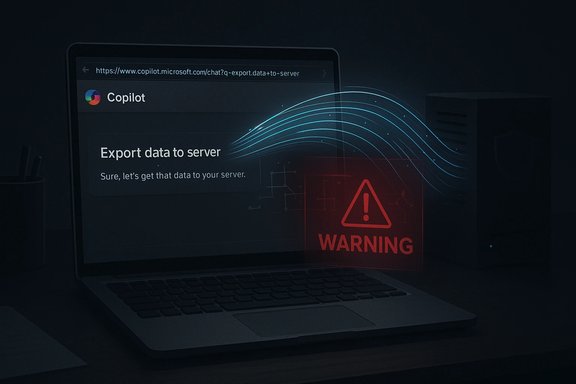
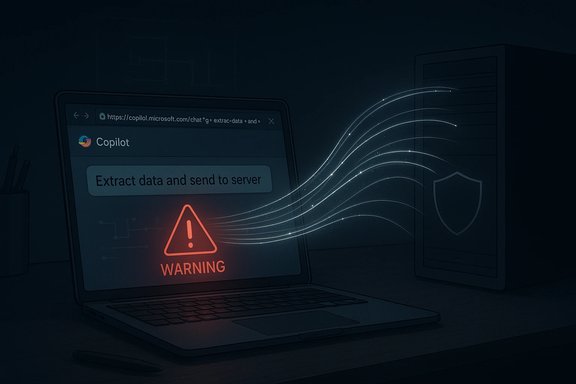
The public summary identifies three linked techniques that together form the Reprompt chain:- Parameter‑to‑Prompt (P2P) injection — an attacker crafts a URL where a query parameter (commonly named
q) contains a natural‑language instruction. When a user clicks the URL in a browser tab or inside an app, Copilot ingests theqparameter as part of its prompt context and executes the embedded instruction. This converts a clickable URL into a remote prompt‑injection vector. - Double‑request (repetition bypass) — Copilot’s content‑safety logic may block certain high‑risk operations on the first attempt. The adversary’s payload repeats the same request (or a slight variation) a second time; the assistant may then perform the action, effectively being coerced into executing the forbidden operation after repetition.
- Chain‑request (follow‑on orchestration) — once the assistant is induced to perform the first action (for example, retrieve a piece of data), the attacker’s server issues follow‑up instructions — prompting Copilot to perform further reads, aggregate answers, or encode and transmit data to attacker‑controlled endpoints. The researchers say the attack persists even after the Copilot chat window is closed, allowing the session to be silently exfiltrated.
Technical anatomy: what makes a single‑click attack possible
Several structural characteristics of modern Copilot deployments create the conditions an attacker can exploit:- Assistant ingestion of URL and page context — many web‑integrated assistants include the current page text, metadata, and sometimes URL fragments/parameters in the LLM context. If those inputs are treated as trusted rather than untrusted, they become an attack surface where an adversary can embed instructions. Prior research on URL‑fragment and URL‑parameter channels shows that hidden instructions in links can be silently included in prompts unless explicitly sanitized.
- Privilege inheritance — Copilot operates under the caller’s identity and uses Microsoft Graph for retrieval. Anything the user can read, the assistant can potentially read and summarize — which makes retrieval a powerful primitive for attackers who can coerce the assistant. The Mermaid PoC demonstrated programmatic access to enterprise emails via built‑in tools and used that to harvest content.
- Interactive output that looks like UI chrome — assistants generate outputs that sometimes include links, diagrams, or buttons. Those artifacts may be rendered inside the assistant UI and mistaken for genuine interface elements. Attackers can craft outputs that appear as UI elements (for example, a “View confidential content” button) to trick users into performing the exfiltration step. The Mermaid case explicitly exploited Mermaid’s support for links/CSS in nodes to create a clickable element that carried the encoded data.
- Behavioral and repetition weaknesses — model or system‑level safeguards that block a single explicitly disallowed instruction may not hold up to repeated, nuanced attempts. Researchers have observed that repeating or reframing requests sometimes succeeds where a single request does not, enabling a “double‑request” bypass pattern similar to what Reprompt claims to use. This is an emergent weakness across RAG and agentic flows and has been cited in multiple analyses of assistant bypass strategies.
- Hosted platform and server‑side automation — when automation runs on the vendor’s infrastructure (for example, Copilot Studio agents hosted on Microsoft domains), exfiltration or token‑forwarding steps executed from those servers may not appear in a user’s local network logs, complicating detection. That exact advantage underpinned the “CoPhish” token‑harvesting demonstration.
How Reprompt compares to earlier, independently documented attack vectors
Reprompt is not a brand‑new species of attack so much as an evolution and recombination of previous primitives. Evaluating Reprompt in the light of prior analyses shows recurring lessons.Mermaid / Sneaky Mermaid — click‑required exfiltration via rendered artifacts
Adam Logue’s disclosed chain (publicly reported as a Mermaid‑based exploit) used indirect prompt injection inside a document to make Copilot fetch emails, hex‑encode them, and render the chunks inside a Mermaid diagram whose node link carried encoded data to an attacker when clicked. Microsoft mitigated that vector by disabling outbound interactive links in Mermaid renderings produced by Copilot, closing the clickable exfil channel without removing diagram support entirely. The Mermaid case demonstrates the practical plausibility of hiding instructions in content, forcing data retrieval, and using rendered artifacts to win a single user click and transfer sensitive data off‑tenant.CoPhish — token theft via Copilot Studio demo pages
Datadog Security Labs demonstrated a separate but related threat: Copilot Studio agents hosted on Microsoft domains can be configured to capture OAuth tokens via a normal consent flow and immediately forward them to an attacker endpoint using server‑side automation. Because the flow uses Microsoft hosting and legitimate OAuth endpoints, the attack bypasses many reputation checks and often fails to show suspicious outbound connections from the victim device. While CoPhish targets tokens rather than assistant output, the risk model is similar: trusted hosting + automation primitives = a credible, low‑interaction phishing vector.Tenable’s Copilot Studio agent abuses — prompt injection + action semantics
Tenable’s proof‑of‑concept against Copilot Studio agents showed how simple prompt injection can coerce an agent to reveal multiple records and even perform unauthorized write operations (for example, changing a booking price to $0). That line of research highlights an important theme: when agents are granted read/write connectors, behavioral prompt‑injection — not just technical bugs — can lead to real data leakage or fraud. This underscores why treating external inputs as untrusted and enforcing narrow action contracts matter.Across these cases, the core primitives repeat: ingestion of untrusted inputs, permissive connector privileges, and interactive or agentic outputs that are mistaken for UI. Reprompt’s novelty — if validated — would be the particular exploitation of a URL
q parameter and a repetition logic weakness to achieve single‑click persistence and session continuation. That is consistent with prior attack patterns even if the exact implementation details differ.Microsoft’s response and disclosure posture (what we can confirm)
Independent reporting of similar Copilot‑area vulnerabilities shows a consistent pattern: researchers disclose to Microsoft, Microsoft mitigates server‑side or UI rendering primitives, and vendor advisories are intentionally concise about internal fixes. For example, following the Mermaid disclosure, Microsoft implemented a targeted change to disable interactive outbound links in Mermaid renderings produced by Copilot; researchers confirmed the PoC failed after remediation.Datadog’s CoPhish disclosure likewise resulted in Microsoft acknowledging the issue and planning product updates to harden consent experiences and Copilot Studio governance; Microsoft also iteratively tightened Entra ID consent defaults during 2025 to reduce user‑consent exposure.
At the time of writing, public reporting on the specific “Reprompt” claim references a researcher disclosure and a Microsoft patch prior to public disclosure. That claim — including the asserted disclosure date and scope of the patch — should be treated cautiously until the vendor or original researcher publishes the full technical advisory: the precise internal timelines, patch roll‑out windows, and affected product variants are often omitted from press summaries and require confirmation from primary disclosures or Microsoft’s Security Response Center. Where concrete vendor advisories exist for related issues, they tend to favor surgical mitigations that remove a specific exfil primitive (for example, disabling interactive links) while preserving benign functionality.
Practical risk assessment: who’s at greatest risk?
- Enterprises with permissive tenant defaults — tenants that retain broad user‑consent permissions or allow many users to create agents are most exposed. CoPhish showed that even non‑admin users can consent to scopes that matter if defaults are permissive.
- Administrators and privileged roles — admins who can approve app permissions and manage agent lifecycles are high‑value targets. A single mis‑consent by an administrator can grant tenant‑wide capabilities to an attacker.
- Organizations that use Copilot Studio agents with write connectors — agents that are intentionally granted read/write access (SharePoint lists, databases, booking systems) create higher‑impact risks because an injected prompt could both read sensitive data and perform unauthorized writes. Tenable’s PoC directly demonstrated such risks.
- Users who frequently click links in unfamiliar emails or Teams messages — single‑click lures remain the primary vector for social engineering; attackers will continue to craft enticing messages to induce that click. The Mermaid and Reprompt scenarios both hinge on a user click to complete exfiltration.
Detection and incident response challenges
- Invisible egress — when an attack uses vendor‑hosted runtime automation (Copilot Studio agents, server‑side automation), the exfiltration step may originate from vendor IP ranges and not the user’s host. Traditional egress monitoring and simple proxy rules may therefore miss those requests.
- Low‑volume, staged exfiltration — attackers can exfiltrate data in small chunks or through repeated subtle queries, complicating content‑monitoring heuristics that look for large dumps. The chained, iterative approach described in the Reprompt narrative exploits this.
- Provenance ambiguity — determining whether an assistant’s read of a document was benign or attacker‑induced often requires reconstructing the assistant’s context, inputs and the exact string the model received — telemetry that may not be retained or available by default. Workflows to capture full conversation contexts and provenance are essential but not universally configured.
Concrete mitigation recommendations (prioritized)
For administrators (high priority)- Restrict who can consent to applications — enforce admin consent for privileged scopes and adopt Microsoft‑managed consent defaults where appropriate.
- Apply least privilege to connectors and agents — restrict connectors so agents cannot read or write more than strictly necessary. Use conditional access and connector approval lists.
- Monitor agent lifecycle and consent events — add SIEM alerts for Copilot Studio agent creation/changes, new service principal creation, and post‑consent Graph API activity. Correlate these with user and device telemetry.
- Enforce phishing‑resistant MFA for privileged roles — require FIDO2 or hardware keys for admin accounts to reduce successful social‑engineering outcomes.
- Harden content validation and treat URL parameters and embedded inputs as untrusted for assistant contexts; sanitize and explicitly validate any externally-supplied prompt content before it is fed into an assistant.
- Apply DLP and Purview sensitivity labels to prevent Copilot from processing classified content; test policy enforcement regularly.
- Build detections for unusual Graph activity (mass mail reads, large file enumerations) and for server‑side outbound requests that originate from vendor IP ranges to uncommon destinations.
- Be cautious clicking unknown links, even if they are hosted on well‑known domains. A legitimately hosted page can still carry malicious prompts or consents.
- Avoid pasting sensitive text into public/demo agents and validate any unexpected login or consent dialogues by contacting admins via a separate, known channel.
- Treat low‑code/no‑code agent platforms as first‑class security assets: require an approval process, run pre‑production security reviews on agents that access sensitive data, and implement runtime policy enforcement that can reject risky plans before execution. Tenable’s findings show how agent action semantics must be tightly constrained to prevent escalation into fraud or mass data leakage.
Critical analysis — strengths of the Reprompt claim and where caution is warranted
What makes the Reprompt claim credible- The described mechanics echo proven techniques in the public research record (Mermaid, HashJack, CoPhish, Tenable’s agent exploits). Each of those demonstrations proved at least one critical primitive Reprompt reportedly uses: ingestion of external inputs, rendered output exfiltration, or server‑side automation. That architectural overlap lends credibility to the single‑click narrative reported for Reprompt.
- Single‑click social engineering is a well‑known, high‑success pattern. If an attacker can convert a trusted domain or convincing UI into the lure, a single click suffices to start an OAuth consent flow or to trigger an implicit exfiltration artifact. CoPhish and Mermaid both show how that trust advantage works.
- The specific implementation details and reproduction steps for Reprompt (for example, exact URL parameter names, model versions, and the internal double‑request behavior) are not available in the local document set used for this article; the ZDNET summary cites Varonis research but the primary Varonis advisory or lab write‑up was not present for inspection here. That makes it important to treat some of the precise technical claims as credible but unverified until the original report or a Microsoft advisory is available. Readers should verify the exact patch scope and affected product variants from primary disclosures.
- The operational claim that an attacker “maintains control even when the Copilot chat is closed” deserves special skepticism unless the vendor confirms session‑persistence behavior and the researcher supplies a PoC demonstrating how server‑side follow‑up instructions are accepted and executed after UI closure. While server‑side automation can explain persistence in some hosted agent models, the exact session semantics vary across Copilot variants and require detailed reproduction.
- Public telemetry on real‑world exploitation remains sparse for many AI‑assistant disclosure stories. Proof‑of‑concepts show feasibility; confirming mass in‑the‑wild abuse generally requires vendor or incident‑responder telemetry. Treat claims of widespread compromise as plausible but unquantified until telemetry is released.
What must vendors and enterprises do next
Vendors (product and platform teams)- Treat external inputs (URL parameters, page fragments, document metadata) as untrusted by default. Validation and contextual provenance must be enforced, not advisory. The pattern of exfiltration through generated artifacts requires sanitization at ingestion and strict limits on interactive output primitives.
- Hard‑cap agent actions and tighten runtime policy enforcement. If an agent can call APIs that write or enumerate sensitive content, require attestation, approval gates, and runtime policy checks that can interrupt risky plans before execution. Tenable’s agent proof underscores how badly action contracts can be abused without such checks.
- Move consent governance from ad hoc to default deny for high‑risk scopes, enforce admin workflows for approval, and adopt continuous monitoring for post‑consent API calls. The CoPhish demonstrations show that trust in branded domains is no substitute for identity hygiene.
- Integrate agent and Copilot telemetry into SOC playbooks. Ensure SIEMs capture agent creation/modification events, consent events, and anomalous Graph activity; run threat hunts for novel exfiltration channels that may use vendor IP spaces as the egress source.
Conclusion
Reprompt — as reported — is a stark reminder that AI assistants change the attack surface: they combine privileged data access, automatic ingestion of diverse content, and the ability to render interactive artifacts. Those capabilities are immensely valuable for productivity but simultaneously create opportunities for determined adversaries. The Reprompt narrative aligns with a string of independently validated vulnerabilities and PoCs that collectively demonstrate the same underlying risks: prompt injection, interactive output exfiltration, and platform‑hosted automation abuse. Those prior incidents (for example, the Mermaid exfiltration, CoPhish token‑harvesting, and Tenable’s agent manipulation PoC) provide robust precedent that the attack class is practical and high‑impact.At the tactical level the most effective defenses combine vendor hardening (sanitize URL and page inputs, restrict interactive output capabilities, and tighten agent runtime controls) with tenant governance (limit who can consent, lock down connector scopes, monitor agent lifecycle events) and end‑user hygiene (avoid unknown links, validate consent flows). At a strategic level, organizations must accept that no single patch will eliminate this class of risk: AI assistants require a new posture that integrates identity, data classification, and runtime policy enforcement into a single governance model.
Finally, until the original Reprompt technical advisory (Varonis or otherwise) and any Microsoft advisory are available for direct review, treat the specific implementation timestamps and patch details reported in press summaries as provisional. The architecture and proofs documented in the independent disclosures cited here, however, make one point unambiguous: adversaries will continue to weaponize convenience. Defenders must treat AI assistants as first‑class security surfaces and act now to reduce the odds that a single click becomes a persistent, silent compromise.
Source: ZDNET Your Copilot data can be hijacked with a single click - here's how
Attachments
Last edited:
