

Microsoft and SAP announced in May 2026 that they will expand the global RISE with SAP on Microsoft Azure initiative, more than doubling customer capacity in 2026 for a no-extra-cost program that pairs SAP migrations with Microsoft Azure engineering, architecture, and support resources.
That sounds like partner-program boilerplate until you read it as a signal about where enterprise cloud projects actually fail. The companies are not merely selling more infrastructure or another migration framework; they are admitting that moving SAP’s most important workloads to the cloud is still hard enough, risky enough, and politically sensitive enough to require a staffed runway. For WindowsForum readers, the news matters because Azure is not just the hosting layer in this story — it is becoming the operating environment for some of the most consequential business systems in the enterprise.
RISE with SAP has always been pitched as a path away from the old ERP world: less owned infrastructure, more managed service, fewer fragmented upgrade cycles, and a cleaner road toward SAP S/4HANA and cloud-native modernization. In practice, that promise collides with the stubborn reality of ERP estates that have been modified, integrated, extended, and politically defended for decades.
Microsoft’s role in the expanded initiative is therefore not simply to provide Azure capacity. The program gives approved customers access to SAP-skilled Microsoft product engineers, cloud solution architects, support experts, and the Microsoft Cloud Accelerate Factory. That is a notable escalation from the usual cloud-provider posture of “here are the reference architectures, good luck with your partner ecosystem.”
The most revealing part of the announcement is that the program is offered at zero additional cost to approved customers. Microsoft and SAP are effectively absorbing the cost of extra handholding because the alternative is more expensive: stalled migrations, botched cutovers, angry boards, delayed innovation claims, and a perception that RISE is another grand enterprise transformation that looks better in PowerPoint than in production.
This is why the expansion should be read less as a victory lap and more as a pressure release valve. If thousands of customers are already moving through RISE with SAP on Azure, as SAP says, then the bottleneck has shifted from convincing enterprises to consider cloud ERP to making sure their go-lives do not become cautionary tales.
That audience does not move because a vendor says “AI-ready” in a press release. It moves when the risk of staying put exceeds the risk of migration. SAP has spent years trying to create that pressure through S/4HANA modernization, cloud economics, process standardization, and the promise of more frequent innovation. Microsoft has spent just as long arguing that Azure can host the enterprise core without forcing customers to abandon their existing Microsoft identity, security, analytics, and productivity investments.
The expanded initiative lands at the intersection of those two pressures. SAP needs RISE migrations to look less like bespoke consulting odysseys. Microsoft needs Azure to be seen as the safest landing zone for SAP workloads, especially in companies already standardized on Microsoft 365, Entra ID, Defender, Sentinel, Power Platform, Teams, and Fabric.
The named customers in SAP’s announcement — Nestlé, Migros, and Samsung — are doing quiet work here. These are not logos chosen only for glamour; they represent the kind of scale, geography, and operational complexity that makes ERP modernization terrifying. If such companies can be framed as already transforming on RISE with SAP on Azure, the message to other CIOs is clear: you are not early anymore.
That is where the joint initiative becomes interesting. SAP says the program provides streamlined escalation paths across SAP and Microsoft, with aligned oversight and guidance at every step. That may not sound glamorous, but in a complex SAP-on-cloud project it is often the difference between a difficult weekend and a damaging outage.
The classic enterprise failure mode is not that nobody knows anything. It is that too many parties know one slice of the stack, each with contractual reasons to point elsewhere. SAP owns the application and managed service. Microsoft owns the cloud substrate. A systems integrator may own much of the migration execution. The customer owns the business consequences. When performance, networking, identity, storage, backup, latency, or integration problems appear, the seams become visible fast.
A joint escalation model is an attempt to hide those seams from the customer at the worst possible moment. It does not eliminate complexity, but it changes the operating model from sequential blame assignment to coordinated troubleshooting. For IT pros who have lived through critical incidents involving multiple vendors, that is not a minor perk. It is the product.
That matters beyond infrastructure revenue. SAP on Azure pulls along networking, identity, monitoring, security, data integration, analytics, and AI services. A successful RISE migration can make Azure the platform through which the business accesses operational data, automates processes, and experiments with AI on trusted enterprise records.
This is why Microsoft’s language around the program emphasizes a “secure, predictable, and AI-ready journey.” Predictability is the bridge to AI. Before a company can sensibly talk about copilots, agents, forecasting, or process automation, it needs the core system to be stable, observable, governed, and accessible through modern interfaces.
The strategic bet is that SAP modernization will become an Azure adoption engine. Microsoft does not need every SAP customer to become a cloud-native purist. It needs them to decide that the least risky way to modernize the ERP core is to do it in a cloud environment where Microsoft can surround SAP with identity, security, data, developer, and productivity services.
RISE with SAP softens that tension by packaging the business transformation narrative under SAP’s umbrella while allowing major cloud partners to provide the underlying environment. Azure is one of the most important of those environments because Microsoft already has deep enterprise relationships and a massive footprint inside the same companies SAP wants to move.
The expanded program makes the dependency more explicit. SAP is not saying, “Trust us alone.” It is saying, “Trust us with Microsoft beside us.” That is a stronger message for customers who have already built governance, security, compliance, and operations around Azure.
There is a practical reason for this humility. ERP modernization is not simply a workload placement exercise. It touches business process design, regulatory controls, reporting, custom code, data residency, disaster recovery, user access, and decades of integration debt. SAP may own the process model and application roadmap, but Microsoft increasingly owns the enterprise control plane in which those processes operate.
That does not mean the broader RISE journey is cheap, simple, or devoid of consulting cost. It means the vendors are removing one obvious objection to deeper engagement: the fear that every escalation, review, or engineering touchpoint becomes another line item. For customers already staring at a large ERP modernization budget, bundled access to specialized help can change the internal conversation.
It also sharpens the competitive positioning against other hyperscalers. AWS and Google Cloud both have credible SAP stories, and many enterprises run mixed-cloud estates. But Microsoft can now argue not only that Azure is a capable SAP platform, but that SAP and Microsoft have built a jointly staffed acceleration model designed to reduce migration risk.
That matters because cloud selection for SAP is rarely a purely technical benchmark contest. It is a board-level risk decision wrapped in commercial negotiation. A free, vendor-backed, escalation-friendly program gives Microsoft account teams a powerful way to make Azure feel less lonely.
That standardization is essential if the company wants to scale high-touch SAP migrations without turning every project into artisanal consulting. Azure architecture reviews, health checks, migration patterns, readiness milestones, and support paths can be packaged into a repeatable operating model. The more repeatable that model becomes, the more Microsoft can reduce variance in customer outcomes.
This also gives Microsoft a better view into where SAP-on-Azure migrations stumble. If the same integration, networking, sizing, identity, availability, or operational-readiness problems appear across many customers, Microsoft can feed that intelligence back into engineering, documentation, tooling, and partner guidance.
For customers, the upside is access to patterns that have been hardened through previous projects. The downside is that factories tend to favor standardization, and SAP estates are often deeply nonstandard. The program’s value will depend on whether Microsoft and SAP can apply repeatable discipline without ignoring the messy exceptions that make each ERP landscape unique.
A failed or degraded ERP cutover can interrupt invoicing, payroll, inventory movement, procurement, manufacturing planning, financial close, and customer fulfillment. Unlike many software outages, ERP failures often become business-process failures almost immediately. The risk is not just that a server is down. The risk is that the organization cannot reliably execute the transactions that make it function.
This is where proactive health checks and architecture reviews become more than ceremonial gates. They are attempts to catch the boring but dangerous issues before the final weekend: insufficient capacity planning, weak network assumptions, poorly understood dependencies, incomplete monitoring, fragile integrations, unclear rollback plans, and ownership gaps between teams.
The program’s promise is that customers will receive engagement at key project milestones rather than waiting until the final stage to discover that readiness was more aspirational than real. If that works, the program could reduce the number of migrations that technically succeed but leave business teams exhausted, distrustful, and reluctant to pursue further modernization.
The irony is that the most important AI-enabling work is not glamorous. It is data quality, process standardization, security boundaries, identity governance, integration architecture, and operational resilience. RISE with SAP on Azure is attractive to vendors because it creates a cleaner foundation for future AI services, but customers should not confuse the foundation with the outcome.
For Windows and Azure administrators, this is a familiar pattern. The flashy demo depends on the unflashy control plane. If Entra ID, role design, monitoring, network segmentation, backup, incident response, and compliance evidence are weak, the AI layer will inherit that weakness. If the ERP data model remains fragmented and poorly governed, no amount of agentic branding will make it trustworthy.
That is why the expanded initiative’s practical support mechanisms may matter more than its innovation language. The route to AI-ready SAP estates runs through careful cloud operations. Microsoft and SAP are not really promising magic; they are promising to help customers do the hard preparatory work without falling into the gaps between vendors.
That can be powerful. Identity policies, conditional access, privileged access controls, logging, security monitoring, and compliance workflows can become more coherent when SAP-related infrastructure and adjacent services are integrated into Azure-native operations. Security teams can benefit from a more unified view of access and activity.
But concentration also creates systemic risk. If the Microsoft tenant, identity configuration, privileged access model, or monitoring architecture is poorly managed, the blast radius can expand. A cloud ERP migration is therefore not only an SAP project or an Azure infrastructure project. It is an enterprise security architecture project.
This is where IT pros should resist the temptation to treat RISE as something the SAP team and a systems integrator will “handle.” The Windows, identity, networking, endpoint, and security teams need a seat at the table early. The technical choices made during a RISE migration can shape access patterns, operational visibility, and incident response for years.
That can be good for customers and uncomfortable for weaker partners. A partner that relies on ambiguity, proprietary migration folklore, or endless advisory cycles may find it harder to justify its role when SAP and Microsoft provide clearer best-practice guidance and direct escalation paths. Strong partners, by contrast, can use the program as a force multiplier.
The healthiest version of this ecosystem is one where SAP defines the application and process path, Microsoft hardens the Azure foundation, and partners focus on the customer-specific transformation work that vendors cannot industrialize. The unhealthy version is one where too many parties crowd the project, each adding meetings but not accountability.
Customers should therefore ask a sharper question: not “who is involved?” but “who owns each failure mode?” If performance lags, who investigates first? If a cutover task slips, who decides whether to proceed? If an integration fails, who has authority to change the design? The expanded initiative is valuable only if it clarifies responsibility rather than adding another layer of coordination theater.
That is why RISE with SAP on Azure is more strategically important than a normal cloud workload announcement. If Microsoft can make Azure the preferred environment for SAP modernization, it gets a stronger claim on the next generation of enterprise process automation. Fabric, Power BI, Power Platform, Copilot, Teams, Defender, Sentinel, and Azure AI all become easier to position around the SAP core.
SAP benefits too, because a smoother Azure path can accelerate movement away from legacy environments and toward its preferred cloud operating model. The company needs customers to modernize fast enough to support its product strategy, but not so fast that they revolt against the cost and complexity. A joint support initiative helps thread that needle.
The bigger story is that enterprise cloud is entering a phase where control of the application, control of the data platform, and control of the operational plane are converging. SAP brings the business system. Microsoft brings the cloud estate. The customer brings the risk. This program is an attempt to make that convergence feel manageable.
Eligibility will shape the real-world impact. If the program prioritizes large strategic accounts, global brands, complex migrations, or customers already deep in the RISE pipeline, smaller organizations may see the announcement mainly as a sign of direction rather than a resource they can immediately use. If capacity expands broadly and consistently, the initiative could become a more meaningful standard part of the RISE-on-Azure journey.
Execution will matter even more. Enterprise customers have heard countless promises about best practices, shared accountability, and simplified transformation. The test is whether the program produces fewer escalations, faster resolutions, cleaner go-lives, and more predictable operations after cutover.
There is also a measurement problem. Vendors love to celebrate migrations completed; customers care about business outcomes after the celebratory slide deck has been archived. The strongest evidence for this initiative will not be the number of customers admitted, but whether those customers avoid the prolonged instability, cost overruns, and operational frustration that have haunted ERP projects for decades.
Source: SAP News Center Expanding the Global RISE with SAP on Microsoft Azure Initiative: Elevating Customer Success with Microsoft and SAP
That sounds like partner-program boilerplate until you read it as a signal about where enterprise cloud projects actually fail. The companies are not merely selling more infrastructure or another migration framework; they are admitting that moving SAP’s most important workloads to the cloud is still hard enough, risky enough, and politically sensitive enough to require a staffed runway. For WindowsForum readers, the news matters because Azure is not just the hosting layer in this story — it is becoming the operating environment for some of the most consequential business systems in the enterprise.
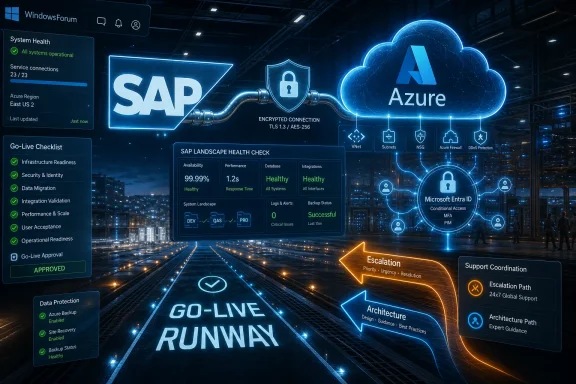 SAP and Microsoft Are Selling Confidence, Not Just Compute
RISE with SAP has always been pitched as a path away from the old ERP world: less owned infrastructure, more managed service, fewer fragmented upgrade cycles, and a cleaner road toward SAP S/4HANA and cloud-native modernization. In practice, that promise collides with the stubborn reality of ERP estates that have been modified, integrated, extended, and politically defended for decades.Microsoft’s role in the expanded initiative is therefore not simply to provide Azure capacity. The program gives approved customers access to SAP-skilled Microsoft product engineers, cloud solution architects, support experts, and the Microsoft Cloud Accelerate Factory. That is a notable escalation from the usual cloud-provider posture of “here are the reference architectures, good luck with your partner ecosystem.”
The most revealing part of the announcement is that the program is offered at zero additional cost to approved customers. Microsoft and SAP are effectively absorbing the cost of extra handholding because the alternative is more expensive: stalled migrations, botched cutovers, angry boards, delayed innovation claims, and a perception that RISE is another grand enterprise transformation that looks better in PowerPoint than in production.
This is why the expansion should be read less as a victory lap and more as a pressure release valve. If thousands of customers are already moving through RISE with SAP on Azure, as SAP says, then the bottleneck has shifted from convincing enterprises to consider cloud ERP to making sure their go-lives do not become cautionary tales.
The RISE Pitch Has Reached Its Hardest Audience
SAP’s installed base is not made up of hobbyists looking for the newest platform. It is made up of manufacturers, retailers, banks, logistics companies, public-sector bodies, and multinational conglomerates whose ERP systems are often closer to industrial infrastructure than conventional software.That audience does not move because a vendor says “AI-ready” in a press release. It moves when the risk of staying put exceeds the risk of migration. SAP has spent years trying to create that pressure through S/4HANA modernization, cloud economics, process standardization, and the promise of more frequent innovation. Microsoft has spent just as long arguing that Azure can host the enterprise core without forcing customers to abandon their existing Microsoft identity, security, analytics, and productivity investments.
The expanded initiative lands at the intersection of those two pressures. SAP needs RISE migrations to look less like bespoke consulting odysseys. Microsoft needs Azure to be seen as the safest landing zone for SAP workloads, especially in companies already standardized on Microsoft 365, Entra ID, Defender, Sentinel, Power Platform, Teams, and Fabric.
The named customers in SAP’s announcement — Nestlé, Migros, and Samsung — are doing quiet work here. These are not logos chosen only for glamour; they represent the kind of scale, geography, and operational complexity that makes ERP modernization terrifying. If such companies can be framed as already transforming on RISE with SAP on Azure, the message to other CIOs is clear: you are not early anymore.
The Real Product Is the Escalation Path
Enterprise buyers are conditioned to distrust frictionless migration stories. They know the vocabulary: readiness assessment, health check, architecture review, best practice, innovation pathway. What they want to know is simpler: when the cutover clock is running and something breaks, who owns the problem?That is where the joint initiative becomes interesting. SAP says the program provides streamlined escalation paths across SAP and Microsoft, with aligned oversight and guidance at every step. That may not sound glamorous, but in a complex SAP-on-cloud project it is often the difference between a difficult weekend and a damaging outage.
The classic enterprise failure mode is not that nobody knows anything. It is that too many parties know one slice of the stack, each with contractual reasons to point elsewhere. SAP owns the application and managed service. Microsoft owns the cloud substrate. A systems integrator may own much of the migration execution. The customer owns the business consequences. When performance, networking, identity, storage, backup, latency, or integration problems appear, the seams become visible fast.
A joint escalation model is an attempt to hide those seams from the customer at the worst possible moment. It does not eliminate complexity, but it changes the operating model from sequential blame assignment to coordinated troubleshooting. For IT pros who have lived through critical incidents involving multiple vendors, that is not a minor perk. It is the product.
Azure Wins When SAP Becomes Someone Else’s Urgency
Microsoft has spent years turning Azure into the default enterprise cloud for organizations that already live inside the Microsoft ecosystem. SAP workloads are among the last great prizes because they are sticky, expensive, and strategically central. If the system that runs finance, procurement, manufacturing, inventory, and supply chain lands on Azure, a large portion of the enterprise’s digital center of gravity moves with it.That matters beyond infrastructure revenue. SAP on Azure pulls along networking, identity, monitoring, security, data integration, analytics, and AI services. A successful RISE migration can make Azure the platform through which the business accesses operational data, automates processes, and experiments with AI on trusted enterprise records.
This is why Microsoft’s language around the program emphasizes a “secure, predictable, and AI-ready journey.” Predictability is the bridge to AI. Before a company can sensibly talk about copilots, agents, forecasting, or process automation, it needs the core system to be stable, observable, governed, and accessible through modern interfaces.
The strategic bet is that SAP modernization will become an Azure adoption engine. Microsoft does not need every SAP customer to become a cloud-native purist. It needs them to decide that the least risky way to modernize the ERP core is to do it in a cloud environment where Microsoft can surround SAP with identity, security, data, developer, and productivity services.
SAP Needs the Hyperscalers More Than Its Branding Suggests
SAP’s cloud strategy has always carried a tension. The company wants customers to think of SAP as the strategic cloud partner for business transformation, not merely as an application vendor running on someone else’s infrastructure. Yet the reality of global enterprise cloud infrastructure is that hyperscalers bring scale, regions, tooling, and operational maturity that even the largest software companies prefer to harness rather than recreate.RISE with SAP softens that tension by packaging the business transformation narrative under SAP’s umbrella while allowing major cloud partners to provide the underlying environment. Azure is one of the most important of those environments because Microsoft already has deep enterprise relationships and a massive footprint inside the same companies SAP wants to move.
The expanded program makes the dependency more explicit. SAP is not saying, “Trust us alone.” It is saying, “Trust us with Microsoft beside us.” That is a stronger message for customers who have already built governance, security, compliance, and operations around Azure.
There is a practical reason for this humility. ERP modernization is not simply a workload placement exercise. It touches business process design, regulatory controls, reporting, custom code, data residency, disaster recovery, user access, and decades of integration debt. SAP may own the process model and application roadmap, but Microsoft increasingly owns the enterprise control plane in which those processes operate.
“No Additional Cost” Is a Competitive Weapon
The phrase “no additional cost” is easy to skim past, but it is one of the most commercially aggressive parts of the announcement. Enterprise transformation programs usually create an entire economy of advisory fees, premium support tiers, migration packages, partner accelerators, and governance workshops. Here, SAP and Microsoft are saying that selected customers can receive expanded technical resources without paying extra for the program itself.That does not mean the broader RISE journey is cheap, simple, or devoid of consulting cost. It means the vendors are removing one obvious objection to deeper engagement: the fear that every escalation, review, or engineering touchpoint becomes another line item. For customers already staring at a large ERP modernization budget, bundled access to specialized help can change the internal conversation.
It also sharpens the competitive positioning against other hyperscalers. AWS and Google Cloud both have credible SAP stories, and many enterprises run mixed-cloud estates. But Microsoft can now argue not only that Azure is a capable SAP platform, but that SAP and Microsoft have built a jointly staffed acceleration model designed to reduce migration risk.
That matters because cloud selection for SAP is rarely a purely technical benchmark contest. It is a board-level risk decision wrapped in commercial negotiation. A free, vendor-backed, escalation-friendly program gives Microsoft account teams a powerful way to make Azure feel less lonely.
The Cloud Accelerate Factory Shows Where Microsoft Wants Control
The announcement’s reference to the Microsoft Cloud Accelerate Factory deserves more attention than it will probably get. “Factory” language can sound like enterprise-marketing wallpaper, but it signals Microsoft’s desire to standardize repeatable modernization motions across customers.That standardization is essential if the company wants to scale high-touch SAP migrations without turning every project into artisanal consulting. Azure architecture reviews, health checks, migration patterns, readiness milestones, and support paths can be packaged into a repeatable operating model. The more repeatable that model becomes, the more Microsoft can reduce variance in customer outcomes.
This also gives Microsoft a better view into where SAP-on-Azure migrations stumble. If the same integration, networking, sizing, identity, availability, or operational-readiness problems appear across many customers, Microsoft can feed that intelligence back into engineering, documentation, tooling, and partner guidance.
For customers, the upside is access to patterns that have been hardened through previous projects. The downside is that factories tend to favor standardization, and SAP estates are often deeply nonstandard. The program’s value will depend on whether Microsoft and SAP can apply repeatable discipline without ignoring the messy exceptions that make each ERP landscape unique.
Go-Live Risk Is the Enemy Both Vendors Are Trying to Defeat
SAP’s announcement emphasizes frictionless go-lives, reduced technical downtime, reduced risk, and fewer post-processing cutover delays. That vocabulary may sound operational, but it points to the emotional core of enterprise ERP work: fear of the go-live.A failed or degraded ERP cutover can interrupt invoicing, payroll, inventory movement, procurement, manufacturing planning, financial close, and customer fulfillment. Unlike many software outages, ERP failures often become business-process failures almost immediately. The risk is not just that a server is down. The risk is that the organization cannot reliably execute the transactions that make it function.
This is where proactive health checks and architecture reviews become more than ceremonial gates. They are attempts to catch the boring but dangerous issues before the final weekend: insufficient capacity planning, weak network assumptions, poorly understood dependencies, incomplete monitoring, fragile integrations, unclear rollback plans, and ownership gaps between teams.
The program’s promise is that customers will receive engagement at key project milestones rather than waiting until the final stage to discover that readiness was more aspirational than real. If that works, the program could reduce the number of migrations that technically succeed but leave business teams exhausted, distrustful, and reluctant to pursue further modernization.
AI Is the Halo, but Operations Are the Work
Both Microsoft and SAP now frame almost every strategic cloud story through AI. That is understandable; enterprise buyers are under pressure to show that their technology roadmaps can support generative AI, agents, automation, and analytics. But in the SAP world, AI ambition is constrained by the condition of the underlying business systems.The irony is that the most important AI-enabling work is not glamorous. It is data quality, process standardization, security boundaries, identity governance, integration architecture, and operational resilience. RISE with SAP on Azure is attractive to vendors because it creates a cleaner foundation for future AI services, but customers should not confuse the foundation with the outcome.
For Windows and Azure administrators, this is a familiar pattern. The flashy demo depends on the unflashy control plane. If Entra ID, role design, monitoring, network segmentation, backup, incident response, and compliance evidence are weak, the AI layer will inherit that weakness. If the ERP data model remains fragmented and poorly governed, no amount of agentic branding will make it trustworthy.
That is why the expanded initiative’s practical support mechanisms may matter more than its innovation language. The route to AI-ready SAP estates runs through careful cloud operations. Microsoft and SAP are not really promising magic; they are promising to help customers do the hard preparatory work without falling into the gaps between vendors.
Windows Shops Should Watch the Identity and Security Implications
For many Windows-heavy enterprises, Azure is already the identity, device, and productivity backbone. Moving SAP workloads into that orbit can simplify some governance conversations, but it also raises the stakes. The ERP system becomes more tightly connected to the same Microsoft ecosystem that employees use every day.That can be powerful. Identity policies, conditional access, privileged access controls, logging, security monitoring, and compliance workflows can become more coherent when SAP-related infrastructure and adjacent services are integrated into Azure-native operations. Security teams can benefit from a more unified view of access and activity.
But concentration also creates systemic risk. If the Microsoft tenant, identity configuration, privileged access model, or monitoring architecture is poorly managed, the blast radius can expand. A cloud ERP migration is therefore not only an SAP project or an Azure infrastructure project. It is an enterprise security architecture project.
This is where IT pros should resist the temptation to treat RISE as something the SAP team and a systems integrator will “handle.” The Windows, identity, networking, endpoint, and security teams need a seat at the table early. The technical choices made during a RISE migration can shape access patterns, operational visibility, and incident response for years.
The Announcement Quietly Raises the Bar for Partners
Systems integrators and managed service providers will not disappear from this model. If anything, customers will still need them for process redesign, custom code remediation, integration work, data migration, testing, change management, and industry-specific expertise. But the expanded SAP-Microsoft initiative changes the partner landscape by putting more vendor engineering muscle closer to the customer.That can be good for customers and uncomfortable for weaker partners. A partner that relies on ambiguity, proprietary migration folklore, or endless advisory cycles may find it harder to justify its role when SAP and Microsoft provide clearer best-practice guidance and direct escalation paths. Strong partners, by contrast, can use the program as a force multiplier.
The healthiest version of this ecosystem is one where SAP defines the application and process path, Microsoft hardens the Azure foundation, and partners focus on the customer-specific transformation work that vendors cannot industrialize. The unhealthy version is one where too many parties crowd the project, each adding meetings but not accountability.
Customers should therefore ask a sharper question: not “who is involved?” but “who owns each failure mode?” If performance lags, who investigates first? If a cutover task slips, who decides whether to proceed? If an integration fails, who has authority to change the design? The expanded initiative is valuable only if it clarifies responsibility rather than adding another layer of coordination theater.
This Is Also a Battle Over the Future of ERP Gravity
ERP systems have gravity. They attract data, workflows, reporting, integrations, permissions, and executive attention. Where ERP lands, other systems tend to orbit.That is why RISE with SAP on Azure is more strategically important than a normal cloud workload announcement. If Microsoft can make Azure the preferred environment for SAP modernization, it gets a stronger claim on the next generation of enterprise process automation. Fabric, Power BI, Power Platform, Copilot, Teams, Defender, Sentinel, and Azure AI all become easier to position around the SAP core.
SAP benefits too, because a smoother Azure path can accelerate movement away from legacy environments and toward its preferred cloud operating model. The company needs customers to modernize fast enough to support its product strategy, but not so fast that they revolt against the cost and complexity. A joint support initiative helps thread that needle.
The bigger story is that enterprise cloud is entering a phase where control of the application, control of the data platform, and control of the operational plane are converging. SAP brings the business system. Microsoft brings the cloud estate. The customer brings the risk. This program is an attempt to make that convergence feel manageable.
The Fine Print Lives in Eligibility and Execution
SAP says the program will more than double the number of customers allowed into it in 2026. That phrasing matters. This is not an open entitlement for every customer running SAP or considering Azure. It is a program for approved customers, accessed through SAP or Microsoft account representatives.Eligibility will shape the real-world impact. If the program prioritizes large strategic accounts, global brands, complex migrations, or customers already deep in the RISE pipeline, smaller organizations may see the announcement mainly as a sign of direction rather than a resource they can immediately use. If capacity expands broadly and consistently, the initiative could become a more meaningful standard part of the RISE-on-Azure journey.
Execution will matter even more. Enterprise customers have heard countless promises about best practices, shared accountability, and simplified transformation. The test is whether the program produces fewer escalations, faster resolutions, cleaner go-lives, and more predictable operations after cutover.
There is also a measurement problem. Vendors love to celebrate migrations completed; customers care about business outcomes after the celebratory slide deck has been archived. The strongest evidence for this initiative will not be the number of customers admitted, but whether those customers avoid the prolonged instability, cost overruns, and operational frustration that have haunted ERP projects for decades.
The Practical Message Hiding Inside the Partner Language
The expanded RISE with SAP on Azure initiative is easy to mistake for a conventional alliance update. It is more useful to read it as a practical checklist for what enterprises now expect from mission-critical cloud programs.- Enterprises are no longer satisfied with generic cloud reference architectures for systems as central as SAP.
- Microsoft and SAP are betting that direct engineering access and joint escalation paths can reduce the perceived risk of RISE migrations.
- Azure’s value in this program is not just hosting capacity, but its surrounding identity, security, data, support, and AI ecosystem.
- The zero-cost program model suggests both vendors see migration confidence as strategically valuable enough to subsidize.
- IT teams should treat RISE on Azure as a cross-domain architecture program involving SAP, cloud infrastructure, identity, security, networking, data, and business continuity.
- The program’s success will be judged less by announcement language than by go-live quality, post-cutover stability, and the speed with which customers can safely modernize after migration.
Source: SAP News Center Expanding the Global RISE with SAP on Microsoft Azure Initiative: Elevating Customer Success with Microsoft and SAP
