

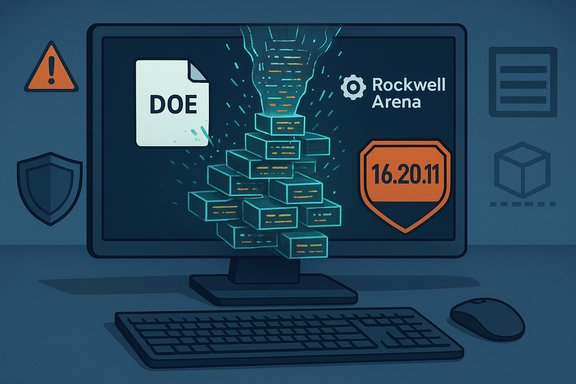
Rockwell Automation has disclosed a stack‑based buffer overflow in Arena® Simulation that can be triggered when the product parses a malicious DOE file, allowing a local user who opens that file to potentially execute arbitrary code — affected installs are Arena version 16.20.10 and earlier, and Rockwell’s patch for the issue is Arena 16.20.11 (or later).
Background / Overview
Arena® Simulation is a widely used discrete‑event modeling tool in manufacturing, logistics and operations research, often run on Windows engineering workstations where it processes project and data exchange files such as DOE files. On November 14, 2025 Rockwell published Security Advisory SD1763 describing a stack‑based buffer overflow in the DOE file parser that has been assigned CVE‑2025‑11918. The vendor rates the defect as high severity and recommends upgrading to Arena 16.20.11 to remediate the vulnerability. National and third‑party vulnerability trackers have ingested the disclosure and reflect the same core facts: the flaw is a local, file‑parsing memory corruption that requires the victim to open a crafted DOE file and that, if successfully exploited, can yield arbitrary code execution in the context of the user running Arena. The NVD and independent aggregators show the CVE metadata and scoring consistent with the vendor advisory.What the advisory says — the essential facts
- Vulnerability: Stack‑based buffer overflow in the DOE file parsing code path.
- CVE: CVE‑2025‑11918.
- Affected versions: Arena 16.20.10 and prior.
- Fixed in: Arena 16.20.11 and later.
- Attack vector: Local — requires a user to open a malicious DOE file; no unauthenticated remote execution path documented.
- Impact: Arbitrary code execution (confidentiality, integrity and availability impacts are rated high when exploitation succeeds).
- Scores: Rockwell reports a CVSS v3.1 base score of 7.0 and a CVSS v4 base score of 7.1; some aggregators display slightly differing v3.x scores (minor scoring variances are common across registries). Administrators should use vendor and CNA data in their vulnerability management systems.
Why this matters to Windows‑centric OT/ICS environments
Arena is typically used on engineering workstations that hold design artifacts, simulation data, and sometimes credentials or access to operational engineering networks. Those hosts are often more trusted than a standard desktop and, when compromised, can be leveraged as footholds for lateral movement into operational technology (OT) environments.- Engineering workstation privileges: The process running Arena is generally executed with the privileges of a logged‑in engineer or operator; a successful exploit executes code at that privilege level. That is enough in many environments to tamper with project files, exfiltrate data, or stage further escalation.
- File‑exchange workflows: DOE and other project files are commonly exchanged between vendors, contractors and internal teams. Trusted file interchange increases the practical risk because adversaries often weaponize that trust to deliver crafted files.
- Patch windows in OT: Industrial environments frequently delay or tightly control software updates; this extends the exposure window after disclosure and increases reliance on compensating controls.
Technical analysis — how the flaw behaves and how realistic exploitation is
The bug: stack‑based buffer overflow in DOE parsing
The published advisory describes a classic stack buffer overflow (CWE‑121) triggered when Arena parses DOE files. If parsing logic copies unvalidated or overlong input into a fixed‑length stack buffer, adjacent stack memory (return addresses, frame pointers, local variables) can be corrupted, enabling crashes or, with carefully crafted payloads and favorable process memory layout, control‑flow hijacking and code execution.Exploitation model and prerequisites
- The attacker must deliver a malicious DOE file to the target system — common vectors include email attachments, shared repositories, contractor file drops or removable media.
- A local user must open that DOE file in Arena; there is no documented unauthenticated remote trigger. Because user interaction is required, the vector is classified as local + user interaction.
Practical exploitability considerations
- Modern Windows mitigations — ASLR, DEP/NX, stack canaries and Control Flow Guard (CFG) — raise the difficulty of converting a stack overflow into reliable arbitrary code execution, but they do not eliminate the risk. Skilled exploit authors can chain memory leaks or predictable layouts to bypass mitigations in some environments, and many OT hosts run older OS images or lack the latest mitigations.
- The vendor and registry scores indicate high impact but a local vector; operational risk is therefore concentrated where file exchange and workstation trust are permitted.
- At the time of disclosure, no confirmed in‑the‑wild exploitation has been reported, but absence of observed exploitation is not a guarantee that weaponization is impossible or won’t follow.
Cross‑checking the record (verification and scoring discrepancies)
Multiple independent sources were reviewed to validate the vendor’s claims and scoring:- Rockwell’s advisory SD1763 provides the authoritative vulnerability description and remediation path (upgrade to 16.20.11).
- The U.S. national feed (NVD/CVE) has ingested the CVE and reflects the local, file‑parsing overflow description; NVD lists a CVSS v4 vector consistent with the vendor’s v4 assessment.
- Third‑party aggregators (CVE Details, OpenCVE, Aqua Security / AVD) mirror the vendor’s technical summary and show minor numeric differences in v3.x scoring in some mirrors. Such discrepancies typically arise from vendor vs. registry vs. third‑party re‑scoring methodologies; prioritize the vendor/CNA and NVD entries for operational decisions.
Mitigation checklist — immediate and medium‑term actions
The vendor’s single corrective action is to upgrade Arena to 16.20.11 or later. Where upgrades cannot be applied immediately, implement layered compensating controls tailored to OT/engineering hosts.Priority actions (apply in order):
- Patch
- Upgrade affected hosts to Arena 16.20.11 and validate simulation workflows in a test environment before wide rollout.
- Inventory and prioritize
- Build an accurate inventory of all engineering workstations and servers running Arena.
- Prioritize patching by exposure (domain‑joined hosts, machines that access shared project repositories, and systems that can reach OT networks).
- Network segmentation and egress filtering
- Place engineering hosts into an isolated VLAN with strict firewall rules.
- Block or sharply restrict outbound SMB and other file‑share protocols from engineering hosts unless explicitly required and monitored; this reduces the value of credential harvesting or lateral movement if post‑exploit activity attempts SMB connections.
- File handling and authentication controls
- Enforce safe file exchange practices: scan DOE and other project files with endpoint AV/EDR and sandboxing before allowing them on engineering machines.
- Use file integrity monitoring for project directories and prefer signed/verified project artifacts when available.
- User awareness and hardening
- Train engineering and vendor personnel to treat unsolicited or unexpected DOE files as suspicious.
- Apply least‑privilege principles: avoid running Arena with administrative rights; run under a user account that has only the minimum necessary privileges.
- Endpoint protection and detection
- Ensure EDR solutions are tuned to detect anomalous child processes, post‑exploit persistence attempts, and unusual writes to privileged file locations.
- Log and monitor file open events for Arena processes so suspicious DOE file opens generate alerts.
- Incident readiness
- Prepare a tested rollback and recovery plan for engineering hosts — snapshot or backup images enable faster remediation if exploitation is suspected.
- Establish contact and escalation processes with Rockwell support and national incident response entities if compromise is suspected.
Operational guidance for defenders and prioritized playbook
- Identify: Query asset management for Arena installs and filter by version ≤16.20.10. Record hostnames and business owners.
- Isolate: Move vulnerable hosts into a restrictive network with no direct path to OT controllers or PLC programming interfaces until patched.
- Patch: Test Arena 16.20.11 in a sandboxed engineering lab and then roll out according to change control.
- Hunt: Search logs and EDR telemetry for recent DOE file imports or new files placed into project directories over the prior 90 days; prioritize scanning of files from external contractors.
- Re‑validate: After patching, confirm the application no longer accepts malformed DOE inputs that previously triggered the crash in controlled tests.
Strengths and limitations of the vendor advisory and public information
Notable strengths
- The vendor published a clear remediation (fix available in 16.20.11) and assigned a CVE, enabling coordinated tracking and patching.
- Multiple independent trackers quickly ingested the advisory, which helps SOCs and vulnerability management systems reflect inventory and risk accurately.
Limitations and risk flags
- The advisory describes the vulnerability at a high level (stack overflow in DOE parsing) but does not provide exploit PoC details or in‑depth root‑cause information; that is a typical vendor practice but complicates defenders’ ability to produce robust detection signatures without reverse‑engineering.
- Because the attack vector depends on file delivery and user interaction, organizations that frequently exchange project files with third parties face higher exposure and must rely heavily on operational controls rather than assuming patching alone is sufficient.
- Minor discrepancies in CVSS variant numbers across trackers are present; teams should document which score is used for internal prioritization and why.
Risk scenarios and threat modeling
- Low‑complexity targeted intrusion: An attacker compromises a contractor’s machine, embeds a weaponized DOE file in routine project exchanges, and a target engineer opens the file. Result: code executes with the engineer’s privileges; attacker moves laterally or persists. This is realistic in supply‑chain or targeted ICS intrusion campaigns.
- Opportunistic phishing campaign: Mass delivery of malformed DOE files to engineering teams could trigger localized compromises where patching or segmentation is lax. Because exploit requires user action, social engineering remains the enabling factor.
- Post‑exploit escalation: If the exploited account has domain privileges or access to shared build servers, the attacker can abuse those credentials or place further payloads to achieve persistence and remote access to other assets.
What defenders should tell executives — succinct guidance for decision makers
- Impact: A successful local exploit can execute arbitrary code under the running user’s account and therefore should be treated as a high‑impact risk to engineering hosts.
- Immediate ask: Approve a prioritized patch window for all Arena installations (test → patch → validate), and authorize network segmentation and egress filtering for engineering VLANs until the patch is complete.
- Operational risk: Expect some upgrade testing overhead; coordinate with engineering owners because simulation workflows must be validated before production rollout.
- If patching is delayed: Require compensating controls (isolation, file scanning, EDR tuning) and document the risk acceptance rationale and timeline.
Closing analysis — balancing urgency against operational realities
CVE‑2025‑11918 is a high‑impact, local file‑parsing vulnerability that fits a familiar pattern in industrial tooling: trusted engineering software that accepts complex, structured files creates attractive avenues for targeted attacks. The presence of a vendor patch (Arena 16.20.11) simplifies remediation decisions — patch as the first line of defense — but the real operational challenge lies in coordinating safe rollouts in OT and engineering environments that may be change‑controlled.Organizations with mature OT‑IT segmentation, robust patch testing procedures, and strict file‑exchange hygiene will be able to neutralize this risk quickly. Those that rely on ad hoc file sharing or let engineering hosts traverse between IT and OT networks without egress restrictions should elevate this item and deploy compensating controls immediately to reduce exposure while patching proceeds. Responsible, prioritized patching combined with network isolation, file handling controls, and active detection will mitigate the core threat. Given the nature of the vector — user action opening a DOE file — training and process improvements around handling external project files are a cost‑effective, high‑value complement to technical fixes.
Conclusion
The technical facts are clear: upgrade Arena installations to 16.20.11 or later to remediate CVE‑2025‑11918, and in the meantime apply layered compensating controls — inventory, isolate, scan, and monitor — to protect engineering hosts that process DOE files. The vendor advisory, national registries and independent trackers corroborate the vulnerability description and remediation path; defenders should treat the issue as high priority for patching and operational hardening.
Source: CISA Rockwell Automation Arena Simulation | CISA
